A Time Traveler's Guide to Gilded Age New York, 1890
Your guide to Gilded Age New York in 1890 - the most unequal city in the Western world, where Vanderbilt mansions and deadly tenements occupied opposite ends of the same island.
Read Wikipedia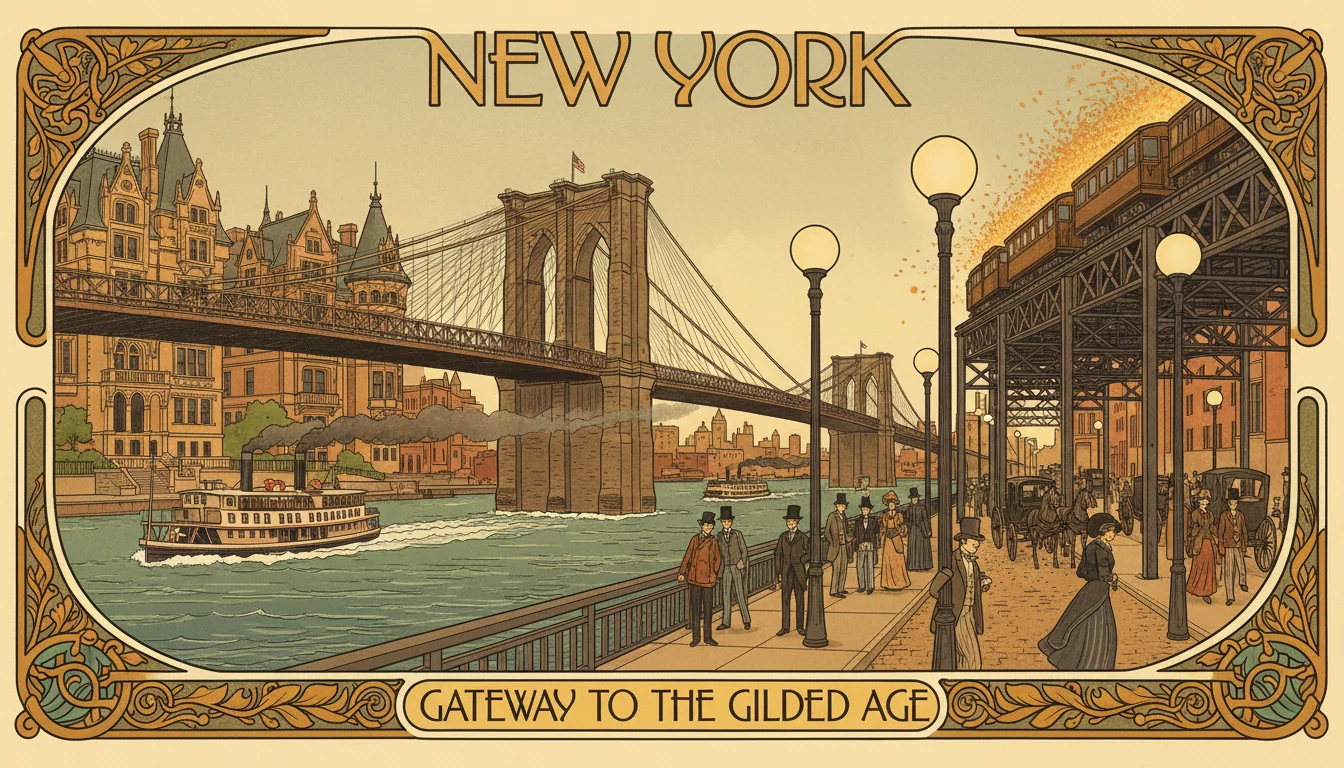
New York in 1890 is simultaneously the richest city in the Western Hemisphere and one of its most lethal. The two conditions are related. The same economic forces that built the Vanderbilt mansions on Fifth Avenue packed the Lower East Side with 700 people per acre and gave those people no running water, no garbage collection, and tuberculosis rates that would appall a modern epidemiologist. You should visit this New York. You should just know what you are walking into before you do.
The population of Manhattan is about 1.5 million. Brooklyn is still a separate city - the consolidation that creates Greater New York does not happen until 1898. The Brooklyn Bridge has been open since 1883, the Statue of Liberty since 1886. Electric lighting is spreading on the wealthier streets but is far from universal. Carnegie Hall has not yet opened - that happens in 1891. Ellis Island has not yet opened either - it begins receiving immigrants in January 1892. The old immigrant reception station at Castle Garden has just closed, replaced temporarily by a barge office. This is a city between eras, building toward something it cannot yet see.
First, know what kind of place you're entering
The Gilded Age is not a metaphor. The gilding is literal on the interiors of the mansions lining the upper blocks of Fifth Avenue. The Vanderbilts have multiple separate residences between 51st and 58th Streets. Mrs. Astor's ballroom is sized for exactly 400 guests, because Ward McAllister has calculated that that is how many people actually matter in New York. This social arithmetic is taken with complete seriousness.
Three blocks from where these calculations are made, people are dying in tenements.
The cover story that will serve you best is that you are a visitor from Britain or from one of the western states, in the city for business or for the cultural season. This explains your unfamiliarity with local geography and customs. Do not claim to be a New Yorker unless you are prepared to name a neighborhood, a ward boss, and a church. New Yorkers of 1890 identify themselves by all three.
Dress like you belong
Men need:
- A wool suit in dark grey, brown, or navy. Three-piece for most occasions, two-piece acceptable in warmer weather
- A white shirt with a stiff detachable collar - the collar is the visible class marker
- A derby hat for daytime, a top hat for evening events, a flat cap if you want to blend into working-class areas
- Leather lace-up shoes, polished
Women need:
- A long skirt reaching the ankle, fitted at the waist with a slight bustle that is smaller in 1890 than it was earlier in the decade
- A fitted blouse with a high collar
- A corset - not optional if you want to pass inspection in any social setting
- Gloves whenever you are out of the house
- A hat, always a hat
Avoid anything with visible zippers, synthetic fabrics, rubber-soled shoes, or any item with text on it. Leave modern wristwatches at home and carry a pocket watch, or simply ask passersby for the time. That is normal and unremarkable in 1890.
Getting around
The elevated railways are your main option for distance. Steam locomotives haul wooden coaches on iron viaducts above Second, Third, Sixth, and Ninth Avenues. The noise when a train passes overhead is extraordinary. A ride costs a nickel, flat fare regardless of distance.
On the streets, horse-drawn vehicles dominate completely. The streets are paved in central Manhattan but coated in an uneven layer of manure and compacted dirt. Electric streetcars are just beginning to appear on a few routes. For a short trip, hail a hansom cab - negotiate the fare before you get in. Do not enter one in the Tenderloin district after dark without knowing where you are going.
Three places you should not miss
The Brooklyn Bridge
The bridge opened in 1883 and is already a wonder of the world. Walk it on foot. The wooden pedestrian promenade runs down the center above the carriage lanes. On a clear day you can see from the harbor to the northern reaches of the island. The East River traffic below is dense with ferries, tugs, and sailing vessels. The bridge's scale is unlike anything that existed in the world before its construction, and seven years on, New Yorkers still look at it with something between pride and disbelief.
Walk from the Brooklyn side on a weekday morning and you will pass hundreds of workers heading into Manhattan. The bridge transformed lower Brooklyn from a backwater into something resembling a commuter suburb.
Central Park
Olmsted's great park is mature now and heavily used. The Bethesda Fountain, the formal Mall, and the Sheep Meadow - where actual sheep still graze - are the center of middle-class leisure. On a Sunday afternoon the park displays New York's social strata in horizontal layers: wealthy carriages on the drives, middle-class pedestrians on the promenades, working people on the grass. The Metropolitan Museum of Art sits on the park's eastern edge.
The Lower East Side at midday
This requires nerve but rewards it. The blocks between the Bowery and the East River, from Houston Street south toward the waterfront, are the most densely populated urban district in the world. The streets are open markets: pushcarts selling pickles, herring, bread, fabric, tools, and secondhand clothing. You will hear Yiddish, Italian, Polish, and a dozen other languages simultaneously. Smells of fish, coal smoke, and cooked food compete in the same block.
Go at midday, not at night. Do not stop and stare at people as though they are a spectacle. This is where people live, and they know a tourist's gaze when they see it.
Food, drink, and money
Your currency is US dollars. A nickel buys a beer or a cup of coffee at most establishments. A dollar buys a decent lunch at a working-class restaurant. Dinner at a respectable midrange establishment runs several dollars.
Delmonico's on Fifth Avenue has been the city's most celebrated restaurant since the 1830s and is at peak reputation in 1890. A meal there costs real money and requires a proper suit. It is worth it once.
Safe choices for a visitor:
- Oysters from a reputable vendor near the waterfront - New York's oyster beds are still productive and the oysters are large, cheap, and safe if bought fresh
- Bread and cheese from a delicatessen on the Lower East Side
- A table d'hote lunch at a respectable midtown restaurant - fixed menu, predictable quality
- Bottled beer rather than tap water in any neighborhood you do not know well
Things to avoid: raw milk in summer, street food from obviously dirty vendors, tap water in unknown neighborhoods, and absinthe from unlabeled bottles - adulteration is common and can damage your vision.
Politics and what not to mention
Tammany Hall runs the city. Richard Croker is the boss, and the network of ward bosses beneath him controls everything from street-cleaning contracts to police appointments. If you need a favor, a permit, or a problem resolved, Tammany's ward heeler is who you see. This is understood by everyone and offensive to almost no one except the reform politicians who periodically try and fail to displace the machine.
Do not speak disparagingly of Tammany in a working-class Irish neighborhood. Do not speak favorably of it at a Protestant reform club or in a newspaper editor's office. Read the room carefully before offering any political opinions at all.
Other topics to handle with care: the income of anyone who did not volunteer it, the status of specific immigrant groups (anti-Italian and anti-Jewish sentiment is casual and pervasive among the middle class), and any suggestion that women should vote. The suffrage movement is active but far from mainstream.
Health and survival
Arrive vaccinated against smallpox and typhoid. Tuberculosis is the city's largest single killer, concentrated in the tenements but not confined to them - the great conductor and social worlds cross enough that infection does not respect class. Cholera outbreaks have become rarer since improvements to the Croton water supply, but they still occur in summer. Drink only beer, table wine, or bottled water. Wash hands obsessively before eating. Avoid public swimming facilities entirely.
The streets are filthy in a way that requires seeing to believe. Carry a handkerchief. Consider your shoes expendable.
What not to do under any circumstances
Do not mention the Spanish-American War - it happens in 1898 and nobody here can imagine it. Do not carry a backpack or anything that visually does not belong in 1890. Do not wander north of 110th Street on the West Side after dark. Always confirm a cab fare before you get in, not after.
Do not warn anyone in the tenements that their building will be torn down. It will be. Several generations of their families will live in those rooms first.
The one thing worth doing twice
Go back to the Brooklyn Bridge at dusk. The harbor turns orange and then a deep grey-blue. The gaslights of the lower Manhattan waterfront are coming on, supplemented in some blocks by the newer electric lamps that Edison's network has reached. The ferries are still running. The city is enormous and loud and smells of horses and coal smoke and salt water.
In a decade it will double in size by absorbing Brooklyn. In two decades it will have a subway beneath its feet. In 1890 it is simply the largest thing that has happened to the North American continent so far, still building itself, still becoming. That is worth standing on a bridge and watching for a while.
Pack sensibly, dress correctly, and do not drink the tap water in neighborhoods you do not know. New York in 1890 will not be comfortable. It will be, in the most original sense of the word, astonishing.
For more American city guides from the same era, see Roaring Twenties Chicago in 1925 and Harlem Renaissance New York in 1925.
Quick Answers
Common questions about this topic
What was New York City like in 1890?
New York in 1890 was a city of about 1.5 million people on Manhattan Island - Brooklyn was still a separate city. It was undergoing rapid industrialization, immigration, and construction. The elevated railways provided transit. The Brooklyn Bridge had opened in 1883. The gap between the mansion districts of Fifth Avenue and the tenements of the Lower East Side was extreme.
How did people get around New York in 1890?
The primary rapid transit was the elevated railway network - steam-powered trains running on iron structures above Second, Third, Sixth, and Ninth Avenues. Horse-drawn vehicles dominated the streets. Electric streetcars were just beginning to appear on a few routes. The Brooklyn Bridge connected Manhattan to Brooklyn for foot traffic and carriages.
Was the Lower East Side really as bad as Jacob Riis described?
Largely yes. Riis published 'How the Other Half Lives' in 1890 with photographs documenting tenement conditions on the Lower East Side. Population densities in some blocks exceeded 700 people per acre. Tuberculosis, typhoid, and cholera were common. Child mortality in tenement districts was dramatically higher than in middle-class neighborhoods.
What was Tammany Hall in 1890?
Tammany Hall was the Democratic Party political machine that effectively controlled New York City government. In 1890, its boss was Richard Croker, who had taken over in 1886. Tammany delivered votes through a network of ward bosses who provided services to immigrant communities in exchange for political loyalty. Most city contracts, jobs, and permissions flowed through its patronage system.

Need Advice from Someone Who Lived There?
Get firsthand accounts from people who actually lived through these moments in history.
Create your free account →No card required. Some figures and features require a paid plan.
Join the HistorIQly Club
Get smarter about the past.
Weekly stories, deep dives, and exclusive content straight to your inbox.