A Time Traveler's Guide to Fin de Siècle Vienna
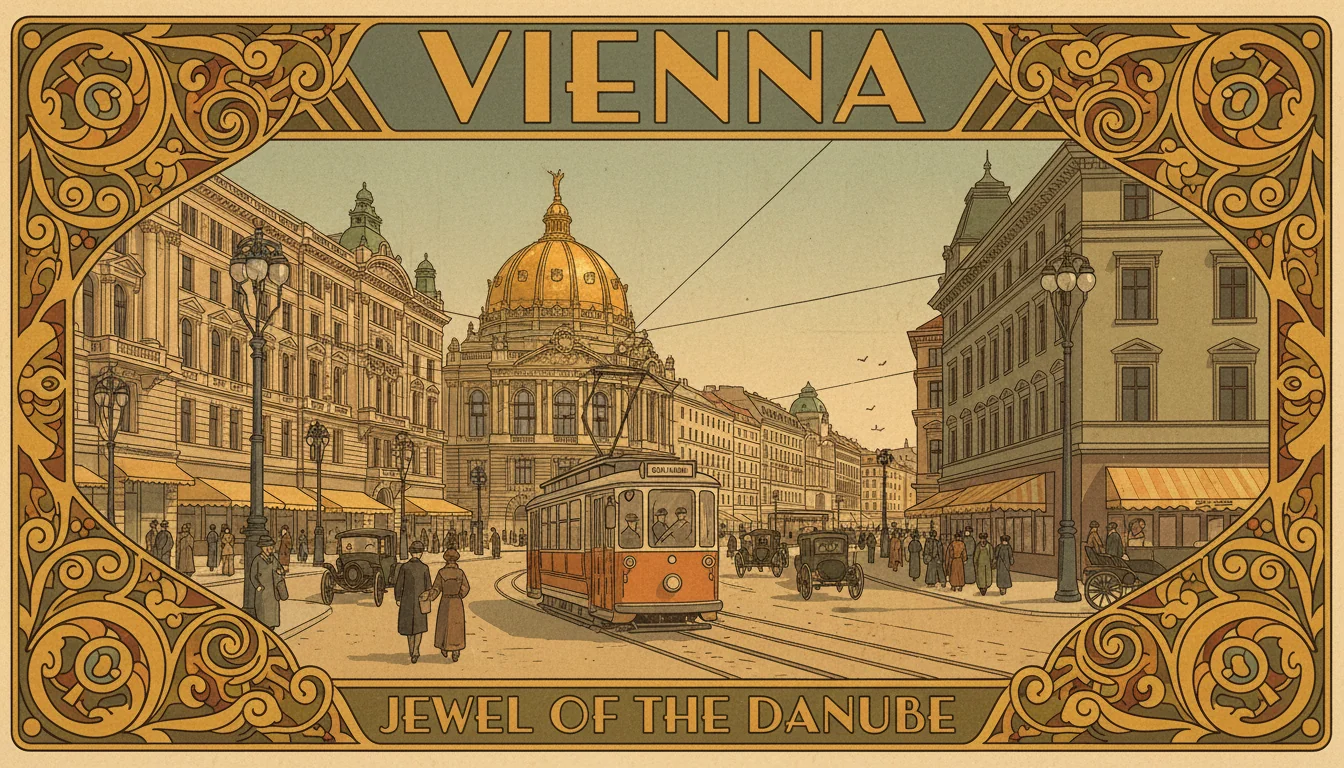
Fin de siecle Vienna in 1900: the capital of a doomed empire where Klimt, Freud, and Mahler were quietly inventing the twentieth century over coffee.
If you only ever visit one fading imperial capital, make it Vienna in 1900. The Habsburg monarchy is in its 52nd year under Emperor Franz Joseph, who has outlived his wife, his son, and most of his ministers. The Ringstrasse is complete. Gustav Klimt is painting the ceiling panels for the new university. Sigmund Freud is writing The Interpretation of Dreams. Gustav Mahler is the iron-handed director of the Court Opera. Arnold Schoenberg is twenty-five and about to break tonality. Adolf Hitler will arrive seven years from now as a failed art-school applicant, and the city will quietly install in him the bitter politics he will export to Berlin in the 1930s.
Vienna does not yet know it has only fourteen years left as the capital of a great power. That ignorance is part of why it is so beautiful to visit. Here is your practical guide.
Understand what you are walking into
Vienna 1900 has about 1.7 million people, making it the fifth-largest city in Europe. It is the political and cultural heart of the Austro-Hungarian Empire, a multinational state stretching from the Swiss border to Transylvania, from Bohemia to the Adriatic. The city is German-speaking, but more than a quarter of its residents are first- or second-generation immigrants from Bohemia, Moravia, Galicia, Hungary, and Italy, and most middle-class households have a Czech maid and a Hungarian cook.
This polyglot reality is what makes Vienna culturally generative and politically poisonous at the same time. The city is producing new music, new painting, new psychiatry, and new architecture at a furious pace. It is also producing the political career of Karl Lueger, the popular antisemitic mayor whose rhetoric will leave a permanent mark.
Your safest cover story is that you are a foreign visitor from Switzerland, Britain, or the United States, in the city to attend a Klimt exhibition or a Mahler performance.
Dress like you belong
Vienna 1900 is a city of strict, observable dress codes. Walking down the Graben in modern clothing will draw attention within seconds.
For men, your minimum kit is:
- a dark wool three-piece suit, jacket buttoned high, trousers narrow
- a stiff white shirt with a detachable starched collar and matching cuffs
- a dark silk necktie or cravat, neatly pinned
- polished black leather shoes or boots
- a hat. Always a hat. A bowler in the morning, a black silk top hat for evening at the Opera, a soft Tyrolean Lodenhut on weekends in the Vienna Woods
For women, your minimum is:
- a long, ankle-length skirt over a corset and at least two petticoats
- a high-collared blouse or fitted bodice in subdued colors
- gloves, always, when out of the house
- a wide hat secured by a long pin, with feathers, ribbons, or silk flowers in season
- a small handbag, never a backpack
Avoid bright synthetic colors, modern fabrics, zippers, sneakers, anything with visible logos, and any item of clothing that exposes the ankle or the upper arm in daytime. Carry a small pocket watch on a chain, not a wristwatch. Wristwatches exist in 1900 but are mostly worn by women and considered slightly unmasculine for daytime.
Get used to the streets
The Ringstrasse, the grand boulevard built in the 1860s on the line of the demolished medieval walls, is the centerpiece of the city. It is paved, lit by gas and increasingly by electric lamps, and lined with monumental public buildings: the Parliament, the Rathaus, the Burgtheater, the Court Opera, the new university, and the twin Kunsthistorisches and Naturhistorisches Museums.
The first electric tram lines opened in 1897 and now thread through the inner city. The Stadtbahn light railway, designed by Otto Wagner with Art Nouveau station houses, runs on a network of viaducts and cuttings around the center. You should ride at least one Wagner station purely to admire the green-and-gold ironwork. Negotiate every Fiaker fare before you climb in.
Three places you absolutely must visit
The Café Central
The Wiener Kaffeehaus is the central institution of Vienna 1900, and the Café Central on Herrengasse is the most concentrated example. It is enormous, marble-floored, lit by chandeliers, with newspapers in seven languages clipped to wooden racks. You may sit for four hours over a single cup of coffee and no one will ask you to leave. Trotsky plays chess in the back. Peter Altenberg lives there. Adolf Loos drops in to argue about ornament.
Order a Melange, a glass of cold water on a silver tray, and a slice of Apfelstrudel. Do not engage other patrons unless they invite you. The Kaffeehaus is a place to sit, read, and be conspicuously alone in good company.
The Secession Building
Walk down the Ringstrasse to the Secession, the strange white temple-like exhibition hall built in 1898 by Joseph Maria Olbrich for the artists who broke with the conservative Vienna Künstlerhaus. Above the door are inscribed the words "Der Zeit ihre Kunst, der Kunst ihre Freiheit" (To every age its art, to art its freedom), which are the unofficial motto of fin de siècle Vienna.
Gustav Klimt's Beethoven Frieze, painted in 1902, will not be there yet on a strict 1900 visit. Aim for late 1902 if you want to see it in situ. If you arrive earlier, the Secession is still hosting one provocative show after another, and the building itself, with its enormous gilded laurel-leaf dome, is the most architecturally radical structure in the city.
The Court Opera under Mahler
Gustav Mahler took over as director of the Vienna Court Opera in 1897 and has, by 1900, transformed it into the most exacting opera house in Europe. He has banned applause between acts, forbidden the entry of late-arriving guests, demolished the casual claque system, and is producing performances of Wagner, Mozart, and Beethoven that will be remembered for a century.
A ticket in the standing-room gallery costs roughly the price of two beers. Arrive an hour early to claim a spot at the rail. Bring a handkerchief, a single white camellia for your buttonhole if you are male, and absolute silence during the performance. Mahler will personally turn around from the podium and stare down a single coughing patron if necessary.
What to eat, what to drink
Vienna 1900 is the apex of central European bourgeois cuisine. Professional kitchens turn out dishes you will recognize: Wiener Schnitzel, Tafelspitz (boiled beef with horseradish), Sachertorte. The Würstelstand on every major corner sells boiled or grilled sausages with mustard and dark rye.
Safe choices: schnitzel with potato salad at a respectable Gasthaus, goulash at a Hungarian restaurant in the second or third district, Kaiserschmarrn for dessert, Heuriger wine in the village of Grinzing on a Sunday afternoon under a vine arbor. Avoid pork from vendors without a permanent address, cream-filled pastries left on a counter in summer, and the absinthe craze reaching Vienna from Paris.
Politics, money, and what not to mention
The Dual Monarchy is held together by Franz Joseph's personal authority, an enormous bureaucracy, and a fragile balance among nationalities. Public conversation about politics is fraught.
Acceptable topics: the Emperor (always referred to with respectful formality), the new architecture, the Opera, the weather, fashion, horse racing at the Prater, and the latest exhibition at the Secession.
Topics to avoid:
- the Hungarian question (the Kingdom of Hungary's relationship with the rest of the empire is constantly contentious)
- the Czech national movement
- the pan-German movement
- antisemitism in any direction (Mayor Karl Lueger's rhetoric is virulent and your neighbors at a café table may or may not agree with him)
- the personal life of the Emperor's son Crown Prince Rudolf, who killed himself and his teenage mistress Marie Vetsera at Mayerling in 1889 and is still a raw wound
Currency is the krone, divided into 100 heller. Tip in coins, visibly. Pickpockets in 1900 Vienna are professional and will spot a tourist's purse from across the Stephansplatz.
Health and survival
Vienna in 1900 is one of the cleanest big cities in Europe by the standards of its day, but standards are low. The municipal water supply, completed in 1873 to bring spring water from the Alps via a 95-kilometer aqueduct, is excellent. Drink the tap water. It will be cleaner than anything you can buy in a sealed bottle.
Tuberculosis respects no class. Avoid public baths, do not share cigarettes. Get vaccinated against smallpox before you leave the future. The General Hospital is the largest in central Europe, and the medical school attached to the University of Vienna is among the best in the world. Sigmund Freud has consulting rooms at Berggasse 19, but his fees are high.
What not to do under any circumstances
Do not mention the First World War, the assassination at Sarajevo, the collapse of the monarchy, or anything political after 1900. Do not discuss Adolf Hitler, who is currently a teenager in Linz. Do not offer modern psychological vocabulary; Freud is inventing the field as you visit. Do not praise Berlin loudly in any restaurant. Do not photograph the Imperial Palace or Schönbrunn without permission. Do not overtip; it is read as American gaucherie.
Most importantly, do not warn anyone about Sarajevo 1914. Vienna 1900 still believes the Habsburg arrangement is permanent. Do not break that for them.
For other European imperial capitals in the time-travel series, see Visiting Bourbon Versailles, 1685 and Time Travel to Weimar Berlin, 1929.
The experience you should not miss
If you can manage one moment in 1900 Vienna, take it on the steps of the Court Opera House about thirty minutes before a Mahler performance. The Ringstrasse is glittering with the new electric lamps. Carriages are arriving in long lines. Officers in the dark blue of the Imperial-Royal Army are escorting wives in mauve and silver. A military band is playing somewhere across the park. The opera-goers are speaking German with Hungarian, Czech, Polish, Italian, and Yiddish accents all flowing through the crowd at once.
For about twenty minutes, the city looks exactly like every painting and photograph you have seen of Habsburg Vienna, only louder and more alive. You are watching the late evening of an empire that has already lost the future, but does not yet know it.
Pack lightly, dress carefully, and tip in coins. Vienna 1900 is one of the great stops on any time-travel itinerary. Just try not to mention 1914.

Need Advice from Someone Who Lived There?
Get firsthand accounts from people who actually lived through these moments in history.
Ask Them YourselfJoin the HistorIQly Club
Get smarter about the past.
Weekly stories, deep dives, and exclusive content straight to your inbox.