A Time Traveler's Guide to Rapa Nui (Easter Island), 1500
Rapa Nui in 1500: a guide to the world's most isolated island, where the Rano Raraku quarry is active, the moai are being carved, and the forest is disappearing.
Read Wikipedia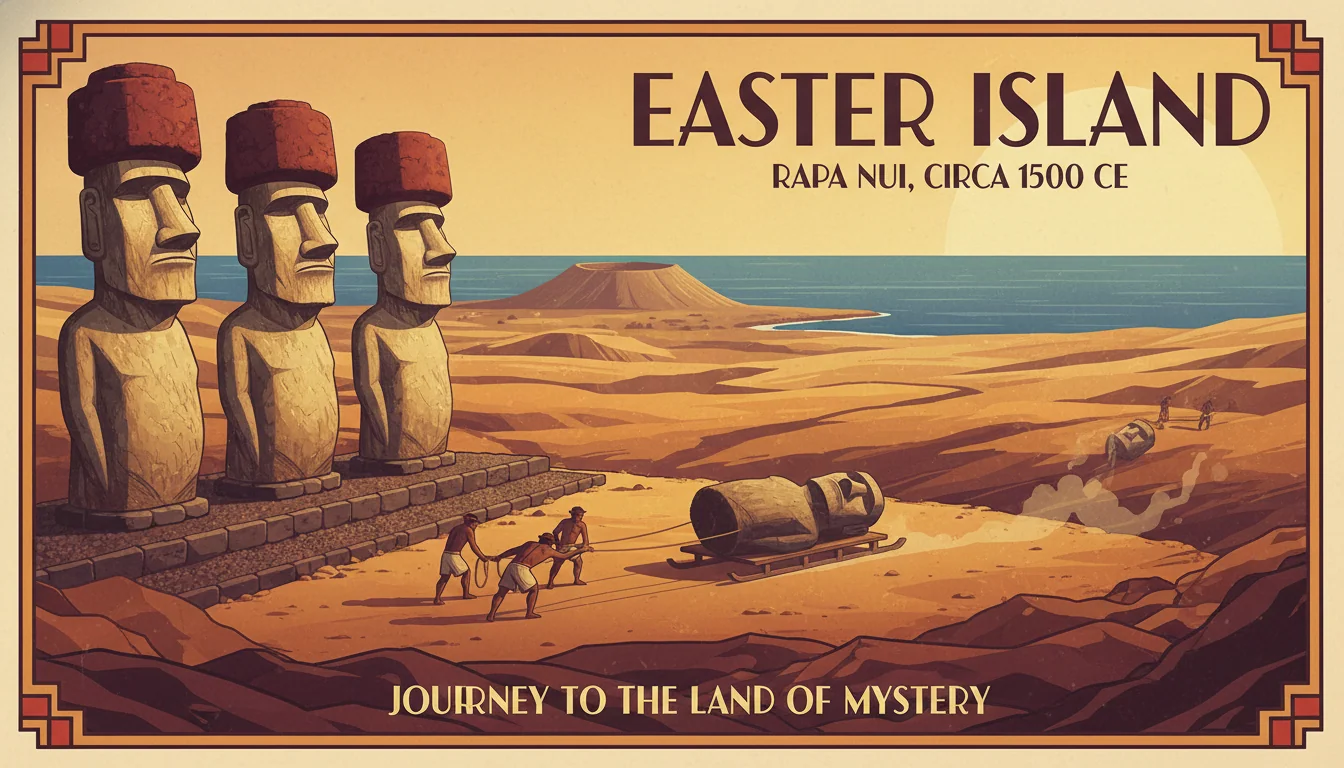
Congratulations. You have arrived at the most remote inhabited island on earth, roughly 3,700 kilometers off the Chilean coast and about the same distance from Tahiti in the other direction. There is no nearby land. There is no backup destination. Your only view from the clifftops is open Pacific in every direction, and the same was true for the people who found this place on purpose, possibly using nothing more than the stars, the wind, and the behavior of birds.
They arrived, depending on which genetic and archaeological study you prefer, somewhere between 1200 and 1300 CE. You are visiting around 1500. The island is at or near its cultural peak. The quarry at Rano Raraku is working. The stone faces are being carved, transported, and set upright on their ahu platforms along the coast. The air smells of saltwater and, increasingly, of cleared ground where palm trees used to stand.
Here is what you need to know before you step off the time machine. (For other far-flung societies at their cultural peak around the same era, see our guides to Mongol Karakorum around 1250 and Tudor London in 1540.)
What kind of place you are entering
Rapa Nui in 1500 is a society organized around competing clans, each occupying a wedge-shaped territory radiating from the coast to the island's volcanic interior. The island is roughly triangular, formed by three dormant volcanoes: Rano Kau in the southwest, Poike at the eastern tip, and Maunga Terevaka at the center and highest point. It is small, about 163 square kilometers, roughly the size of a modest county.
The population is probably somewhere between 3,000 and 8,000. Nobody really knows. The chiefly class, the ariki, derives its prestige in large part from the quality and scale of the ahu platforms and the moai that stand on them. A clan with a bigger moai is saying something specific about the power of its ancestors. Building one is an act of politics, religion, and one-upmanship simultaneously.
The clans are not always at peace. By 1500, internal tensions are real and will eventually produce the practice of huri-moai, the toppling of rival clans' statues. That comes later. For now the focus is on building.
Your first priority: do not look like a threat
The Rapa Nui of 1500 have no history of contact with strangers from elsewhere. The island was self-contained for at minimum two centuries before your arrival. An unfamiliar person appearing from the ocean will be treated with a mixture of curiosity and serious caution.
You need a cover story. The best one available is that you are from a distant island in the direction of the setting sun, traveling alone on a small vessel, which was wrecked or abandoned. The Rapa Nui concept of their ocean as a source of distant peoples exists, if vaguely. Arriving alone rather than in a group makes you less threatening. Arriving without weapons, or at least without displayed weapons, is essential.
You will not speak Rapa Nui. This is a significant problem. The language is an Eastern Polynesian tongue related to Hawaiian and Tahitian, and it was not written down in any recoverable form until the 19th century. Bring patience, use pointing and gesture extensively, and accept that your first weeks will be conducted in pantomime. Children will be your best teachers of vocabulary because they are curious and have time.
Dress and equipment
Wear nothing modern. Rapa Nui dress in 1500 is minimal: men typically wear a loincloth of bark cloth, women a skirt of the same material. Cloaks are worn in colder weather and for ceremony. Leave anything synthetic, metal-fitted, or visibly manufactured at home.
Useful items you can bring without attracting fatal suspicion: obsidian-tipped tools (they use obsidian, volcanic glass, for cutting), shell hooks, and braided rope of organic fiber. The island has obsidian from Rano Kau, so a flint or obsidian knife will look normal. A metal knife, by contrast, is a 16th-century miracle and will cause you problems.
Food and water
The Rapa Nui diet in 1500 centers on sweet potatoes (kumara), which were introduced from South America in a genuinely remarkable piece of pre-European maritime contact, chicken, fish, taro, yams, and occasionally marine mammals. The sweet potato is the dietary staple. Learn to like it in every preparation.
Fresh water comes from the volcanic crater lakes and from wells. Rano Kao, the large southwestern crater, holds a permanent freshwater lake. Rano Raraku, the quarry volcano, has another. The water is safe and used communally.
Do not eat the rats. You will see a lot of Polynesian rats (Rattus exulans), introduced by the original settlers either deliberately as a food source or accidentally in the hulls of their canoes. They have proliferated enormously and are one of the reasons the palm forest is being stripped, because they eat the palm seeds before the trees can regenerate. The Rapa Nui do eat them occasionally. You can if you must. But you should not need to.
The quarry
If you are going to understand anything about this civilization, you need to go to Rano Raraku, the volcanic crater on the eastern side of the island where nearly all of the moai were carved. Walk toward it in the morning when the light is right and you will see the slope covered in statues at every stage of completion, some barely roughed out of the rock face, some nearly finished and standing in pits that served as temporary bases during the carving process.
The quarry is active around 1500. You will find workers there, using stone picks (toki) of basalt to chip the figures out of the compressed volcanic ash of the crater walls. The work is slow, systematic, and organized. The largest unfinished statue in the quarry, later called El Gigante, is more than 21 meters long and was never completed, possibly because it was determined to be too large to move.
Do not touch the moai or the tools. Do not enter the quarry without being brought there by someone local. The work being done here is religious as well as practical, and uninvited participation is not something you can explain away.
The ahu and the moai themselves
The moai are not standing in the interior. They stand on ahu, stone platforms constructed along the coast, facing inland toward the clan's territory rather than toward the sea. The image of Easter Island moai as gazing at the ocean is a post-collapse image, the result of statues toppled and rearranged. In 1500, the living statues face inward, watching over the people they protect.
They also wear red stone hats. The pukao, cylindrical topknots of red scoria from a separate quarry at Puna Pau, sit on many of the finished moai. The combination of the gray stone face, the red hat, and the elongated ears was deliberate. The ancestors these figures represent were the ariki mau, divine chiefs, and the statues made their presence permanent and visible.
The transport method is worth watching if you can catch it without getting in the way. Modern archaeological experiments suggest the statues were walked upright, rocked from side to side with ropes, in a controlled gait that explains both why the roads leading from Rano Raraku are worn in specific patterns and why some statues toppled in transit and were left where they fell.
The birdman ceremony
By 1500, possibly somewhat earlier, a ceremony based at the ceremonial village of Orongo has become important. The tangata manu, the birdman competition, involves young men swimming to the islet of Motu Nui to retrieve the first egg of the season from the sooty tern nesting colony. The man whose representative retrieves the egg first becomes the birdman for the year, with associated ritual status.
Orongo sits on the rim of Rano Kau, with terraced stone houses built into the cliff. If you visit during the right season, late summer, you may witness the competition from the clifftop. Stay well back. This is not a spectator sport in the modern sense; it is a political and religious event with real stakes.
What you should worry about
The deforestation is visible. By 1500, Rapa Nui's original palm forest, which covered much of the island at the time of first settlement, is largely gone. The hillsides that were once forested are now open grassland. The Rapa Nui have adapted: they use rock gardens to protect sweet potato crops from wind and salt spray, a technique (called manavai) that works but is labor-intensive.
The loss of large trees means no large canoes. The ocean fishing available from big outriggers, the kind that brought the settlers here in the first place, is no longer practical. The Rapa Nui of 1500 fish from smaller craft close to shore. This matters for your exit: if your plan involves getting off the island by any method that requires a large boat, the island cannot provide one.
The first European ship to reach Rapa Nui will be the Dutch vessel of Jacob Roggeveen, arriving on Easter Sunday 1722. That is more than two centuries away. You have time, but you have no rescue coming.
What to carry back
Leave without taking anything. The stone, the obsidian, the shell: none of it belongs to you, and more to the point, none of it belongs to the period you will return to. What you can carry is the memory of a civilization at full operational capacity, carving colossal figures of its ancestors and walking them across an island at the end of the world, in a world without steel, without wheels, and without any horizon that promised outside help.
They built something extraordinary with what they had. The collapse that eventually followed was real, but it was not inevitable, and it was not complete, not until European contact finished the work the rats had started. In 1500, the mana of the ancestors is still present on the ahu, the quarry is still cutting, and the island is, in the most technical sense of the word, thriving.
Quick Answers
Common questions about this topic
Who built the moai on Easter Island?
The moai were carved and erected by the Rapa Nui people, Polynesian settlers who reached the island somewhere between 1200 and 1300 CE according to current archaeological and genetic consensus. By around 1500 the island's chiefly clans were competing to build the largest and most elaborate ahu platforms and statues as symbols of ancestral power and clan prestige.
How were the moai moved?
The leading hypothesis supported by modern experiments is that the moai were walked upright using ropes, rocked from side to side in a controlled waddle by teams pulling on the ropes. This method, tested successfully by archaeologists Terry Hunt and Carl Lipo in experiments with full-sized replica statues, explains both the transport mechanism and the paved roads leading from Rano Raraku to the coastal ahu sites.
What caused the collapse of Rapa Nui civilization?
The picture is more complicated than the popular 'ecocide' narrative. Deforestation was real and ongoing by 1500, likely accelerated by Polynesian rats introduced during settlement. But major population decline appears to have followed European contact from 1722 onward, with the decisive blow struck by Peruvian slavers in 1862-1863 who kidnapped most of the adult male population, including all surviving elders with knowledge of rongorongo script.
How many people lived on Rapa Nui around 1500?
Population estimates for pre-contact Rapa Nui range widely, from around 3,000 to perhaps 12,000. The archaeological record and the known agricultural capacity of the island suggest a figure toward the lower end of that range is more likely, with the population probably peaking sometime before or around 1500 and then declining as the forest cover diminished.

Need Advice from Someone Who Lived There?
Get firsthand accounts from people who actually lived through these moments in history.
Create your free account →No card required. Some figures and features require a paid plan.
Join the HistorIQly Club
Get smarter about the past.
Weekly stories, deep dives, and exclusive content straight to your inbox.