A Time Traveler's Guide to Gold Rush San Francisco, 1850
A survival guide to Gold Rush San Francisco, 1850 - when the boomtown was the loudest, richest, and most dangerous port in the Western Hemisphere.
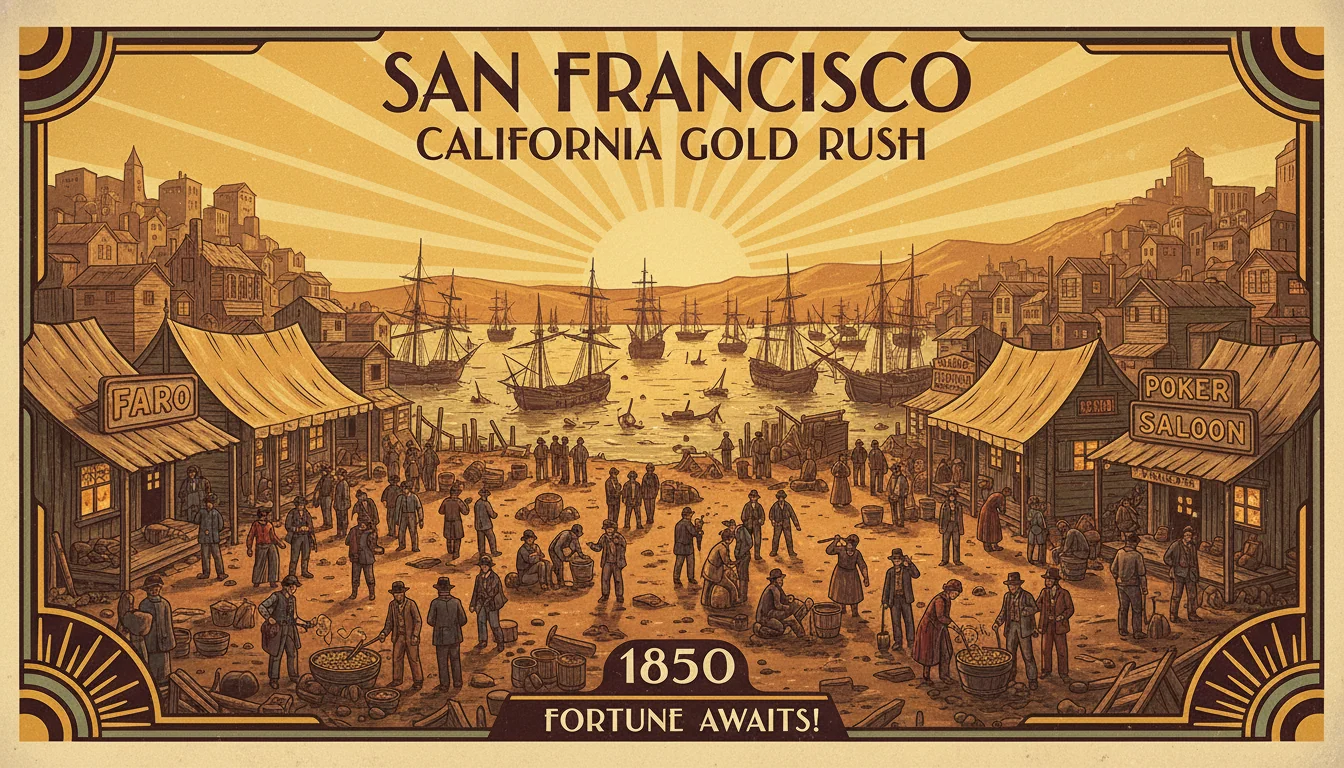
If you want to visit the most chaotic boomtown in 19th-century America, set your time machine for San Francisco in 1850. Eighteen months ago, this was a dusty Mexican-California settlement of 1,000 people called Yerba Buena. Now it is a chaotic American city of 25,000, with a harbor full of abandoned ships, gold dust circulating like cash, fires that burn the town down twice in 1850 alone, and prices for a meal that would humiliate a Manhattan banker.
It is also a place where gambling halls run 24 hours a day, where vigilante committees hang men with little legal process, and where every social institution is being improvised on the fly. So before you click your watch into 1850, here is your practical guide to surviving, blending in, and enjoying a visit to Gold Rush San Francisco.
First, know what kind of place you're entering
San Francisco in 1850 has just tipped from settlement to metropolis. The discovery of gold at Sutter's Mill in January 1848 produced an avalanche of arrivals through 1849, the year that gave the "49ers" their nickname. By 1850, the population is about 25,000, of whom roughly 90 percent are men, mostly between the ages of 18 and 35, mostly armed, mostly drunk by mid-afternoon.
The city has no proper sewage. Streets are mud in winter and dust in summer. Buildings are mostly wooden, hastily erected, and routinely burn down. Two of the famous fires of 1850, in May and June, consumed multiple blocks of the central business district. By the end of the year a third major fire will hit. Reconstruction is a permanent industry.
The harbor is filled with hundreds of ships abandoned by sailors who jumped ship to chase gold. Some have been pulled onto the shore and converted into hotels, warehouses, or, eventually, into the foundations of new neighborhoods on filled-in waterfront.
Your safest cover story is that you are a businessman or merchant from the East Coast, arriving via Cape Horn or Panama, intending to go into commerce, supply, or shipping. The vast majority of newcomers are exactly this. A foreign accent, especially British, French, German, Australian, Chinese, or Chilean, is also acceptable. San Francisco in 1850 is one of the most internationally polyglot cities in the world.
Dress like you belong
Dress in 1850 San Francisco varies dramatically by class and occupation. The miners returning from the gold fields wear practical, durable clothing that is often filthy. The merchant class in the city itself wears late 1840s American business attire.
For business-class men, wear:
- a dark wool frock coat or sack coat
- matching trousers
- a stiff shirt with detachable collar
- a vest with a watch chain
- a four-in-hand tie or stock
- polished leather boots
- a tall hat (top hat, slouch hat, or felt slouch in transit)
For miners or rough travelers, wear:
- canvas trousers (the famous Levi Strauss riveted denim trousers will not appear until 1873)
- a flannel work shirt
- a vest
- sturdy leather boots
- a wide-brim hat
- a bandana
For women (still rare in San Francisco at this date, although increasing), wear:
- a long bustled or hooped dress
- a corset
- gloves
- a bonnet or hat
- buttoned leather boots
Bring your own clothing. Imported clothing in San Francisco is extraordinarily expensive. A new shirt that costs $1 in New York costs $10 in San Francisco. A pair of boots costs $30. A meal at a respectable restaurant costs $5. Plan your budget accordingly.
Carry a pistol, a knife, or both. San Francisco in 1850 expects every adult man to be armed. Going unarmed marks you as either naive or insulated, both of which invite predation.
Get used to the chaos
San Francisco in 1850 has no functioning municipal government. The first elected mayor took office on May 1, 1850, and was almost immediately overwhelmed by the scale of urban problems. The legal system is improvised. Real estate titles are contested. Crime is constant. The First Committee of Vigilance, which will execute several men by hanging, will form in 1851 in response to the perceived collapse of formal law enforcement.
Walking the streets at night is dangerous. The Sydney-Town district north of the central business area, populated by recently arrived Australians from the convict colonies, is a notorious pocket of robbery and assault.
Carry your money in multiple hidden pockets. Do not pull out a roll of bills in public. Conduct large transactions in private rooms or in established merchant houses.
Three places you absolutely must visit
The Plaza (Portsmouth Square)
The central plaza is the heart of San Francisco in 1850. Surrounded by gambling halls, hotels, and merchant offices, it is where news arrives, where mass meetings are held, and where ships are unloaded onto carts headed inland. Walk the perimeter in the evening. You will hear at least six languages within an hour.
The El Dorado, the Verandah, the Bella Union, and the Parker House are the principal gambling halls of the era. They operate around the clock, with faro, monte, roulette, and various dice games. The amounts of gold dust changing hands are spectacular by any standard, although house edges and rigged tables make sustained winning unlikely.
The Long Wharf
The Long Wharf extends from the eastern shore far into the bay, accommodating the vessels that crowd the harbor. It is the principal commercial entrance to the city. Watch a clipper ship unload from the Atlantic, or a Chinese junk from Hong Kong, or a Chilean schooner with a load of agricultural goods. Mining supplies, foodstuffs, alcohol, building materials, and labor all enter the city through the wharves.
Chinatown
San Francisco's Chinatown is just emerging in 1850, centered around Sacramento Street. Chinese immigrants arrived in significant numbers from 1849 onward, mostly Cantonese-speaking men from the Pearl River Delta region, often working as cooks, laundrymen, and miners. The Chinese population in 1850 is several hundred but growing fast.
Chinatown food is a genuine novelty for most non-Chinese visitors. A meal at a Chinese restaurant on Sacramento Street is one of the most distinctive culinary experiences available in the city. Be respectful. Pay in coin or gold dust. Tip lightly.
How to talk to people without causing trouble
English is the dominant business language. Spanish is widely spoken, particularly among older Californio residents who lived here before American annexation. French, German, Italian, Cantonese, and Spanish-Chilean dialects are all common.
A few universal rules help:
- introduce yourself by name and place of origin
- pay for drinks promptly
- never accuse someone of cheating in a card game without certainty (this is a quick way to die)
- avoid political conversation about slavery (California is a free state but tensions are sharp)
- treat Californio residents with appropriate respect
- give way to women on the wooden plank sidewalks
If a watch officer asks your business, give a short and clear answer. The city has only minimal formal law enforcement, but the watchmen who do exist are quick to detain ambiguous strangers.
What to eat, what to avoid
San Francisco food in 1850 is paradoxical: simultaneously the most expensive in the United States and often the worst. Most restaurants serve poorly preserved imported staples (bacon, beans, hard biscuits, flour) at extraordinary markups. Fresh produce is rare. Imported fruit is rarer.
Safe choices for a visitor:
- a steak or beef stew at a respectable restaurant (the Tehama House, the Union, the El Dorado restaurant)
- bread and butter from a recognized bakery
- canned goods of recognized brands (Burnham's preserved meats, etc.)
- imported wine from a sealed bottle
- Chinese food in Chinatown
- Mexican-style stews from Californio establishments
Things to be careful of:
- water from any well or fountain (boiled coffee or tea is much safer)
- raw produce of unknown origin
- shellfish in summer
- imported butter that has been sitting in warm warehouses
- whiskey of dubious provenance
- excessive consumption of "tarantula juice" (cheap fortified spirits)
Prices will shock you. A loaf of bread can cost $1. Eggs are $1 each. A pound of butter is $6. A simple meal at a tolerable restaurant is $5. The current daily wage for a competent laborer is $20-30, which is why many men are willing to work, but also why many burn through their savings within weeks.
Money, gifts, and gold dust
Gold dust circulates as currency in San Francisco in 1850, weighed on small scales at almost every commercial establishment. The standard valuation is about $16 per ounce of pure dust, though local merchants discount this somewhat. Coins, particularly Spanish-Mexican silver dollars, U.S. gold eagles ($10 coins), and the new $20 double eagles (introduced in 1850), are common.
If you bring money, prefer:
- U.S. gold coins
- silver dollars
- letters of credit drawn on East Coast banks (treated cautiously)
Do not flash large amounts of gold dust. Robbery is constant. Carry a small purse of immediate-use funds and conceal your reserves elsewhere.
Politics you should know about, briefly
California was admitted to the Union as a free state on September 9, 1850, as part of the Compromise of 1850. If you arrive before this date, statehood is being intensely debated in Washington. If you arrive after, it has just happened.
Tensions over slavery, Mexican land claims, Chinese immigration, and the role of foreign miners are all sharp. The Foreign Miners Tax of 1850 imposes a $20 monthly fee on non-American miners, particularly aimed at Mexican, Chinese, and Chilean prospectors. The tax produces violent confrontations and significant emigration of foreign miners.
Avoid taking strong positions on slavery in mixed company. Do not defend Mexican land claims publicly. Do not criticize the Foreign Miners Tax in establishments frequented by white American miners.
What not to do under any circumstances
Let me save you from the classic mistakes.
Do not:
- accuse anyone of cheating in a card game
- discuss specific individuals' wealth in public
- enter Sydney-Town at night
- attempt to file a mining claim without local guidance
- carry obvious gold in unsafe areas
- sleep in a hotel without checking that the door locks
- eat at unfamiliar restaurants in the harbor district
- accept whiskey from strangers
- comment on Mexican-American or anti-Chinese politics
Most importantly, do not warn anyone about the great fire of June 14, 1850, or any of the subsequent fires. San Francisco will burn down approximately seven times between 1849 and 1851. The reconstruction industry depends on this. Let it happen.
The experience you should not miss
If you have one moment in Gold Rush San Francisco, take it at sunset on the rooftop of any tall building near Portsmouth Square, looking out across the harbor. The bay is filled with hundreds of abandoned ships, their masts forming a vast skeleton forest. Smoke rises from a thousand chimneys. The newest buildings are still under construction. A fast schooner is rounding the headlands of the Golden Gate, bringing a fresh load of hopefuls from the East Coast.
You are watching the most accelerated urbanization in American history happen in real time. The city you are visiting will, within fifty years, be the largest on the West Coast and one of the great commercial capitals of the Pacific Rim. It is also one fire away from burning to the ground tonight.
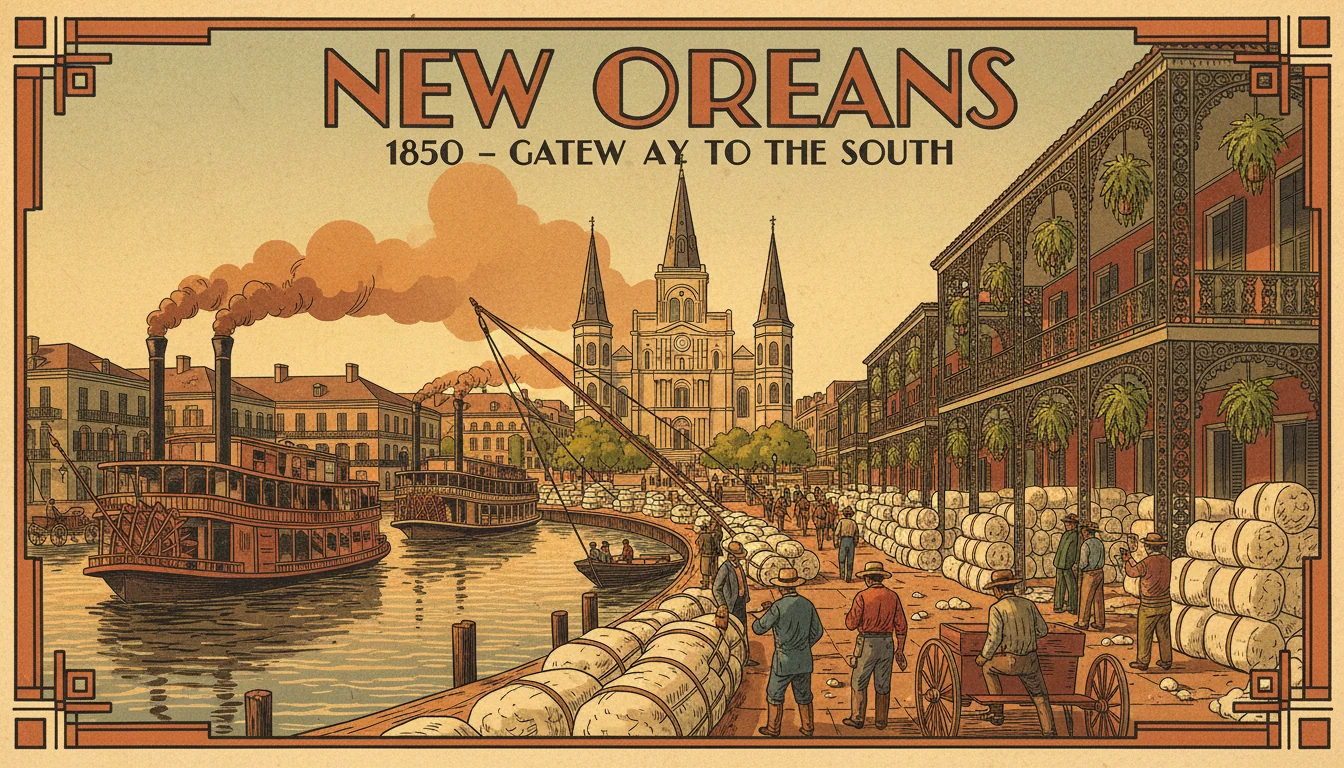
Carry your money in hidden pockets, eat at established restaurants only, and never accuse a man of cheating. Gold Rush San Francisco in 1850 is one of the most dangerous and exhilarating destinations on any time-travel itinerary. For a very different American city of the same era, see our guide to antebellum New Orleans in 1850, and for the Gilded Age that followed the Gold Rush's chaotic opening chapter, New York in 1890 shows where the money eventually settled.

Need Advice from Someone Who Lived There?
Get firsthand accounts from people who actually lived through these moments in history.
Ask Them YourselfJoin the HistorIQly Club
Get smarter about the past.
Weekly stories, deep dives, and exclusive content straight to your inbox.