A Time Traveler's Guide to Jerusalem, AD 33
A survival guide to Jerusalem in AD 33: how to dress, where to stay, what to eat for Passover, and how not to be crucified during history's most significant week.
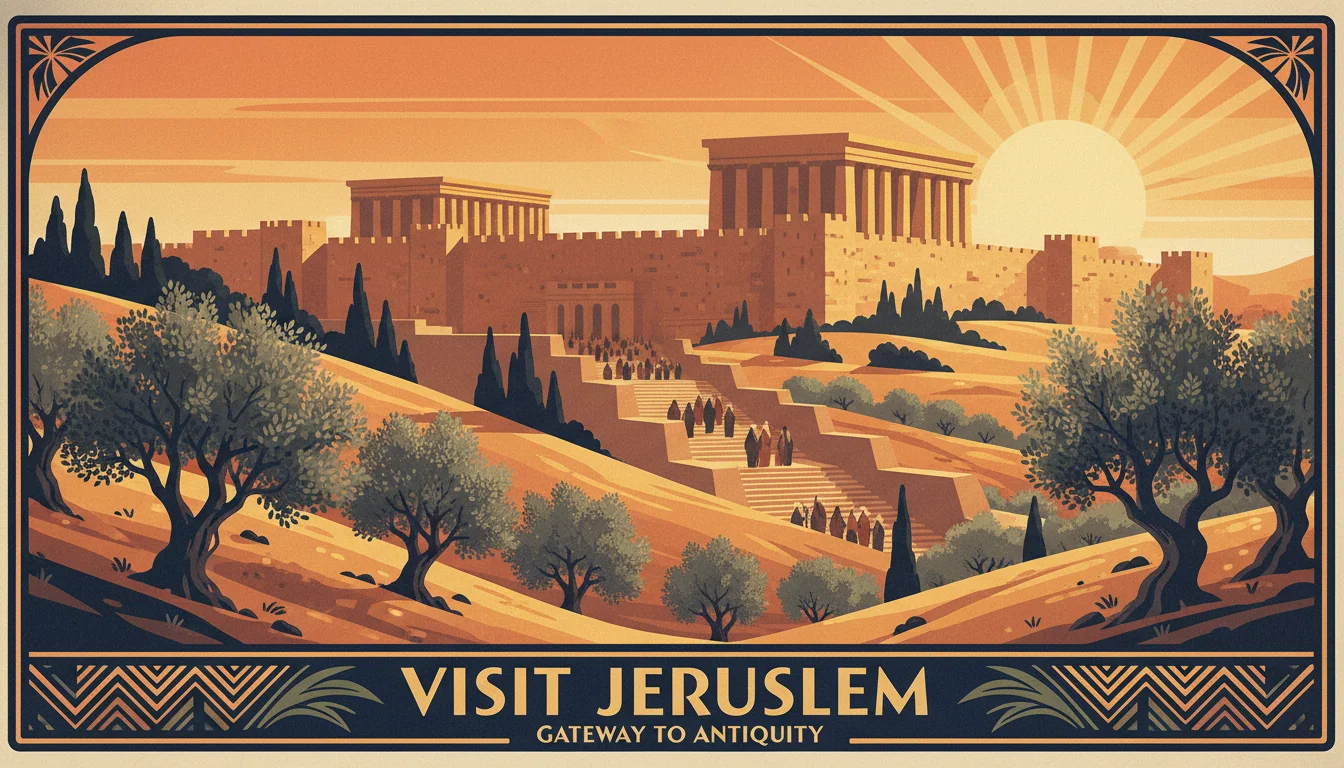
Welcome to AD 33. If you have just stepped out of your chronosphere onto the Mount of Olives, take a moment before you descend. Below you, across the Kidron Valley, the white limestone walls of Jerusalem catch the morning sun, and the gold-plated facade of Herod's Temple is so bright at noon that pilgrims compare it to a mountain of snow on fire.
You have arrived in the nineteenth year of the emperor Tiberius. Pontius Pilate is the Roman prefect. Caiaphas is the high priest. Herod Antipas holds the tetrarchy in Galilee. And it is Passover week, which is both the worst and the best time to visit. According to Josephus, the population swells from a baseline of around 30,000 to north of 200,000 pilgrims in a single week. Every rooftop is occupied. Every Roman cohort in the province has been recalled in case the crowd does something interesting.
Here is how to make it home with all your limbs and most of your dignity.
Don't Look Like a Roman
The fastest way to end your trip badly is to be mistaken for a Roman official or tax collector. Do not wear a toga. Do not wear hobnailed military sandals. Do not, under any circumstances, wear a laurel anything.
The Tunic: A knee-length linen or wool tunic, undyed or in earth tones (cream, brown, dusty red). Tie it at the waist with a simple cloth or leather belt.
The Cloak: A rectangular wool cloak (himation in Greek, tallit in Hebrew). The fringes (tzitzit) at the corners are commanded in Numbers 15:38; a man without them reads as a Gentile or someone hiding something.
The Sandals: Flat leather sandals with simple straps. Not boots. Nothing that looks like it came off a legionary.
Beards (men): In. Trim them, never shave them clean. A clean-shaven Jewish man reads as Hellenized to the point of apostasy or, worse, an actor.
Hair (women): Cover it. A linen veil drawn over the head in public is non-negotiable for married women.
Jewelry: Modest. No signet rings with imperial portraits, no purple borders on anything.
Language Survival
Jerusalem is trilingual on a good day, quadrilingual on a bad one.
Aramaic is what you will hear in the markets and in most homes. If you only learn one language for this trip, make it Aramaic.
Hebrew is the language of scripture and liturgy. You will hear it inside the Temple precincts and in synagogues, but ordinary conversation almost never takes place in it.
Koine Greek is the lingua franca of the eastern Roman world. Educated Judeans, traders, and most Roman auxiliaries will understand it. Fall back to Greek before you try anything else.
Latin is confined to the Antonia fortress and the prefect's staff. Speaking it in the street marks you as either a Roman official or a person pretending to be one. Do not.
A few useful Aramaic phrases:
- Shlama - peace, hello.
- Todah - thanks.
- Aiyka - where?
- Kammah - how much?
- La - no. Ein - yes.
Where to Stay
There is no Hilton on the Mount of Olives. There are essentially three options, and during Passover all three fill up fast.
Pilgrim guest-houses near the Damascus Gate. Private homes whose owners rent out upper rooms for a few denarii a week. Touts will find you at the gate before you find them. Vet the host.
Rooftops. During Passover, sleeping on a flat city rooftop is normal, expected, and free if you have a friend in the city. Bring your cloak. Jerusalem nights in early spring are colder than visitors expect.
Bethany. A village two miles east, on the slope of the Mount of Olives. Quieter, cooler, with olive groves. Many pilgrims base themselves here and walk in each morning. The walk takes about forty-five minutes and is genuinely pleasant.
Need a local guide? Chat with Jesus on HistorIQly - the most famous resident of AD 33 Jerusalem, plus 143 other historical figures from $9/month.
What to Eat for Passover
The seder is the meal of the year. If you can wangle an invitation you will eat well and learn more about first-century Judaism in three hours than in three months of reading.
The Lamb: A one-year-old male without blemish, slaughtered at the Temple on the afternoon of 14 Nisan, then roasted whole on a spit of pomegranate wood. A single lamb feeds a chavurah (eating-company) of ten to twenty.
Matzah: Unleavened flatbread. No yeast in the house during the festival. If you are caught with leavened bread (chametz) you will be fined and shamed.
Bitter herbs (maror): Wild lettuce, endive, or horseradish-like roots. Symbolic of the bitterness of slavery in Egypt.
Wine: Four cups, mixed with water, drunk in a prescribed order through the seder. Local, often from the Hebron hills, sweeter and lower in alcohol than modern table wine.
Street food the rest of the week: Bread-and-fish stalls in the Lower City do brisk trade. Pickled fish from Galilee, flatbread, olives, dates, soft cheese, lentil stew. Avoid pork. Avoid anything that has been sitting in the sun since the morning sacrifice.
Navigating the City
The Upper City (western hill) is where the wealthy live: the priestly aristocracy, the Sadducees, Herod's old palace (now Pilate's residence). Wide streets, big houses with mikvaot (ritual baths) in the basements. The archaeologist Jodi Magness has documented these mikvaot in detail; they are everywhere in the priestly quarter.
The Lower City (the City of David) is where the tradesmen, fishermen, and most pilgrims actually live and shop. Narrower streets, more crowded, more interesting if you want to see ordinary life.
The Temple Mount dominates everything. Herod's renovation has more than doubled the original platform, and at 36 acres it is one of the largest sacred enclosures in the ancient world.
The Pool of Siloam at the southern end of the Lower City is the main public ritual bath. Most pilgrims pass through it before ascending to the Temple.
The Antonia fortress sits on the northwest corner of the Temple Mount, looking down into the Court of the Gentiles. Roughly 600 auxiliary soldiers are stationed there during festivals. Assume they are watching. They are.
How Not to Be Crucified
Crucifixion is a Roman punishment for slaves, rebels, and provincial troublemakers. Here is how to stay off a cross.
- Do not claim to be the Messiah. The province has had several would-be messiahs in the last fifty years, and Pilate's standard response is to crucify them, plus their followers, plus anyone standing nearby.
- Do not carry weapons near the Temple. Pilate's troops have standing orders to detain anyone with a concealed blade in the precincts. The Sicarii (literally "dagger men") have made the prefect nervous.
- Do not argue with centurions. If one tells you to carry his pack a mile (legal, under Roman angaria), you carry it. You do not negotiate.
- Avoid Zealot circles. Sympathizing with them in the wrong tavern can put you on a Roman list. The list does not have a happy ending.
- Pay your Temple tax in the right currency. The half-shekel must be paid in Tyrian shekels, not Roman denarii (which carry the emperor's image and are considered idolatrous). The moneychangers' tables in the Court of the Gentiles will swap your coins for a small commission. Yes, those are the same moneychangers you may have heard about. Be polite.
Must-See: The Temple
If you do nothing else in AD 33, walk the Temple Mount. Herod the Great's renovation, begun around 20 BC and still not finished, is the most ambitious building project in the eastern Mediterranean.
The Court of the Gentiles is the vast outer plaza where anyone may walk. Vendors sell sacrificial doves and lambs. Moneychangers work at low tables. The noise is extraordinary.
The Soreg is a low stone barrier separating the outer court from the inner courts. Bilingual inscriptions in Greek and Latin warn Gentiles in unambiguous terms: any non-Jew who passes the barrier is responsible for his own resulting death. Two have survived to the modern day. Do not test them.
The Holy of Holies, the innermost chamber, is empty. The Ark of the Covenant has been gone since the Babylonian destruction in 586 BC. Only the high priest enters this chamber, and only once a year, on Yom Kippur, with a rope tied around his ankle in case he is struck dead inside.
Day Trip: Bethany or the Mount of Olives
When the city becomes too much (and it will), walk east. Up the slope, through the olive groves, past the press at Gethsemane, over the ridge to Bethany. It is cooler up there. The breeze carries the smell of olive blossom and woodsmoke instead of crowds and incense. From the western brow of the mount, you get the same postcard view you arrived with, only now you know what is in it.
Many pilgrims who have given up on finding a bed camp on these slopes during Passover. You will not be alone, but you will be quiet, and quiet is its own luxury this week.
Bring water. Bring your cloak. Bring a willingness to keep your modern opinions to yourself. AD 33 is the most over-documented week in Western history, and it is happening, right now, in the streets below you. Watch. Listen. Mind the centurions.
And whatever you do, do not stand too close to the man on the donkey when he comes down the road from Bethphage. The Roman cohort at the Antonia is already taking notes.
For more time-traveler guides to the ancient world, see A Time Traveler's Guide to Ancient Thebes, 1250 BC.
Quick Answers
Common questions about this topic
What was Jerusalem like in AD 33?
Jerusalem in AD 33 was a fortified Roman client city of roughly 30,000 permanent residents, ruled spiritually by the high priest Caiaphas and politically by the prefect Pontius Pilate. During Passover the population swelled to between 150,000 and 250,000 pilgrims, according to Josephus.
What language was spoken in first-century Jerusalem?
Aramaic was the everyday street language of Judea. Hebrew was reserved for liturgy and scripture. Koine Greek served as the lingua franca of trade, while Latin was confined mostly to Roman officers inside the Antonia fortress.
How safe was first-century Jerusalem for travelers?
Reasonably safe by day, less so at night and considerably less so during Passover. Roman patrols kept order but were quick to use force, and political tension between Roman authority, Temple aristocracy, and Zealot factions could turn a market day violent without warning.
Where would you stay during Passover in AD 33?
Most pilgrims stayed in private guest-houses inside the city walls, slept on rooftops, or camped in villages such as Bethany on the Mount of Olives. There were no inns in the modern sense; householders opened their upper rooms to traveling kin and strangers alike.

Need Advice from Someone Who Lived There?
Get firsthand accounts from people who actually lived through these moments in history.
Ask Them YourselfJoin the HistorIQly Club
Get smarter about the past.
Weekly stories, deep dives, and exclusive content straight to your inbox.