Time Traveler's Guide to Medieval Prague, 1350
In medieval Prague, 1350, Charles IV is building Europe's crown jewel. Navigate court intrigue, survive tavern brawls, and don't insult the king's new bridge.
Read Wikipedia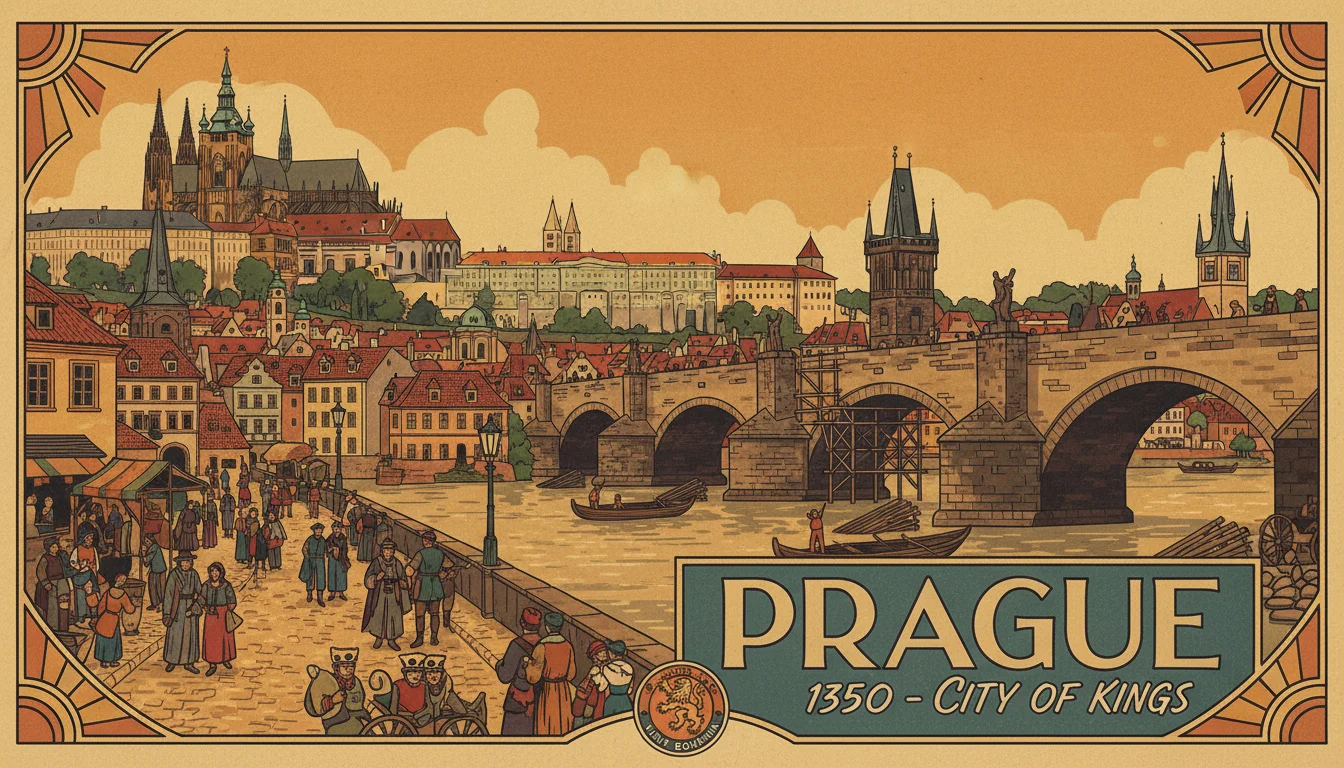
Welcome to medieval Prague, 1350 - where Charles IV is turning a scrappy Bohemian town into the "Rome of the North" and you're about to witness one of history's greatest urban makeovers. The king just founded the first university north of the Alps, construction crews are swarming the hilltop castle, and if you say the wrong thing about Luxembourg succession politics, you might end up in a dungeon. Let's make sure you don't.
What to Wear
Men: Tunic (thigh-length, wool), braies (linen underwear-trousers), hose (leg coverings tied to your belt), leather boots, and a hood or cap. Colors matter: bright reds and blues signal wealth (expensive dyes), browns and grays mark you as a commoner. If you're posing as a merchant, add a fur-lined cloak. If you're playing poor, stick to undyed wool and patch your tunic visibly.
Women: Long woolen gown (kirtle) with fitted sleeves, linen chemise underneath, wimple or veil to cover your hair (married women MUST cover their heads), leather shoes, and a cloak for outdoors. Jewelry is dangerous - it marks you as a target for thieves. Keep it minimal: a simple brooch, maybe a belt with a small purse.
Don't: Wear trousers as a woman (scandal), show too much skin (church courts will fine you), or dress above your station (sumptuary laws are enforced). Prague's guilds are watching.
What to Eat & Drink
The Bohemian diet is hearty, meat-heavy, and washed down with some of Europe's best beer.
Breakfast (if you can afford it): Bread, cheese, beer. Yes, beer for breakfast - safer than water.
Lunch/Dinner: Roast pork, duck, goose, or mutton. Cabbage, turnips, onions, and peas are the veggie staples. Bread comes with everything - dark rye for commoners, wheaten for the rich. Street vendors sell koláče (pastries with cheese or poppy seeds) and grilled sausages near Wenceslas Square.
Beer is EVERYWHERE. Prague's brewers are masters. Try the dark černé pivo (black beer) or lighter světlé (pale). Taverns serve it in wooden tankards, and it's cheaper than wine.
What to avoid: Tap water (contaminated), undercooked meat (parasites), and anything from a street vendor who looks sketchy. Food poisoning can kill you here. If you're vegetarian, good luck - Lent is your only hope for variety (fish, beans, bread).
Money & Costs
Currency: Prague groschen (silver coins). 1 groschen = decent daily wage for a laborer.
Rough prices:
- Loaf of bread: 1-2 denarii (1/12 of a groschen)
- Mug of beer: 1-2 denarii
- Night at a tavern: 3-6 denarii
- Wool tunic: 5-10 groschen
- Horse: 20-50 groschen
How to get money: Carry a small stash of silver. Gold attracts attention (and thieves). If you need to exchange, find a Jewish moneylender in Josefov (the Jewish Quarter) - Christians aren't allowed to charge interest, so Jews dominate banking. Be respectful. Antisemitism is casual and brutal here.
Where to Stay
Best bet: U Zlatého Kohouta (The Golden Rooster), a tavern near Old Town Square. It's noisy, crowded, and smells like sweat and roast pork, but it's safe, cheap, and you'll blend in. 5 denarii gets you a straw mattress in the common room, breakfast (bread + beer), and proximity to the action.
If you're rich: Rent a room in a merchant's house near Celetná Street. Expect a private chamber, a real bed, and maybe even a window with glass (rare!). 10-20 groschen per week.
Avoid: Sleeping outdoors (bandits, wolves, freezing cold) or in the poorest quarters (disease, crime). The Vltava riverbanks are dodgy after dark.
Must-See Sights
Prague Castle (Pražský hrad): Charles IV is renovating like a maniac. St. Vitus Cathedral is under construction - you'll see scaffolding, stonemasons, and the king's architects arguing about Gothic arches. Entrance is free, but don't wander into restricted areas unless you want to explain yourself to guards.
Charles Bridge (Karlův most): It's BRAND NEW. Construction started in 1357, but the foundations are going up right now. You can watch the stone layers work, hear the monks blessing the mortar, and marvel at the engineering. Legend says eggs are mixed into the mortar for strength (they are).
Old Town Square (Staroměstské náměstí): Heart of Prague. The Astronomical Clock is being built on the Old Town Hall tower - a mechanical marvel that tracks sun, moon, and zodiac positions. Executions happen here too, so if you see a crowd gathering, check before you join.
Josefov (Jewish Quarter): Narrow streets, synagogues, and the Old Jewish Cemetery. Fascinating, but tread carefully. Jews are tolerated under royal protection, but mob violence can flare without warning. Be respectful, don't preach Christianity, and if there's trouble, leave immediately.
Vyšehrad Fortress: South of the city, overlooking the Vltava. Legendary burial site of Bohemian princes. Quieter than the castle, with stunning views. Walk the ramparts at sunset.
Customs & Social Rules
Language: Czech (Old Czech dialect), Latin (for church and scholars), German (for merchants). If you don't speak Czech, try Latin with priests or German with traders. Don't fake fluency - accents mark you as foreign, which makes you a target or a curiosity (depends on the crowd).
Religion is SERIOUS. Catholicism is the law. Church attendance is mandatory. If you're caught skipping Mass, expect fines or public penance. Don't blaspheme, don't question church doctrine, and if a priest speaks, shut up and listen. Heresy trials are real.
Greetings: "Buď pochválen Ježíš Kristus" (Praised be Jesus Christ) - standard greeting. Reply: "Na věky věků" (Forever and ever). It's Catholic boilerplate, but it signals you're not a heretic.
Hygiene: Forget daily showers. Public bathhouses exist, but they're breeding grounds for disease. Most people bathe monthly (if that). Lice are normal. Perfume (if you can afford it) masks body odor. Chamber pots are emptied into the streets - watch your step.
Women traveling alone: Extremely unusual and risky. If you're female, travel with a male companion (real or pretend) or join a group of pilgrims. Solo women are assumed to be prostitutes or witches. Neither is good.
Dangers to Avoid
Plague is EVERYWHERE. The Black Death hit 1348-1350, and Prague is still reeling. Bodies in the streets, mass graves, and paranoia. If you see someone with buboes (swollen lymph nodes), RUN. Don't touch corpses, avoid crowded areas during outbreaks, and pray you don't catch it. No cure exists.
Crime: Pickpockets, cutthroats, and con artists thrive. Don't flash wealth, don't walk alone at night, and keep your purse hidden. If attacked, scream for the city watch (they're useless, but the noise might scare off thieves).
Political intrigue: Charles IV is consolidating power, and nobles are plotting constantly. Don't take sides, don't gossip about the king, and if someone asks your opinion on the Papal Schism (two rival popes in Rome and Avignon), smile and say, "God will sort it out."
Drunken brawls: Taverns are fun until someone pulls a knife. If a fight breaks out, exit immediately. City guards show up late and arrest everyone.
Wolves and bandits: Outside the city walls, it's medieval Wild West. Hire guards if you're traveling, stick to main roads, and never camp alone.
Helpful Phrases
- "Kde je hostinec?" (Where is the tavern?)
- "Potřebuji lůžko" (I need a bed)
- "Kolik to stojí?" (How much does this cost?)
- "Nejsem kacíř!" (I'm not a heretic!) - Learn this. Might save your life.
When to Visit
Spring (March-May): Mild weather, construction booming, Easter festivities (if you're into hours-long Latin Mass).
Summer (June-August): Warm, crowded, smelly. Markets are busiest, taverns loudest. Good for people-watching, bad for plague risk.
Fall (September-November): Harvest season, beer flows freely, festivals. Best time for food.
Winter (December-February): BRUTAL. Freeze-your-ass-off cold, snow, ice, and starvation risk if crops fail. Skip unless you love suffering.
Final Tips
- Blend in. Don't lecture locals on "medieval superstition" or "outdated feudalism." You'll get punched or worse.
- Respect the king. Charles IV is beloved. Criticize him, and you're done.
- Trust no one fully. This is a world of shifting loyalties, where yesterday's ally is tomorrow's accuser.
- Carry a rosary. Even if you're not religious, it signals orthodoxy and keeps witch-hunters off your back.
- Don't drink the water. Beer or wine. Always.
Prague in 1350 is a city of contrasts - soaring Gothic ambition and street-level brutality, imperial grandeur and plague-ridden squalor. It's glorious, dangerous, and unforgettable. Just don't overstay your welcome. The Middle Ages are better as a visit than a residency.
Safe travels - and if you see Charles IV, bow deeply. He's building an empire, and you're just passing through.
For more medieval European time travel guides, see our editions on medieval Krakow in 1400 and Ottoman Istanbul in 1555.

Need Advice from Someone Who Lived There?
Get firsthand accounts from people who actually lived through these moments in history.
Create your free account →No card required. Some figures and features require a paid plan.
Join the HistorIQly Club
Get smarter about the past.
Weekly stories, deep dives, and exclusive content straight to your inbox.