Time Traveler's Guide to Medieval Krakow, 1400
Your guide to medieval Krakow in 1400 - what to wear, eat, and know before stepping into Poland's golden-age capital and the scholars of its famous Jagiellonian university.
Read Wikipedia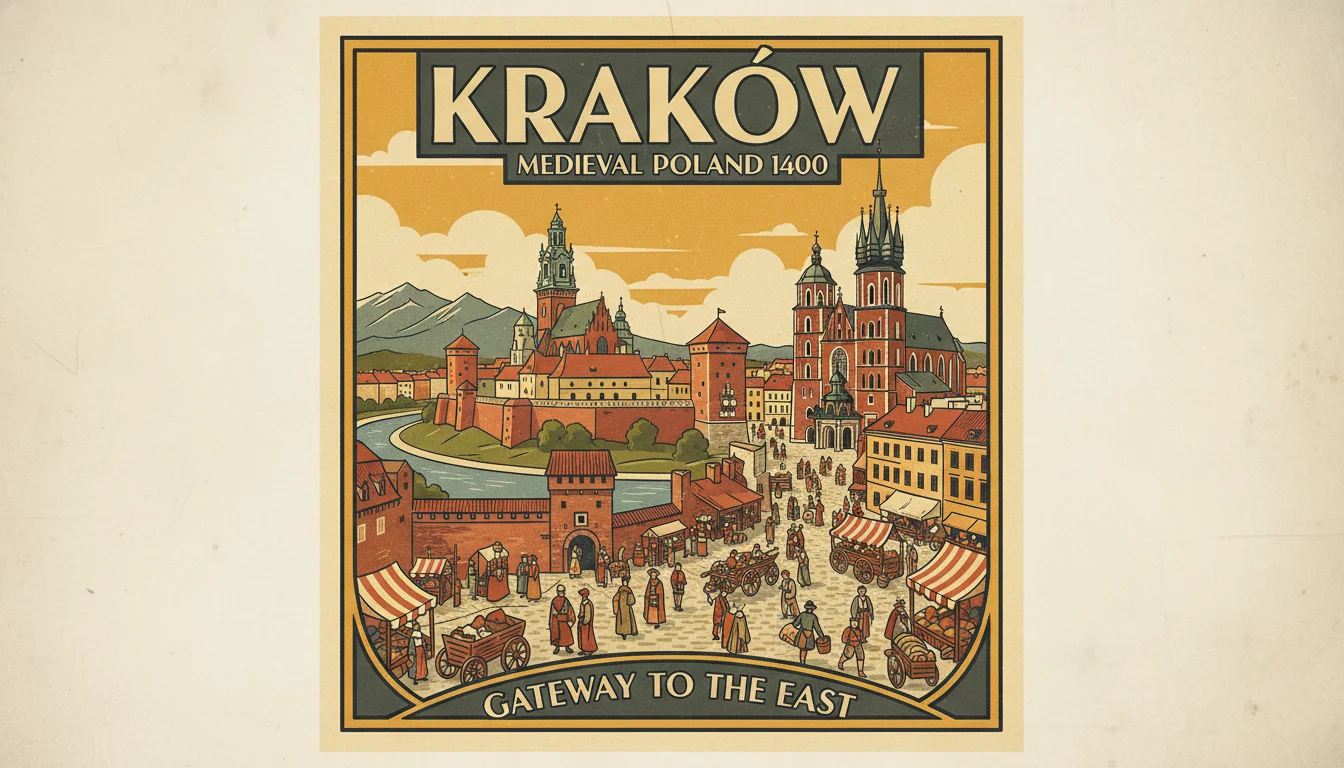
You've arrived in Krakow, the jewel of the Kingdom of Poland, just as the Jagiellonian dynasty is transforming this merchant city into one of Europe's great intellectual and commercial centers. King Władysław II Jagiełło sits on the throne, fresh from his 1386 union with Lithuania that created the largest state in Europe. The city hums with ambition.
But first - you need to blend in. Standing in the middle of the Rynek Główny looking confused will get you robbed, questioned, or worse. Let's get you sorted.
What to Wear
Medieval Krakow is a fashion crossroads. German merchants, Italian traders, Lithuanian nobles, and Jewish scholars all walk these streets, each with distinct styles.
For Men:
- A wool tunic (suknia) reaching mid-thigh, belted at the waist
- Braies (loose linen undergarments) and hose
- A felt or wool cap - essential, as going bareheaded marks you as either a peasant or a foreigner
- Leather boots, preferably pointed (this is the era of poulaines - the pointier, the wealthier)
- A short cloak (płaszcz) for the unpredictable Polish weather
For Women:
- A linen chemise under a wool kirtle reaching the floor
- A surcoat for warmth and status display
- Hair must be covered - married women wear wimples, unmarried women can show braided hair but still need a veil for church
- Avoid bright scarlet or purple unless you want to explain your aristocratic credentials
Critical Warning: The city has strict sumptuary laws. Certain furs, gold embroidery, and silk are restricted to nobles. Dress above your apparent station and you'll attract the wrong kind of attention.
Finding Food and Drink
The Main Market Square (Rynek Główny) is your culinary headquarters. One of the largest medieval squares in Europe, it's dominated by the Sukiennice (Cloth Hall) where merchants hawk everything from English wool to Oriental spices.
What's on the menu:
Breakfast doesn't exist. The day starts with work. Your first meal comes around mid-morning:
- Dark rye bread with butter or lard
- Cheese from local farms
- Dried or smoked fish
The main meal (around noon):
- Bigos - a hunter's stew of cabbage, sauerkraut, and various meats that's been simmering for days
- Roasted goose or pork (beef is expensive)
- Freshwater fish from the Vistula - carp, pike, perch
- Kasha (buckwheat groats) as a constant accompaniment
- Root vegetables - turnips, parsnips, carrots
Drink:
- Beer. Lots of beer. Water is questionable, so everyone drinks beer, including children
- Mead for celebrations
- Hungarian wine if you're wealthy or well-connected
- Kwas (fermented rye drink) for the common folk
Street food tip: Look for vendors selling pierogi - yes, they already exist! These dumplings stuffed with meat, cabbage, or cheese are perfect for eating on the go.
How to Get Around
Krakow is compact and walkable. The city walls, recently reinforced, enclose a roughly oval area you can cross in fifteen minutes.
Key landmarks to know:
- Wawel Castle - the royal residence on the hill south of the main square. Don't try to enter unless invited.
- The Rynek Główny - your central navigation point
- St. Mary's Church - the tall Gothic towers are visible from anywhere. Every hour, a trumpeter plays the Hejnał mariacki, cutting off mid-note to commemorate the 1241 Mongol invasion
- The Jewish quarter of Kazimierz - technically a separate town, just south of Krakow proper
Getting there: Walk. Everyone walks. Horses are for nobles and merchants transporting goods. If you must travel further, negotiate with a carter at one of the city gates.
Local Customs You Must Know
The University: Krakow's university (later called Jagiellonian) was founded in 1364 and is about to be revived and expanded by Queen Jadwiga's endowment. Scholars are everywhere, speaking Latin and debating theology, law, and the increasingly fashionable study of astronomy. Showing respect for learning will open doors.
Religious life: Poland is devoutly Catholic. The church bells regulate daily life. You'll hear:
- Matins at dawn
- Lauds shortly after
- Prime, Terce, Sext throughout the day
- Vespers at sunset
- Compline before bed
Attend mass. Not attending will make you conspicuous. Cross yourself when passing churches.
The Jewish community: Krakow has a significant Jewish population with royal protection. Kazimierz, the adjacent town, hosts most Jewish residents. Interfaith tensions exist but are generally manageable under Jagiellonian tolerance policies. Don't make ignorant comments.
The Guilds: Every trade is controlled by a guild - goldsmiths, butchers, bakers, weavers. If you want to work, you need guild membership. If you're just passing through, stay out of guild politics.
Dangers to Avoid
Disease: The Black Death devastated Poland in 1348-1351, and periodic outbreaks continue. Watch for quarantine notices. If you see red crosses on doors, leave that neighborhood immediately.
Fire: Medieval Krakow has burned multiple times. Most buildings are timber. Carry nothing flammable, avoid open flames, and know your exits.
Crime: The market square after dark is risky. Pickpockets, drunken students, and mercenaries passing through create hazards. Stay in well-lit taverns or your lodgings once the sun sets.
Political intrigue: The Jagiellonian succession is always contested. The Teutonic Knights to the north are a constant threat. Don't discuss politics loudly unless you want to be suspected as a spy.
The weather: Polish winters are brutal. If you're arriving between November and March, prepare for temperatures that can kill. Fur is not a luxury - it's survival gear.
Must-See Experiences
Watch the Hejnał: Every hour, climb the tower of St. Mary's Church to see the trumpeter play. The melody that stops mid-phrase commemorates the legendary trumpeter shot by Mongol arrows while sounding the alarm in 1241.
Visit a bathhouse: Yes, medieval people bathed. Public bathhouses offer hot water, social mixing, and relaxation. Bring your own towel.
Attend a feast: If you can finagle an invitation to a guild celebration or noble banquet, take it. Multiple courses, entertainment, and social networking you can't get elsewhere.
Explore Wawel Hill: Even if you can't enter the castle, walk around the hill. The cathedral holds royal tombs and relics. The view of the city and the Vistula River is magnificent.
Shop the Cloth Hall: Even if you're not buying, watching the merchants haggle over English wool, Flemish cloth, Hungarian copper, and Oriental spices is a masterclass in medieval commerce.
A Day in the Life
Dawn: Wake to church bells. Eat bread and cheese. Head to work or whatever business brought you here.
Mid-morning: The market comes alive. Farmers from surrounding villages bring produce. Craftsmen open their shops. The noise is tremendous.
Midday: Main meal. Find a tavern near the square. Bigos and beer will cost a few groszy.
Afternoon: Business continues. If you're not working, explore. The churches are always open for prayer or quiet reflection.
Evening: As the sun sets, businesses close. Taverns fill up. Students from the university argue loudly about Aristotle and drink even louder.
Night: The city gates close. If you're outside, you're sleeping outside. Curfew is enforced. Find your lodgings before dark.
Final Thoughts
Medieval Krakow in 1400 offers a rare combination: a thriving commercial center, serious intellectual life, religious diversity (by medieval standards), and relative political stability. The Jagiellonian golden age is just beginning. In a few decades, this city will produce Nicolaus Copernicus.
You're witnessing the emergence of Central Europe as a major force. The Latin West meets the Eastern steppes here. The result is a city more cosmopolitan than you might expect, and more dangerous too.
Keep your head down, your purse close, and your religious opinions to yourself. Pay attention to the scholars - they're changing the world. Eat the pierogi.
And whatever you do, don't miss the trumpet call that ends mid-note. Some traditions are worth the climb.
For another great medieval city in the same era, see our guide to Mamluk Cairo in 1400. For the earlier Carolingian capital that shaped European Christian culture, see Carolingian Aachen in 800 AD.

Need Advice from Someone Who Lived There?
Get firsthand accounts from people who actually lived through these moments in history.
Create your free account →No card required. Some figures and features require a paid plan.
Join the HistorIQly Club
Get smarter about the past.
Weekly stories, deep dives, and exclusive content straight to your inbox.