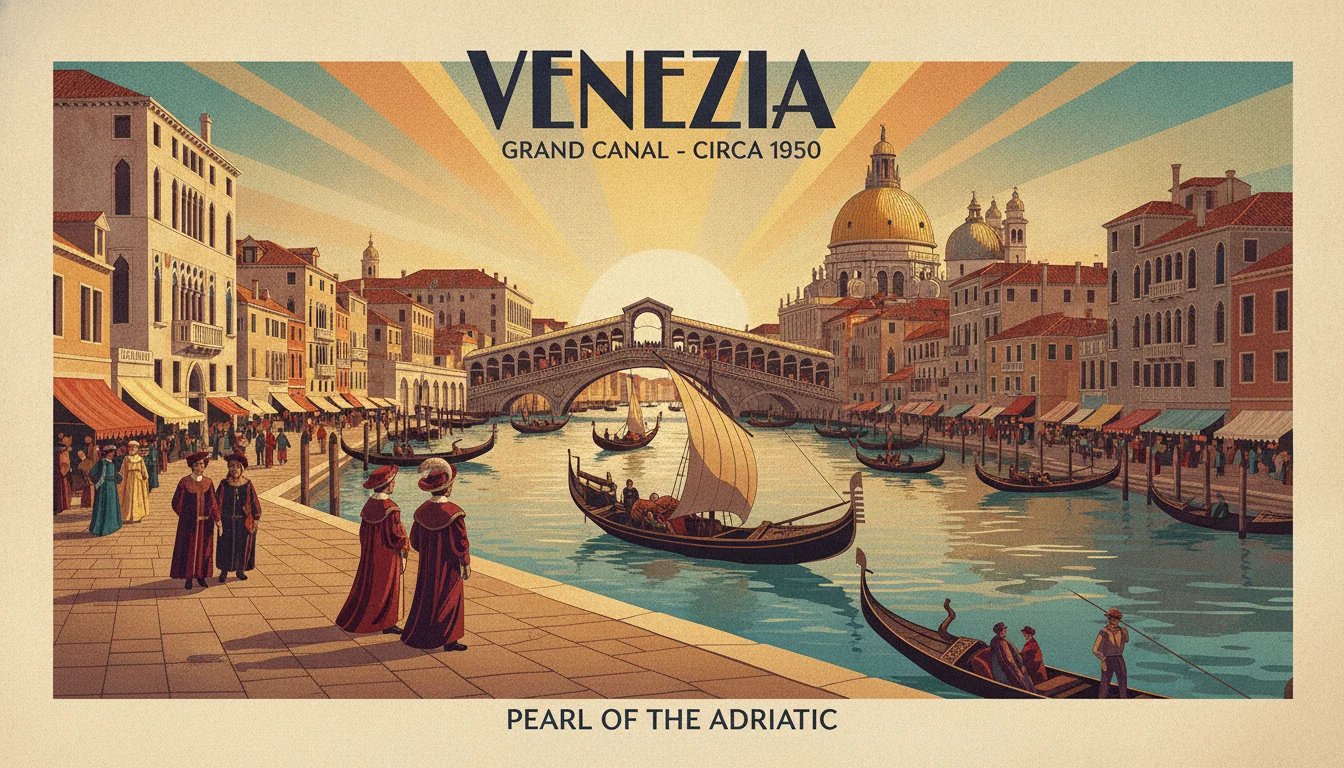
Time Traveler's Guide to Medieval Venice, 1300
Medieval Venice in 1300: survive the labyrinthine canals, political intrigue, and merchant princes of the world's most improbable city at the height of its power.
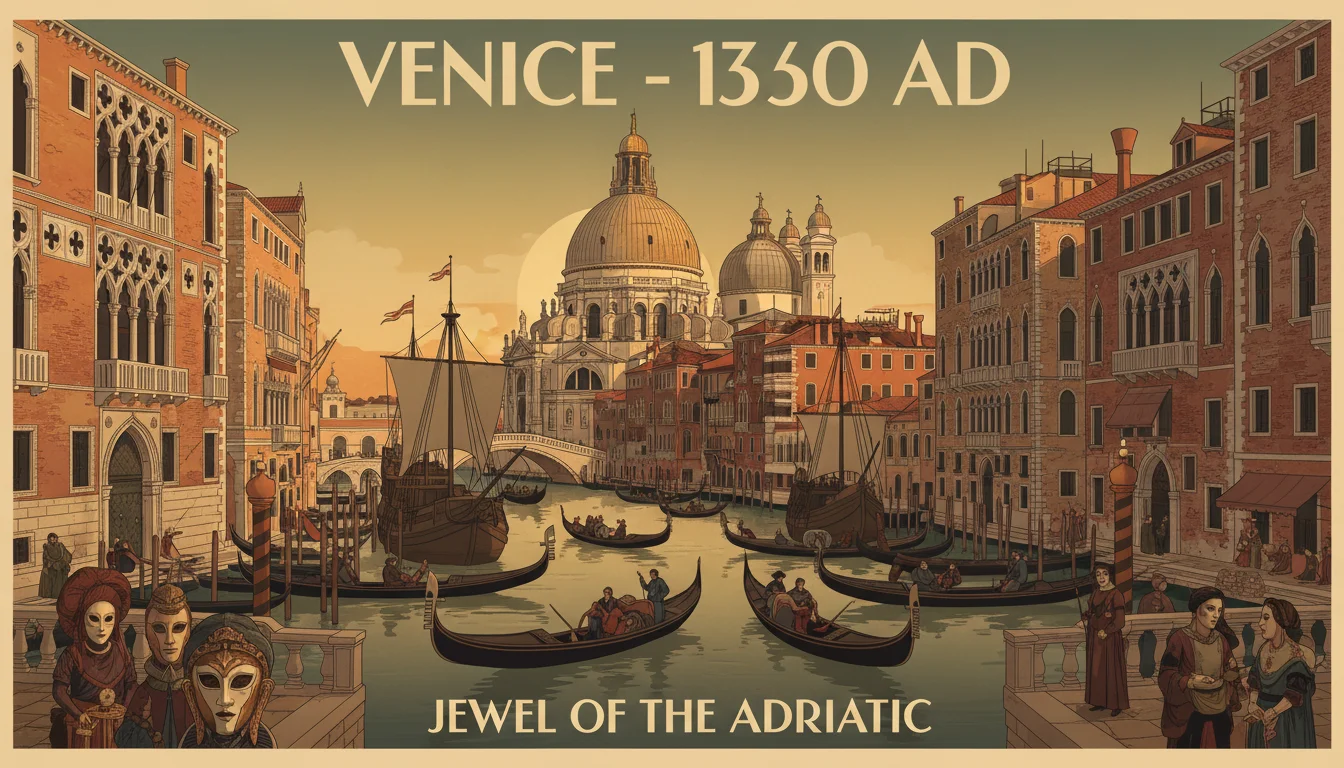
Your gondola slices through murky green water as you enter the most impossible city ever built. Venice in 1300 isn't just a city - it's a floating empire built on millions of wooden pilings driven into a muddy lagoon. The Serene Republic sits at the peak of its commercial power, controlling trade routes from Constantinople to Alexandria, and you've arrived just as the city's wealth reaches almost obscene levels.
Welcome to the drowning city that refuses to sink.
When to Visit
March through October offers the best experience, though be warned - Venice is humid year-round. The lagoon's salt air corrodes everything, including your lungs if you're not careful. Summer brings mosquitoes the size of small birds and the distinctive aroma of canal water that hasn't been refreshed since... well, ever.
The city truly comes alive during Carnival, held before Lent. Masks aren't just festive here - they're a way of life. Venetian nobles wear them year-round to gamble, conduct affairs, and plot political schemes without being recognized. Pick up a bauta mask (the white one with no mouth that makes you look vaguely terrifying) and you can go almost anywhere.
What to Wear
Leave your medieval peasant costume at home. Venice is the fashion capital of the Mediterranean, and Venetians can spot an underdressed foreigner from across the Grand Canal. The city has actual sumptuary laws regulating who can wear what, which tells you everything about how seriously they take appearance.
For men: A fitted tunic called a giornea over tight hose, preferably in rich colors. The wealthier you look, the better you'll be treated. Venetian nobles favor deep reds, purples, and blacks - the dyes alone cost more than a year's wages for a craftsman.
For women: Layers are everything. A gamurra (underdress) beneath a cotta (overdress), ideally in silk. Venetian women are famous for their elaborate hairstyles, often incorporating false hair pieces and spending hours with curling irons. They also bleach their hair blonde using a mixture that would make a modern dermatologist cry.
Essential accessories: A money pouch worn INSIDE your clothing (pickpockets are professionals here), sturdy shoes for the slippery stone bridges, and a small knife for eating - forks exist but are still considered pretentious by some.
Getting Around
Forget horses. Venice banned them centuries ago because, well, where would you put them? The city operates entirely on foot and by boat.
The Grand Canal is your highway, curving through the city in a massive S-shape. Hire a gondola for longer trips - yes, they already exist and yes, they're already overpriced for tourists. Negotiate firmly. A ferry service runs at several points across the Grand Canal for just a few small coins.
Walking is free but requires strategy. Venice is a maze of 118 islands connected by over 400 bridges. The locals have a sixth sense for navigation that you will not develop in a weekend. When lost (not if - when), head toward the sound of crowds or follow people carrying goods toward the Rialto market.
The Rialto Bridge is currently wooden and lined with shops. It's the only bridge crossing the Grand Canal, making it the most congested point in the city. Everyone passes through here eventually.
What to Eat
Venetian cuisine is a glorious collision of East and West. The spice trade flows through here, meaning your food will be seasoned like nowhere else in Europe.
Breakfast doesn't really exist as a concept. Grab some bread and cheese from your lodgings and call it done.
Lunch and dinner revolve around:
- Seafood everything - sardines, oysters, cuttlefish in its own black ink, salt cod (baccalà)
- Rice dishes - Venice introduced rice to Western Europe, and they're obsessed with it
- Polenta - ground corn from... wait, that's not here yet. Never mind, skip the polenta for another 200 years
- Pasta - surprisingly common, often served with butter and cheese
- Vegetables from the lagoon gardens - artichokes, radicchio, asparagus
Wine flows constantly. Venetians import it from all over the Mediterranean and consume it at rates that would concern a modern physician. Water from the city's cisterns is theoretically drinkable but... stick with wine.
Essential Venetian Customs
The Republic is paranoid about spies. And for good reason - every power in Europe and the East wants to know Venice's trade secrets. Don't ask too many questions about shipping routes, cargo manifests, or military matters unless you want to meet the Council of Ten (you don't).
Social hierarchy matters intensely. At the top sit the noble families whose names appear in the Golden Book - they alone can serve in government. Below them are the cittadini originarii (original citizens), who run the bureaucracy. Below them, everyone else. Know your place.
Bowing and hat-doffing are expected when encountering social superiors. Err on the side of excessive politeness - Venetians appreciate good manners almost as much as good commerce.
The Doge is the elected head of state, but don't think "elected" means what you think. Only nobles vote, the selection process takes weeks, and the Doge's power is deliberately limited to prevent tyranny. He's more figurehead than ruler, surrounded by councils watching his every move.
Dangers to Avoid
The canals themselves are your biggest threat. No railings exist, and after dark (or after wine), drownings are common. The water is thoroughly disgusting - falling in means immediate bathing and prayer.
Plague visits periodically. If you hear rumors of sickness, leave immediately. Venice will eventually build the world's first quarantine station (lazaretto), but that's still decades away.
Political intrigue runs deep. The Council of Ten has eyes everywhere, and suspected troublemakers simply... disappear. Don't discuss politics with strangers. Don't criticize the government. Don't even joke about it.
Loan sharks operate openly near the Rialto (the word "ghetto" comes from Venetian - the foundry district where Jewish moneylenders were forced to live). Check exchange rates carefully before changing currency - the Venetian ducat is Europe's most trusted coin, and you'll need it.
Must-See Experiences
St. Mark's Square (Piazza San Marco) is the ceremonial heart of the Republic. The Basilica gleams with stolen Byzantine gold and looted treasures - the Venetians "acquired" most of it during the Fourth Crusade when they... got creative with the whole crusading concept. The four bronze horses above the entrance? Lifted from Constantinople's hippodrome.
The Arsenal is the largest industrial complex in Europe - essentially an enormous shipyard capable of producing a complete warship in a single day. The secrets inside are guarded more closely than any treasure. Don't try to sneak in.
Murano Island holds the glass-makers, forcibly relocated there so their furnaces wouldn't burn down the main city (and so their secrets couldn't escape). Murano glass is coveted across the known world. Craftsmen who try to leave face death threats.
The Rialto Market opens at dawn and the chaos is magnificent - spices from India, silk from China, furs from Russia, slaves from... various places. Yes, Venice trades in human beings. The medieval world has different values.
A nobleman's palazzo if you can wrangle an invitation. The wealth on display will recalibrate your understanding of the word. These families have been accumulating treasures for generations, and they build their homes to impress.
Useful Phrases
Venetian isn't quite Italian - it's its own dialect that locals take enormous pride in:
- Bondi - Hello (informal)
- Ciao - Goodbye (yes, this word is Venetian originally)
- Scuseme - Excuse me
- Quanto costa? - How much?
- No so - I don't know (useful when officials ask questions)
- Omo de mezo - Middleman/broker (you'll need one for any serious business)
Final Survival Tips
Bring trade goods if you can - Venice runs on commerce, and having something to sell opens doors that gold alone cannot.
Trust no one completely. This is a city of merchants who've elevated deal-making to an art form. Everyone is calculating angles.
Stay in a fondaco - a combination inn-warehouse where foreign merchants lodge. They're regulated by the government, which means some protection from the worst scams.
Leave before you're broke. Venice is expensive in ways that will sneak up on you - accommodation, food, gondolas, bribes, entertainment. The city extracts wealth from visitors with cheerful efficiency.
The Serene Republic has another 500 years of independence ahead of it, but right now, in 1300, it stands at the absolute zenith. You're visiting the richest, most sophisticated, most cynically practical city in the Western world. Embrace the contradictions: stunning beauty built on ruthless commerce, republican ideals enforced by secret police, Christian piety funded by trade with Islamic empires.
For other medieval European city guides, see our time-traveler's visits to Krakow in 1400 and Ottoman Istanbul in 1555, two cities at comparable moments of commercial power.
Just don't fall in the canal.

Need Advice from Someone Who Lived There?
Get firsthand accounts from people who actually lived through these moments in history.
Ask Them YourselfJoin the HistorIQly Club
Get smarter about the past.
Weekly stories, deep dives, and exclusive content straight to your inbox.