A Time Traveler's Guide to Medieval Paris, 1300
A guide to medieval Paris in 1300: Notre-Dame newly finished, the Knights Templar at their peak, and Philip IV reshaping royal power over 200,000 inhabitants.
Read Wikipedia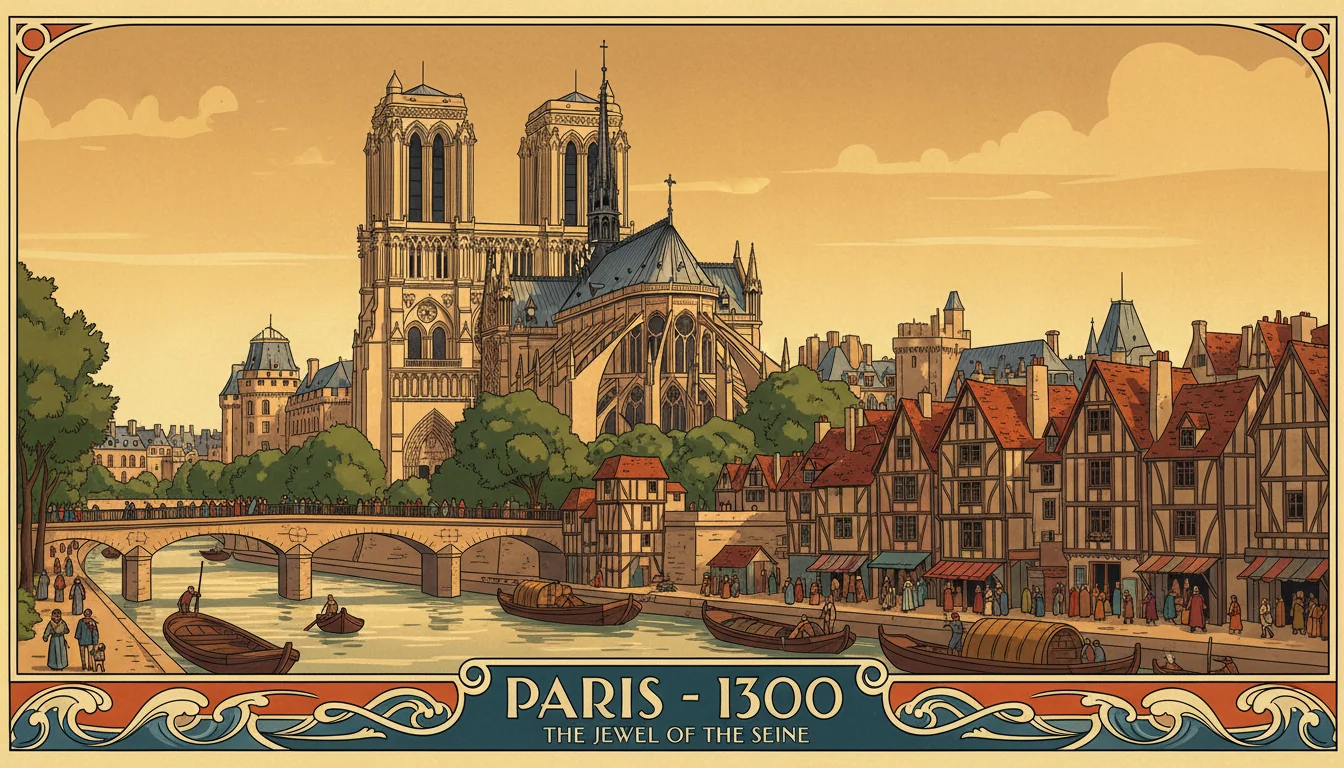
If you want to stand in what was, in 1300, one of the largest and most intellectually charged cities on earth, set your coordinates for Paris on the Seine. Philip IV - Philip the Fair, they call him, and the nickname is accurate - is thirty-two years old and has been king for fifteen years. His court is aggressive, expensive, and full of lawyers rewriting the boundaries of royal power. The University of Paris is in its stride, drawing students from every corner of Christendom. Notre-Dame Cathedral is essentially complete. And in a fortified enclave just outside the city wall, the Knights Templar are still the richest military order in the Western world, seven years before Philip arrests them all in a single dawn raid.
This is not a quiet visit. But here is how to survive it.
What you are walking into
Paris in 1300 has somewhere between 200,000 and 250,000 inhabitants, which makes it one of the two or three largest cities in Latin Christendom - comparable to Florence, far ahead of London. It is divided by the Seine into three distinct worlds.
The Ile de la Cite sits in the middle of the river, the original nucleus of the city. It holds the royal Palais de la Cite, the seat of Philip's government and courts, and the cathedral of Notre-Dame, which has been under construction for 130 years and is now, in most respects, finished. The rose windows are in. The flying buttresses are holding up the nave walls. The twin towers of the west front dominate the skyline.
The Right Bank - the Rive Droite - is the commercial city. Les Halles, the covered market, sits just north of the river and has been the beating commercial heart of Paris for generations. The guild of drapers, the grain merchants, the money changers - their operations cluster on the Right Bank, along streets named for what they sell: Rue de la Ferronnerie for ironmongers, Rue de la Tabletterie for small goods.
The Left Bank - the Rive Gauche - is the intellectual city. The University of Paris, founded in the late 12th century, spreads through the quarter that will eventually take the name Saint-Germain. Students have come here from England, Germany, Italy, and Aragon. Thomas Aquinas taught here in the 1260s. By 1300 the university is organized into four formal nations (French, Picard, Norman, and English) and enrolls thousands. The smell of parchment and the sound of Latin disputation are as common as woodsmoke in this quarter.
Getting your bearings and your cover story
Your safest cover as a visitor is a merchant from one of the Italian trading cities - Lucca, Siena, or Florence - attached to one of the banking houses that have offices in Paris. Italian bankers are everywhere in Philip's court. They finance the king's wars and collect papal taxes and are tolerated, lightly taxed, and occasionally expelled. A Florentine merchant speaking mangled French with a thick Italian accent will attract suspicion of the ordinary commercial kind rather than anything more dangerous.
Do not claim to be English unless you speak excellent French and understand that relations between France and England are strained over Gascony. Do not claim to be Flemish. Philip is in the middle of a grinding war with Flanders that began with the Sack of Bruges in 1300 and will not resolve cleanly for years. A Flemish accent in Paris in 1300 is not a comfortable thing to have.
Dress like you have a guild affiliation
Paris has strict customs around dress, enforced not primarily by law but by the intensely class-conscious social structure of a medieval city where everyone knows everyone's business.
For men of the merchant class:
- A long wool cotehardie or supertunic, belted at the waist, in a dark color (madder red, weld yellow, or woad blue are common; brighter versions of these colors are expensive)
- A linen undershirt visible at the neck and cuffs
- Wool hose attached to a belt
- Leather shoes with modest pointed toes - the extreme long toes (poulaines) come later
- A hood worn up in cold weather, pushed back in the city
- A belt from which a small knife and a pouch hang
For women:
- A long-sleeved cotehardie over a linen chemise
- A wimple covering the hair and neck if married
- A long veil for going out in public
- Flat leather shoes or wooden pattens for wet streets
Avoid anything dyed with expensive saffron yellow or crimson on a first entry into the city. The sumptuary instincts of the period run strong, and a foreigner in ostentatious colors will attract the wrong kind of attention from guild inspectors and royal tax agents.
The smell, the sound, the texture
Medieval Paris in 1300 is loud. Church bells ring the canonical hours and mark the opening of courts and markets. The street criers of Les Halles shout their goods from before dawn. Horses, mules, and oxen share the streets with apprentices, beggars, pilgrims, and knife-sharpeners. The Seine is the main arterial road for heavy goods, and the river port below the Palais de la Cite is crowded and noisy.
The city smells of everything it produces and discards at close quarters. The tanneries that process leather are clustered south of the Ile de la Cite on the Left Bank near the Bievre river, which runs open through this quarter to the Seine. On warm days the tanneries' odor covers the whole southern city. Butchers' offal goes into the street. Cesspits are dug under courtyards and overflow in wet weather into the lanes.
The Seine at Paris in 1300 is the city's water supply, its dump, and its main road simultaneously. Drink from the wells of the inner city rather than directly from the river.
Three places that justify the trip
Notre-Dame Cathedral
The cathedral is new. That is easy to forget when you stand before a building that in your own time looks ancient, but in 1300 the stonework is still pale, the mortar is fresh in many places, and the stained glass is brilliant rather than darkened by centuries of urban grime. The north and south rose windows were installed in the 1250s. The light they cast on the interior stone is extraordinary.
The nave is a public space. Pilgrims, merchants, and the curious circulate freely. Go in mid-morning when the light from the south transept rose is at its best. The cathedral is already a major pilgrimage destination - it holds relics including a piece of the True Cross and a nail from the Passion.
Sainte-Chapelle
Louis IX built this royal chapel between 1242 and 1248 to house the Crown of Thorns. The upper chapel is almost entirely glass - fifteen enormous windows fill nearly every wall. When the light is right, the stone structure disappears. Access requires a court connection, but the exterior alone is worth the detour.
The Temple Enclave
A short walk northeast from Les Halles, outside the Augustan wall, sits the fortified complex of the Knights Templar - the Tour du Temple and its surrounding buildings. The Templars have been bankers and warriors for nearly 180 years. In 1300 they are still at the height of their wealth and political influence. Their Paris preceptory is a walled compound with its own courts, workshops, and treasury.
See it while you can. On October 13, 1307, Philip IV will arrest every Templar in France simultaneously in a pre-dawn operation coordinated by royal agents across hundreds of sites. The order will be dissolved. The Tour du Temple will become a royal prison. The men you see here in 1300 have seven years left.
How to talk to people without incident
Medieval French in 1300 is Old French in its later phase - you will be understood as a foreigner regardless. Latin works with clergy and students. Basic social rules: remove your hood entering a church or court building, address noblemen as "monseigneur," step aside on narrow streets for knights and clergy, never handle market goods without invitation.
The real danger is politics. Philip IV is in a prolonged confrontation with Pope Boniface VIII over taxation of the French clergy. Offering an opinion on it - in any direction - is unwise. Philip's agents are present and the university is split. Stick to merchant small talk and keep theological opinions to yourself.
What to eat, what to avoid
Wine is a dietary staple here, consumed at every meal in watered form. The Seine valley produces serviceable wine; Burgundy and the Loire are premium. Safe choices at Les Halles: bread from guild-marked bakers, baked river carp or pike, roasted pork, thick vegetable pottage from a Right Bank inn.
Avoid anything involving untreated river water, street food from unlicensed vendors, and meat in warm weather from stalls without guild identification. The Seine in 1300 is simultaneously the city's water supply and its main drain. Drink the wine.
What not to do
Theft is the constant background risk and the watch is thin. More specifically: do not speak approvingly of the Flemish cause, do not speak critically of the king, do not discuss Templar banking arrangements with strangers, do not claim English court connections, and do not offer theological opinions to anyone. The Inquisition is active in Paris, focused mainly on Cathar remnants and university disputes. It can turn.
The one thing you must see before you leave
If your visit allows one moment, take it on a clear morning at Notre-Dame's west front, just after Prime has rung. The bells are setting the day in motion. Students cross the Petit Pont toward the university. Pilgrims file through the central portal. Philip IV's lawyers are already at work in the Palais a hundred meters to the west.
Paris in 1300 is at the peak of its medieval confidence and on the edge of an abyss it cannot see. The Black Death is forty-seven years away. The Templars have seven years. Philip the Fair himself dies in 1314.
Bring a hood, speak Italian when in doubt, and stay away from the river wells.
For related guides to medieval Europe, see Time Traveler's Guide to Medieval Venice, 1300 and Time Traveler's Guide to Merovingian Paris, 600.

Need Advice from Someone Who Lived There?
Get firsthand accounts from people who actually lived through these moments in history.
Create your free account →No card required. Some figures and features require a paid plan.
Join the HistorIQly Club
Get smarter about the past.
Weekly stories, deep dives, and exclusive content straight to your inbox.