A Time Traveler's Guide to Meiji Tokyo, 1880
Everything you need to survive a visit to Meiji Tokyo in 1880, when Japan was reinventing itself out of feudalism in a single extraordinary generation.
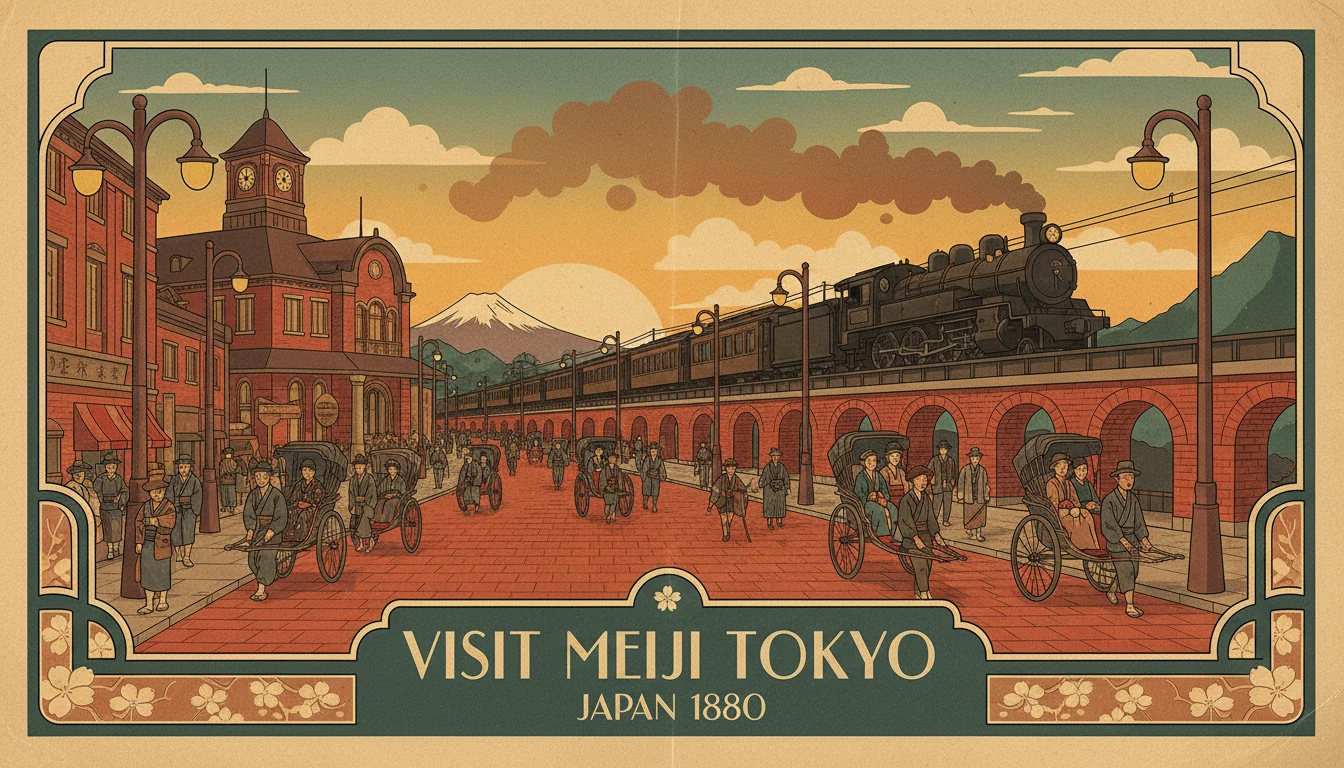
If you want to visit a city reinventing itself faster than any other capital in modern history, set your time machine for Tokyo in 1880. The Meiji Restoration is twelve years old. The samurai class has been formally abolished. Western-style trains run from Shimbashi to Yokohama. A daily newspaper, the Tokyo Nichi Nichi Shimbun, has been publishing since 1872. The Imperial Household has moved from Kyoto into the former Edo Castle. Brick buildings are rising in Ginza. And along the same streets, men in kimono walk past men in frock coats, and the sounds of telegraph wires mix with the songs of street vendors.
It is the most rapidly modernizing city in the world. So before you click your watch into 1880, here is your practical guide to surviving, blending in, and enjoying a visit to Meiji Tokyo.
First, know what kind of place you're entering
Tokyo in 1880 has a population of about 800,000. It is the seat of a young constitutional reform movement, a centralized imperial bureaucracy, and an economy in violent transition. The samurai class, which had defined Japanese social structure for 700 years, was officially abolished in 1873. Many former samurai are now civil servants, military officers, or struggling shopkeepers. Others have been compensated with government bonds and are losing their savings as the bonds depreciate.
The city is undergoing massive physical change. The 1872 Ginza fire prompted the construction of Western-style brick buildings along the main commercial streets. Gas streetlights, horse-drawn omnibuses, and rickshaws (a recently invented vehicle, dating only to 1869) move through neighborhoods that still retain large stretches of traditional wooden architecture.
Your safest cover story is that you are a visiting Western technical advisor or merchant, perhaps connected to one of the foreign concessions in Yokohama. Tokyo in 1880 hosts a substantial population of foreign teachers, engineers, military advisors, and missionaries, known collectively as oyatoi gaikokujin (hired foreigners). Most are here on government contracts and have a recognized social position.
Do not pretend to be a Japanese local. Foreigners with imperfect Japanese are common and accepted. Foreigners pretending to fluency they do not have are quickly exposed.
Dress like you belong
Dress in 1880 Tokyo is in dramatic transition. The same individual may wear traditional Japanese clothing on certain days and Western clothing on others, depending on context.
For Western men, wear:
- a dark frock coat or suit jacket
- a stiff white shirt with a high collar
- a dark waistcoat
- trousers in matching wool
- polished leather shoes
- a top hat or bowler
For Japanese men adopting Western style:
- the same Western kit, often with a Japanese-style hairstyle (most men have cut their topknots after the 1871 dampatsurei edict but some have grown beards in the new fashion)
For traditional Japanese men:
- a dark kimono with hakama (divided skirt-trousers)
- haori coat
- tabi socks and either zōri or geta sandals
For Western women:
- a long bustled dress in current fashion
- a corset (yes, still required for plausibility)
- gloves
- a hat with feathers or ribbon
- buttoned leather boots
For Japanese women adopting Western style:
- Western clothing is rare and reserved for elite women associated with the Rokumeikan circle, which will not formally open for another three years (1883). Women adopting Western style now do so cautiously.
For traditional Japanese women:
- a kimono with appropriate seasonal pattern and obi
- proper hairstyle (Western perm waves are not yet introduced)
- white tabi and zōri
If you are a Western visitor, stick to Western clothing. Adopting Japanese dress as a foreigner is socially complicated and may signal pretension.
Get used to the streets
Tokyo in 1880 mixes the old and new in dizzying ways. Horse-drawn omnibuses operate on main routes. Rickshaws are everywhere. The first horse-drawn streetcars will appear in 1882. Trains run from Shimbashi station to Yokohama. Telegraph poles and wires line the major boulevards.
But step a block off the main streets and you are in old Edo. Wooden buildings, narrow lanes, public baths, kabuki theaters, geisha districts, fish markets at Nihonbashi, and Buddhist temples that have stood for centuries all continue their daily business.
Carry a small lantern after dark. Streetlights exist on major roads but disappear quickly in residential lanes. Watch for sudden cultural transitions. A street that begins in Western Tokyo can end in old Edo before you have walked four blocks.
Three places you absolutely must visit
Ginza
The new brick streets of Ginza are the visual symbol of Meiji modernization. Gas lamps line the avenue. Western-style shop windows display imported goods. Newspaper offices, watchmakers, photographers, and Western tailors have established themselves here. Walk the length of Ginza in the evening to see the city's most performative modern face.
Asakusa
By contrast, Asakusa remains the cultural heart of old Edo. The Sensō-ji temple complex draws pilgrims daily. Street performers, food stalls, kabuki theaters, and entertainment districts create an atmosphere that has continued largely unchanged since the Tokugawa period. The Sensō-ji's Hozomon gate is currently undergoing repairs after the 1865 fire damage.
Visit on a festival day. Buy a fan or a wood-block print from a small vendor. Watch a kabuki performance.
Shimbashi Station
Tokyo's original major railway station, opened in 1872, is one of the most photographed buildings in early Meiji Japan. The station and its platforms, the steam trains arriving from Yokohama, and the mixture of crowds (foreign travelers from the treaty ports, government officials, traditional Japanese merchants, and curious onlookers) make it one of the most memorable Meiji settings.
You can buy a ticket for the 30-kilometer trip to Yokohama for a few sen. Take the trip at least once. The journey along the coast is one of the great experiences of late 19th-century travel.
How to talk to people without causing trouble
Spoken Japanese in 1880 differs significantly from modern Japanese in vocabulary and politeness levels. Even fluent modern speakers will sound foreign to a Meiji-era Tokyoite. Most educated Japanese men in the capital have basic written English, French, or German, and conversational interactions with foreigners frequently happen in those languages.
If you do not speak Japanese:
- engage an English-speaking guide or contact through a foreign concession
- carry written cards of common requests in Japanese
- learn basic greetings and apologies
A few universal rules help:
- bow lightly when meeting officials or elders
- never enter a Japanese home without removing your shoes
- accept offered tea or sake with both hands
- do not blow your nose loudly in public
- avoid touching anyone (especially women) casually
- give way to processions of officials or nobles
If a police officer or government official asks your business, give a short, polite answer. The Meiji state is highly bureaucratic and tracks foreigners carefully.
What to eat, what to avoid
Meiji Tokyo cuisine reflects the country's cultural blending. Traditional Japanese food, soba, sushi, tempura, miso soup, rice, pickles, fish, remains the urban norm. But Western food is increasingly available. Beef, banned during the Edo period for Buddhist reasons, was reintroduced in the 1870s and is now fashionable. Bread, butter, beer, and Western-style pastries appear in selected restaurants.
Safe choices for a visitor:
- soba or udon noodles from a stall on a busy street
- grilled fish at a small restaurant
- tempura at a Nihonbashi vendor
- gyu-nabe (beef hotpot, a Meiji innovation)
- green tea or sake at any reputable establishment
- bread, butter, and coffee at a Western-style café in Ginza
Things to be careful of:
- raw fish in summer at unfamiliar establishments
- water from open canals
- unfamiliar Western foods at low-quality establishments (the Western culinary infrastructure is still being developed)
- excessive sake on an empty stomach
- unfamiliar street snacks during festival days
Politics you should know about, briefly
The Meiji government in 1880 is in the middle of an enormous program of legal, military, educational, and infrastructural reform. The samurai class has been abolished. Universal conscription has been implemented (1873). Western-style schools are spreading. The Iwakura Mission (1871-1873), which sent senior officials on a tour of Western countries, has concluded with extensive reports on what reforms Japan should adopt.
The Freedom and People's Rights Movement (Jiyū Minken Undō) is gaining strength, demanding a constitution and an elected national assembly. Itagaki Taisuke, Ōkuma Shigenobu, and others are public figures in this movement. The constitution they demand will eventually be issued in 1889.
Tensions exist between the old samurai class (some of whom revolted in the Satsuma Rebellion of 1877) and the new bureaucratic elite. The unequal treaties imposed on Japan by Western powers in the 1850s and 1860s remain a source of national resentment.
If you must discuss politics, repeat conventional praise of the Emperor Meiji, avoid taking sides between the government and the People's Rights Movement, and never criticize the imperial institution.
What not to do under any circumstances
Let me save you from the classic mistakes.
Do not:
- discuss the imperial family casually
- criticize the Emperor
- enter Buddhist or Shinto sacred precincts without removing your shoes
- handle Japanese swords (they are still being decommissioned and remain politically sensitive)
- attempt to photograph people without permission
- praise China at the expense of Japan
- defend the unequal treaties
- enter an entertainment district at night unaccompanied
Most importantly, do not predict any future Japanese military events. Meiji Japan in 1880 is in the middle of building itself. The wars with China (1894-95) and Russia (1904-05) are in the future. Do not warn anyone about any of it.
The experience you should not miss
If you have one moment in Meiji Tokyo, take it at sunset standing on the Nihonbashi Bridge, looking down at the river traffic. Boats laden with rice, vegetables, and lumber move slowly along the waterway. Telegraph wires hum above your head. The brick facades of Ginza glow to the south. The wooden architecture of old Edo extends to the north and east. A train whistles somewhere near Shimbashi.
You are watching one of the most rapid civilizational transformations in human history happen in real time. The Tokyo you are visiting will, within forty years, be the capital of a major industrial power. Within seventy years, it will be one of the most populous cities in the world.
Carry a small lantern, bow when uncertain, and always remove your shoes. Meiji Tokyo in 1880 is one of the most vivid destinations on any time-travel itinerary.
For related guides to Japanese history, see Time Traveler's Guide to Heian Kyoto, 1000 and Time Traveler's Guide to Sengoku Japan, 1560.

Need Advice from Someone Who Lived There?
Get firsthand accounts from people who actually lived through these moments in history.
Ask Them YourselfJoin the HistorIQly Club
Get smarter about the past.
Weekly stories, deep dives, and exclusive content straight to your inbox.