A Time Traveler's Guide to Mongol Karakorum
Your guide to Mongol Karakorum in 1250 - the steppe capital of the world's largest empire, where Buddhists and Muslim merchants shared the same dusty streets.
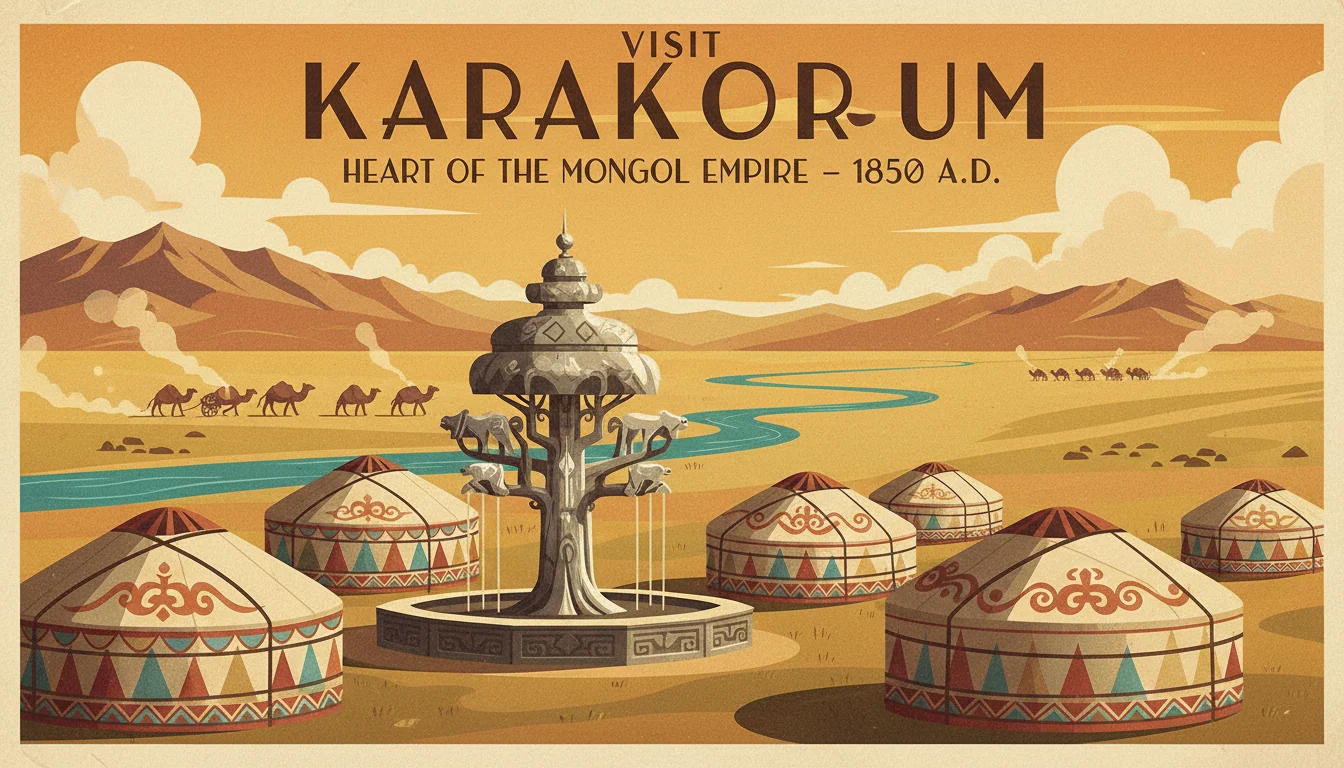
If your time machine is calibrated for ambition, set it for Karakorum in 1250. The Mongol Empire is the largest contiguous land empire in human history. Its capital sits in the upper Orkhon Valley of central Mongolia, a planned city built mostly out of compacted earth and timber, ringed by ger camps and trade caravans, full of envoys from every kingdom from Korea to France.
It is also a freezing, dusty, crowded, ferociously bureaucratic place, and one of the strangest crossroads any traveler has ever stood in. So before you pack, here is your practical guide to surviving, blending in, and enjoying a visit to Mongol Karakorum.
First, know what kind of place you're entering
Karakorum was founded in the 1220s by Genghis Khan as a base camp and was formalized as the imperial capital under his son Ögedei in 1235. By 1250, under the regency of Töregene Khatun and the early reign of Möngke Khan, it has become a strange hybrid: part traditional steppe encampment, part walled administrative city.
The city itself is small, perhaps a square kilometer, surrounded by an earthen wall pierced by four gates. Inside are foreign quarters for Chinese, Persian, Uyghur, Khitan, and European visitors, separate religious districts where Buddhist temples, mosques, Nestorian Christian churches, and Daoist shrines sit within walking distance of one another, and the imperial palace at the center, called the Tumen Amgalan, the Palace of Ten Thousand Tranquilities.
Outside the walls, in every direction, sit ger camps, livestock pens, and trading caravans. The actual population probably exceeds the walled city several times over.
Your safest cover story is that you are a foreign envoy or a merchant attached to a delegation. Karakorum in 1250 is host to ambassadors from the Pope, from Korea, from the Seljuk Sultanate, from the Caliphate, and from Russian princes. Almost no one expects a foreigner to speak Mongolian well.
Dress like you belong
Steppe and city dress in 1250 is layered, fur-trimmed, and built for sharp temperature swings. A merchant or envoy would be visible by quality of cloth more than by cut.
For men, wear:
- a long quilted robe (deel) crossing right over left at the chest, belted at the waist
- woolen or leather trousers
- felt or leather boots, turned up at the toe
- a fur-trimmed cap or felt hat
For women, wear:
- a longer deel, falling to mid-calf or ankle
- a high stiff headdress (bocta or boqta) for married women, made of birchbark and silk, sometimes a foot or more tall
- felt or leather boots
- bone or silver hair pins
Do not wear bright synthetic colors. Mongolian textiles in 1250 favor reds, blues, browns, and golds, with silk used among the wealthy. Avoid fitted modern silhouettes. Carry a sheathed knife on your belt for eating, never for display.
Crucially: never step on the threshold of a ger. Stepping on a threshold is a serious offense. Step over it. Always.
Get used to the cold and the dust
Karakorum sits at about 1,500 meters elevation. Winters are brutal, with temperatures regularly dropping below minus 30 degrees Celsius. Summers are short, dry, and often dusty. Spring brings sandstorms.
Visit between late May and early September if you can. Even then, carry a heavy felt cloak. The wind across the Orkhon Valley can shift the temperature by 20 degrees in an hour.
Dust will be everywhere. The streets are not paved. Wagons, horses, sheep, and pedestrians stir up steady clouds of dry earth. Cover your nose and mouth with a cloth in heavy traffic.
Three places you absolutely must visit
The Silver Tree
The most famous object in the imperial palace is the Silver Tree of Karakorum, designed by the captured Parisian goldsmith Guillaume Boucher around 1250. The tree dispenses four different drinks, mare's milk (airag), Chinese rice wine, mead, and grape wine, from spouts shaped as serpents and lions. A trumpeting silver angel signals the servants when more drink is required.
You can see the tree if you are admitted to the palace, which generally requires being attached to a foreign delegation. The Franciscan friar William of Rubruck, who arrived in Karakorum in 1253, wrote a famous description of the tree.
The Foreign Quarters
Walk through the Khitan, Chinese, and Muslim quarters in a single afternoon. You will hear at least six languages, smell unfamiliar food, and see religious processions from three different traditions cross paths without conflict. The pragmatic religious tolerance of the Mongol court is one of the most surprising things you will encounter.
Mosques use call to prayer publicly. Buddhist monks chant in Tibetan. Nestorian Christians celebrate liturgy in Syriac. Mongol khatuns sometimes attend more than one service in the same week to honor different traditions. The blending is real, even if the policy is utilitarian.
The Imperial Treasury
If you are connected to a delegation, you may be able to see, from a respectful distance, the treasury rooms where tribute from across the empire is stored. Silk from China, silver from Persia, gold from Korea, sable furs from Siberia, and the loot of recently conquered Russian princes is all assembled here. It is the most concentrated display of intercontinental wealth in any city in the world in 1250.
How to talk to people without causing trouble
Mongolian is difficult and not commonly known among foreigners in 1250. Most diplomatic and commercial conversation in Karakorum happens through interpreters. Many of these interpreters are Uyghurs, who provide much of the empire's literate scribal class.
If you do not speak Mongolian, you should engage:
- a Uyghur or Khitan interpreter, hired through your merchant patron
- in Persian, which functions as a secondary lingua franca for trade
- in fragmented Latin or Italian if you can find a European cleric
A few universal rules help:
- never enter a ger without invitation
- never sit with the soles of your boots facing the host
- accept all offered food and drink, even if you only sip
- do not refuse mare's milk; it is sacred and refusing is offensive
- bow lightly when meeting officials
If a Mongol noble asks your business, give a short, deferent answer through your interpreter. Lengthy unsolicited speeches are not appreciated.
What to eat, what to avoid
Food in Karakorum reflects the empire. The local diet is heavy in meat and dairy, with mutton, horse, beef, yak, mare's milk, yogurt, dried curds (aaruul), and fermented mare's milk (airag) at the center. Imported foods include Chinese millet and rice, Persian dried fruits, and Central Asian breads.
Safe choices for a visitor:
- mutton stew (shulen) from a public kitchen
- fresh flatbread
- well-fermented airag, served from a leather bag
- dried fruits from a Persian merchant
- grilled meat skewers in the foreign quarter
Things to be careful of:
- raw mare's milk (sour your stomach immediately)
- river water from outside the city
- any unfamiliar fermented dairy that doesn't smell right
- exotic gifts whose preparation you don't understand
When in doubt, copy the most ordinary-looking traveler near you.
Money, gifts, and the postal system
The Mongol economy uses several currencies. Silver bars, weighed out in fractions, are standard for large transactions. Chinese paper money issued by the Yuan administration begins to circulate in this period and is treated cautiously by foreign merchants. Coined silver dirhams from Persia are also accepted.
If you want to move quickly across the empire, the Yam, the Mongol postal system, is one of the marvels of the medieval world. It is not for casual use, but if you are attached to an official delegation, you may travel along its relay stations, with horses available every 30 to 50 kilometers. The system spans nearly 10,000 kilometers and links Karakorum to Beijing, Samarkand, and Tabriz.
For the right credentials, you can move from Mongolia to China in about 30 days. Without them, you are walking, riding privately, or waiting for a caravan. The Yam is one of the reasons the Mongol Empire holds together.
Politics you should know about, briefly
In 1250 the empire is in political transition. The death of Güyük Khan in 1248 was followed by an interregnum dominated by Töregene Khatun and other regents. The election of Möngke Khan as Great Khan at the kurultai of 1251 is approaching or has just occurred, depending on exactly when in the year you arrive.
Avoid taking positions on factional disputes. Do not praise specific princely lines unless you are sure who you are talking to. The Toluid faction, which includes Möngke and his brothers Kublai and Hülegü, is rising. The Ögedeid faction is in decline. Internal politics here can be lethal.
Other topics to avoid: the recent sack of Kiev (1240), the recent campaigns in Hungary and Poland (1241), and any speculation about the next phase of conquests.
What not to do under any circumstances
Let me save you from the classic mistakes.
Do not:
- step on the threshold of a ger
- pour airag onto the ground (it's like throwing the host's blessing back in their face)
- show the soles of your boots toward a senior person
- refuse offered food or drink completely
- attempt to speak directly to the Khan without invitation
- walk past sacred ovoo (cairn shrines) without circling them clockwise
- hunt or kill an animal in restricted royal grounds
Most importantly, do not predict the future of the empire. The Mongol world in 1250 believes itself eternal. You should not be the one to say otherwise.
The experience you should not miss
If you have one moment in Karakorum, take it on a clear evening at sunset, standing on the city's earthen wall, looking westward across the Orkhon Valley. The wind moves through the grass. Smoke rises from thousands of ger camps stretching toward the horizon. Caravans move slowly along the trade roads. The temple bells of three different religions sound at slightly different intervals.
You are watching the operational center of the largest contiguous land empire in human history. It is held together by horses, paper, and a network of envoys and interpreters who have, for one strange moment, made the whole of Eurasia feel like a single negotiable space.
Pack your felt cloak, sip your airag carefully, and never insult a horse. Karakorum in 1250 is one of the most remarkable destinations on any time-travel itinerary.
For the civilizations the Mongols absorbed and influenced, our guide to Timurid Samarkand, 1400 shows what Central Asia became in the century after Mongol rule, and Yuan Dynasty Khanbaliq, 1280 takes you to the eastern capital of Kublai Khan's empire.

Need Advice from Someone Who Lived There?
Get firsthand accounts from people who actually lived through these moments in history.
Ask Them YourselfJoin the HistorIQly Club
Get smarter about the past.
Weekly stories, deep dives, and exclusive content straight to your inbox.