A Time Traveler's Guide to Olmec La Venta
Everything you need to know before visiting Olmec La Venta in 900 BCE - the ceremonial heart of the first great civilization of Mesoamerica.
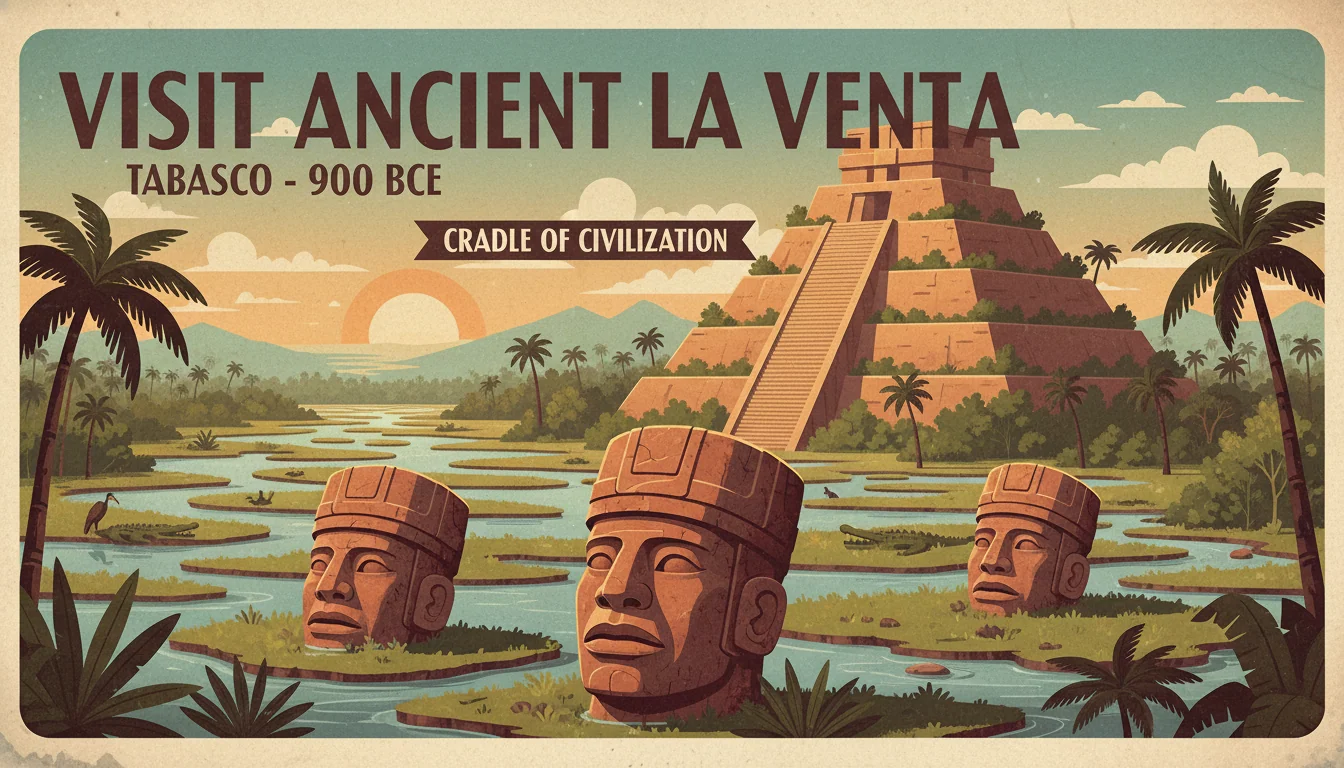
If your time machine is calibrated for civilizational firsts, set it for La Venta in 900 BCE. You are standing at the ceremonial heart of the Olmec civilization, the so-called Mother Culture of Mesoamerica. The colossal stone heads have been carved. The earthen pyramid is rising on the central plaza. Jade is being worked into ritual masks. A complex calendar and the seeds of the writing systems that will eventually shape the Maya, Zapotec, and Aztec worlds are already in development here.
It is also a hot, humid, mosquito-infested swamp on the Gulf Coast of what is now Tabasco, Mexico, with no urban density and no obvious way for an outsider to blend in. So before you click your watch into 900 BCE, here is your practical guide to surviving a visit to Olmec La Venta.
First, know what kind of place you're entering
La Venta is not a city in the Mesopotamian or Egyptian sense. It is a ceremonial center, the seat of an elite priestly and political class that controls a network of farming villages, riverine trade routes, and coastal communities. The ceremonial complex itself covers about 200 hectares of platform mounds, plazas, and ritual deposits.
The famous Great Pyramid of La Venta, which dominates the central axis, rises about 30 meters above the surrounding swampland. It is one of the earliest pyramids in Mesoamerica. Aligned with celestial events and built of clay and earth, it was once thought to mimic the volcanic mountains of the Tuxtlas to the west.
The colossal stone heads, weighing up to 24 tons each, were carved from basalt quarried in the Tuxtla Mountains and transported to La Venta over a distance of about 100 kilometers. How exactly the Olmec moved these blocks remains a topic of active debate among archaeologists. Some involve rafts on the rivers. Others involve sledges and rolling logs.
Your safest cover story is that you are a trader from a coastal village to the north or east, attached to a delegation bringing salt, fish, or shells to La Venta as offerings. The ceremonial center receives constant traffic from satellite communities. A foreign trader is plausible. A solo wanderer is not.
Dress like you belong
Olmec dress is light, practical, and shaped by the heat and humidity of the Gulf Coast. Status is signaled through jewelry, headdresses, and body modification rather than fabric quality.
For men, wear:
- a simple woven loincloth, usually cotton
- a light cape or shawl over the shoulders for ceremonial moments
- bare feet or simple woven sandals
- modest jade, shell, or stone ear ornaments
For women, wear:
- a simple wrap skirt of cotton, falling to the knee or mid-calf
- a light woven blouse or shoulder cloth
- modest necklaces of shell or stone
- bare feet or simple sandals
Avoid bright synthetic colors. Olmec textiles are dyed with vegetable and mineral dyes producing earth tones, reds, blues, and yellows. The wealthy and important wear elaborate jade ornaments. You should not. Possessing high-status jade as a foreigner without authorization will mark you as a thief or a fraud.
Body modification matters here. The Olmec elite practice cranial deformation, dental modification (sometimes inlaying jade in the front teeth), and tattooing. You will not be able to fake any of these. Settle for an unmodified appearance and a low-status story.
Get used to the climate
La Venta in 900 BCE sits at the center of one of the wettest, hottest regions in pre-Columbian America. Rainfall exceeds 2,000 millimeters annually. The Tonalá River and its tributaries flood seasonally. Mosquitoes carry malaria, dengue (or its ancient relatives), and other tropical diseases.
If you have any choice in your arrival window, visit during the dry season (December through April). Temperatures still climb above 30 degrees Celsius daily, but the rains and the worst of the insect activity are reduced.
Carry water purification tablets if your time travel ethics allow. Drink only water from boiled or smoked sources. Eat hot, cooked food whenever possible. Sleep under a canopy or netting at night. Tropical disease is the single biggest threat to your survival.
Three places you absolutely must see
The colossal stone heads
Four colossal heads are currently visible at La Venta in 900 BCE. They are arranged at strategic points around the ceremonial complex and are believed to depict specific Olmec rulers, each with distinctive facial features and headgear. They are extraordinary up close.
Walk past them respectfully. Do not touch. Do not climb. The Olmec attach religious and political significance to these portraits. Damaging one would be a serious offense, possibly punishable by death.
The Great Pyramid
The earthen pyramid at the center of the complex is the largest construction project in Mesoamerica at this point in history. You can approach the base. You probably cannot climb to the top, which is reserved for ritual specialists.
Visit at dawn, when ceremonial activity is most likely. You may witness offerings being placed at the base or processions moving along the central axis.
The buried offerings
La Venta is famous for elaborate buried offerings of jade, serpentine, and other precious stones, sometimes assembled into complex mosaics depicting jaguars or other deities. These offerings are buried in stages by ritual specialists. You will not be able to see most of them, since they are hidden below the surface, but you may witness the burial of a new offering if you are present during a major festival.
Stand at a respectful distance. Do not approach. The offerings represent the political and religious cooperation of the entire society. Interfering with one is unthinkable.
How to talk to people without causing trouble
The Olmec language is unknown to modern linguists, although it was almost certainly a Mixe-Zoquean language related to languages still spoken in southern Mexico. You will not be able to fake fluency.
Your strategy is to be a quiet, deferential trader. Use gestures, point to goods, smile politely, and let your attached merchant patron do the talking.
A few universal rules help:
- bow lightly when meeting officials
- never speak directly to a priest or ritual specialist in their working space
- avoid prolonged eye contact with high-status people
- accept all offered food and drink, even if you only sip
- do not touch ritual objects under any circumstances
- give way to processions
If a guard or official asks your business, respond with a single short phrase in your weakest version of the local language and defer to your patron.
What to eat, what to avoid
Olmec food is plant-heavy with significant fish, fowl, and small game. Maize, beans, and squash, the famous Three Sisters, are staples. Avocado, cacao, chili peppers, sweet potatoes, and tropical fruits like papaya and zapote round out the diet. Salt is imported from coastal saltworks.
Safe choices for a visitor:
- maize tortillas or tamales from a household kitchen
- beans cooked in a stew with squash and chili
- grilled fish from the river or coast
- fresh tropical fruit
- water that has been boiled or smoke-treated
Things to be careful of:
- raw fish or shellfish in the wet season
- standing water from any village well
- unfamiliar plants
- alcohol of unknown preparation (some pulque-like drinks are very strong)
- anything offered ritually before you understand the context
When in doubt, copy the most ordinary-looking person nearby.
Money, gifts, and the value of jade
The Olmec economy uses no coinage. Value moves through goods, especially jade, obsidian, salt, cacao beans, and finely worked stone tools. Jade is the most prestigious material. Large pieces of high-quality jade, especially the apple-green variety, are reserved for elite use and ritual offerings.
If you bring barter goods, prefer:
- coastal shells, especially conch
- salt, in small wrapped packages
- modest cacao beans, well-stored
- simple obsidian blades from the highlands
Do not flash quantities of jade. Possessing high-status jade as a foreigner is dangerous. Olmec elites trace specific pieces of jade to specific quarries and trade routes. A piece you cannot account for will draw immediate scrutiny.
Politics you should know about, briefly
In 900 BCE, La Venta is approaching the height of its power. The earlier Olmec center at San Lorenzo, about 60 kilometers to the west, declined around 1000 BCE under unclear circumstances, possibly involving deliberate destruction by either rival groups or a political upheaval. La Venta has emerged as the principal ceremonial center.
The Olmec system is organized around a divine kingship that fuses political, religious, and military authority in a small elite class. The colossal stone heads probably represent rulers in this class. Below them are priestly specialists, merchants, craftsmen, farmers, and possibly enslaved laborers.
Avoid speculating publicly about the fall of San Lorenzo. Do not compare La Venta unfavorably to coastal towns. Do not suggest that any neighboring polity is more powerful.
What not to do under any circumstances
Let me save you from the classic mistakes.
Do not:
- announce that you are from the future
- touch a colossal stone head
- climb the Great Pyramid
- handle ritual jade offerings
- attempt to remove a polished stone object as a souvenir
- mock the body modifications of elites
- offer to interpret the calendar
- insult the rain god or any deity
- wander unaccompanied at night
Most importantly, do not predict the future of the Olmec civilization. La Venta will be largely abandoned by 400 BCE under causes that remain unclear. The Olmec sphere of influence will reshape Mesoamerican civilization for the next 2,500 years. Do not break this for anyone.
The experience you should not miss
If you have one moment in La Venta, take it at sunset, standing at the southern end of the central axis, looking north toward the Great Pyramid. The pyramid throws a long shadow over the plaza. Smoke rises from the household kitchens of the nearby village. Insects begin to call from the swamps. A procession of priests in jaguar-themed regalia moves along the axis toward the pyramid base.
You are watching the founding civilization of Mesoamerica at the height of its ceremonial power. Every later Mesoamerican culture, from the Maya at Tikal to the Aztecs at Tenochtitlan, will inherit something from the people you are watching: their calendar, their ballgame, their political theology, their corn-based agriculture, and their conception of jaguars as embodiments of supernatural power.
Pack your insect netting, drink only boiled water, and never touch a stone head. Olmec La Venta in 900 BCE is one of the most demanding and rewarding destinations on any time-travel itinerary.
For other ancient ceremonial capitals, see our guides to Hittite Hattusa, 1300 BC and Achaemenid Persepolis, 500 BC.

Need Advice from Someone Who Lived There?
Get firsthand accounts from people who actually lived through these moments in history.
Ask Them YourselfJoin the HistorIQly Club
Get smarter about the past.
Weekly stories, deep dives, and exclusive content straight to your inbox.