A Time Traveler's Guide to Restoration London, 1665
Your survival guide to Restoration London 1665 - a city of royal decadence, reopened theaters, and bubonic plague killing thousands every week. Navigate it if you dare.
Read Wikipedia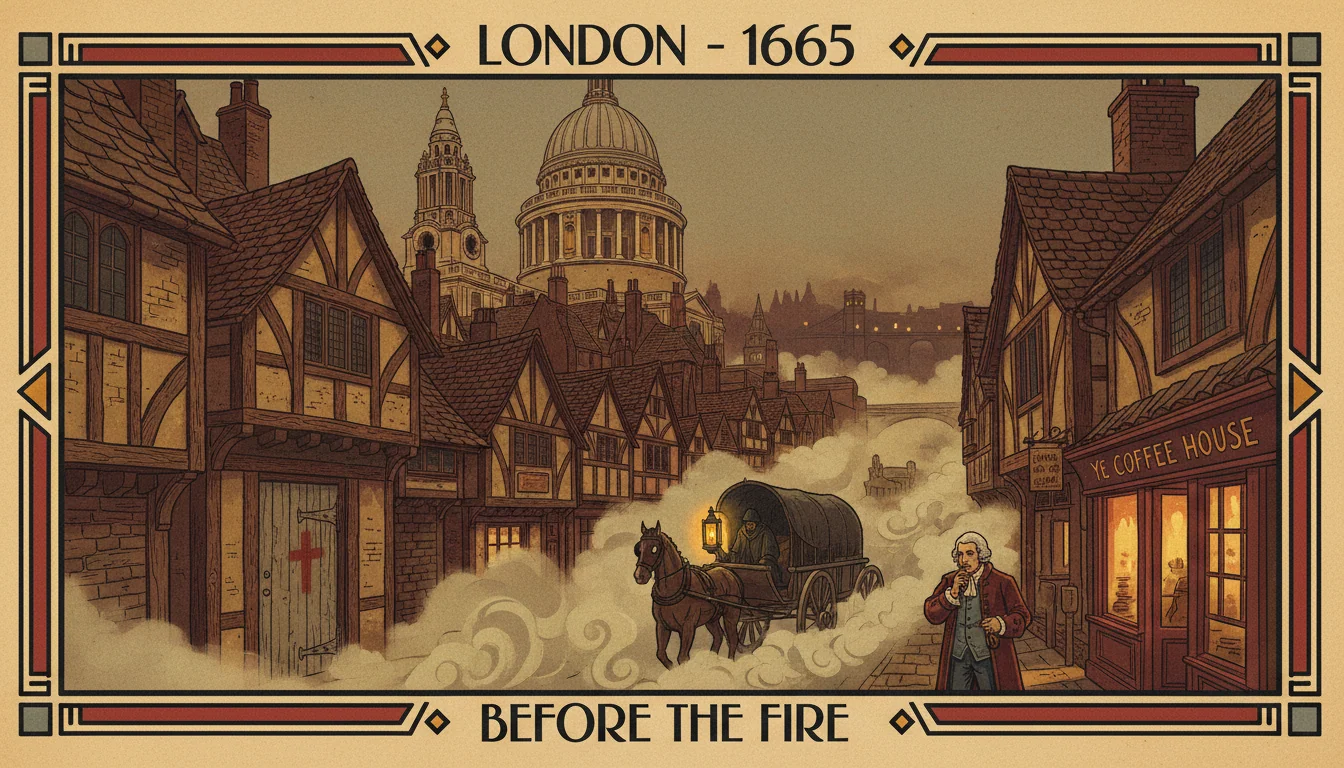
You have picked what is, by any fair assessment, an extremely bad time to visit London. Restoration London 1665 offers royal decadence and intellectual ferment alongside one of the worst plague outbreaks in English history. The year is 1665. King Charles II is on the throne, the theaters are open, and the court at Whitehall is the most dissolute place in the English-speaking world. London is also in the middle of the worst plague outbreak in two centuries. The Bills of Mortality, posted every Thursday at parish churches across the city, are recording numbers that would seem implausible in peacetime. In the worst week of August 1665, seven thousand people will die in a city of about 400,000.
But if you want to see London at its most raw and extraordinary, at the precise moment when a giddy, exhausted Puritanism is giving way to baroque excess while corpses are being carted through the same streets, this is your week. Here is how to survive it.
Know what you are walking into
The Restoration began in May 1660 when Charles II rode into London through cheering crowds. For eleven years England had been governed by the Parliament and then by Oliver Cromwell's Protectorate, a relentlessly Protestant regime that closed the theaters, banned Christmas celebrations in some years, and regarded most human enjoyment as spiritual peril. When Cromwell died in 1658 and his son Richard proved incapable, the army invited Charles back from his exile in the Dutch Republic. The reaction against Puritan austerity was immediate and absolute.
By 1665 the theaters on Drury Lane and Lincoln's Inn Fields are performing again. Nell Gwyn is selling oranges and starting her acting career. The court at Whitehall throws banquets, stages masques, and conducts amorous conspiracies that Pepys chronicles with barely concealed excitement. Fashion has gone from the sober black of the Interregnum to colored satins, enormous wigs, lace cuffs, and shoes with heels and ribbons. The city feels like a party that has been compressed into five years after a decade of prohibition.
The plague started in the parish of St Giles-in-the-Fields, northwest of the old City walls, in the spring of 1665. By June it had reached the City proper. By August it is everywhere. The connection between rats and fleas and Yersinia pestis bacteria is not understood; contemporary theories focus on bad air (miasma), divine judgment, and the dangerous influence of a recent alignment of Saturn, Jupiter, and Mars. The standard preventive measures include carrying nosegays of herbs, avoiding crowds, burning tar or juniper in the streets, and smoking tobacco, which some physicians claim offers protection.
None of this works. You will be relying on modern knowledge: avoid the sick, avoid rat-infested basements and alleys, and do not let fleas settle on you.
Dress like you belong
Restoration fashion is specific and class-coded, and getting it wrong will mark you immediately as an outsider.
Men of the middling sort, the class you want to pass as, wear:
- a full-bottomed periwig, or peruke, of natural or powdered hair. Wigs became fashionable when Charles II started wearing them after his hair went gray prematurely. Every man of status now wears one.
- a coat, called a justaucorps, that reaches mid-thigh, usually dark wool or silk
- breeches gathered below the knee
- white linen shirt with lace or plain cuffs visible at the wrists
- leather shoes with a modest heel and a large buckle
- a broad-brimmed hat, often plumed
Women of the same class wear a long skirt, a fitted bodice, and a linen cap or hood for daytime. For evening, necklines drop considerably. Pepys is particularly detailed on the clothing and beauty of the women he admires, and his diary records make clear that women of the merchant class dressed to be seen.
Avoid anything synthetic. Avoid anything with a zipper, a logo, or a visible machine stitch. Your clothing must be wool, linen, or silk. Carry a handkerchief perfumed with lavender or rosemary. This is not affectation; it is the social norm and your best available plague prevention.
Where to go in the City
The old City of London, inside the Roman walls, is the commercial heart. The Royal Exchange, built by Thomas Gresham under Elizabeth I and rebuilt after a fire in 1666, is where merchants gather to trade news and goods. It is a magnificent building, arcaded around a central courtyard, and it doubles as a shopping center. You can buy cloth, jewelry, spices, and luxury imports in the upper galleries.
The coffeehouses are the other essential institution. By 1665 London has several dozen, concentrated around the Exchange and in Cheapside. For a penny, any man can enter, sit for hours, read the available newsbooks, and listen to or contribute to the continuous conversation about trade, politics, and gossip. These are the social media of 1665: loud, chaotic, partisan, and addictive. Jonathan's in Change Alley is particularly popular with merchants who trade information about ship arrivals and commodity prices. You can listen here for hours without anyone questioning you.
The Thames is the city's main highway. To cross from the north bank to Southwark, take a wherry, a small rowboat rowed by licensed watermen. Negotiate the fare beforehand. The river is full of craft and the watermen are proud of their skill and their rights.
Where to avoid
St Giles-in-the-Fields is plague ground. The parish northwest of the old City walls is where the current outbreak began, and it remains heavily infected. If you stray into the overcrowded alleys of St Giles or the neighboring parishes of Holborn and Aldgate, you will encounter houses with red crosses painted on the doors, a watchman stationed outside to ensure no one enters or leaves, and the faint but unmistakable smell of a city managing mass death.
Houses with the red cross and the words "Lord have mercy upon us" painted beneath mean someone inside is infected. The family is quarantined for forty days. The watchman is paid by the parish. The quarantine drives families mad, separates the healthy from the sick in the same room, and almost certainly makes the death toll worse by trapping uninfected people inside infected households. Do not approach these houses.
Avoid the cemeteries after dark. The plague pits, large mass graves dug in fields at the edge of established churchyards, are being filled at night to avoid spreading panic. The sound of the carts, the wooden wheels on cobblestones and the bells the carters ring to collect the dead, is the nighttime soundtrack of London in 1665. Pepys calls it the most terrible sound he has ever heard.
What to eat and drink
Do not drink the water. London's water supply draws from the Thames and from shallow wells, both of which are contaminated. Everyone drinks beer, ale, or wine by preference. Small ale, a low-alcohol fermented grain drink, is the standard daily beverage for people of all ages including children. It is safer than the water and tastes better than modern non-alcoholic substitutes.
Street food is abundant. Bakers sell bread from their shop fronts. Street vendors sell pies, roasted chestnuts, and oysters from the Thames. Oysters are cheap and safe; they come from cleaner water than the river within the city. Pepys eats them enthusiastically throughout the plague year.
For a proper meal, taverns in the City offer a table d'hote dinner, a set meal at a fixed price, at midday and early evening. Expect roast meat, bread, vegetables stewed with butter, and pies of various kinds. The food is heavy, salted, and filling. Do not ask about refrigeration. It does not exist.
The social scene
The theaters at Drury Lane and Lincoln's Inn Fields closed in June 1665 as plague deaths rose, by order of the Privy Council. This removes one of the most distinctive pleasures of Restoration London: plays by John Dryden, William Wycherley, and the other new voices of the age, performed in houses where the audience throws food and argues with the actors.
The coffeehouses remain open, performing an essential function. The church services continue, though many clergy fled London with the wealthy. The Royal Society, founded in 1660 and meeting since then at Gresham College in the City, suspended formal meetings but continued corresponding. Robert Hooke and Robert Boyle and Christopher Wren are all within a mile of you. The intellectual life of early modern science is happening in these streets even while the plague is happening in them too.
Getting out
The practical exit question matters. London has regular coach services by 1665 running to Oxford, Cambridge, and other major towns. The coaches depart from specific inns, the coaches' official staging posts, on set days of the week. Your cover story should be that you are returning from commercial business, not fleeing the plague, since panic-fleeing is both socially stigmatized and practically dangerous on roads crowded with others doing the same thing.
Book your place on the Oxford coach from the inns around the Strand or Cheapside. Carry enough coin. Ride out before August, when the weekly death tolls will exceed anything you want to witness close up.
If you do stay through August, stay sober enough to stay alert, stay away from rats and their fleas, and keep your nosegay fresh. Samuel Pepys stayed. He found the city terrible and fascinating in equal measure, and his diary entries from that season are some of the finest writing in the English language. You will understand, after a week in this place, exactly why he could not put the pen down.
For other immersive historical guides, Belle Epoque Paris, 1900 offers a very different kind of European city at a very different kind of crisis, and Medieval Prague, 1350 brings you to the Holy Roman Empire at its height.
Quick Answers
Common questions about this topic
What was the Great Plague of London?
The Great Plague of 1665 was the last major outbreak of bubonic plague in England. It killed an estimated 100,000 Londoners, roughly a quarter of the city's population, between the spring of 1665 and late 1666. The disease spread through flea bites from infected rats, though contemporary Londoners attributed it to bad air, divine punishment, and the alignment of Saturn.
What was the Restoration period?
The Restoration refers to the return of the English monarchy in 1660, when Charles II was brought back from exile in the Netherlands following the death of Oliver Cromwell and the collapse of the Interregnum. The period is associated with a cultural reaction against Puritan austerity: theaters reopened, fashion became lavish, and the court was notoriously dissolute.
Did people flee London during the plague?
Yes. The wealthy and those with country properties left London in large numbers as the plague worsened in summer 1665. King Charles II and his court relocated to Oxford in late summer. Samuel Pepys, who stayed in London through most of the epidemic, recorded watching his neighbors' houses being shut up with red crosses and the sound of the death carts at night.
Who was Samuel Pepys and why does his diary matter?
Samuel Pepys was a naval administrator and Member of Parliament who kept a detailed personal diary from 1660 to 1669, written in shorthand to preserve privacy. His entries from 1665 are among the most vivid primary sources for the Great Plague, recording daily death tolls, his own fear, the social disruption, and the strange gallows humor that Londoners developed in the face of mass mortality.

Need Advice from Someone Who Lived There?
Get firsthand accounts from people who actually lived through these moments in history.
Create your free account →No card required. Some figures and features require a paid plan.
Join the HistorIQly Club
Get smarter about the past.
Weekly stories, deep dives, and exclusive content straight to your inbox.