Time Traveler's Guide to Swinging London, 1967
Your survival guide to Swinging London, 1967 - find the Beatles, wear bell-bottoms on Carnaby Street, and dance until dawn at the UFO Club.
Read Wikipedia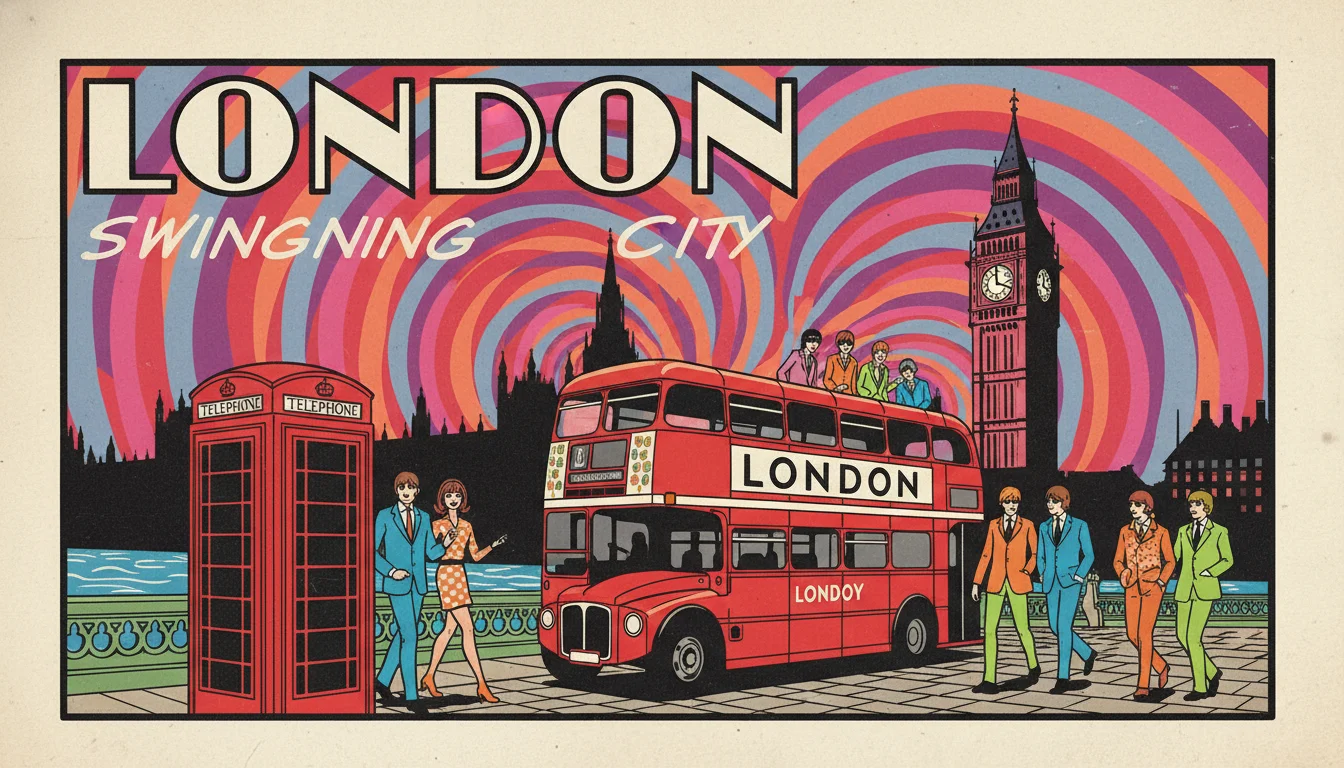
London in 1967 is the center of the known universe. The Beatles just released "Sgt. Pepper's Lonely Hearts Club Band." Mick Jagger's getting busted for drugs while dressed better than most aristocrats. Twiggy is on every magazine cover. The miniskirt has conquered the world. And everyone - absolutely everyone - wants to be here.
Pack your bell-bottoms and leave your inhibitions behind. You're about to visit the most exciting city on Earth during its most exciting year.
Getting Your Bearings
London is still rebuilding from the war. Bomb sites dot the city, some now converted to car parks, others hosting wildflowers. The skyline is low - nothing taller than St. Paul's Cathedral - but the energy is stratospheric.
The city runs on a pre-decimal currency system that will baffle you. There are 12 pennies to a shilling and 20 shillings to a pound. That's 240 pennies to a pound. You'll also encounter half-crowns (two shillings and sixpence), florins (two shillings), and farthings if you're unlucky. Just nod confidently and hand over notes when possible.
The Underground is your friend, costing sixpence for most central journeys. The red double-decker buses are iconic but slower. Black cabs are expensive but the drivers know every alley in London - they've all passed "The Knowledge," a grueling test requiring memorization of 25,000 streets.
Where to Go
Carnaby Street is ground zero. This pedestrian strip in Soho has transformed from a quiet backwater into a global fashion phenomenon. Boutiques with names like Lord John, Irvine Sellars, and Gear compete for your attention with outrageous window displays. The clothing is wild - crushed velvet suits, frilled shirts, floral prints that would make your grandmother faint. Men's fashion here is more daring than women's fashion anywhere else.
King's Road in Chelsea caters to a slightly older, slightly richer crowd. This is where you'll spot actual rock stars. Mary Quant's Bazaar started the miniskirt revolution here. Granny Takes a Trip sells antique military jackets and Victorian curiosities reimagined for the modern dandy. The Chelsea Drugstore (no, not that kind of drugstore - it's a hip department store) stays open until midnight.
Abbey Road in St. John's Wood looks like an ordinary street, and it is, except for EMI Studios at Number 3. The Beatles are practically living there this year. You won't get inside - security is tight - but you might spot a Beatle arriving in a psychedelic-painted Rolls-Royce.
Portobello Road Market operates on Saturdays, selling everything from Victorian furniture to African masks to military surplus. The antique dealers have figured out that rock stars are buying, so prices are climbing. Get there early.
What to Wear
For women, the miniskirt is mandatory. We're talking mid-thigh minimum. Pair it with white go-go boots, patterned tights, and a poor-boy sweater. Hair should be either dramatically short (the Twiggy look) or dramatically long (the hippie look). False eyelashes are enormous - think Dusty Springfield. Makeup is pale foundation, white eye shadow, and very little lip color.
For men, throw away everything your father taught you. Shirts are frilly, high-collared, and in colors like pink and lavender. Trousers are tight and getting tighter. Flares at the bottom, hugging at the thigh. Jackets are velvet or corduroy, often with military braiding. Hair is past the ears, minimum. Mustaches are becoming fashionable again. Beards are for squares.
Unisex dressing is emerging. The same boutique might sell the same silk scarf to a man and a woman. The same floral pattern appears on both sexes. This scandalizes older Londoners, which is exactly the point.
What to Eat
London's food reputation is dreadful, and honestly, somewhat earned. But you can eat well if you know where to look.
The English Breakfast remains glorious - eggs, bacon, sausages, grilled tomatoes, baked beans, toast, and strong tea. Find a proper "caff" (café, pronounced with a flat a) for the authentic experience. Prices range from one to two shillings.
Wimpy Bars are everywhere, serving the British version of American hamburgers. They're actually served on plates with cutlery, which defeats the purpose, but teenagers love them.
Indian restaurants are revolutionizing British dining. The curry house boom is underway, clustered around Brick Lane in the East End. This is your best option for flavor. Chicken tikka masala may have just been invented - historians argue about this - but whatever they're serving is magnificent.
Trattorie (Italian restaurants) have become fashionable after a decade of British holidays to the Mediterranean. You'll find them in Soho, serving spaghetti Bolognese and chianti in wicker-wrapped bottles. The food is simple but the atmosphere is romantic.
Avoid: hotel restaurants, British "Chinese" food (mostly invented for local tastes), and anything served in a railway station.
Entertainment
The UFO Club at 31 Tottenham Court Road is where it's happening. Pink Floyd plays here regularly, performing their light shows in a former Irish dancehall. It opens at 10 PM Friday nights and continues until dawn. The entrance fee is ten shillings. Expect avant-garde films projected on the walls, poetry readings between sets, and a distinct herbal aroma.
The Marquee Club on Wardour Street hosts whoever's about to be huge. The Who, David Bowie, Led Zeppelin - they all pass through. It's cramped, sweaty, and legendary. Cover is usually five to seven shillings.
The Royal Albert Hall and Royal Festival Hall host everything from classical concerts to pop spectacles. The Beatles played the Albert Hall, though they've given up touring now.
The West End theaters are thriving. "Fiddler on the Roof" is packing them in. Harold Pinter's latest is confusing everyone. For something completely different, try the "happening" scene - performance art events where anything might occur. These are advertised by word of mouth and flyers posted on Carnaby Street lampposts.
Navigating Society
The class system is cracking but not broken. The novelty of 1967 is that working-class kids from Liverpool and the East End are now setting cultural trends. This has never happened before in British history, and the upper classes are fascinated and horrified in equal measure.
That said, accent still matters. A posh accent opens doors; a regional accent marks you as either authentic (cool) or common (not cool). As a time traveler, cultivate a mid-Atlantic accent if possible - Americans are exotic and therefore classless.
Homosexuality was partially decriminalized in July 1967, but only for men over 21 in private. The gay scene exists but remains underground. Men meeting men should look for certain pubs - The Coleherne in Earl's Court, The Salisbury near Leicester Square - but be discreet.
Drug use is technically illegal but enforcement is selective. Marijuana is everywhere. LSD is technically legal until October (a loophole will soon close). The police occasionally raid clubs, mostly for publicity. Rock stars get arrested; ordinary people get warnings. Pills called "purple hearts" and "black bombers" (amphetamines) fuel all-night dancing.
Dangers and Irritations
The weather is terrible. This is London. Carry a compact umbrella and wear layers. The Swinging Sixties swing in drizzle as often as sunshine.
The smog has lessened since the Clean Air Act of 1956, but coal fires still burn. Particularly cold days produce a yellowish haze that tastes of sulfur.
The Underground closes at midnight. Plan accordingly. Night buses exist but are unreliable. Minicabs (unlicensed taxis) are sketchy. Your best option is to dance until dawn or find someone with a floor.
Racism is real and ugly. Signs reading "No Coloureds, No Irish" appear in rental listings. Enoch Powell hasn't delivered his infamous speech yet (that's 1968), but the sentiment exists. Non-white visitors should stick to cosmopolitan central London.
Sexism is casual and constant. Women cannot get a mortgage without a male guarantor. Want a drink in a pub? Some won't serve unaccompanied women. The revolution is real but incomplete.
Things to See Before They Vanish
The original Kensington Market is just getting started in an old department store. It's a warren of stalls selling antique clothes, handmade jewelry, and imported incense. By the 1990s it will be a commercial shell, but right now it's magical.
Joe Orton is alive and writing plays. He'll be murdered by his lover in August. See "Loot" while you can.
The old Covent Garden market still operates as an actual fruit and vegetable market. The famous transformation into a tourist destination is fifteen years away. Right now it's authentic, grimy, and fascinating at 4 AM when the porters move crates.
The Beatles are still together and still friends. In a few months they'll start recording "Magical Mystery Tour." Everything seems possible.
Evening Itinerary
Start at Biba on Kensington Church Street (it moved there this year) for some shopping. The dark, incense-filled interior sells affordable fashion to models and shopgirls alike. Barbara Hulanicki has created a total aesthetic - art nouveau meets Victorian gothic meets decadence.
Dinner at San Lorenzo in Beauchamp Place, where Princess Margaret dines among rock stars. Book ahead. If that's too fancy, grab fish and chips wrapped in newspaper from any number of chippies - still the best cheap meal in Britain.
Drinks at The Speakeasy on Margaret Street, a members' club where musicians hang out. Flash a knowing smile and dress the part; they might let you in. The jukebox is legendary.
End at Middle Earth in Covent Garden if it's a weekend, or try to find one of the impromptu "freak out" parties that happen in squatted houses across West London. Follow the music and the beautiful people.
Survival Tips
Carry cash. Credit cards exist but are rare and suspicious. Traveler's checks work at banks.
The metric system hasn't arrived. Everything is measured in miles, stones, ounces, and guineas.
Television runs three channels and shuts off before midnight. Radio is more exciting - pirate stations broadcast from ships offshore. Radio Luxembourg offers pop music after dark.
The phrase "groovy" is current but aging. "Fab" is very early '60s. "Far out" works. "Man" can end any sentence. "Square" means boring. "Straight" means conventional.
When asked about politics, remember: Harold Wilson is Prime Minister (Labour), Vietnam protests are building, and the EEC (European Economic Community) is a contentious topic - Britain applied this year but De Gaulle keeps vetoing.
Most importantly: be young, be beautiful, be now. The Swinging Sixties believe in the present moment. Nobody's planning for the future because the future is already here.
Swinging London, 1967, was the most concentrated burst of cultural reinvention any city has compressed into a single year. The party couldn't last - economic reality and political upheaval would end it by decade's close. But for one glorious moment, London was the place where the future was being invented. And you're invited.
For the city at other transformative moments, our guide to Elizabethan London, 1590 shows the capital during its first cultural golden age, and Georgian London, 1780 takes you through the age of empire and coffeehouse culture.

Need Advice from Someone Who Lived There?
Get firsthand accounts from people who actually lived through these moments in history.
Create your free account →No card required. Some figures and features require a paid plan.
Join the HistorIQly Club
Get smarter about the past.
Weekly stories, deep dives, and exclusive content straight to your inbox.