A Time Traveler's Guide to Tudor London
Your guide to visiting Tudor London in 1540: what to wear, eat, and avoid during Henry VIII's reign, when heresy was fatal and the Reformation was reshaping England.
If you want to walk the streets of one of the most volatile capitals in early modern Europe, set your time machine for London in 1540. Henry VIII has been on the throne for 31 years. The Reformation is in full swing. The monasteries have just been dissolved. Thomas Cromwell is about to be executed. The king has just married his fourth wife, the unfortunate Anne of Cleves, and is already secretly courting his fifth, Catherine Howard.
It is one of the most psychologically intense years in the history of the English court. So before you click your watch into 1540, here is your practical guide to surviving, blending in, and enjoying a visit to Tudor London.
First, know what kind of place you're entering
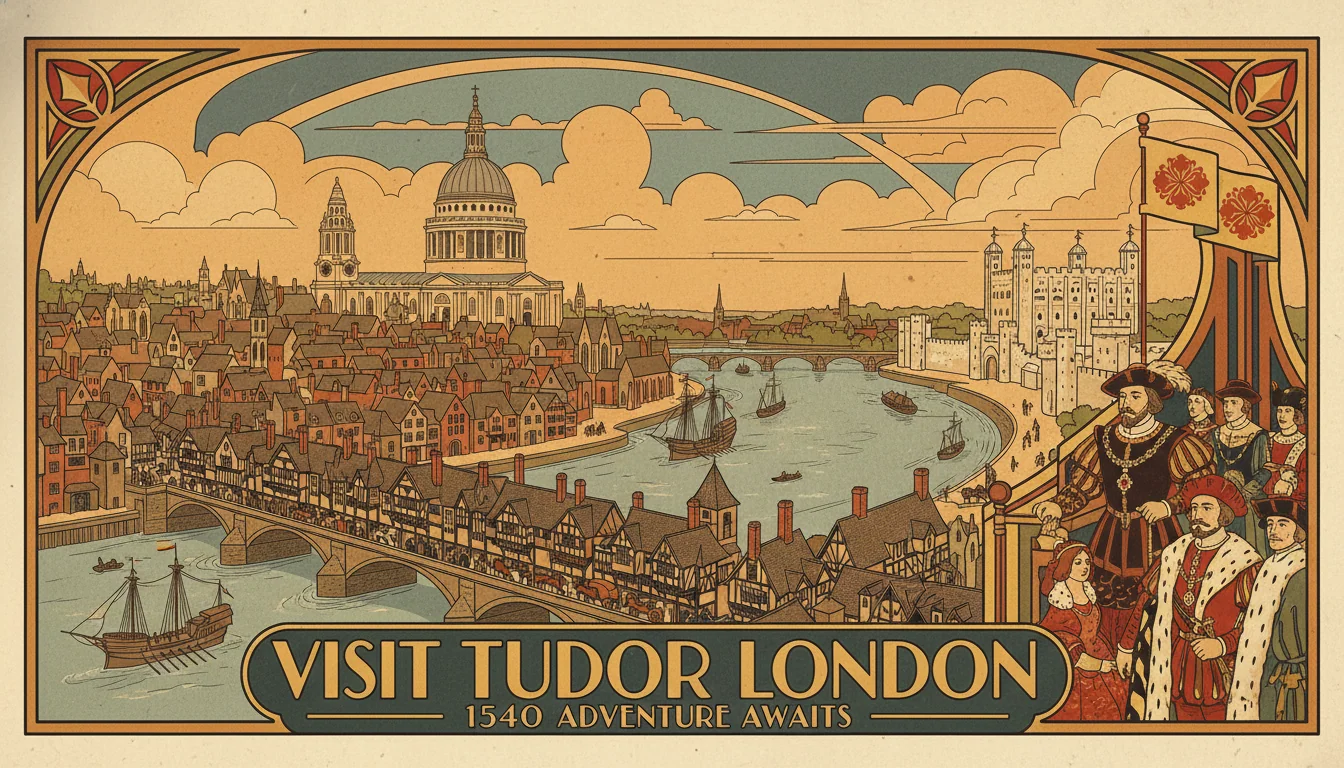
London in 1540 has about 60,000 inhabitants inside the old Roman walls and a few thousand more in the surrounding suburbs of Southwark, Westminster, and Smithfield. It is a tightly packed city of timber houses, narrow streets, and crowded riverside wharves, dominated by the spire of St. Paul's Cathedral and the massive grey stone of the Tower of London.
The political climate is dangerous. Henry VIII's break with Rome has produced a religious upheaval that no one has fully resolved. The dissolution of the monasteries (1536-1540) has just been completed. Thousands of monks and nuns are now homeless or hidden among the laity. Religious heretics, of both Catholic and Protestant flavors, are being burned at Smithfield.
Your safest cover story is that you are a foreign Hanseatic merchant from Hamburg, Lübeck, or Danzig, attached to the Steelyard, the Hanseatic trading enclave on the north bank of the Thames near London Bridge. The Hanseatic League has its own quarter, its own customs, and its own legal privileges. Foreigners in this orbit attract less suspicion than free-floating travelers.
Do not pretend to be French unless you actually speak French. Do not pretend to be Spanish under any circumstances. England's relations with both crowns are complicated and sometimes hostile.
Dress like you belong
Tudor dress in 1540 is heavy, layered, and rigidly structured by class. Sumptuary laws dictate exactly what fabrics and colors people of each rank may wear, and the Privy Council enforces these laws with periodic raids and prosecutions.
For men, the basic kit includes:
- a fitted doublet of wool or linen, padded at the chest
- a coat or jerkin over the doublet, often slashed to show colored lining
- knee-length breeches, padded in the latest style
- thick wool stockings tied below the knee
- broad, flat-soled shoes
- a flat velvet cap with a small feather
For women:
- a long-sleeved kirtle (gown) over a chemise, usually wool or linen
- a fitted bodice with a square neckline
- a long full skirt to the floor
- a French hood or English gable hood, depending on social aspiration
- a pair of leather slippers (street shoes are wooden pattens)
- a kerchief or partlet covering the upper chest
Avoid bright synthetic dyes. Tudor cloth is dyed with woad, madder, weld, and walnut. Browns, dark reds, dark blues, and deep greens are common. Silver and gold thread is restricted by sumptuary law to the upper aristocracy. Wearing it without entitlement can earn you a fine and a reputation as either a fraud or a foreigner who does not understand the rules.
Get used to the smell and the noise
Tudor London is loud. Bells ring constantly. Street criers advertise everything from oysters to needles to news. Carts rattle over uneven cobbles. Pigs run loose in some lanes despite repeated efforts to ban them. Apprentices brawl. Drunks shout outside taverns.
The city smells. The Thames is the city's main sewer. Cesspits leak into wells. Tanneries, dye houses, and slaughterhouses cluster around the Fleet River and the city's outer edges. Kitchen waste, animal waste, and human waste mix in narrow lanes that are mostly unpaved.
Carry a perfumed handkerchief. Avoid the riverside at low tide. Move quickly through Smithfield on market days. The smell at the cattle pens is stunning.
How the day works
The city wakes before dawn. By 5 a.m. in summer, water-carriers, milkmaids, and bakers are already on the streets. Markets open early. Most ordinary people work from dawn to dusk, with breaks for the day's main meal at around 11 a.m. and a lighter supper around 5 p.m.
City gates close at sunset. After dark, the streets are dangerous. Watchmen patrol but lightly. If you are out after curfew, carry a torch and a respectable companion, or stay off the streets entirely.
Three places you absolutely must visit
St. Paul's Cathedral
The old Gothic cathedral, before the Great Fire of 1666 destroys it, dominates London's skyline. The nave (called Paul's Walk) functions as a public meeting place where people post job advertisements, gossip, exchange news, and conduct informal business. The bookstalls in St. Paul's Churchyard are the early printing capital of England.
Visit the spire (it stood until 1561 when lightning destroyed it) for one of the best views of the city. Walk the nave at midmorning to see Tudor London's commercial life happening inside a cathedral.
The Tower of London
The Tower in 1540 is many things at once: a royal palace, a prison, a mint, an armory, a menagerie, and a small fortified city. As a respectable foreign merchant, you may be admitted to the public areas with an introduction. You may also see the lions kept in the royal menagerie.
Be careful what you say. The Tower is also where political prisoners are held and tortured. In 1540 alone, Cromwell will be executed there in July. The Earl of Surrey, Henry Howard, will be imprisoned there in 1546. Casual treason talk in earshot of guards has consequences.
London Bridge
The medieval London Bridge is one of the most spectacular structures in England. It carries 19 arches across the Thames, supports a row of houses and shops along its length, and features a chapel dedicated to Thomas Becket at the center. It is also where traitors' heads are displayed on pikes at the southern gate, dipped in tar to preserve them.
Walk across at midday. Buy something small from one of the merchants. Do not stop too long at the southern gate to look at the heads. Locals do not.
How to talk to people without causing trouble
English in 1540 is recognizable but different from modern English. The Great Vowel Shift is in progress, vocabulary is partly different, and pronunciation is much closer to certain regional Northern English accents than to anything modern. You can probably make yourself understood, but you will sound foreign.
A few universal rules help:
- doff your cap to anyone of higher rank
- never address a noble without invitation
- bow lightly to gentlemen, deeply to nobility
- women curtsy
- never sit in a chair before the head of household sits
If you are introduced to someone, give a short and modest account of your business. Tudor English society is intensely status-conscious. Boasting about wealth or position is dangerous, both because it invites suspicion and because exact rank determines how everyone speaks to you.
What to eat, what to avoid
Tudor food is heavy on bread, salt meat, fish, root vegetables, and beer. Sugar is a luxury. Spices are imported and expensive. Vegetables are eaten more than the popular history suggests, but salads are unfashionable.
Safe choices for a visitor:
- bread from a recognized baker (cheaper bread can be adulterated)
- pottage (a thick vegetable and grain stew)
- roasted mutton or beef from a respectable inn
- pickled herring or smoked salmon
- weak beer (small beer) at every meal
Things to avoid:
- water from any city well or fountain
- raw shellfish from the Thames
- exotic foreign foods from unknown vendors
- meat in summer that has been hanging in a market stall
- anything sweet that you cannot identify
Tea has not arrived in England yet. Coffee will not arrive for another century. Wine is for the wealthy. Beer is for everyone, including children, in low-alcohol form.
Politics you should know about, briefly
In 1540 Henry VIII is 49 years old, increasingly obese, in steadily worsening health, and emotionally volatile. He has just married Anne of Cleves in January and is already disgusted with her. The marriage will be annulled in July. Catherine Howard will marry him at the end of the same month.
Thomas Cromwell, the king's chief minister, is at the height of his power early in the year and dead by July. His fall is rapid and largely the result of court politics, particularly the Howard family's ascendancy and the failure of the Cleves marriage.
Religious policy is officially Protestant in name and Catholic in much of practice. The Six Articles of 1539 reaffirmed transubstantiation, clerical celibacy, and the mass. The result is a confused middle ground in which reformers can be burned for heresy and traditionalists can be hanged for treason.
If you must discuss politics, repeat conventional praise of the king, avoid all theological specifics, and never criticize any of his wives.
What not to do under any circumstances
Let me save you from the classic mistakes.
Do not:
- speak well of the Pope
- speak ill of Henry VIII
- discuss the dissolution of the monasteries critically
- defend Anne Boleyn as innocent
- handle religious objects you do not understand
- enter a private home without invitation
- attempt to walk into Whitehall Palace
- carry obvious weapons in the city center
Most importantly, do not predict the future of the king's marriages or the religious settlement. Tudor London in 1540 is dangerous specifically because no one knows what tomorrow's official position will be.
The experience you should not miss
If you have one moment in Tudor London, take it on a Sunday morning at Westminster Abbey, watching the king and court process to mass. Henry VIII himself, surrounded by his Yeomen of the Guard, the Privy Council, and a swirl of bishops, lawyers, and ladies-in-waiting, moves through the cloisters at a stately pace.
You are watching the most powerful and unstable monarch in 16th-century Europe at the precise moment when his court is reshaping English religion, English law, and English geography. Almost everyone in that procession will be dead, exiled, or imprisoned within the next decade.
Bring a cap to doff, a perfumed handkerchief, and a willingness to keep your mouth shut. Tudor London in 1540 is one of the most thrilling and terrifying destinations on any time-travel itinerary.
If Tudor England leaves you wanting more, our guide to Elizabethan London in 1590 picks up the story fifty years later under Elizabeth I. The Elizabeth vs. history breakdown examines how Hollywood dramatized the queen who defined the era.

Need Advice from Someone Who Lived There?
Get firsthand accounts from people who actually lived through these moments in history.
Ask Them YourselfJoin the HistorIQly Club
Get smarter about the past.
Weekly stories, deep dives, and exclusive content straight to your inbox.