A Time Traveler's Guide to Roaring Twenties Chicago
Everything you need to know before visiting Chicago in 1925, when Al Capone ran the bootleg empire and the city was the loudest, jazziest, and bloodiest in America.
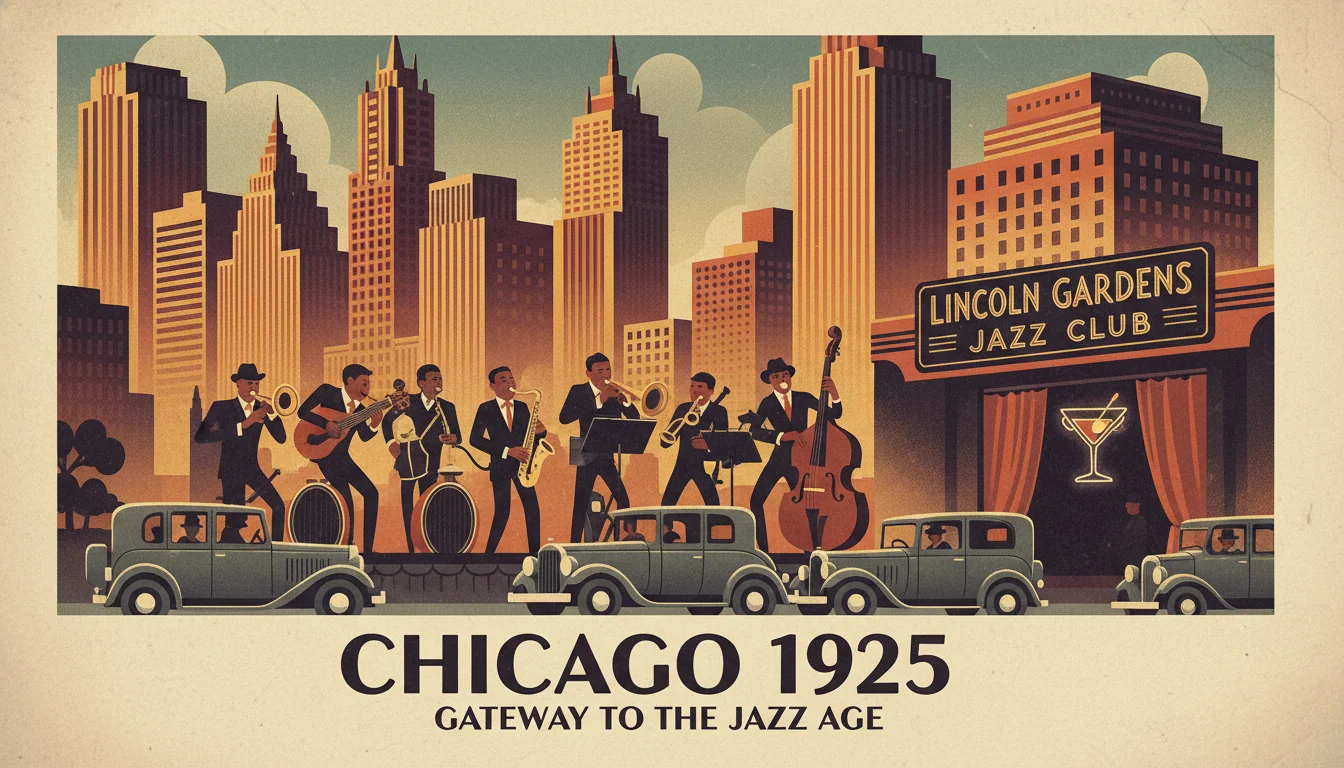
If you want to walk into the most famous American city of the Jazz Age, set your time machine for Chicago in 1925. This guide to Chicago 1925 daily life starts with the basics: Al Capone has just taken control of the South Side bootlegging empire from Johnny Torrio. The skyline is racing upward with the construction of Art Deco towers along Michigan Avenue. Louis Armstrong has arrived from New Orleans and is recording with King Oliver. Speakeasies operate in basements and apartments across the city. The Cubs and the White Sox draw enormous crowds. Two years from now, the Saint Valentine's Day Massacre will reshape American organized crime.
If Chicago feels too far west, consider a comparable visit to Prohibition-era New York in 1925 or up to Harlem during the Renaissance of the same year for the other half of the Jazz Age picture.
It is also a city where police are routinely on the take, where racial segregation is enforced through violence, and where ordinary citizens can find themselves caught in the crossfire of bootlegger turf wars. So before you click your watch into 1925, here is your practical guide to surviving, blending in, and enjoying a visit to Roaring Twenties Chicago.
First, know what kind of place you're entering
Chicago in 1925 has a population of about 3 million, second largest in the United States after New York. It is in the middle of an extraordinary economic, demographic, and cultural transformation. The Great Migration is bringing tens of thousands of African Americans north from the South every year, settling primarily in the South Side neighborhood known as Bronzeville. Industrial jobs in the stockyards, the steel mills, and the rail networks fuel the city's economy.
The Eighteenth Amendment to the U.S. Constitution, the Prohibition law banning the manufacture and sale of alcohol, has been in force since January 1920. It will not be repealed until 1933. The five years between 1925 and 1930 are the peak of organized bootlegging in Chicago, with multiple competing crime networks fighting for control of distribution.
Your safest cover story is that you are a businessman from the East Coast or Europe, visiting Chicago on commercial matters. The city receives constant traffic of executives, salesmen, journalists, and tourists. A foreign accent is fine. A clear story about what you are doing in town is essential.
Dress like you belong
1925 fashion is the most visually distinctive of the early 20th century. The silhouettes are clean, the colors are bold, and the social codes are strict.
For men, wear:
- a single-breasted three-piece suit in dark wool or pinstripe
- a stiff white shirt with a soft turn-down collar (stiff detachable collars are going out of fashion)
- a silk necktie with a four-in-hand or Windsor knot
- polished leather shoes
- a felt fedora or homburg hat
- an overcoat in cooler months
- if you are wealthy, a pocket watch on a chain across the vest
For women, wear:
- a drop-waist dress falling to the calf or knee (the flapper silhouette)
- a cloche hat covering most of the head
- silk or rayon stockings
- T-strap shoes with a low heel
- a long string of pearls (the Coco Chanel-influenced fashion)
- a fur coat or stole in cooler months
- short bobbed hair, if you can manage the cut
Avoid bright synthetic dyes that postdate the 1920s. The signature colors of 1925 are deep blues, dark greens, blacks, beiges, and dusty pinks.
Crucially: do not bring obvious technology. Wristwatches are acceptable, but pocket watches are more common among older men. Avoid digital indicators of any kind.
Get used to the noise and the layered city
Chicago in 1925 is loud. Streetcars run along most major arteries. Steam trains arrive constantly at Union Station and Dearborn Station. Newspapers are sold by shouting boys on every corner. Construction is everywhere. The smell of the stockyards reaches northward depending on the wind.
The Chicago Loop, the central business district enclosed by the elevated rail lines, is the densest concentration of office buildings outside Manhattan. The Wrigley Building (completed 1924) and the Tribune Tower (completed 1925) are the dramatic new additions to the skyline. The Chicago River runs west and reverses its flow toward the Mississippi (a 1900 engineering feat) rather than toward Lake Michigan.
Carry a city map. Use the elevated railway (the L) for fast cross-city transit. Take a yellow taxi for shorter trips. Walk only in well-populated districts after dark.
Three places you absolutely must visit
The Green Mill Cocktail Lounge
The Green Mill, at the corner of Broadway and Lawrence on the North Side, is one of the most famous speakeasies of Chicago, operating in plain sight as a jazz club with a "tea room" cover. Owned in part by Capone associate Jack McGurn, the Green Mill features regular performances by jazz musicians of the era. You can buy "tea" in cups that contain bootleg whiskey or Canadian spirits.
Entry is by recommendation. Dress well. Tip generously. Do not draw attention to the contents of your cup.
The Lincoln Gardens
The Lincoln Gardens, on the South Side at 31st Street and Cottage Grove, is one of the most important jazz venues in 1920s America. King Oliver's Creole Jazz Band performs here regularly. Louis Armstrong, recently arrived from New Orleans, is one of the band's stars.
Visit on a Saturday night for the most electric atmosphere. The crowd is racially mixed (unusual for Chicago in this era), the music is the leading edge of American culture, and the food is good. Black-and-tan clubs like the Lincoln Gardens are one of the few public spaces where racial integration is informally tolerated, although tensions remain.
The Marshall Field & Company department store
If you want to see the height of 1920s commercial elegance, visit Marshall Field's flagship store on State Street. The 12-story building, completed in 1907 with a Tiffany-designed glass dome, is one of the largest department stores in the world. The third-floor Walnut Room is a famous restaurant. Tea service in the afternoon is one of the city's social rituals.
How to talk to people without causing trouble
English is universal, with regional variations. Italian, Polish, Yiddish, and German are common in immigrant neighborhoods. Black English is spoken on the South Side. Spanish appears in some industrial areas. Educated Chicagoans use a flat Midwestern accent that may sound nasal to East Coast or European ears.
A few universal rules help:
- introduce yourself by name and city of origin
- avoid asking strangers about their professions
- never ask where someone got their alcohol
- do not discuss specific organized crime figures by name in public
- treat African American visitors and residents with respect (the South Side is enormously sensitive to white visitors who behave badly)
- give way to women on busy sidewalks
If a police officer asks your business, give a short and clear answer. Carry identification (a passport or a letter of introduction). Chicago police in 1925 are often on the take but generally polite to visiting businessmen.
What to eat, what to avoid
Chicago food in 1925 is varied and frequently excellent. The city's stockyards make beef cheaper and more plentiful than almost anywhere else in the United States. Italian, Polish, Jewish, German, and increasingly Mexican immigrant communities have established their own cuisines. Soda fountains sell sundaes, malts, and ice cream sodas to a sweet-loving population that has had to give up alcohol publicly.
Safe choices for a visitor:
- a steak dinner at a respectable restaurant (the Berghoff, the Italian Village, the Walnut Room)
- a Polish sandwich at a South Side eatery
- a Chinese dinner in the small Chinatown along Wentworth Avenue
- a chocolate malted at any soda fountain
- a Coca-Cola or Hires root beer
Things to be careful of:
- bootleg whiskey of unknown origin (some bottles are dangerously adulterated; "rotgut" can include wood alcohol)
- shellfish in summer
- dairy products at small unfamiliar groceries
- street food at industrial-area carts
- bathtub gin at private parties
Coffee is universal. Tea is fashionable for women. Hot chocolate at the Walnut Room is a social institution.
Politics you should know about, briefly
In 1925, William E. Dever is mayor of Chicago. Dever, elected in 1923, ran on an anti-corruption platform and is unusually committed to enforcing Prohibition compared to his predecessor or successor. His police department is more aggressive against bootleggers than under previous administrations, although corruption persists at lower levels.
In 1927, William Hale "Big Bill" Thompson will be reelected mayor on an explicitly pro-bootlegger platform. Capone's empire will reach its full power under the Thompson administration.
The 1924 Republican-Democratic political alignment is complex. Chicago is a Democratic city machine in transition. Race relations are tense following the 1919 Race Riot, which killed 38 people and injured hundreds. The Black population is concentrated in Bronzeville and faces systemic restrictions on housing, employment, and movement outside the South Side.
If you must discuss politics, repeat conventional praise of Mayor Dever, avoid taking strong positions on Prohibition, and never speak ill of Capone or the major bootlegging factions in places where they might be overheard.
What not to do under any circumstances
Let me save you from the classic mistakes.
Do not:
- mention Al Capone, Bugs Moran, or any other crime figure by name in public
- ask where alcohol comes from
- attempt to enter a speakeasy without an introduction
- carry obvious large amounts of cash
- venture into the South Side neighborhoods (especially Bronzeville) at night without a local contact
- attempt to photograph people without permission
- discuss the Black Sox scandal of 1919 in mixed company
- praise New York City at the expense of Chicago
- enter a private club without an explicit invitation
Most importantly, do not predict the Saint Valentine's Day Massacre of February 14, 1929, the Stock Market Crash of October 1929, or the eventual repeal of Prohibition in 1933. The city you are visiting believes itself to be at the height of a permanent commercial and cultural ascent. Let it.
The experience you should not miss
If you have one moment in Roaring Twenties Chicago, take it on a Saturday evening at the Lincoln Gardens. Louis Armstrong is on cornet. The dance floor is packed. The whiskey in your teacup is not bad. The music is the loudest, fastest, most American sound that has ever come out of an American city. A few tables away, two white couples are listening to a Black band in mixed company in a way that would not have been possible ten years earlier and may not be possible ten years from now.
You are watching the cultural revolution that will reshape American music, dress, dance, and language for the rest of the 20th century. The same city, two years from now, will host the Saint Valentine's Day Massacre. The same speakeasies will close. The same cocktails will be reborn legally. But for this one moment, in 1925, Chicago is the loudest and most exhilarating city in the world.
Carry your story straight, tip your jazz musicians, and never name a gangster aloud. Roaring Twenties Chicago in 1925 is one of the most thrilling destinations on any time-travel itinerary.

Need Advice from Someone Who Lived There?
Get firsthand accounts from people who actually lived through these moments in history.
Ask Them YourselfJoin the HistorIQly Club
Get smarter about the past.
Weekly stories, deep dives, and exclusive content straight to your inbox.