A Time Traveler's Guide to Romanov St. Petersburg, 1900
Your guide to St Petersburg 1900 history: the Romanov imperial capital at its final peak before war and revolution bring the old order down.
Read Wikipedia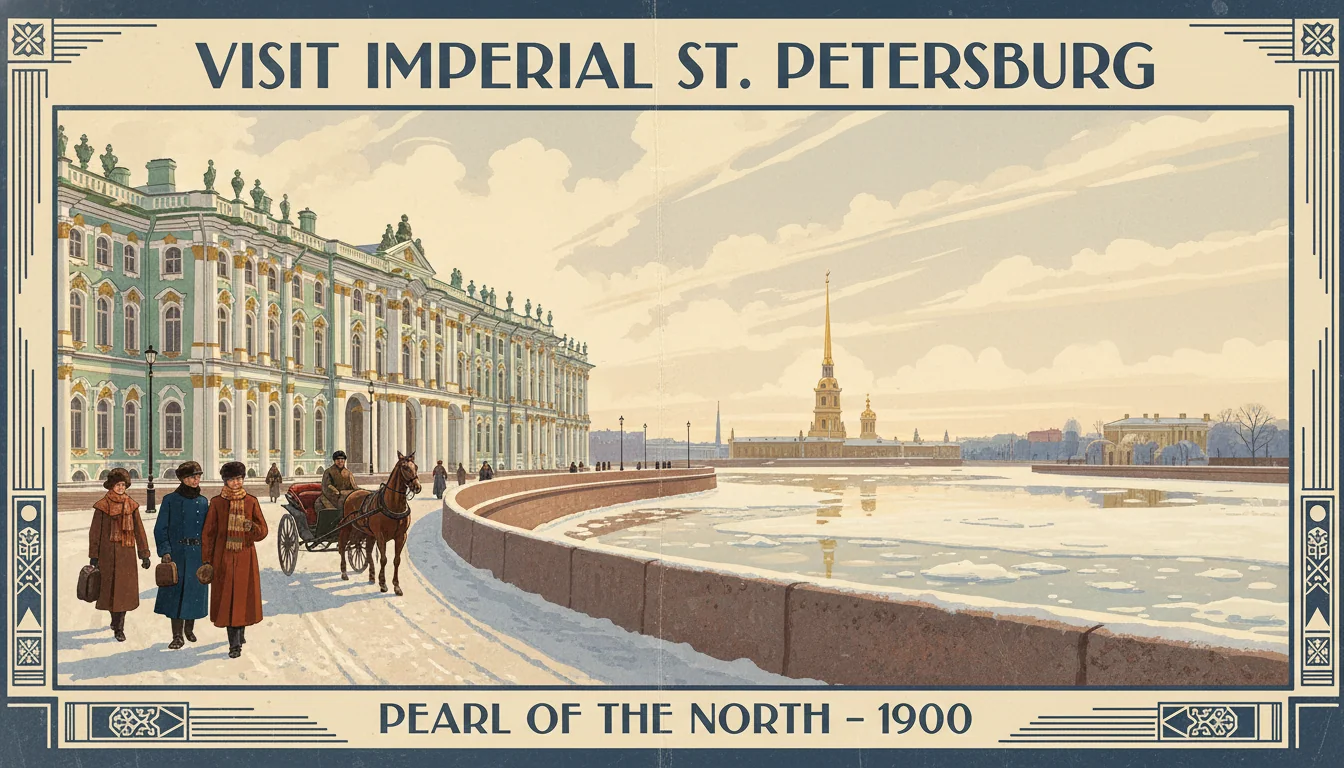
Go now, while you still can. Not because St. Petersburg is about to disappear - it will survive the next century, unlike the regime that built it - but because what you are about to visit is the last fully operational performance of a system that has been running since Peter the Great imported Western Europe's aesthetics and grafted them onto Asian autocracy. Five years from now a war against Japan will shake the foundations. Twenty years from now the whole thing will be ash and executions. In 1900 the ice is cracking, but the chandelier is still lit.
This is the most architecturally beautiful city in the world, built by forced labor on a Neva River delta that floods every few years, and it is gloriously, catastrophically alive. Bring good boots.
What kind of city you are entering
St. Petersburg in 1900 is a city of about 1.3 million people, the capital of the Russian Empire, and the seat of the Romanov dynasty since Peter the Great founded it in 1703 by draining marshes and importing Dutch engineers.
The city sits on the Baltic coast, on dozens of islands cut by the branches of the Neva River delta. This gives it canals, bridges, and in spring a breathtaking light that comes off the water at a low northern angle and makes even the warehouse districts look like paintings. In winter it turns into a killing ground of ice fog and temperatures that reach minus twenty Celsius in February. Plan accordingly.
The social structure is extreme and visible. At the top: the Romanov court, the grand dukes, the nobility of several grades, the senior officials and military officers who cluster around the Winter Palace. In the middle: a growing professional and merchant class, German-born craftsmen, Finnish workers, Jewish traders living under heavy legal restriction, and the Armenian, Georgian, and Polish subjects of the empire who have come to the capital looking for opportunity. At the bottom: about half a million factory workers and domestic servants living in tenements so overcrowded that a family of six shares a single room, often with boarders.
Your safest cover is foreign visitor. Several hundred thousand tourists and businesspeople pass through St. Petersburg every year. Your best alibi for anything unusual is that you are a merchant from Hamburg, a journalist from London, or a scholar visiting the Imperial Public Library on Sadovaya Street.
Speaking the language
Russian is the official language and the language of the street. French is the language of the aristocracy in formal social settings - many nobles speak Russian only to their servants. German is the language of the engineering and merchant classes. If you speak only one of these, choose Russian for most practical purposes; French if you expect to be invited to salons.
Do not attempt to speak Russian badly and pretend to be Russian. St. Petersburgers have highly calibrated ears for who is from where, and being caught in a class pretension is socially worse than being a foreigner.
Getting dressed
The city will see through you in two minutes if you dress wrong.
For men: a dark wool coat reaching the knee, a suit underneath with a waistcoat, a stiff shirt collar, and a hat. Always the hat. A round-crowned felt hat in the middle class, a top hat for anything formal, a fur-lined cap called an ushanka for outdoor winter use. Gloves are mandatory from October through April. A walking stick is optional but raises your apparent status.
For women: a long dress with a fitted bodice and high collar, a heavy wool coat for the street, gloves, and an elaborate hat. Court dress for anything near the palace involves considerably more; you need to know someone to be invited anywhere formal, and if you do, a lady's maid to dress you is effectively required.
Avoid anything synthetic-looking, anything brightly colored in a modern way, and any practical footwear that looks like the 21st century.
Getting around
The city has horse-drawn trams running on rails along Nevsky Prospekt and the main boulevards. Electric trams are still years away. For hired transport, you want a droshky - a light horse-drawn cab. Negotiate the fare before you get in; drivers will attempt to charge foreigners triple the going rate. For longer distances, a more enclosed izvozhchik cab provides some protection from the weather.
Walking is safe along Nevsky Prospekt, around Palace Square, and on the embankments of the Neva in reasonable weather. The working-class districts behind the Narva Triumphal Arch and on Vasilyevsky Island are safe by day but grim by night and heavily patrolled.
Do not walk the outer factory districts after dark.
What to see - the three things you must not miss
The Winter Palace and Palace Square
This is the largest palace in Europe and the operational center of the Russian Empire. The building, painted pale green and white, faces south across Palace Square toward the Alexander Column, the tallest freestanding monument in the world when erected in 1834. You cannot enter the palace proper without an imperial invitation, but you can walk the square freely and look up at 1,786 windows. The scale is designed to make you feel small. It succeeds.
In January 1905, this same square will be where troops fire on a crowd of petitioning workers, killing hundreds in what becomes known as Bloody Sunday. In 1900, it is still simply the most impressive open space in the world.
Nevsky Prospekt from the Admiralty to the Alexander Nevsky Monastery
The main boulevard runs roughly four kilometers from the Admiralty building at the western end to the monastery at the eastern. Walking its length takes about an hour and gives you everything: the Kazan Cathedral with its colonnade modeled on St. Peter's in Rome, the Anichkov Bridge with its famous horse-tamer statues, the Gostiny Dvor shopping arcade, the Eliseyev Brothers food emporium, and more cake shops than any city strictly needs. The quality of the bakeries is extraordinary. The coffee is less impressive than Vienna's but better than London's.
The Peter and Paul Fortress
Built by Peter the Great in 1703 as the original city fortification, the fortress sits on Zayachy Island in the Neva, directly across from the Winter Palace embankment. Its golden spire is the defining needle of the St. Petersburg skyline. Inside the Cathedral of Saints Peter and Paul, every Russian tsar from Peter I onward is buried. The fortress also contains the Trubetskoy Bastion, which has served as a political prison since the 18th century and currently holds several people who would rather not be mentioned.
You can visit the cathedral as a tourist without incident. Do not loiter near the prison wing.
What to eat and drink
Russian cooking in 1900 divides sharply by class.
In a respectable restaurant or a household with any means: borscht (beet soup with sour cream), shchi (cabbage soup, which is better than it sounds), pirozhki (small stuffed pastries with meat, cabbage, or egg), kasha (buckwheat porridge, which is filling and safe), and river fish from the Neva served in various preparations. At the high end, Donon's restaurant on the Moika embankment serves French-influenced cooking that would not embarrass Paris.
Bread is very good. The dark rye bread sold at street stalls is dense, sour, and reliable.
Vodka is everywhere and at every social level. It is not optional at any male gathering of any social class. You will be expected to drink it from a small glass in a single shot. If you physically cannot, claim a doctor's order. No one will believe you, but they will let it pass.
Avoid raw shellfish and any water that has not been boiled. Cholera is a recurring visitor to the Neva delta.
The political weather
This is the part that could kill you.
Russia in 1900 is a tinderbox. The Tsar rules by autocratic power with no parliament and no constitutional check. The Socialist Revolutionary Party is about to be founded (it organizes formally in 1902). The Russian Social Democratic Labour Party held its first congress in 1898, three years ago; a faction within it is busy writing a newspaper called Iskra - The Spark - from exile in Munich. One of its editors goes by the pseudonym Lenin.
The Okhrana, the political police, is everywhere and has informants inside every political organization in the country. Foreign visitors are automatically suspicious but also relatively protected by their nationality - Russian authorities in 1900 are still cautious about incidents involving British or German subjects. This protection is thin and situational.
Do not attend political meetings. Do not accept revolutionary pamphlets. Do not express sympathy for factory workers in earshot of anyone who might report it. Do not, under any circumstances, attempt to visit known political activists.
If the Okhrana picks you up for questioning, invoke your foreign nationality loudly and immediately, ask for your consulate, and answer nothing else until a consular officer arrives.
The timeline you are entering
Everything you see in 1900 is operating under borrowed time, though nobody standing on Nevsky Prospekt knows it yet. The Russo-Japanese War begins in 1904, ends in a humiliating defeat in 1905, and triggers the first revolution, which briefly extracts a constitution from Nicholas before he walks it back. The First World War begins in 1914 and grinds the army to pieces. The February Revolution of 1917 ends the Romanov dynasty in three days. The October Revolution follows eight months later.
Nicholas II and his family - his wife Alexandra, daughters Olga, Tatiana, Maria, and Anastasia, and son Alexei - are executed in Yekaterinburg in July 1918.
In 1900 none of this has happened. The Winter Palace lights are on, the Nevsky is full, and the city's extraordinary architecture is intact and gleaming. Go in June, when the White Nights give you twenty hours of diffuse northern light per day and the Neva reflects the sky all the way to the horizon, and the whole doomed empire looks, briefly, like it might last forever.
Take careful notes. Nobody who was there is still alive to tell us what it smelled like. For the darker sequel to everything you see on Nevsky Prospekt, the Stalinist Moscow 1937 guide covers where the revolution ends up. Kievan Rus, 980 CE shows where this empire's roots reach.
Quick Answers
Common questions about this topic
What was St. Petersburg like in 1900?
St. Petersburg in 1900 was a city of sharp contrasts: a glittering imperial capital of palaces, opera houses, and French-speaking aristocracy built on the backs of roughly 1.3 million people, many of them factory workers living in severe poverty. It was architecturally magnificent and socially explosive, already generating the revolutionary pressure that would erupt in 1905 and fully ignite in 1917.
Who ruled Russia in 1900?
Tsar Nicholas II, the last Romanov emperor. He had come to the throne in 1894 after the death of his father Alexander III and was widely considered cautious, indecisive, and poorly suited to the crisis of governing a modernizing empire under revolutionary pressure. His wife Alexandra and their household were increasingly influenced by Rasputin, though in 1900 that relationship had not yet begun.
How dangerous was St. Petersburg in 1900?
Physically dangerous if you were poor: factory conditions were brutal, housing was overcrowded and disease-prone, and the police made no distinctions between genuine criminals and anyone who looked like a revolutionary agitator. Politically dangerous for anyone expressing liberal or socialist views within earshot of the Okhrana, the Tsar's secret police. For a foreign visitor presenting as a tourist, the city was relatively safe.
What should I know about the Okhrana?
The Okhrana was the Tsarist political police, founded in the 1880s and by 1900 operating an extensive network of informants, agents provocateurs, and surveillance. It monitored foreign visitors, infiltrated political groups, and could imprison people for subversive reading material. Keep your political opinions to yourself, avoid public meetings organized by workers, and do not, under any circumstances, be found carrying revolutionary pamphlets.

Need Advice from Someone Who Lived There?
Get firsthand accounts from people who actually lived through these moments in history.
Create your free account →No card required. Some figures and features require a paid plan.
Join the HistorIQly Club
Get smarter about the past.
Weekly stories, deep dives, and exclusive content straight to your inbox.