A Time Traveler's Guide to Carolingian Aachen, 800 AD
A traveler's guide to Carolingian Aachen in 800 AD: Charlemagne's chapel is rising, Alcuin is lecturing, the food is tolerable, and the politics will get you killed.
Read Wikipedia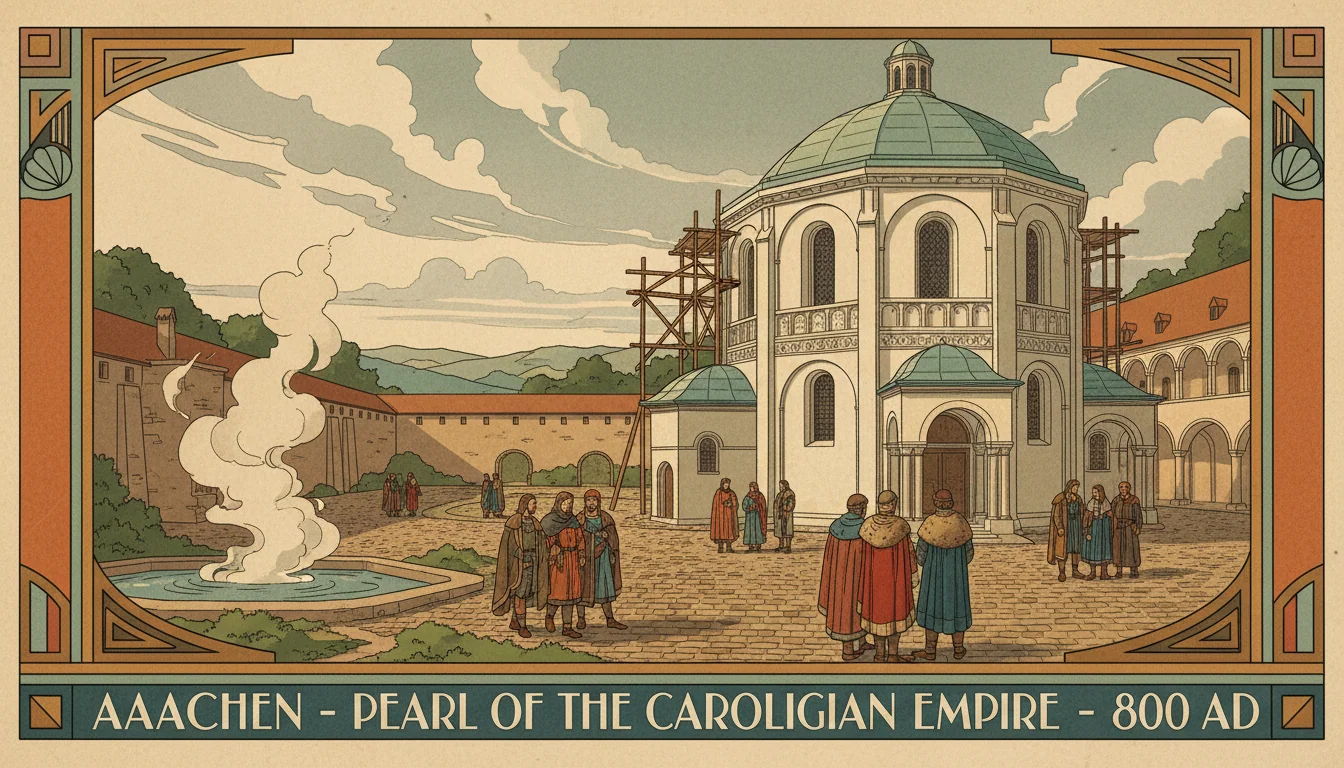
Before you arrive in Carolingian Aachen, understand one thing: the city you are visiting does not consider itself a city. Aachen in the year 800 is a royal residence, a hot spring, a building site, and the center of an empire being assembled in real time by the most energetic ruler Europe has seen since Augustus. For comparable early-medieval European destinations, our guides to Anglo-Saxon Winchester around 880 and medieval Prague in 1350 pair well with this one. The population is maybe a few thousand people, clustered around the palace complex and the thermal springs the Romans called Aquis Granum. The Palatine Chapel, which will anchor the site for the next twelve centuries, is still under construction.
Arrive in spring or early summer, when the roads from Cologne and the Rhine valley are passable and the court is in full session. Avoid late autumn: Charlemagne leaves on campaign in summer and returns to Aachen in winter, but the autumn movement of his court and its enormous retinue churns the roads to mud and the available lodging to nothing. In the year 800 specifically, the court will leave for Rome in the autumn. If you are there in October, you will watch the assembled power of the Frankish empire moving south, and then Aachen will be very quiet.
Know what you are walking into
Charlemagne's court is, by the standards of 800 AD, a remarkable intellectual environment. Alcuin of York, an English-born scholar of considerable range, runs the palace school and corresponds with learned figures across Europe. Einhard, who will one day write the most important biography of Charlemagne, is here, probably in his twenties, trained as a craftsman and metalworker. Angilbert, a poet, holds the court position of Homer. Theodulf of Orleans, a theologian and future bishop, composes verse for court occasions. They have given each other classical nicknames: Charlemagne is "David," Alcuin is "Flaccus," Einhard is "Bezalel."
This playful scholarship coexists with an absolutely serious political violence. The Frankish court operates by a code of personal loyalty and personal revenge that has not been significantly softened by Christianity. Blood feuds are managed, not abolished. Charlemagne himself had ordered the execution of 4,500 Saxon prisoners at Verden in 782, an act that even his admirers found difficult to reconcile with the Christianity he promoted. You are visiting an empire that is simultaneously funding the copying of classical manuscripts and executing people for refusing baptism.
How to present yourself
Your cover identity needs to be plausible and immediately parseable to anyone who stops you. The safest options are:
A Frankish minor cleric or scribe traveling on church business. Literacy is rare and instantly grants you protective status. Carry a wax tablet and a stylus. Know enough church Latin to recite the Lord's Prayer and a psalm.
A merchant from the Rhine trading region, bringing cloth, metalwork, or Rhenish wine. Commerce is regular along the river routes, and merchants from the valley are expected and not particularly suspicious. Your Latin can be bad. Speak slowly and gesture.
A pilgrim heading toward one of the Frankish churches or eventually toward Rome. Pilgrims move throughout the empire in numbers, receive hospitality at monasteries, and are protected by custom if not always by law. The role requires you to look poor and pious.
Do not claim to be a nobleman. Frankish aristocrats know each other, know each other's families, and will want to know your lineage in detail within minutes.
What to wear
Frankish clothing in 800 is layered, wool-heavy, and functional. Men wear:
- a linen undertunic (reaching the knee or mid-calf)
- wool over-tunic, belted at the waist
- loose wool trousers, cross-gartered with linen strips from ankle to knee
- leather shoes with simple buckles or lacing
- a short wool cloak, pinned at one shoulder
In cooler weather, add a heavier outer mantle. Never appear in public without a belt - it signals free status. Slaves and servants are unbelted. A man without a belt in a Frankish court is either destitute or making a statement neither is good.
Women wear long linen underrobes, a long woolen overdress, a linen veil, and a mantle for outdoor travel. Jewelry signals rank. Do not wear silver or gold if you are presenting as a merchant or pilgrim - it will attract the wrong kind of attention.
Leave every piece of modern synthetic fabric, zipper, and logo-bearing material behind. Leather, linen, and undyed wool are your materials.
Getting around
Aachen in 800 is compact enough to walk in twenty minutes. The palace complex, centered on the Palatine Chapel and the royal hall, sits on slightly raised ground above the springs. Around it, within a short walk, are the workshops, granaries, stabling, and accommodation structures that support the court. The thermal springs themselves are not far.
Travel within the empire is by horse or by foot along Roman roads, many of which the Carolingians maintained and used. A fit traveler on foot covers 25 to 30 kilometers per day on good roads in good weather. Horses are expensive and require fodder. You will not own a horse without a plausible backstory.
The Rhine is the major arterial route in this region. Boats move goods north and south along it regularly. If you need to leave quickly, the river is your best option. Know which direction the current runs.
What to eat and drink
The court kitchen provides for those with standing in the household. For everyone else, the diet in 800 AD is bread, peas, and whatever meat is available. Charlemagne, according to Einhard, preferred simple food: roasted meat (usually game), bread, wine, and occasionally vegetables. The court would have had better access to grain, preserved meat, fish, and Rhenish wine than any ordinary settlement in the region.
Do not drink standing water. Wine, ale, or water boiled with grain are your safe options. Dysentery is not a dramatic emergency in the 21st century; in 800 AD it is a serious and occasionally fatal illness with no treatment beyond rest and time.
Fresh vegetables are seasonal. Salt-preserved fish, especially herring, is widely available and provides reliable protein. Cheese is common. If you are offered hospitality at a monastery, take it - monastery kitchens are the most reliable food supply in early medieval Europe.
Three things worth seeing
The Palatine Chapel
The octagonal chapel being built at Charlemagne's direction will survive largely intact for more than twelve centuries. Its model is San Vitale in Ravenna, which Charlemagne visited and admired. The interior will feature bronze railings, marble columns brought from Rome and Ravenna, and Byzantine-style mosaics. In 800, it is close to completion but not yet consecrated - scaffolding is likely still visible. Watching this building being finished, with materials sourced from the ruins of the Western Roman Empire, is worth the entire trip.
The thermal baths
The hot springs at Aachen were the original reason for the settlement, and Charlemagne used them constantly. Einhard describes him swimming with his sons, nobles, and bodyguards simultaneously - the pools were large enough for a hundred people. By 800 standards, the bathing complex is genuinely impressive: warm mineral water, stone pools, a level of physical comfort unavailable at almost any other location in northern Europe.
You will not, realistically, gain access to the royal bath. But the thermal spring area is not entirely sealed from visitors, and the water itself is accessible. It tastes of minerals and smells slightly of sulfur. It is real.
The palace school lectures
Alcuin of York teaches in the palace school, drawing on his training at the cathedral school of York to run what is, for 800 AD, an extraordinary curriculum: the seven liberal arts, theological debate, Latin composition, biblical commentary. If you can position yourself in the orbit of the scholars - as a scribe, a messenger, someone seeking to copy a text - you may hear lectures that are preserving classical education through the darkest period of European intellectual life.
The dangers
The primary danger is being nobody. In the Frankish court, your identity and your patron determine your physical safety. A stranger with no patron, no recognizable rank, and no verifiable business is a target - for theft, for arbitrary detention, for the violence of bored armed men. Get a connection to a church establishment as quickly as possible. Monasteries provide both cover and protection.
The secondary danger is religion. Charlemagne is actively forcible in his Christianization of the empire. Saying the wrong thing about faith, appearing to practice any pre-Christian ritual, or being visibly associated with unconverted populations will bring serious consequences. Carry a small cross. Cross yourself in public. Know the Nicene Creed in Latin.
The tertiary danger is politics. Do not ask questions about court intrigue. Do not ask about the pope's situation in Rome (in 800, Pope Leo III is recovering from a violent attack and Charlemagne is about to travel to adjudicate the aftermath - the entire court is tense about this). Do not speculate about the succession. The Frankish court in 800 is not a safe place for opinion.
Leave before October. Aachen without the court is a construction site and a hot spring. That is not worth wintering for.
Quick Answers
Common questions about this topic
Why did Charlemagne choose Aachen as his capital?
Aachen sits atop a network of hot thermal springs that the Romans had developed into bathing facilities. Charlemagne loved to swim and used the springs daily, according to his biographer Einhard. Beyond personal preference, Aachen's location in the Frankish heartland made it defensible and central to his territories. He built his palace complex around the springs and returned to Aachen more frequently than any other residence.
What was the Carolingian Renaissance?
The Carolingian Renaissance was an 8th and 9th century intellectual revival centered on Charlemagne's court, particularly at Aachen. Charlemagne gathered scholars from across Europe - including Alcuin of York from England, Peter of Pisa from Italy, and Theodulf of Orleans from Visigothic Spain - to establish a palace school, reform church Latin, standardize biblical texts, and promote literacy among the clergy. It produced the Carolingian minuscule script, the ancestor of modern lowercase letters.
Was Charlemagne actually crowned emperor at Aachen?
No. Charlemagne was crowned Emperor of the Romans by Pope Leo III in St. Peter's Basilica in Rome on Christmas Day, 800 AD. Aachen was his administrative capital and preferred residence, but the coronation happened in Rome. He returned to Aachen after the ceremony and the city functioned as the center of his empire until his death in 814.
What languages were spoken at Charlemagne's court?
Latin was the official language of government, church, and scholarship. Charlemagne and his Frankish nobles spoke Old Frankish, a Germanic dialect ancestral to modern German and Dutch. Visitors from different parts of his empire brought Old High German dialects, early Old French, and various Romance varieties. Charlemagne reportedly studied Latin, Greek, and other languages, though his Latin writing remained imperfect.

Need Advice from Someone Who Lived There?
Get firsthand accounts from people who actually lived through these moments in history.
Create your free account →No card required. Some figures and features require a paid plan.
Join the HistorIQly Club
Get smarter about the past.
Weekly stories, deep dives, and exclusive content straight to your inbox.