A Time Traveler's Guide to Stalinist Moscow, 1937
A visitor's guide to Stalinist Moscow 1937 at the height of the Great Terror: what to wear, say, and never write down as a foreigner in Stalin's capital.
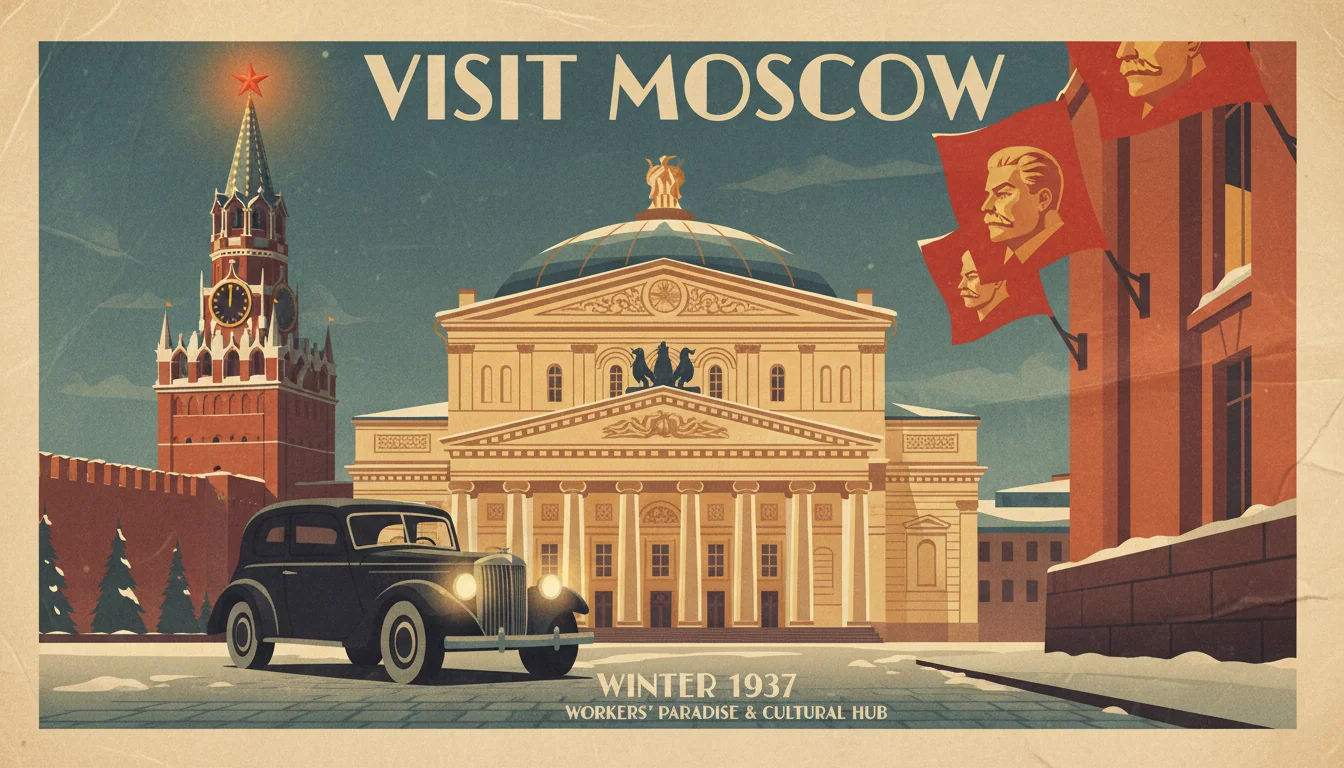
If you are going to time-travel to a Soviet city, almost any year is safer than 1937. The Great Terror is at its full industrial pitch. The Lubyanka is running 24-hour shifts. The Bolshoi is still performing Swan Lake every Saturday night. The first line of the Moscow Metro has just been extended to Sokol, and the chandeliers in Mayakovskaya station are some of the most beautiful pieces of public architecture in Europe. The same week the trains start running through them, three of the men who designed the line are arrested, and one of them is shot.
Moscow in 1937 is a city of marble palaces and locked apartment doors, of celebrated parades and blackout-drawn windows. You can see it. You can even enjoy it. But you must do everything correctly the first time. Here is your practical guide.
First, understand what you are walking into
By 1937, the Soviet Union has been ruled by Joseph Stalin in an undisputed personal dictatorship for almost a decade. The first Five-Year Plan transformed industry. Collectivization devastated the countryside. The Kirov assassination in December 1934 has been used as a pretext to launch a sweeping internal terror that, in 1937 and 1938, will reach its highest peak. Roughly 750,000 people will be executed by the NKVD during these two years. Many will be denounced by neighbors, coworkers, or relatives. About one in twenty adult Muscovites will be arrested before the wave subsides.
You are entering this city as a foreigner. That is, by an enormous margin, the safest cover story you have. Soviet citizens cannot leave. Foreigners can, and that fact makes you slightly less terrifying to the locals and slightly more interesting to the secret police. Both of these facts will affect your entire trip.
Your best official cover is a tourist booked through Intourist, the state foreign-tourism agency, which has had a Moscow branch since 1929. Intourist will assign you a guide. Your guide is, almost certainly, also reporting to the NKVD. Treat them politely, tip in cigarettes, and never confide anything personal.
Dress the part
Modern clothing will mark you as a foreigner in two seconds, which is fine. What you cannot afford to look like is an accidental tourist who is going to embarrass the regime.
For men in 1937 Moscow, foreign visitors wear:
- a dark wool single-breasted suit with a wide notched lapel
- a white or light-blue shirt with a soft collar
- a sober tie, ideally striped, never red
- polished oxfords or brogues
- a gray or brown soft hat (a fedora or a homburg)
- a heavy wool overcoat from October through April
For women:
- a knee-length dress in muted color, dark blue, brown, or burgundy
- a fitted wool jacket
- closed-toe leather shoes with a low heel
- a hat with a small brim
- gloves at all times outside
- silk stockings (cotton stockings are a giveaway of Soviet origin)
Avoid bright synthetic fabrics, anything with a visible logo, jeans, sneakers, sunglasses with mirrored lenses, and any kind of religious jewelry. A small wristwatch is acceptable for foreigners and unusual enough to be useful as conversation. Bring American or British cigarettes. They are better currency than rubles.
What you can say, and what you must not say
Public conversation in Moscow in 1937 is full of land mines. The cardinal rule is that nothing you say in any public place should ever be quotable against you or against anyone you are speaking to.
Topics that are safe in casual conversation:
- the weather
- the Metro stations
- the new buildings on Gorky Street
- Soviet sports, especially Spartak and Dynamo football
- the recent Pushkin centennial (1937 is the 100th anniversary of his death)
- agricultural production at a vague level
Topics that are dangerous, even in private:
- the trial of Marshal Tukhachevsky, executed in June 1937
- any specific mention of arrests in the Red Army
- the disappearance of any specific neighbor or colleague
- comparisons between the USSR and Nazi Germany
- any opinion about Trotsky, who is by now a non-person whose name has been removed from books, films, and photographs
- religion of any kind
If a stranger raises a dangerous topic, assume they are testing you. Do not commit to any view. Praise the regime in non-specific terms. Move the conversation.
If you are introduced to someone and your guide names them as an engineer, a writer, or a Party official, do not ask follow-up questions about what they do. Their answers will be shaped by what they think you might report.
Where to stay
The Hotel Metropol, on Teatralnaya Square, is the standard Intourist assignment for foreign visitors. It is comfortable. The dining room serves caviar, blini, smoked sturgeon, and surprisingly good champagne. The rooms are spacious and full of period furniture seized from previous owners during the early 1920s. They are also bugged. So is the Hotel National across the square, where Lenin briefly lived in 1918.
A second possibility is the Hotel Moskva, which opened in 1935 just north of Red Square in the famous mismatched-facade configuration that legend (probably falsely) says was caused by Stalin signing both proposed plans without indicating which one he wanted built. Slightly more modern, slightly less elegant. Same surveillance.
If you have a choice, take the Metropol. The breakfast is better, the elevators work, and you can walk from your room to the Bolshoi in three minutes.
Three places you absolutely must visit
The Moscow Metro
Lines One and Two are operational. The stations are extraordinary: marble, mosaic, bronze, and chandelier work executed at a level no subway system since has matched. Mayakovskaya, opened in 1938 (one year past your visit if you are strict about dates) is in late construction; Kropotkinskaya and Komsomolskaya are already running. Buy a token for 50 kopecks at any station. Ride the loop once, slowly, and look up.
The Metro is also a reminder of the Terror. Many of its architects, engineers, and decorators were arrested between 1936 and 1938. The names you will not see on any plaque in 1937 are the ones whose memory you should hold quietly.
Red Square at sunset
Walk into Red Square from the north end, entering through the Resurrection Gate (still standing in 1937; Stalin will demolish it in 1931... a year that has already passed in your itinerary, so check whether the gate is up or down before you visit; if it is down, simply enter from the Bolshoi side). St. Basil's is in place. Lenin's Mausoleum is open and receiving long lines of pilgrims every day. The wooden version was replaced in 1930 with the granite version you can now see.
Do not photograph the Kremlin walls. Do not photograph soldiers. Do not photograph the Mausoleum. Photographing St. Basil's is fine. Photographing GUM, the department store on the east side of the square, is fine but will surprise the locals because GUM in 1937 is partly closed.
The Bolshoi Theatre
Tickets to the Bolshoi are, paradoxically, easy to get for a foreign visitor and almost impossible for a Soviet citizen. Intourist will arrange seats for you. Wear formal dress. Bring small gifts of foreign cigarettes for the ushers. The repertoire is heavy on the 19th-century Russian classics: Eugene Onegin, Boris Godunov, Swan Lake, The Nutcracker. Modernist composers are now politically suspect.
The audience will include senior Party officials, foreign diplomats, and a sprinkling of NKVD officers in civilian dress. Applaud politely. Do not whistle (whistling at a performance in 1937 Russia is an insult, not approval).
What to eat, what to drink
Foreign tourists in 1937 Moscow eat better than almost any Soviet citizen. Intourist has secured access to ingredients that ordinary residents cannot find. Take advantage carefully and without comment.
Reliable choices:
- the dining room at the Metropol or the National
- caviar with brown bread and butter, a foreigner's privilege at almost any Intourist hotel
- borscht, pelmeni, smoked fish at a Stolovaya (cafeteria) attached to a state hotel
- Soviet champagne (Sovetskoye Shampanskoye), launched in 1936 and surprisingly drinkable
- vodka in any form, but pace yourself
Avoid:
- street food sold by individual vendors (in 1937, there are very few left)
- meat from unfamiliar shops
- raw vegetables from open markets in summer
- water from any tap
Do not visit any home for dinner unless you are willing to put your hosts at risk. Foreign visitors to private apartments are often interviewed afterward by the NKVD, and so are the hosts.
The everyday surveillance
Assume that every space you enter is monitored. Hotel rooms, hotel telephones, and hotel hallways have microphones. The doormen, the cleaners, and the elevator attendants report on you. The shoeshine boy outside the Metropol reports on you. Your Intourist guide reports on you in writing every evening.
This is not paranoia. It is routine. Behave accordingly. Do not write candid notes on hotel stationery. Do not leave a journal in your room. If you must keep notes, carry them physically on your person and burn them when you leave the country. Do not photograph street scenes that include uniforms, queues, or any factory.
What not to do under any circumstances
Let me save you from the classic mistakes.
Do not:
- praise any Western political figure in any setting
- mention or compare any aspect of life under Stalin to life under Hitler
- attempt to attend a religious service openly (most churches have been closed or repurposed; the Cathedral of Christ the Saviour was demolished in 1931)
- approach the Lubyanka or the Inner Prison for any reason, including photography
- ask anyone, ever, about a person who has been arrested
- carry a Bible openly
- attempt to leave Moscow without your Intourist itinerary
- exchange currency on the black market (this is a capital offense in 1937 if convicted under the right article)
- sing or hum anything by Shostakovich's Lady Macbeth of Mtsensk, denounced in Pravda the previous year
Above all, do not warn anyone about what is coming. Do not tell anyone about the German invasion of June 1941. Do not tell them about the postwar repressions or the death of Stalin in 1953. The doomed quality of Moscow in 1937 is part of why it is so unsettling to visit, and so important to see honestly.
The experience you should not miss
If you can manage just one moment in Moscow in 1937, take it on a clear winter evening at Sparrow Hills (in 1937 still called Lenin Hills), looking northeast toward the city. The new electric lights are coming on across the river. The illuminated star above the Spasskaya Tower of the Kremlin, installed in 1935, glows red against the dusk. Trams clatter across the Moskva bridges. The radio loudspeakers on the squares are playing a Tchaikovsky concert. The temperature is far below freezing.
For about ten minutes, the city looks like the modernist capital it was always meant to become, beautiful and confident and full of future. Then your guide will gently steer you back toward the car, because it is past the hour when foreigners are expected to be at their hotel. You will return to the Metropol. You will write nothing down. And you will leave the country a few days later carrying memories that, for everyone you met, will be far more dangerous to carry than they are for you.
Pack lightly. Dress carefully. Trust no one. Stalinist Moscow in 1937 is one of the most architecturally and culturally rich places on any time-travel itinerary, and one of the most morally dangerous. Visit with respect, and leave on the next train.
For a less fraught time-travel destination, see our guides to 1920s Chicago and Belle Epoque Paris.

Need Advice from Someone Who Lived There?
Get firsthand accounts from people who actually lived through these moments in history.
Ask Them YourselfJoin the HistorIQly Club
Get smarter about the past.
Weekly stories, deep dives, and exclusive content straight to your inbox.