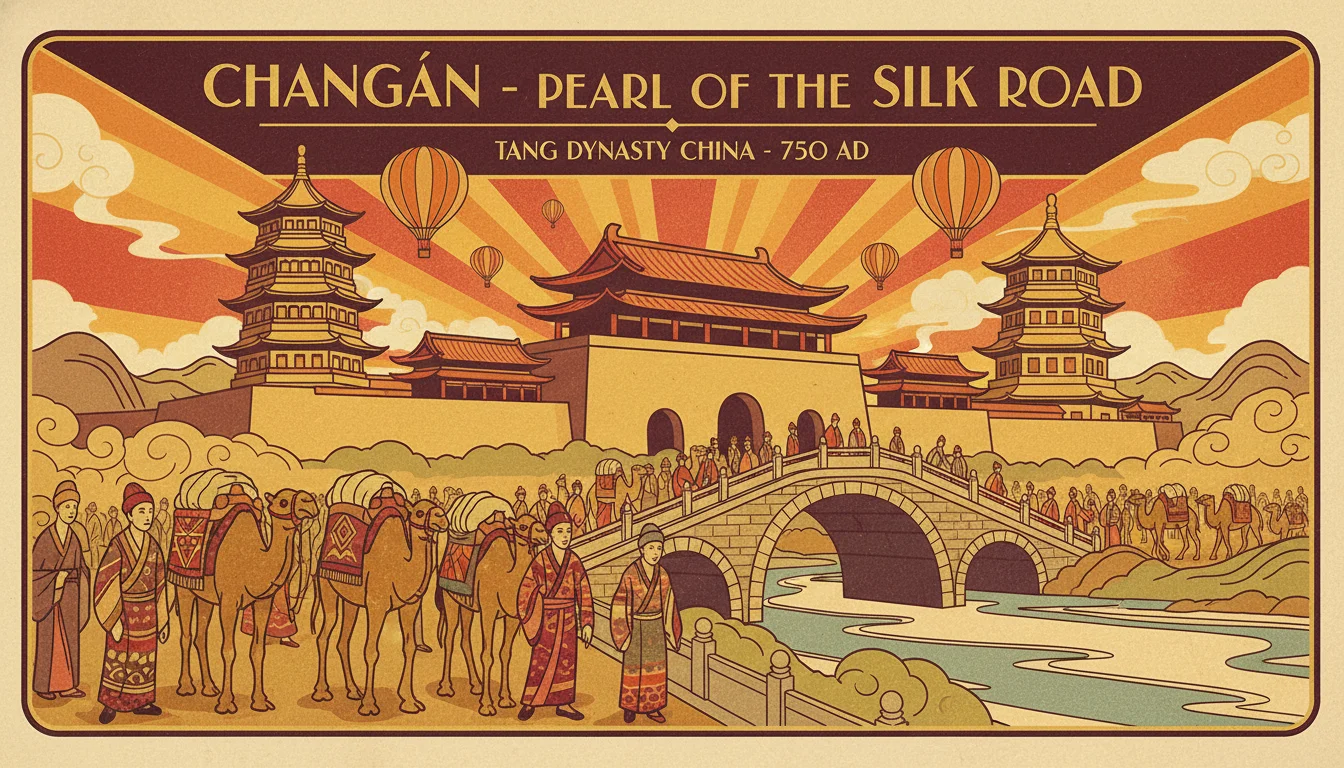
Time Traveler's Guide to Tang Dynasty Chang'an, 750 AD
Survive and thrive in Tang Chang'an, the world's largest city in 750 AD: a cosmopolitan megacity of silk, poetry, and surprisingly strict curfews.
Read Wikipedia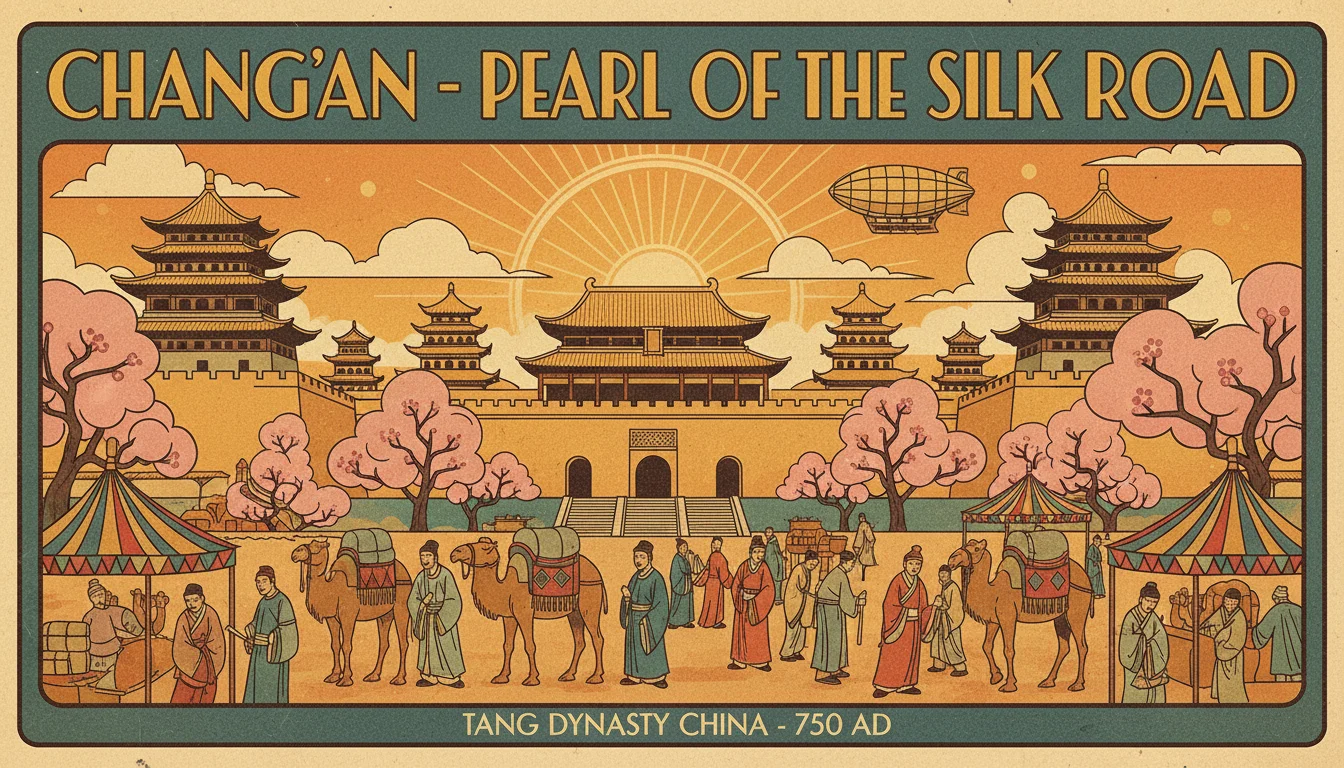
Welcome to Chang'an, capital of the Tang Dynasty and the undisputed center of the known world. With over a million residents, this is the largest city on Earth in 750 AD - bigger than Constantinople, Baghdad, and Rome combined. You're walking into a cosmopolitan wonderland where Persian merchants haggle next to Korean diplomats, where Buddhist monks debate Daoist priests, and where the wine flows as freely as the poetry.
Here's how to survive it.
Getting Your Bearings
Chang'an is laid out on a perfect grid, roughly 10 kilometers east to west and 8 north to south. Think Manhattan, but designed by someone who actually planned ahead. The city is divided into 108 walled wards (fang), each with gates that close at sunset. Yes, close. We'll get to that.
The Imperial Palace sits at the north end. Don't wander toward it looking confused. Guards will ask questions you can't answer. Stick to the eastern and western markets, the entertainment districts, and the many temples scattered throughout the wards.
What to Wear
Your modern clothes will get you arrested or worse - mistaken for a barbarian. Head to the West Market immediately and purchase a round-collared robe (yuanlingpao). Men wear these belted at the waist with a soft cap. Women have more variety - flowing skirts with short jackets, or the increasingly fashionable practice of wearing men's riding clothes (thank Empress Wu's legacy for loosening those norms).
Colors matter. Purple and crimson are reserved for high-ranking officials. Stick to blue, green, or undyed cloth unless you want to explain yourself to a magistrate. Leather boots are standard footwear. Sandals mark you as either a monk or a peasant.
One fun detail: Tang fashion is gloriously international. You'll see Central Asian-inspired hats, Persian-style jewelry, and hairstyles borrowed from half a dozen cultures. If your outfit looks slightly foreign, people will assume you're one of the many traders who call Chang'an home.
What to Eat
You're in luck. Tang Dynasty cuisine is excellent, and the West Market is an international food court eight centuries before the concept existed. Here's your daily menu:
Breakfast: Steamed wheat cakes (bing) from a street vendor. Simple, filling, cheap. Dip them in a sauce if the vendor offers one.
Lunch: Lamb kebabs from the Sogdian quarter. Central Asian merchants brought their grilling traditions, and the locals love it. Pair with flatbread and a bowl of noodle soup.
Dinner: If you can afford it, find a proper restaurant near the Pingkang ward. Braised pork, steamed fish with ginger, seasonal vegetables, and rice. The Tang Chinese are sophisticated cooks - they use soy sauce, vinegar, ginger, garlic, and Sichuan peppercorn with real skill.
Drinks: Tea is catching on but hasn't yet conquered daily life the way it will in later dynasties. Wine made from grapes (imported via the Silk Road) is fashionable among the elite. More common is rice wine or millet ale. The taverns in the entertainment districts serve all of the above, and they stay open late - within their ward walls, at least.
Avoid drinking unboiled water. This advice is good for any century, but especially here.
The Curfew (This Is Not Optional)
Every evening at sunset, a massive drum in the palace beats 800 times. When it stops, the ward gates close. You must be inside your ward. No exceptions. The streets between wards become patrolled no-man's-land until the morning drum sounds 400 beats at dawn.
Getting caught outside your ward at night means a beating - literally. The punishment is 20 strokes of the cane. The night watchmen are not interested in your excuse about getting lost.
Plan accordingly. If you're drinking in the Pingkang entertainment district, make sure your lodging is in the same ward.
Customs and Social Rules
Bowing: The standard greeting. Depth indicates respect. When in doubt, bow deeper than the other person.
Shoes: Remove them before entering anyone's home. Always.
Poetry: This is the golden age of Chinese poetry. Li Bai and Du Fu are alive and composing right now. If someone recites a poem at dinner, look impressed. If someone asks you to compose one, claim you're a foreign merchant with poor Chinese. Nobody expects poetry from a Sogdian trader.
Religion: Chang'an is wildly pluralistic. Buddhist temples, Daoist monasteries, Nestorian Christian churches, Zoroastrian fire temples, and Manichaean meeting halls all operate within the city walls. Pick whichever temple looks interesting. Nobody will question your faith - they might try to convert you, though.
Women's Status: Compared to later Chinese dynasties, Tang women have remarkable freedom. They ride horses, play polo, run businesses, and appear in public without restriction. Empress Wu Zetian ruled China as sole emperor just decades ago. Don't assume the gender dynamics you might expect from later periods.
Dangers
The bureaucracy: Tang China runs on paperwork. You need travel documents to move between cities. Within Chang'an, staying at an inn requires registration. If authorities ask for your papers and you have none, claim to be a newly arrived merchant from Samarkand and pray they buy it.
Smallpox: Active in 8th century China. Stay away from anyone with a rash.
Political tension: You're arriving at the tail end of Tang prosperity. In five years, the devastating An Lushan Rebellion will tear the empire apart. In 750, the warning signs are there - corruption, military governors accumulating power, Emperor Xuanzong distracted by his beloved consort Yang Guifei. Enjoy the golden age while it lasts.
Pickpockets in the markets: The West Market hosts 40,000 people daily. Watch your money pouch.
Must-See Experiences
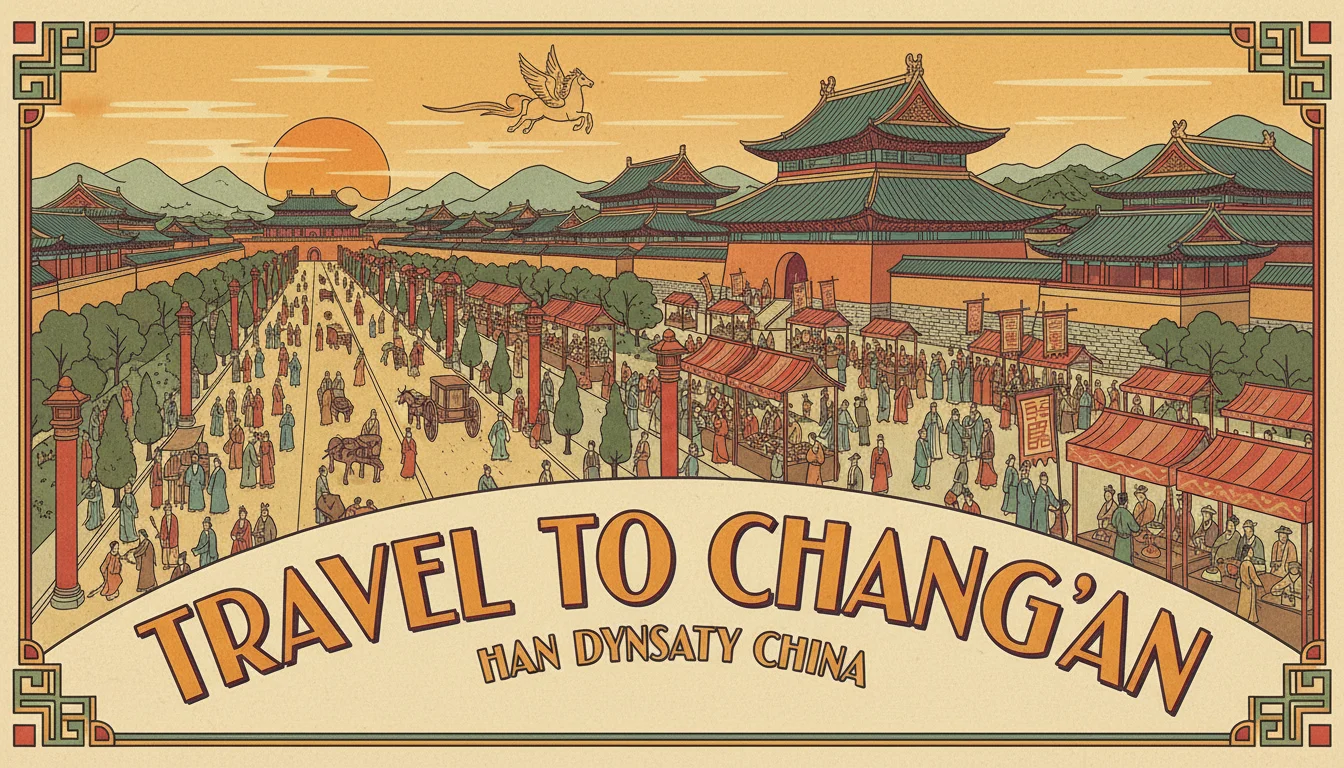
The West Market: Over 200 different trades operate here. Silk, spices, jewels, horses, books, medicine, musical instruments. Spend a full day wandering.
The Great Wild Goose Pagoda: Built to store Buddhist scriptures brought from India. Climb to the top for a panoramic view of the entire city.
The Pingkang Ward: Chang'an's licensed entertainment district. Courtesans here are educated artists - poets, musicians, calligraphers. This isn't a red-light district in the modern sense. It's closer to a salon culture where the city's elite come to be entertained and to show off their own artistic talents.
A polo match: The Tang court is obsessed with polo, imported from Persia. If you can get near the imperial grounds, watching a match is unforgettable.
The Qujiang Pond gardens: South of the city, these imperial gardens are sometimes opened to the public during festivals. Cherry blossoms in spring, lotus flowers in summer.
Quick Survival Tips
- Learn the phrase "wo shi hushang" (I'm a foreign merchant). It explains away most of your strangeness.
- Carry copper coins. Silver is used for large transactions, but daily purchases use strings of copper cash.
- The summer heat is brutal. Chang'an sits in an inland basin. Drink tea or boiled water constantly.
- Don't discuss politics. Emperor Xuanzong's relationship with Yang Guifei is gossip fodder, but criticizing the emperor is a death sentence.
- The Silk Road caravans depart from the West Gate regularly. If you need an exit strategy, join one heading west toward Dunhuang.
Chang'an in 750 is humanity at its most confident - a city that genuinely believes it is the center of civilization, and in many ways, it's right. The poetry, the food, the music, the sheer variety of human life crammed inside these walls - you won't see anything like it again for a thousand years. Just be inside your ward by sunset.
For more East Asian time-travel, see our guides to Heian Kyoto in 1000 AD and Yuan dynasty Khanbaliq in 1280.

Need Advice from Someone Who Lived There?
Get firsthand accounts from people who actually lived through these moments in history.
Create your free account →No card required. Some figures and features require a paid plan.
Join the HistorIQly Club
Get smarter about the past.
Weekly stories, deep dives, and exclusive content straight to your inbox.