Time Traveler's Guide to Mayan Tikal, 750 AD
Your guide to visiting Mayan Tikal, 750 AD: survive the jungle, decode the cosmos, and avoid offending a jaguar priest at the peak of Classic Maya civilization.
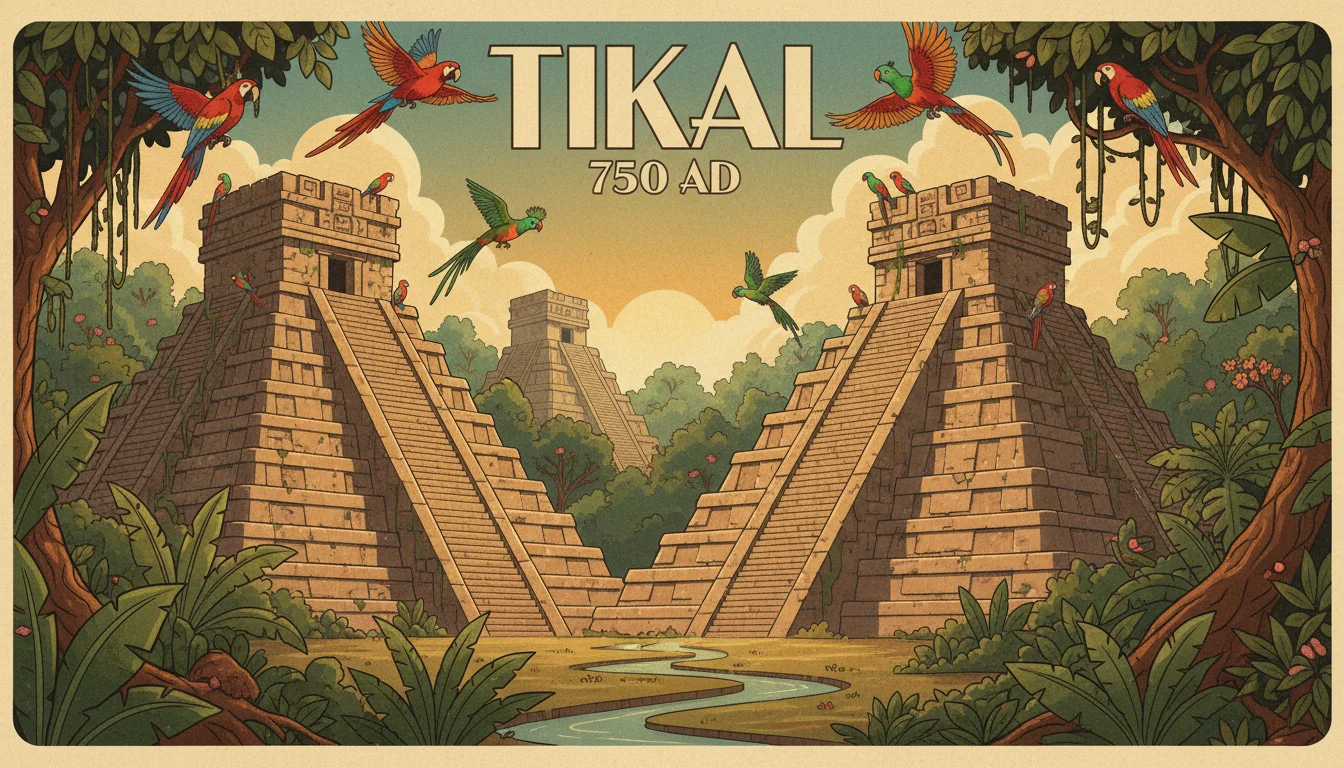
You step off the sacbe - the raised white limestone road - and there it is. Temple I punches through the jungle canopy like a stone fist, its roof comb blazing red and cream against an impossibly green sky. Howler monkeys scream from the treetops. The air is thick, wet, and smells like copal incense and earth. Welcome to Mayan Tikal, roughly 750 AD, the beating heart of Classic Maya civilization and home to maybe 60,000 people spread across the surrounding jungle.
You have arrived at one of the most sophisticated cities in the Americas. Here is how to survive it.
What to Wear
Forget your hiking boots. You will want to blend in, and Maya fashion is surprisingly specific about social rank.
Commoners wear simple white cotton loincloths (called ex) for men and loose cotton shifts (huipil) for women. If you show up in anything fancier without the status to back it up, you will attract the wrong kind of attention. Cotton is king here - it is cultivated, traded, and woven with tremendous skill. The good news: it breathes well in the brutal humidity.
Leave jewelry at home unless you want to be mistaken for nobility - or worse, a thief. Jade is the most precious material in the Maya world, more valuable than gold. Even a small jade bead marks you as someone important. Elites wear elaborate headdresses with quetzal feathers, jade ear spools, and body paint. You are not an elite.
One tip: flatten your forehead. The Maya practice cranial modification from infancy, binding boards to babies' skulls to create an elongated profile considered beautiful. Your round head will mark you as foreign instantly. Wear a cloth wrapped around your head to draw less attention.
What to Eat
Maya cuisine revolves around the sacred trinity: maize, beans, and squash. You will eat corn at every meal, usually as tortillas or tamales, sometimes as atole - a warm, thick corn drink that is surprisingly comforting at dawn.
The chocolate here will ruin you for anything back home. Kakaw is prepared as a frothy, bitter drink mixed with chili peppers, vanilla, and sometimes honey. It is a luxury item - cacao beans literally function as currency. Buying a rabbit costs about ten beans. Do not flash a bag of cacao around carelessly.
Other foods you will encounter: turkey, deer, iguana, various fish, avocados, tomatoes, chili peppers, and an incredible variety of tropical fruits. Squash seeds are roasted and eaten as snacks. Dog meat appears at feasts - do not make a face.
Drink balche, a mildly alcoholic beverage made from fermented bark and honey. It is used in ceremonies but also consumed socially. The water supply comes from massive reservoirs that collect rainwater - Tikal sits on porous limestone with no rivers or lakes, so water management is literally a matter of survival.
Customs That Will Save Your Life
The Maya world runs on a complex social hierarchy, and Tikal is ruled by a k'uhul ajaw - a divine lord who claims descent from the gods. Around 750 AD, this is likely Yik'in Chan K'awiil, a powerful ruler who has recently defeated the rival city of Calakmul. The city is riding high. Morale is good. Construction is booming.
Never look a noble directly in the eyes. Lower your gaze. Step off the path. Show deference. The penalties for disrespecting the elite are not abstract - they involve things you do not want described in detail.
Learn the calendar. The Maya operate two interlocking calendar systems: the 260-day Tzolk'in (ritual calendar) and the 365-day Haab' (solar calendar). Together they create a 52-year cycle that governs everything from planting to warfare to marriage. Asking "what day is it?" requires a complicated answer. Major ceremonies align with astronomical events - solstices, equinoxes, the movements of Venus. If people are heading toward the Great Plaza with painted faces and elaborate costumes, follow at a respectful distance.
Bloodletting is normal. Elites perform ritual bloodletting by piercing their tongues, earlobes, or other body parts with stingray spines or obsidian blades. The blood is dripped onto paper and burned as an offering. You may witness this at public ceremonies. Do not faint.
Human sacrifice exists but is less common than you think. War captives, particularly enemy nobles, are the primary victims. If you are clearly a commoner and not a prisoner of war, you are probably fine. Probably.
Dangers to Watch For
The jungle itself. Tikal sits in the Peten lowlands of what is now Guatemala. Jaguars, venomous snakes (fer-de-lance, coral snakes), scorpions, and disease-carrying mosquitoes are constant companions. Malaria and other tropical diseases will be your biggest invisible threat. Stay near the city center.
Political intrigue. Tikal has spent the last century locked in a superpower rivalry with Calakmul to the north. Although Tikal is currently dominant, spies and agents from rival cities operate throughout the region. Being a stranger with no known lineage or affiliation makes you suspicious. Attach yourself to a merchant caravan as quickly as possible - traders have a relatively protected status.
Dehydration. The reservoir system is impressive but finite. Water is rationed during dry season (roughly February to May). If you arrive during these months, securing reliable water access should be your first priority.
Getting lost. The city sprawls across roughly 60 square kilometers of jungle. Major temples and plazas are connected by sacbeob (raised roads), but residential areas blend into the forest. Without the roads, you will be hopelessly turned around within minutes.
What to See
The Great Plaza. This is the civic and ceremonial heart of Tikal, flanked by Temple I (the Temple of the Great Jaguar) to the east and Temple II to the west. Temple I stands about 47 meters tall and is the burial monument of the ruler Jasaw Chan K'awiil I. The acoustics of the plaza are remarkable - a clap at one end produces a chirping echo off the pyramid steps that sounds eerily like a quetzal bird. The Maya designed this intentionally.
The North Acropolis. A massive complex of temples built on top of each other over a thousand years. Beneath your feet are layers of older buildings, tombs, and offerings stretching back to 400 BC. This is one of the most continuously occupied ceremonial sites in the Maya world.
The marketplace. Located south of the main ceremonial precinct, this is where you will find obsidian blades from the Guatemalan highlands, marine shells from the Caribbean coast, jade from the Motagua valley, quetzal feathers from the cloud forests, and cacao from the lowland plantations. Bartering is standard - cacao beans, jade beads, and woven cotton serve as currency.
The Lost World complex. An older section of the city with an astronomical observation platform. Stand here at dawn during the equinox and watch the sun rise precisely over the eastern temple. The Maya are extraordinary astronomers - they have calculated the length of the solar year to within seconds and can predict eclipses decades in advance, all without telescopes.
Getting There and Getting Out
Tikal is not easy to reach. The nearest coast is several days' walk through dense jungle. Most visitors arrive via the sacbe road network connecting major Maya cities, or by river routes to the north and east. Attach yourself to a trading party - solo travel through the Peten jungle is essentially a death wish.
To leave, reverse the process. The road north leads toward Calakmul (avoid unless you want to test the current peace). The road south eventually reaches the highlands. East takes you toward the Caribbean coast and the trading centers of Belize. Your best exit strategy is the same merchant caravan that brought you in.
One final piece of advice: if you hear drums at night and see torchlight from the temple summits, stay in your quarters. Some ceremonies are not meant for outside eyes. The Maya have been building this civilization for over a thousand years, and they will continue for several more centuries before drought, warfare, and environmental collapse bring the Classic period to its end.
But tonight, in 750 AD, Tikal is magnificent. Enjoy it while it lasts. For the Aztec civilization that would rise centuries later in the same region, see our guide to Aztec Tenochtitlan, 1500. For a film that dramatizes the Maya world at its end, see Apocalypto vs. History.

Need Advice from Someone Who Lived There?
Get firsthand accounts from people who actually lived through these moments in history.
Ask Them YourselfJoin the HistorIQly Club
Get smarter about the past.
Weekly stories, deep dives, and exclusive content straight to your inbox.