A Time Traveler's Guide to Wild West Tombstone
Wild West Tombstone 1881: your practical guide to Wyatt Earp's silver-rush boomtown, two months before the O.K. Corral gunfight rewrote American mythology.
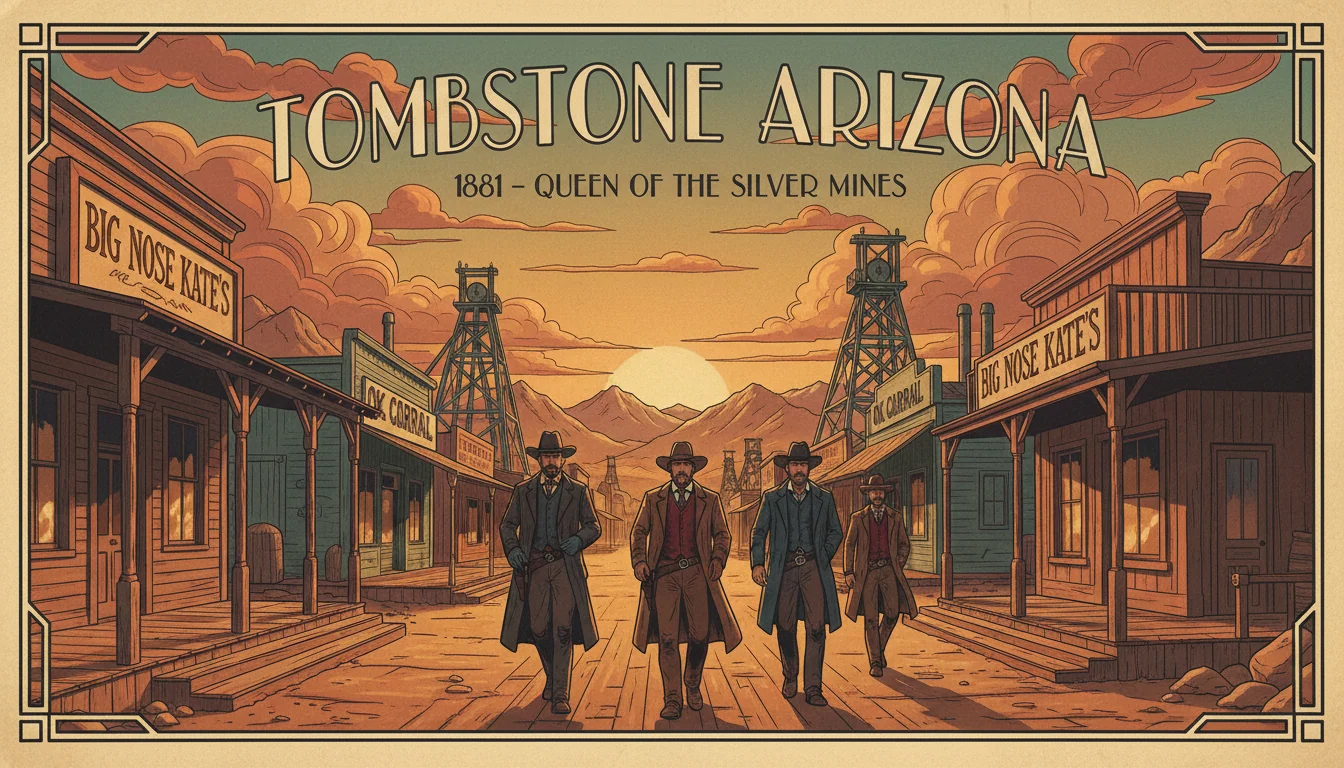
If you want to step into the most famous boomtown in American mythology, set your time machine for Tombstone, Arizona in the summer of 1881. The silver mines are at peak production. The town has 7,000 residents and 100 saloons. Wyatt Earp is a deputy U.S. Marshal. His brother Virgil is the town marshal. Doc Holliday is in town, dying slowly of tuberculosis. And the Cowboys, a loose gang of cattle rustlers and stagecoach robbers, are the town's largest political problem. Two months from now, the gunfight at the O.K. Corral will redraw the legend of the American West.
It is also a hot, dry, casually violent, hard-drinking town in a U.S. territory still six years away from statehood, where political factions cross with criminal networks, and where the law applies unevenly. So before you click your watch into 1881, here is your practical guide to surviving, blending in, and enjoying a visit to Wild West Tombstone.
First, know what kind of place you're entering
Tombstone is a silver-rush boomtown that did not exist five years ago. Prospector Ed Schieffelin filed the first claim in 1877. By 1881, the town has six newspapers, three mining-stock brokerage offices, an opera house, multiple churches, a school, an ice cream parlor, and roughly 100 saloons, dance halls, and gambling establishments. Two-thirds of its residents are men, mostly miners, mining-related laborers, gamblers, merchants, and law enforcement.
The political climate is sharply divided. Republican-leaning townspeople, often Northern transplants, are aligned with the Earps and Mayor John Clum. Democratic-leaning ranchers and rural residents, often with Southern roots, are aligned with the Cowboys, including the Clantons, McLaurys, and their associates. Sheriff Johnny Behan, a Democrat, is the principal county-level officer and is not a friend of the Earps.
Your safest cover story is that you are a mining engineer or stock investor visiting from San Francisco or Denver. Tombstone receives constant traffic of mining experts, brokers, and speculators. A foreign accent is fine. An unclear background is suspicious.
Do not pretend to be a working miner unless you can pass for one. Do not claim to be a prospector. Both will quickly raise questions you cannot answer.
Dress like you belong
Tombstone fashion in 1881 is a mix of working-class durability and aspirational town style. The mining camps and ranches favor practical work clothing. The town center favors the formality of late Victorian American business.
For men in town, wear:
- a dark wool suit jacket or sack coat
- matching trousers
- a stiff white shirt with detachable collar and cuffs
- a vest, often with a watch chain
- a four-in-hand tie or a bow tie
- polished leather boots, knee-high or shorter
- a felt or beaver-fur hat (a slouch hat or short-brim Stetson is common; the wide-brim Stetson is regional)
For men in the field, wear:
- canvas or wool trousers
- a flannel work shirt
- a vest
- sturdy leather boots
- a wide-brim hat with a leather band
- a bandana
For women, wear:
- a long bustled dress in dark wool or cotton
- a corset (still required for plausibility)
- gloves for outdoor wear
- a hat with feather or ribbon trim
- buttoned leather boots
Guns are a normal accessory in Tombstone, although the town has a controversial ordinance (Ordinance Number 9) banning the carrying of firearms within town limits. The ordinance is unevenly enforced and, in fact, will be the proximate cause of the O.K. Corral confrontation in October. As a visitor, do not carry a firearm openly in town. You will draw immediate attention from a deputy.
Get used to the heat and the dust
Tombstone sits at about 4,500 feet elevation in the Sonoran Desert highlands. Summers are hot and dry. Winters are cool with occasional rain. Dust is the permanent atmosphere of the town. Wagons, horses, and pedestrians stir up enormous clouds along Allen Street and the surrounding roads.
Carry a bandana. Drink water frequently. Visit during the cooler months (October through April) if you can. The October week of the O.K. Corral gunfight is, incidentally, an excellent time to visit, with mild temperatures and political tensions about to boil over.
Mosquitoes are not a serious problem at this elevation. Tarantulas, scorpions, and rattlesnakes are. Watch where you step. Shake out your boots in the morning.
Three places you absolutely must visit
The Bird Cage Theatre
Opened in December 1881 (just after the gunfight, but the construction is ongoing in summer), the Bird Cage will become one of the most famous saloons and theaters of the American West. Visit it under construction or, if your timing aligns, after its opening in late December. Even before the formal opening, the lots between Allen Street and Toughnut Street are buzzing with activity.
For a 1881-summer visit, focus on the Crystal Palace Saloon, the Oriental Saloon (where Wyatt Earp has interests), and the Hafford's Corner Saloon at the corner of Allen and Fourth Streets. These are the principal social venues for the Tombstone elite.
The Mining District
The silver mines that built Tombstone are operating at full capacity in 1881. The Tough Nut Mine, the Lucky Cuss, the Contention, and others extend in a band south of the town. You can tour an operating mine if you can secure an introduction through a mining engineer or stock agent.
Do not enter a mine without a guide. Mine accidents are frequent and lethal.
The O.K. Corral
The most famous gunfight in American history will not occur until October 26, 1881. If you visit before then, the O.K. Corral itself is a working livery stable owned by John Montgomery and Edward Benson. The actual gunfight will happen not inside the corral but in a vacant lot on Fremont Street, behind it.
Walk the route. Stand at the corner of Allen Street and Fourth Street. Look down toward Fly's Photographic Studio. The geography of the most famous 30 seconds in Western history is more compressed than you expect.
How to talk to people without causing trouble
English is universal in Tombstone, with regional variation. Mexican Spanish is common in the southern parts of the town and in the surrounding ranches. Chinese is spoken in the small Chinatown along the eastern edge of the business district.
A few universal rules help:
- nod politely when meeting townspeople
- buy a drink for a host or new acquaintance, but do not drink heavily yourself
- never insult someone's horse
- never call someone a liar in public; this is a violent insult
- avoid political conversation about the Cowboys
- remove your hat indoors
- give way to women on wooden sidewalks (they take precedence)
If a deputy asks your business, give a short and clear answer. Do not appear evasive. Tombstone law enforcement is suspicious of strangers without an obvious purpose.
What to eat, what to avoid
Tombstone food in 1881 is varied for a small territorial town, thanks to the railroad connection from Benson and the constant arrival of new merchants. Beef is plentiful. Mexican food is widely available. Wild game and local produce are seasonal. Coffee is the universal beverage.
Safe choices for a visitor:
- a steak dinner at the Crystal Palace or the Russ House (Nellie Cashman's restaurant)
- Mexican stew or carne asada at a small Mexican-run café
- bread and butter from any reputable bakery
- canned goods of recognized brands
- coffee at any establishment
Things to be careful of:
- water from outlying wells (urban wells are usually safe)
- whiskey of unknown origin (cheap "fortified" whiskey can be dangerous)
- pork from open-air vendors in summer
- shellfish (transportation from California is unreliable)
- raw produce in spring or summer
Beer is widely available and brewed locally. Ice is imported by railroad and is genuinely cold, an enormous luxury at this latitude.
Politics you should know about, briefly
In 1881, Arizona is still a federal territory. Statehood will not arrive until 1912. The territorial government is appointed by Washington, and federal authority interacts uncomfortably with local Democratic politics. The Earps are aligned with federal Republican interests. Sheriff Behan is aligned with local Democratic interests.
The Cowboys are not a single organized gang but a loose network of cattle rustlers, stagecoach robbers, and ranch hands operating across the Mexican border. They are protected by their alignment with Democratic ranchers and county officials. Their leaders include Curly Bill Brocius, Johnny Ringo, the Clantons (Old Man Clanton, Ike, Phin, and Billy), and the McLaury brothers (Frank and Tom).
The Earps and the Cowboys have been in slow-burning conflict throughout 1881. A stagecoach robbery in March 1881 produced a deputy's death. Deputy Marshal Wyatt Earp tried to make a deal with Ike Clanton in June for information leading to the arrest of the robbers, but the deal fell apart and Clanton accused Earp of betraying their secret arrangement.
By summer 1881, both sides are armed, watchful, and increasingly public in their hostility. The October confrontation is approaching.
If you must discuss politics, do not take sides. Praise the silver industry and the town's commercial growth. Avoid speculating about specific local figures.
What not to do under any circumstances
Let me save you from the classic mistakes.
Do not:
- carry a firearm openly in town
- enter the Cowboys' favored saloons (the Grand Hotel) wearing visible Republican symbols
- enter the Earps' favored saloons (the Oriental) and praise the Clantons
- gamble heavily with money you cannot replace
- drink whiskey from open bottles whose origin you don't know
- challenge anyone's claim, accusation, or insult
- enter a mine alone
- ride a horse without basic competence
- attempt to photograph a Cowboys faction member without permission
Most importantly, do not warn anyone about the gunfight at the O.K. Corral. The town is approaching a violent confrontation that will reshape American Western mythology. Let it happen.
The experience you should not miss
If you have one moment in Tombstone, take it on Allen Street at sunset. The dust catches the late light. Saloon doors swing open and shut. Wagons move slowly along the rutted road. A miner with a fresh paycheck stops at a Chinese laundry. A stage coach rolls in from Benson. The Earp brothers, in dark suits and felt hats, walk past the Oriental Saloon with measured steps.
You are watching the most famous boomtown in American history at the precise moment of its greatest tension. Within a year, the O.K. Corral gunfight, the assassination of Morgan Earp, and Wyatt Earp's vendetta ride will reshape the entire American Western imagination.
Pack your bandana, drink your water frequently, and never call a man a liar. Tombstone in 1881 is one of the most evocative destinations on any time-travel itinerary.
For another American boom town at an earlier hinge moment, see our guide to Gold Rush San Francisco, 1850. For a very different American city of the same era, see Antebellum New Orleans, 1850.

Need Advice from Someone Who Lived There?
Get firsthand accounts from people who actually lived through these moments in history.
Ask Them YourselfJoin the HistorIQly Club
Get smarter about the past.
Weekly stories, deep dives, and exclusive content straight to your inbox.