Tombstone vs. History: How Accurate Is the 1993 Wyatt Earp Movie?
Tombstone movie accuracy check: how much of Cosmatos's 1993 Western actually happened? The gunfight, the vendetta ride, Doc Holliday, and the invented red sashes.
When Tombstone opened in December 1993, it became the unexpected critical and commercial success of an otherwise tepid Western year, beating Lawrence Kasdan's later, more academic Wyatt Earp (1994) by a wide margin. Kurt Russell played Wyatt Earp as a quietly principled retired lawman dragged back into action. Val Kilmer played Doc Holliday with operatic theatricality. Sam Elliott played Virgil. The film's vision of Tombstone, the Cowboys, and the gunfight has shaped how a generation of viewers imagine the American West.
How does Tombstone movie accuracy hold up against the historical record? Mostly well. The basic events of October 26, 1881 and the months that followed are real. The film softens some details, embellishes others, and gives Doc Holliday a louder voice than the historical record supports. But unlike many Western mythologies, Tombstone is grounded in genuine documentary research and stays unusually faithful to the major facts.
What Hollywood Got RIGHT
The Earps in Tombstone
The film correctly identifies the basic biographical facts. Wyatt Earp moved to Tombstone in December 1879 with his brothers Virgil and James. The Colt Peacemaker he and his brothers carried was the standard sidearm of the era, and the film's depiction of it is accurate. They were accompanied by Mattie Blaylock (Wyatt's common-law wife) and other family members. Morgan joined them in 1880. The brothers held mining claims, ran a stagecoach service, and held law enforcement positions. Virgil eventually became town marshal. Wyatt was a deputy U.S. Marshal during the relevant period.
The film's depiction of their commercial interests, including Wyatt's stake in the Oriental Saloon and the Earps' general drift toward becoming a regional political faction, is accurate. They were not just lawmen. They were a small-business family that had come to Tombstone to make money, and most of their conflicts with the Cowboys had as much to do with commerce and politics as with abstract ideas of justice.
The Cowboys
The film correctly identifies the Cowboys as a loose criminal network rather than a single organized gang. The leaders included Old Man Clanton (Newman Haynes Clanton, killed in August 1881 in a Mexican border ambush), his sons Ike and Billy, the McLaury brothers Frank and Tom, Curly Bill Brocius, and Johnny Ringo. They engaged in cattle rustling across the Mexican border, stagecoach robbery, and assorted minor crimes. They were protected by alignment with Democratic county officials, including Sheriff Johnny Behan.
The casting of Powers Boothe as Curly Bill, Michael Biehn as Johnny Ringo, Stephen Lang as Ike Clanton, and Thomas Haden Church as Billy Clanton is broadly accurate to the actual roles these men played in 1881 Tombstone.
The gunfight at the O.K. Corral
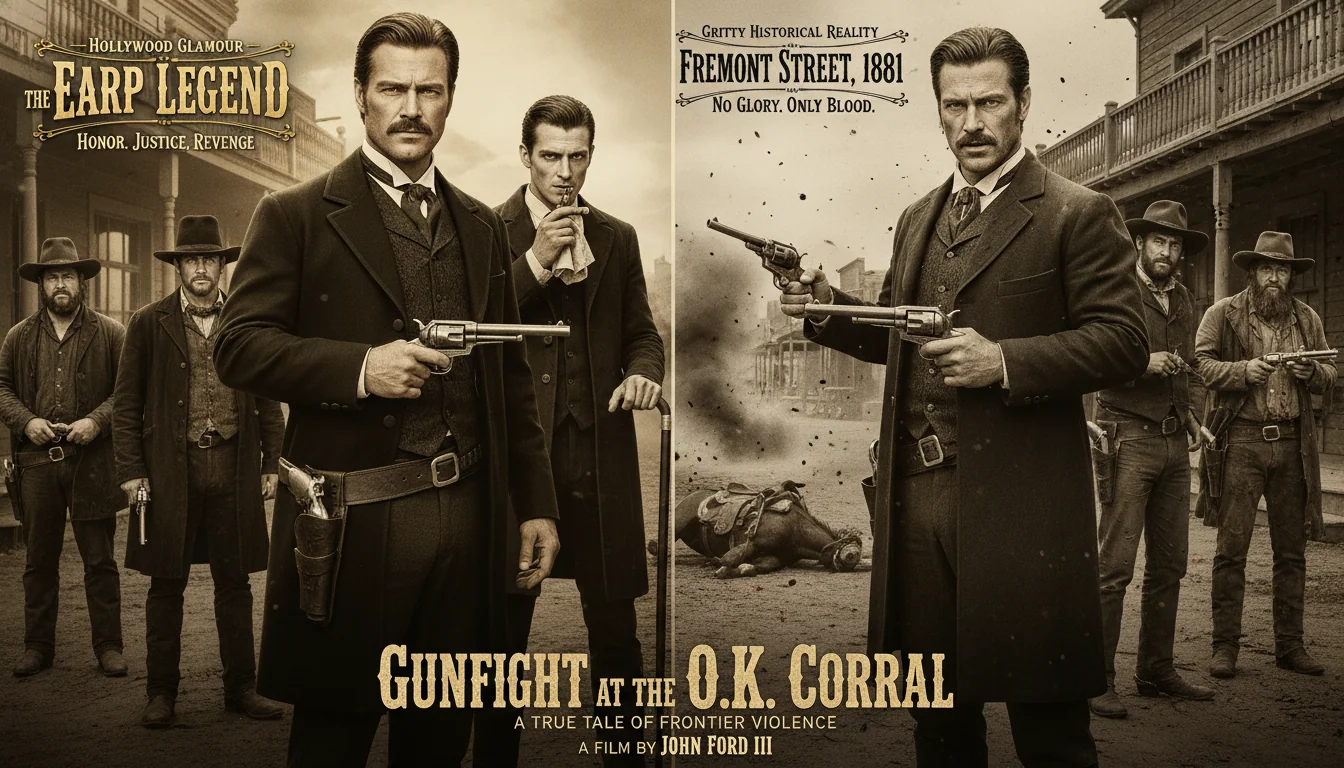
The October 26, 1881 gunfight is depicted with fidelity to the basic facts. Wyatt, Virgil, and Morgan Earp, accompanied by Doc Holliday, confronted Ike and Billy Clanton, Frank and Tom McLaury, and Billy Claiborne in a vacant lot on Fremont Street, behind the O.K. Corral. The disagreement that brought them together was about Tombstone's anti-firearms ordinance, which the Cowboys had been violating publicly that morning.
Roughly 30 shots were fired in approximately 30 seconds. Billy Clanton, Frank McLaury, and Tom McLaury were killed. Virgil Earp was wounded in the calf. Morgan was wounded in the shoulder. Doc Holliday was grazed. Wyatt was unhurt. Ike Clanton, who had been the loudest threatener of the Earps in the days leading to the fight, was unarmed and ran from the scene.
The film's choreography is reasonably accurate, although it cleans up some of the actual confusion. The exact opening shots of the gunfight remain debated, with witnesses giving inconsistent accounts. The film picks one plausible reconstruction.
The vendetta ride
The film's depiction of the Earp Vendetta Ride is broadly accurate. After Morgan Earp was assassinated on March 18, 1882 and Virgil was crippled in an ambush in December 1881, Wyatt Earp led a federal posse, including Doc Holliday, Warren Earp, Sherman McMaster, Texas Jack Vermillion, and Turkey Creek Jack Johnson, on a series of killings across southern Arizona.
Among those killed by the posse were Frank Stilwell (in the Tucson rail yard on March 20, 1882), Florentino Cruz (March 22), and most likely Curly Bill Brocius (in a March 24 fight at Iron Springs). Wyatt was indicted on murder charges but never tried, partly because he fled Arizona for Colorado and California and partly because territorial authority was disputed.
The film's stylized presentation of the vendetta as a focused mission of revenge is more cinematic than the actual chaotic series of confrontations, but the major killings and outcomes match the record.
Doc Holliday's loyalty
Val Kilmer's depiction of Doc Holliday's loyalty to Wyatt Earp is grounded in fact. Holliday, a former dentist from Georgia turned gambler, suffered from advanced tuberculosis throughout his time in Tombstone. He genuinely could outdraw most opponents and was deadly with both pistol and shotgun. His friendship with Wyatt Earp, which went back to their meeting in Texas around 1878, was the central personal relationship of his adult life.
Holliday eventually died of tuberculosis in 1887 at age 36, in a Glenwood Springs, Colorado hotel. His last words, according to traditional accounts, were "this is funny" - supposedly a reflection on dying with his boots off after years of expecting to die in a gunfight.
What Hollywood Got WRONG
The number of Cowboys
The film implies a substantially larger Cowboys force than the historical record supports. The opening scene shows what looks like dozens of Cowboys riding into a wedding to massacre a Mexican family. There was no such single massacre. Cowboys violence against Mexicans on the border was real but consisted mostly of cattle raids and individual killings, not the cinematic spectacle of mass murder.
The black-shirted Cowboys uniformity is also fictional. The actual Cowboys did not wear matching colors or any kind of identifying outfit.
Wyatt Earp's character
Kurt Russell's Wyatt Earp is presented as a reluctant, principled man drawn into violence by external events. The historical Wyatt was more ambitious, more politically calculating, and considerably more interested in commerce than the film suggests. He was also less of a moral paragon. He had spent his earlier career in Dodge City and Wichita as a sometimes-controversial lawman, and his Tombstone career involved business interests that were not always above board.
The film's framing of him as a quietly retired hero pulled into action by gradually escalating provocation is romanticized.
Mattie Blaylock and Josephine Marcus
The film handles the women in Wyatt Earp's life with simplification. Mattie Blaylock, his common-law wife who came with him to Tombstone, was struggling with laudanum addiction and was eventually abandoned by Wyatt for Josephine Marcus, who had been involved with Sheriff Johnny Behan before becoming Earp's lifelong companion.
The film softens this triangle and minimizes Mattie's tragic eventual fate (she died of an overdose in 1888 in poverty). The actual situation was emotionally messier than the film acknowledges.
Johnny Ringo
The film makes Johnny Ringo into a poetic, almost philosophical Latin-quoting villain who personally menaces Doc Holliday. The historical Ringo was a real man with a complicated past, but the cinematic Ringo is a heightened, almost gothic figure. The famous duel between Holliday and Ringo, in which Holliday supposedly kills him, is fictional.
Ringo was found dead under a tree in Turkey Creek Canyon on July 13, 1882, with a single gunshot wound to the head. The official ruling was suicide. Some historians have argued for murder, possibly by Wyatt Earp during a secret return to Arizona, or by Frank Leslie. There is no documentary evidence that Holliday killed him. By July 1882, Holliday was almost certainly elsewhere.
The Cowboy "red sash"
The film's iconic red sashes worn by the Cowboys are a costume invention. The historical Cowboys did not have an identifying garment. The red sash imagery was popularized by Tombstone and has shaped subsequent Western fiction, but it is not historical.
What the film captures even when it bends facts
Tombstone gets one specific thing exactly right: the political and commercial texture of a silver-rush boomtown in 1881. The mixture of gambling, prostitution, mining stock speculation, partisan politics, casual violence, and Victorian social expectations is captured in ways more careful than most Westerns. The film understands that Tombstone was a real working town, not a romantic backdrop.
The film also captures the loyalty and mutual reliance among the Earp brothers and Holliday in ways more emotionally truthful than the documentary record alone can convey. Whatever its embellishments, the film is correct that this was, at its core, a story about a small group of men trying to keep each other alive in a place that was trying very hard to kill them.
Historical Accuracy Score: 7.5/10
Tombstone is one of the more historically accurate Western films of its era. It correctly identifies the major figures, the political alignments, the gunfight at the O.K. Corral, the assassination of Morgan Earp, and the vendetta ride. It embellishes the Cowboys' uniformity and violence, romanticizes Wyatt Earp's character, and invents the Doc Holliday-Johnny Ringo duel.
What the film gets most right: the gunfight, the vendetta ride, and Doc Holliday's loyalty.
What it gets most wrong: the red sashes, the Holliday-Ringo duel, and the moral simplification of Wyatt Earp.
The bottom line is that Tombstone is one of the best Hollywood treatments of a real Western event. If you want the legend in its most cinematic form, watch the film. If you want the man and the town behind the legend, the historical record is more interesting than the myth. For another accuracy question in a different genre, compare Gladiator (2000)'s treatment of Marcus Aurelius.
Quick Answers
Common questions about this topic
Is Tombstone based on a true story?
Yes. The 1993 film, directed by George P. Cosmatos with substantial uncredited direction from Kurt Russell, is based on the real events surrounding Wyatt Earp's time in Tombstone, Arizona between 1879 and 1882, including the gunfight at the O.K. Corral and the subsequent vendetta ride against the Cowboys gang.
Did the gunfight at the O.K. Corral really happen the way the movie shows it?
The basic facts are correct: on October 26, 1881, Wyatt, Virgil, and Morgan Earp, with Doc Holliday, confronted Ike and Billy Clanton, Frank and Tom McLaury, and Billy Claiborne in a vacant lot on Fremont Street. Roughly 30 shots were fired in 30 seconds. Three Cowboys were killed. The film embellishes details but captures the broad event accurately.
Was Doc Holliday really as dramatic as Val Kilmer played him?
Doc Holliday was a dentist turned gambler who suffered from advanced tuberculosis throughout his time with the Earps. His loyalty to Wyatt Earp and his deadly competence with both pistol and shotgun are well documented. The exact tone of Val Kilmer's performance is theatrical, but the underlying character traits are largely accurate.
Did Wyatt Earp actually carry out a vendetta after the gunfight?
Yes. After his brother Morgan was assassinated in March 1882 and Virgil Earp was crippled in an ambush in December 1881, Wyatt Earp led a federal posse on what became known as the Earp Vendetta Ride, killing Frank Stilwell, Curly Bill Brocius, and others. He was indicted but never tried. He fled Arizona and lived to age 80.

Debate the Accuracy with the Real Figures
Ask the real people what Hollywood got wrong about their lives.
Chat with HistoryJoin the HistorIQly Club
Get smarter about the past.
Weekly stories, deep dives, and exclusive content straight to your inbox.