Time Traveler's Guide to Abbasid Baghdad, 800 AD
Survive Abbasid Baghdad in 800 AD - the Round City and greatest metropolis on Earth during the Islamic Golden Age under Caliph Harun al-Rashid.
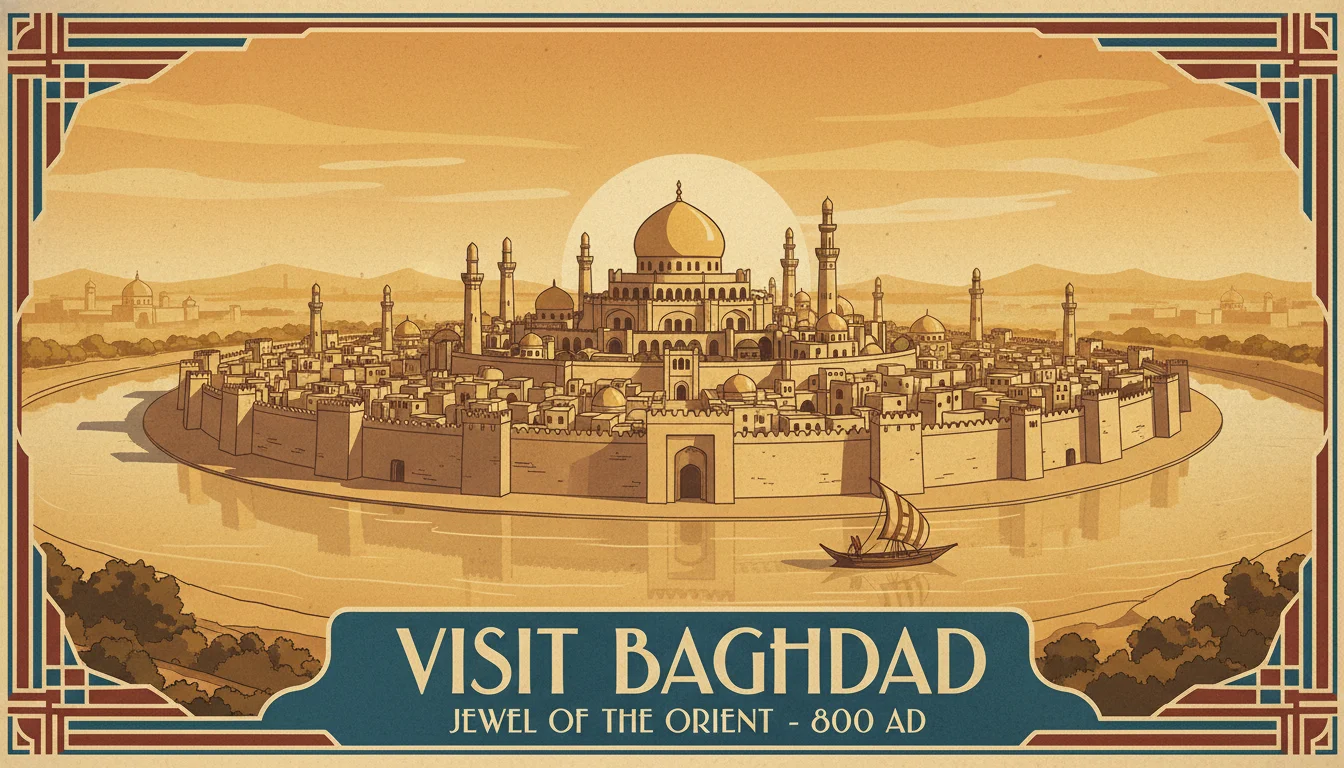
Welcome, traveler, to the center of the known world. The year is 800 AD, and Abbasid Baghdad is not just a city - it is the city. With a population pushing over a million souls, it dwarfs anything in Europe. London is a muddy village by comparison. Constantinople is respectable, but Baghdad? Baghdad is where knowledge, wealth, and power converge like nowhere else on the planet.
Caliph Harun al-Rashid sits on the throne of the Abbasid Caliphate, ruling an empire stretching from Morocco to Central Asia. And you are about to walk through the gates of his capital. Here is everything you need to know to survive - and maybe even enjoy yourself.
Getting Your Bearings
Baghdad was built from scratch in 762 AD by Caliph al-Mansur as a perfect circle - locals call it the "Round City" or Madinat al-Salam, the City of Peace. The original circular walls contain the caliphal palace and the Great Mosque at the center, but by 800 AD the city has sprawled far beyond those walls on both sides of the Tigris River.
The east bank (Rusafa) is the commercial heart. The west bank (Karkh) is where the markets overflow with goods from every corner of the known world. A series of pontoon bridges connect the two halves. You will cross these daily if you want to experience everything.
Do not get lost in the narrow lanes of the souks. Memorize the nearest mosque - the call to prayer five times a day is your free GPS system.
What to Wear
Leave the jeans at home. Men should wear a long tunic called a thawb or qamis, ideally in white or undyed linen. Over that, a loose robe - the jubba. A turban is not strictly required for non-Muslims, but wearing one signals respectability and keeps the Mesopotamian sun from cooking your brain. Cotton and linen are your friends. Silk is available but expensive, and wearing it as a man raises eyebrows among the pious.
Women should wear loose, layered garments and a head covering. A large rectangular cloth (khimar) draped over the head and shoulders is standard. Wealthy women wear colorful silks and brocades underneath.
Footwear: leather sandals or soft boots. The streets are a mix of packed earth, brick, and occasionally something you would rather not step in.
Pro tip: Keep your clothes clean. Baghdadis take personal hygiene seriously. Public bathhouses (hammams) are everywhere, and they are glorious. Use them.
What to Eat (and Drink)
You are in for a treat. Baghdad in 800 AD has perhaps the most sophisticated cuisine in the world. Forget the bland porridge of medieval Europe - this is a food culture that writes actual cookbooks.
Must-try dishes:
- Sikbaj - A sweet-and-sour meat stew with vinegar, honey, and dried fruits. The caliph's personal favorite.
- Tharid - Layers of bread soaked in rich meat broth. Simple, hearty, beloved by everyone from laborers to scholars.
- Harisa - Slow-cooked wheat and meat pounded into a smooth, warming paste. Perfect breakfast food.
- Lauzinaj - Delicate almond pastries wrapped in thin dough, soaked in rosewater syrup. Dessert of champions.
- Fresh fruits - Dates, pomegranates, figs, apricots, and melons are abundant and spectacular.
The markets sell spices from India, saffron from Persia, and sugar (still a luxury, but available). Street food vendors line the major thoroughfares.
Drinking: Water is drawn from the Tigris and sold by water carriers. Fruit drinks - especially pomegranate and tamarind - are popular. Officially, alcohol is forbidden under Islamic law. Unofficially... wine from the Christian and Jewish communities circulates freely, and even the caliph's court is known to enjoy an evening of poetry and wine. Just be discreet about it.
Customs and Social Rules
Religion runs the clock. The call to prayer (adhan) sounds five times daily. During prayer times, most activity pauses. Non-Muslims are not required to pray, but do not eat, drink, or make noise conspicuously during these moments.
Right hand only. Eat with your right hand. Offer things with your right hand. The left hand is considered unclean - using it in social situations is a serious faux pas.
Hospitality is sacred. If someone invites you to their home, accept. Refusing is rude. You will be offered food and drink - eat, compliment the host, and bring a small gift if possible.
Greetings matter. "As-salamu alaykum" (peace be upon you) is the standard greeting. Even non-Muslims can use it, and people will appreciate the effort.
Religious diversity is real. Baghdad is home to Muslims, Christians (especially Nestorians), Jews, Zoroastrians, and Sabians. They all live and work alongside each other, often in the same neighborhoods. The Caliph's personal physician is likely a Christian. Tolerance is not perfect, but it is remarkably broad by any historical standard.
The Barmakid family are the caliph's powerful viziers. Mentioning them favorably opens doors everywhere. But heads up - in a few years, Harun will turn on them spectacularly. Do not get too attached.
Dangers and What to Avoid
The Tigris floods. Springtime can bring devastating floods. If locals start looking nervous and moving their goods to upper floors, follow their lead.
Street crime exists. The souks can be rough after dark. Pickpockets, con men, and occasional armed robbers operate in the alleys. Travel with companions at night and keep your money in a belt pouch, not a dangling purse.
Political intrigue. The Abbasid court is a web of factions, spies, and shifting loyalties. Do not discuss politics with strangers. Do not express opinions about the caliph. Smile, nod, and change the subject.
Disease. This is the 9th century - dysentery, malaria (from the marshes south of the city), and various fevers are real threats. Drink boiled beverages when possible. The hammams are clean, but avoid any that look poorly maintained.
Do not insult Islam. Seriously. Blasphemy is not treated as free expression. Keep theological opinions to yourself.
Must-See Attractions
The House of Wisdom (Bayt al-Hikma) - This is the reason scholars will remember Baghdad for a thousand years. Founded under the Abbasids, this institution is translating Greek, Persian, Indian, and Syriac texts into Arabic at an astonishing pace. Mathematics, astronomy, medicine, philosophy - it is all happening here. If you can talk your way inside, you might meet scholars who are literally inventing algebra.
The Round City walls - Even though the city has expanded beyond them, the original circular fortifications are an architectural marvel. Four gates (Kufa, Basra, Khorasan, and Damascus) point toward the empire's key directions.
The caliphal palace - You will not get inside without an invitation, but the golden gate and surrounding gardens are impressive from the outside. On feast days, processions spill out into the streets with musicians, soldiers, and elephants.
The souks of Karkh - Miles of covered markets selling everything: Chinese silks, Indian spices, African ivory, Persian carpets, Byzantine glassware, and books - so many books. Baghdad has a thriving paper industry (reportedly learned from Chinese prisoners of war, though historians now dispute that tale), and booksellers occupy entire streets.
The Tigris riverfront - Rent a small boat and drift along the river at sunset. Both banks are lined with gardens, mansions, and mosques. The poet Abu Nuwas (who may try to sell you wine and recite scandalous verses) frequents the taverns along the east bank.
Friday prayers at the Great Mosque - Even as an observer, the sheer scale of communal prayer with thousands of worshippers is unforgettable.
Practical Survival Tips
- Learn some Arabic. Persian is widely understood too, but Arabic is the language of government, religion, and scholarship.
- Carry dinars and dirhams. Gold dinars for big purchases, silver dirhams for daily expenses. The Abbasid currency is accepted from Spain to India.
- Find a khan (caravanserai). These are combination hotels and warehouses for travelers. They are basic but safe, and the innkeeper can connect you with local guides.
- Paper is cheap here. Baghdad manufactures paper in bulk. Buy some and keep a journal - you are living in a golden age that will be remembered forever.
- Visit a hospital. Baghdad has actual functioning hospitals (bimaristans) with separate wards, pharmacies, and medical students. They treat patients for free regardless of religion. This is centuries ahead of anything in Europe.
Your One-Sentence Survival Mantra
Keep your right hand ready, your opinions quiet, and your curiosity wide open - you are standing in the intellectual capital of the world, and it will not last forever.
The Mongols are coming in about 450 years - after which the Islamic world's center of gravity shifts west to Mamluk Cairo. But for now, Baghdad shines brighter than any city on Earth. Enjoy every moment.

Need Advice from Someone Who Lived There?
Get firsthand accounts from people who actually lived through these moments in history.
Ask Them YourselfJoin the HistorIQly Club
Get smarter about the past.
Weekly stories, deep dives, and exclusive content straight to your inbox.