Time Traveler's Guide to Achaemenid Persepolis, 500 BC
Your survival guide to Achaemenid Persepolis in 500 BC - what to wear, who to bribe, and how to survive the world's first superpower at its ceremonial height.
Read Wikipedia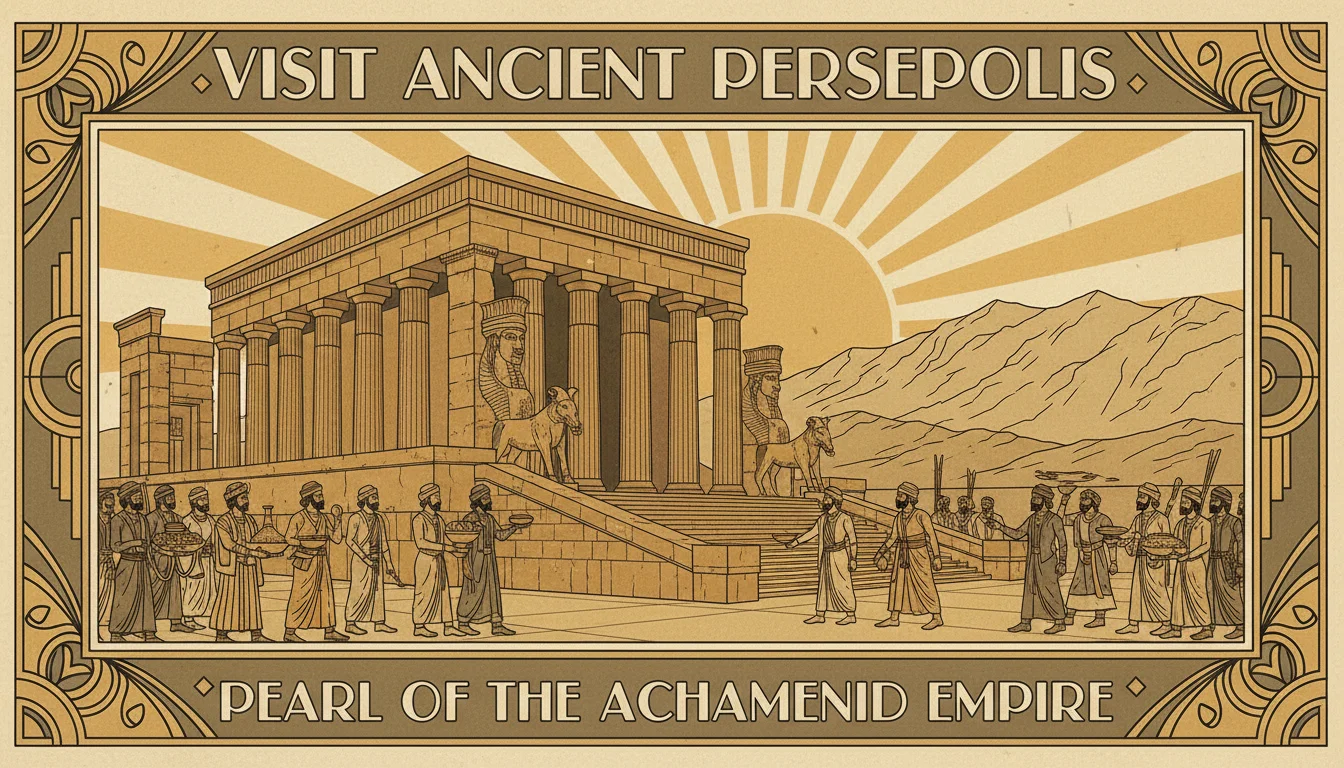
Welcome to Achaemenid Persepolis, the ceremonial heart of the largest empire the world has ever seen. The year is 500 BC, give or take. Darius the Great sits on the throne of thrones, and his domain stretches from Egypt to India. You're about to walk into a city that makes everything you know look provincial.
Pack your humility. You'll need it.
When to Visit
Aim for Nowruz, the spring equinox in late March. This is when the empire literally comes to you. Delegations from twenty-three subject nations parade through the Apadana, bearing tribute to the King of Kings. You'll see Babylonians with bulls, Ethiopians with elephant tusks, Lydians carrying golden vessels, and Gandharans from modern Afghanistan with camels.
Miss Nowruz, and Persepolis becomes almost a ghost town. The court moves seasonally between Susa (winter), Ecbatana (summer), and Babylon (whenever they feel like it). Persepolis is primarily a ritual space, not a bustling metropolis.
Avoid summer. The Marv Dasht plain where Persepolis sits becomes an oven. The elevation helps, but not enough.
What to Wear
Leave the toga at home. Persian fashion operates on different principles.
For men: You'll want the kandys, a sleeved robe worn draped over the shoulders (never actually put your arms through - that's for servants). Underneath, fitted trousers tucked into soft leather boots. The Persians invented trousers, and they think your bare legs are hilarious. Colors matter: purple is for royalty only, so stick to deep reds, blues, or saffron yellow.
For women: Ankle-length pleated robes with wide sleeves. Veils are optional in Persepolis proper, but expected when moving through public spaces. Heavy gold jewelry is not just acceptable - it's a status marker. Understated elegance is not a thing here.
Everyone: Grow your beard (if applicable) and oil it obsessively. A trimmed beard reads as Greek, and Darius is not a fan of Greeks right now. The king just finished crushing the Ionian Revolt, and Marathon is coming in ten years. Best not to remind anyone.
The Currency Situation
The empire runs on silver sigloi and gold darics (named after Darius himself). One daric equals twenty sigloi. The exchange is remarkably standardized for the ancient world - another Persian innovation.
But here's the thing: in Persepolis specifically, most transactions happen through the elaborate royal distribution system. Workers receive grain, meat, wine, and beer rations recorded on clay tablets. The economy isn't fully monetized here. It's more bureaucratic than bazaar.
Bring darics for emergencies, but be prepared to navigate a system that looks more like corporate expense accounts than shopping.
What to Eat
Persian cuisine is already sophisticated, drawing from across the empire.
Breakfast: Flatbread with cheese and honey, pistachios, dates. Strong tea doesn't exist yet (that's China), but you can get fruit juices and watered wine.
Feasts: If you somehow score an invitation to a royal banquet, expect roasted game (deer, boar, wild ass), elaborate stews with pomegranate and walnuts, and rice dishes from the eastern provinces. The Persians learned rice cultivation from India, and they're already improving on it.
Street food: Grilled kebabs aren't anachronistic at all. Skewered meats have been a Persian staple for centuries. Look for lamb or chicken with sumac and saffron. Also try ash, a thick soup-stew situation that's basically the national comfort food.
Warning: Don't drink the water unless it's from the qanat system - the underground channels that bring mountain snowmelt to the city. It's remarkably clean. Everything else will destroy you.
Navigating the Site
Persepolis isn't a city in the normal sense. It's a propaganda machine made of stone.
The Grand Stairway: The main approach is a double-reversing staircase wide enough for horses. The shallow steps are intentionally designed so foreign delegations ascend slowly, in their finest robes, visible to everyone below. Architecture as humiliation.
The Gate of All Nations: Two enormous lamassu (winged bulls with human heads) guard the entrance. There's an inscription in three languages - Old Persian, Elamite, and Babylonian - announcing that Xerxes (Darius's son) built this. You're not at the gate for its beauty; you're there to feel small.
The Apadana: The main audience hall. Seventy-two columns hold up a roof that covers 10,000 standing people. This is where the Nowruz tribute happens. The stone reliefs along the staircases show every nation of the empire in perfect, hierarchical order. Find your approximate homeland and note your position in the cosmic pecking order.
The Treasury: Don't even think about it. Guarded by the Immortals, the king's elite guard of exactly 10,000 men. They're called immortals because whenever one dies, he's immediately replaced, keeping the number constant. Not actually supernatural, but definitely not people you want to test.
Customs That Will Save Your Life
Proskynesis: When approaching anyone of higher rank (and everyone in Persepolis is higher rank than a random time traveler), you bow. The depth of the bow indicates relative status. Before the king, you prostrate yourself entirely, face to ground. Greeks consider this blasphemously excessive. Persians consider Greeks uncouth. Do the bow.
Gift-giving: Never come empty-handed. A small symbolic gift when meeting anyone significant is expected. It doesn't have to be expensive - a well-crafted small object shows thought. The gift is about the gesture, not the value.
Truth-telling: Persians famously teach their children "to ride, to shoot, and to tell the truth." Lying is considered the worst possible moral failing. This doesn't mean they're naive - Persian court intrigue is legendary - but explicit, caught-in-the-act lying marks you as subhuman.
Religious tolerance: The Achaemenid Empire is radically pluralist. Darius personally follows Ahura Mazda (Zoroastrian supreme deity), but he doesn't care what you worship. Jews, Babylonians, Egyptians - everyone keeps their gods. Don't be weird about other people's religions, and nobody will be weird about yours.
Dangers to Avoid
The Royal Road: The empire's highway system stretches 1,600 miles from Susa to Sardis. It's efficient, guarded, and has rest stations every day's ride. It's also monitored. Royal couriers can cover the whole distance in nine days. Messages about a suspicious traveler will move faster than you can.
The Nobility: Persian aristocrats trace their lineage to the original seven families that helped Darius seize power. They're wealthy, proud, and extremely touchy about status. Never suggest you're their equal. Never.
Satraps: The empire is divided into provinces ruled by satraps (governors). They have almost total local authority, including the power of execution. Satrap-level justice moves quickly and doesn't appeal.
The King's Eye: Darius maintains a network of inspectors who roam the empire checking on satrap behavior. They answer only to the king. If one takes interest in you, your options narrow rapidly.
What to See Before You Leave
The Tomb of Darius at Naqsh-e Rostam: About a fifteen-minute ride from Persepolis. The king's tomb is carved into a cliff face, designed to intimidate for eternity. The reliefs show Darius on a platform held up by representatives of every subject nation. It's megalomaniac, but you have to respect the commitment.
The qanat system: The underground channels are an engineering marvel you won't fully appreciate unless you understand how dry this region is. Tour the outlets where mountain water emerges miles from its source.
The inscriptions: The Behistun inscription (days away, unfortunately) records Darius's rise to power in three languages. It will eventually let modern scholars decode cuneiform. You're looking at future Rosetta Stone material.
Pasargadae: About 40 miles northeast. The tomb of Cyrus the Great, the founder of the empire. Even Darius makes pilgrimage here. A modest structure compared to Persepolis, but infinitely more moving.
Your Exit Strategy
Get out before 330 BC, when Alexander the Great will burn the whole complex to the ground, allegedly in a drunken rage. Some say it was revenge for Xerxes burning Athens. Some say a courtesan named Thaïs goaded him into it.
Either way, everything you're seeing will be ash.
Until then, enjoy the greatest empire of the ancient world. It's efficient, tolerant, cosmopolitan, and breathtakingly arrogant. The Persians believe they represent the pinnacle of human civilization, the sacred order holding back chaos.
For another two centuries, they're not entirely wrong.
Safe travels, and remember: always approach from the left, and never look the king directly in the eyes.
For other ancient Near Eastern time-travel stops, see our guides to Hittite Hattusa, 1300 BC and Olmec La Venta, 900 BC.

Need Advice from Someone Who Lived There?
Get firsthand accounts from people who actually lived through these moments in history.
Create your free account →No card required. Some figures and features require a paid plan.
Join the HistorIQly Club
Get smarter about the past.
Weekly stories, deep dives, and exclusive content straight to your inbox.