Visiting Ancient Rome in 44 BC: A Survival Guide
Planning a trip to Ancient Rome? This guide covers where to stay, what to eat, and how to survive the Ides of March in 44 BC - the most dangerous month in Roman history.
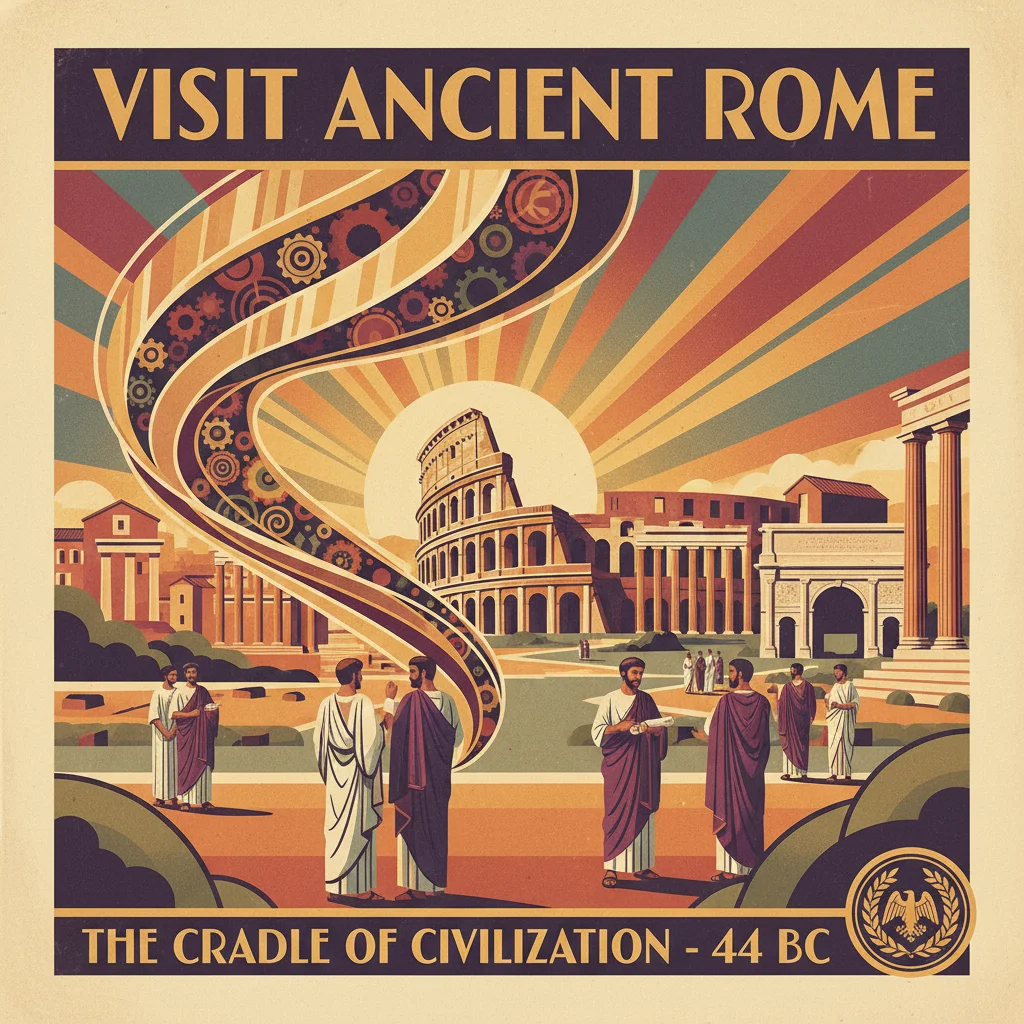
Welcome, time traveler! You've selected March 44 BC for your trip to Ancient Rome. Bold choice. This is one of the most momentous months in human history -though you'll want to stay away from the Senate House on the 15th unless you enjoy political violence.
Let's get you oriented, housed, fed, and (hopefully) alive through your visit to the Eternal City at the height of its Republican glory.
ARRIVAL: What You'll See
As your time machine materializes on the banks of the Tiber, you're immediately struck by the smell. Nobody warned you about the smell.
Ancient Rome has about 1 million inhabitants crammed into a city with no real sewage system, limited running water, and waste dumped directly into the streets. The Cloaca Maxima (the Great Sewer) exists, but it mainly drains the Forum -everywhere else, you're wading through a charming mixture of human waste, animal dung, food scraps, and industrial runoff.
Welcome to the greatest city in the world!
What to bring:
- Sturdy sandals (you'll be walking through... things)
- A toga if you want to blend in (white for citizens, purple trim for senators)
- Silver denarii (Roman coins -credit cards haven't been invented yet)
- A basic knowledge of Latin (Greek also helps; educated Romans are bilingual)
- Modern medicine (you're going to need it)
ACCOMMODATION: Where to Stay
You have two main options, depending on your budget and tolerance for discomfort.
Option 1: The Insula (Budget Option)
What it is: An insula is a multi-story apartment building -ancient Rome's version of a tenement. Most Romans live in these.
The upside:
- Cheap (a few denarii per month)
- Central location (insulae are everywhere)
- Authentic Roman experience
The downside:
- Fire hazard: Built mostly of wood, insulae burn down regularly. The higher the floor, the cheaper the rent -and the more likely you are to die in a fire.
- Collapse risk: Landlords cut corners. Buildings fall down. This happens enough that there are laws about it.
- No running water: Water is on the ground floor only. You're carrying it up six flights of stairs.
- No kitchen: Cooking fires cause those previously mentioned building fires. You'll be eating out every meal.
- No toilet: Chamber pots emptied out the window. Remember that smell we mentioned?
- Noise: Paper-thin walls. Your neighbors include crying babies, loud merchants, and probably a brothel.
Recommendation: Only if you're on a very tight budget or doing immersive historical research.
Option 2: The Domus (Luxury Option)
What it is: A domus is a single-family home, typically built around a central courtyard (atrium). This is how the wealthy live.
The upside:
- Private: Your own space, your own walls
- Safe(r): Stone construction, less likely to collapse or burn
- Running water: Many domus have private aqueduct connections
- Kitchen: The culina allows for home cooking (by your slaves, obviously)
- Toilet: A private latrine that drains into the sewer
- Beautiful: Frescoes, mosaics, gardens, fountains
The downside:
- Expensive: You're looking at thousands of denarii to rent
- Requires staff: A domus assumes you have slaves to run it
- Less central: The nicest domus are on the Palatine Hill, away from the crowded Forum
Recommendation: If you can afford it, definitely go with the domus. Your future self will thank you.
Option 3: Just Stay at Cicero's House
If you can befriend Marcus Tullius Cicero (and honestly, he's quite friendly once you get him talking about philosophy), he has a beautiful domus on the Palatine Hill. He's usually willing to host interesting foreigners.
Pros: Great conversation, extensive library, witness history firsthand Cons: He talks. A lot. Like, a lot a lot.
FOOD: What to Eat (and What to Avoid)
Roman cuisine in 44 BC is surprisingly sophisticated -and sometimes horrifying.
Safe Bets:
Bread The foundation of the Roman diet. Bakeries are everywhere. Fresh loaves are cheap, filling, and generally safe. Look for the round loaves stamped with the baker's mark.
Olives and olive oil Everywhere. In everything. Romans go through olive oil like modern Americans go through coffee.
Wine (watered down) Romans almost never drink wine straight -they mix it with water, sometimes honey, sometimes spices. Drinking it neat is considered barbaric. The water/wine ratio also kills bacteria, making it safer than straight water.
Cheese Roman caseus (cheese) is surprisingly good. Try the aged varieties from the countryside.
Fruit Figs, dates, grapes, apples, pears -all common and generally safe. Avoid anything that looks unwashed.
Meat Pork, chicken, and game birds are common. Beef is rarer (cattle are for work, not food). If you're at a fancy dinner party, you might encounter roasted dormice. Yes, really.
The Infamous Garum: Should You Try It?
Ah, garum. Rome's favorite condiment. Made from fermented fish guts, salt, and time.
Think of it as ancient Rome's version of fish sauce -because that's basically what it is. Romans put garum on everything. Meat, vegetables, fruit, dessert. Everything.
Should you try it?
Honestly? Probably yes, at least once. Modern people who've tried reconstructed garum recipes report that it's actually... not terrible? It's salty, umami-rich, and if you like fish sauce or Worcestershire sauce, you might actually enjoy it.
But start with a small amount. Romans had a much higher tolerance for fermented fish products than we do.
Foods That Don't Exist Yet:
Sorry, but you won't find:
- Tomatoes (from the Americas)
- Potatoes (also Americas)
- Coffee (Africa/Middle East, not popularized yet)
- Chocolate (Americas)
- Tea (China, not in Rome)
- Corn (Americas)
- Sugar (they use honey instead)
- Pasta (that's medieval Italy)
Eating Out:
Thermopolia (ancient fast food joints) line every street. They serve hot food from big clay jars embedded in marble counters. It's cheap, fast, and of wildly varying quality.
Popinae (taverns) serve food and drink. Often doubling as brothels, they have a somewhat seedy reputation.
Fancy dinner parties (cenae) are invitation-only affairs with multiple courses, entertainment, and enough wine to fell an elephant. If you get invited to one, go. Just pace yourself on the wine, and remember: there's a vomitorium (a room for taking breaks, not specifically for vomiting, despite the name).
SAFETY: How Not to Get Killed
This is March 44 BC. History is about to pop off. Here's your survival guide:
Threat #1: The Ides of March
Date: March 15, 44 BC Location: The Theater of Pompey (where the Senate is meeting) Event: The assassination of Julius Caesar
DO NOT:
- Attend the Senate session that day
- Stand near Caesar
- Try to warn Caesar (it won't work, and you'll look insane)
- Get involved in the conspiracy
- Be anywhere near the Theater of Pompey between the hours of 10 AM and noon
DO:
- Stay home
- Stay away from the Forum afterward (riots)
- Avoid taking political sides in the chaos that follows
- If anyone asks, you're a neutral merchant from Gaul
Threat #2: Street Crime
Rome has no police force. Street crime is rampant, especially at night.
Survival tips:
- Travel in groups after dark
- Hire guards if you're carrying money
- Avoid dark alleys (all alleys are dark -there's no street lighting)
- Learn to yell "THIEF!" in Latin: Fur!
- The Subura district is particularly dangerous at night (also where the brothels are, so... risk/reward)
Threat #3: Fire
Remember those insulae? They burn down constantly.
If you hear someone yelling "Fire!" (Ignis!):
- Run
- Don't try to grab your belongings
- The vigiles (fire brigade) will show up eventually, but they're more "controlled demolition" than "firefighters"
Threat #4: Disease
Ancient Rome is a disease factory. No germ theory. No antibiotics. No sanitation.
Common killers:
- Malaria (from the Tiber marshes)
- Typhoid
- Tuberculosis
- Dysentery
- Lead poisoning (it's in the water pipes)
Your best defense:
- Bring modern medicine
- Drink only boiled or wine-mixed water
- Avoid the public baths during plague season
- Don't touch dead bodies
- Wash your hands (they'll think you're weird, but you'll live)
Threat #5: Gladiatorial Games
The games are spectacular entertainment -and occasionally deadly for the audience.
Risks:
- Collapsing amphitheater (it happens)
- Escaping animals (it happens)
- Riot after a controversial decision (it happens)
- Sunstroke (there's limited shade, it's crowded, and you're sitting for hours)
Tip: Sit in the lower sections if you can afford it (shade + escape routes). Avoid the cheap seats in the sun.
Threat #6: Accidentally Offending a Senator
The Senate class is touchy. Roman honor culture is intense.
Things that can get you challenged to a duel or worse:
- Insulting someone's ancestors
- Implying someone isn't a "real" Roman
- Accidentally bumping into a senator
- Wearing purple if you're not entitled to it
- Speaking Greek in the wrong company (some see it as effete)
Survival tip: When in doubt, be overly polite and claim you're a foreign merchant just trying to understand Roman customs. Romans love explaining their superiority to foreigners.
ENTERTAINMENT: What to Do
Assuming you survive, there's actually plenty to see:
Must-See Attractions:
The Forum Romanum The heart of Roman political life. Speeches, trials, gladiatorial funerals, and religious ceremonies all happen here. In March 44 BC, the political tension is electric.
The Circus Maximus Chariot racing! The Romans are absolutely obsessed with chariot racing. The Circus can hold 150,000+ spectators. Pick a team (Blues, Greens, Reds, or Whites) and cheer loudly.
The Theater of Pompey The first permanent theater in Rome. Features Greek dramas and Roman comedies. Also: the site of Caesar's assassination on March 15. (Seriously, don't go that day.)
The Temples The Temple of Jupiter on the Capitoline Hill is spectacular. The Temple of Vesta in the Forum houses the sacred flame tended by the Vestal Virgins.
The Public Baths Social centers of Roman life. Bathing, exercise, massage, socializing. Separate hours for men and women. Bring your own oil and strigil (scraper).
Meeting Historical Figures:
Julius Caesar - Busy conquering things and reforming the calendar. Charismatic, brilliant, doomed. You can probably see him giving speeches in the Forum. Avoid him on March 15.
Cicero - The Republic's greatest orator. Find him at the Forum or his house. He loves talking to foreigners about philosophy.
Mark Antony - Caesar's right-hand man. Soldier, drinker, womanizer. Fun at parties. Terrible at politics (as he's about to demonstrate).
Cleopatra - Actually in Rome right now! Caesar's mistress is staying in his villa across the Tiber. Probably avoid this drama.
Brutus and Cassius - The conspirators. They seem friendly enough... for now.
FINAL SURVIVAL CHECKLIST
- ✅ Secure housing (preferably a domus, realistically an insula)
- ✅ Learn basic Latin phrases
- ✅ Acquire appropriate clothing
- ✅ Stock up on silver denarii
- ✅ Get your vaccinations (if your time machine has a medical bay)
- ✅ Avoid the Senate on March 15
- ✅ Don't drink the water straight
- ✅ Prepare for the smell
- ✅ Pack modern medicine
- ✅ Stay out of politics
DEPARTURE DATE
We recommend leaving Rome no later than March 20, 44 BC. The assassination of Caesar triggers a civil war that will destroy the Republic and birth the Roman Empire. It's fascinating history, but you don't want to live through it.
Marc Antony's funeral oration on March 20 will incite riots. The city will become dangerous. Political assassinations will become common. And within a few years, Octavian (the future Emperor Augustus) will be marching on Rome with an army.
Get out while you can.
Disclaimer: This guide is for educational and entertainment purposes only. Actual time travel to Ancient Rome may result in death by disease, violence, fire, building collapse, or paradox. The author assumes no liability for temporal mishaps, gladiatorial injuries, or assassination-related trauma.
Valete, amici! (Farewell, friends!)
And remember: Watch out for senators with knives.
For Ancient Rome later in its story, our guide to Pompeii in 79 AD covers a provincial city under the Empire that Augustus built after Caesar's death. If the city before Rome interests you, Etruscan Veii in 600 BC was the dominant Italian power that Republican Rome eventually destroyed.

Need Advice from Someone Who Lived There?
Get firsthand accounts from people who actually lived through these moments in history.
Ask Them YourselfJoin the HistorIQly Club
Get smarter about the past.
Weekly stories, deep dives, and exclusive content straight to your inbox.