Time Traveler's Guide to Anglo-Saxon Winchester, 880
Anglo-Saxon Winchester, 880: Alfred the Great's wartime capital and the political heart of Wessex. A practical guide for visiting the kingdom that would invent England.
Read Wikipedia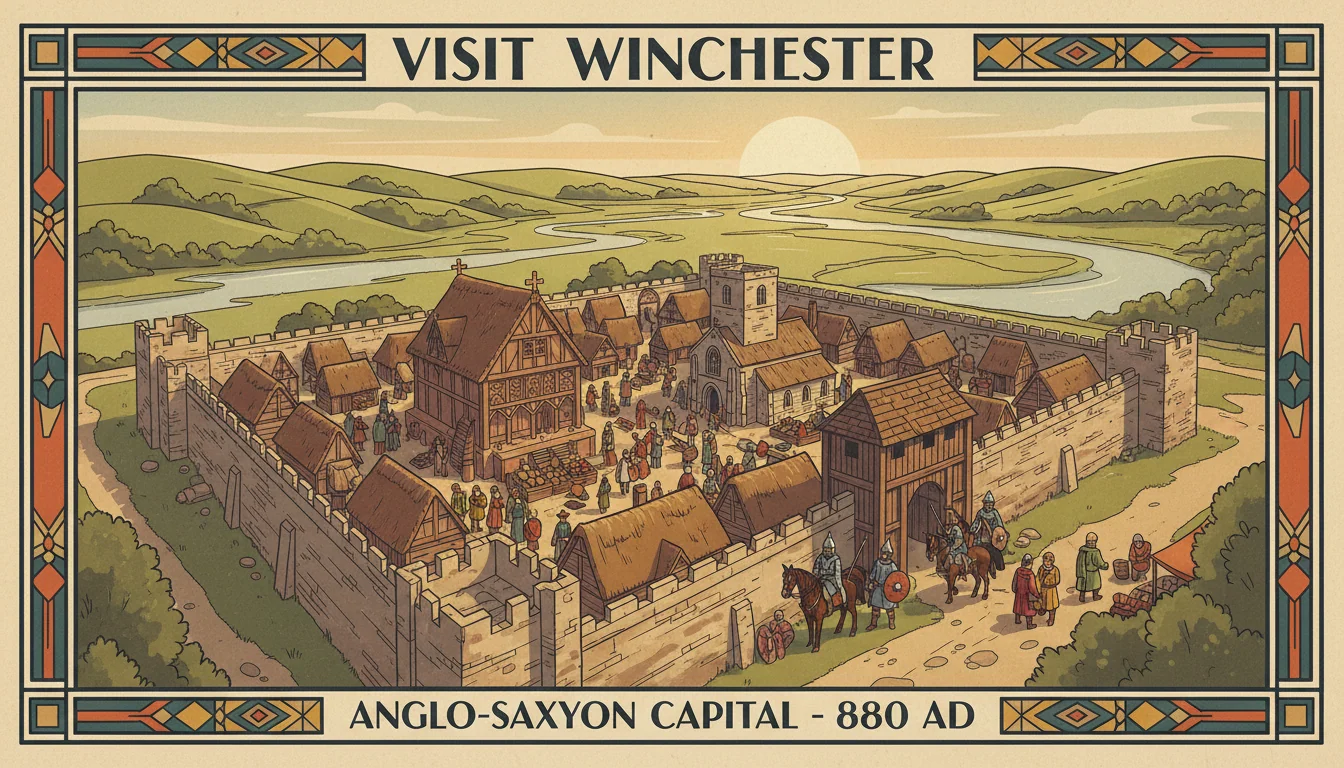
Set your arrival for late spring or early summer in 880. The roads are passable. The first harvest is approaching. Alfred is at his royal vill at Winchester for at least part of the year, dealing with the steady stream of disputes, embassies, and military preparations that fill his calendar. The Vikings are temporarily quiet. You will not find a better window.
The town you are arriving into is small by Roman standards, tiny by modern standards, and uniquely consequential. Within a generation, the kings ruling from this place will have completed the project Alfred is currently beginning: the unification of the English-speaking peoples into a single kingdom under West Saxon authority. You are visiting the soft, contingent moment before any of that is certain.
What you are arriving into
Anglo-Saxon Winchester in 880 sits inside a roughly square circuit of Roman walls that have been standing for around seven centuries. The Romans built the original Venta Belgarum here as a regional administrative centre. The town was largely abandoned in the 5th and 6th centuries, then partially reoccupied by Anglo-Saxon settlers, and is now being reorganized as one of Alfred's burhs - a fortified town intended both for refuge in war and for regular commercial life in peace.
The streets inside the walls are being laid out on a new grid pattern. This is a deliberate royal project, not an organic medieval tangle. The grid is recognizable to anyone who has seen Roman urban planning, but it is being executed under Alfred's supervision in the 870s and 880s, and the result is a town that is more orderly than most of what is happening in northern Europe in this period.
The population is small. Estimating Anglo-Saxon urban populations is difficult, but Winchester probably has at most a few thousand people inside the walls in 880, with more in the surrounding agricultural estates. By the standards of 9th-century England this is a substantial settlement. By the standards of Constantinople or Cordoba, it is a village.
You will know you are in Alfred's principal town the moment you see the gates. They are heavy, guarded, and recently rebuilt. The guards will want to know who you are. Have an answer.
The king and his court
If you have any plausible excuse for being in town, you will at some point be within visual range of Alfred himself. The West Saxon court is not a static institution housed in a palace. It is a mobile body of officials, retainers, churchmen, and family members that travels with the king. When the king is at Winchester, the court is at Winchester.
Alfred is in his early thirties in 880. He has been king for nine years. He is a small, sharp man with reportedly poor health, possibly from a chronic illness that his biographer Asser would later describe in some detail. He is unusually literate for a 9th-century king, and increasingly interested in the project of translating Latin religious and philosophical texts into Old English. He has not yet begun the major translation programme of his later reign, but the instincts that produce it are already visible.
His court includes his wife Ealhswith, his children, his close advisors including various ealdormen and bishops, and a circle of foreign scholars he has been recruiting from Mercia, Wales, and the Frankish kingdoms. The presence of these scholars is unusual and is one of the things that distinguishes Alfred's court from those of contemporary English kings.
Approach with courtesy. Direct contact with the king himself is unlikely unless you have specific business or a sponsor of consequence. Contact with someone close to him is more achievable, and a single conversation with a literate priest or a royal thegn can open doors that would otherwise remain closed.
Dress
Plan your wardrobe carefully. Anglo-Saxon costume in 880 follows recognizable conventions, and arriving in something that visibly violates them marks you as suspicious before you have said a word.
Men wear knee-length tunics belted at the waist, with trousers or leggings underneath, leather shoes, and a cloak fastened at the right shoulder with a metal brooch. Hair is worn shoulder-length or slightly shorter, often parted in the centre. Beards are common. Wool is the standard fabric in winter, linen in summer for those who can afford it. Colours include browns, greys, undyed creams, and for those of higher status, blue, green, or red dyed wool. The bright dyes are expensive and signal rank.
Women wear an undertunic of linen reaching to the ankles, an overgown also reaching to the ankles, and a headcloth or veil pinned in place. Married women keep their hair covered in public. A brooch at the shoulder secures the overgown. Belts at the waist are practical and may carry small everyday tools such as scissors, knives, or keys. Jewellery is more elaborate than the modern eye expects for the period, and well-made garnet inlay and gilded bronze work are within reach of the prosperous.
What you should not wear: anything that signals foreign origin you cannot explain. A Frankish merchant's wardrobe is acceptable if you have a plausible story. A Danish style of dress is acceptable in trading contexts but will invite scrutiny in any setting connected to the royal court. An obvious anachronism - any printed fabric, any modern fastener, any synthetic material - will draw attention immediately.
Eating in Winchester
The food in 880 is more varied than later medieval stereotypes suggest, and considerably better than later medieval Lenten fare.
Bread is the central staple. The grain is barley and wheat, with rye and oats in supporting roles. Bread is baked in domed clay ovens or on hearthstones, generally as a flat or moderately risen round loaf. Quality varies. The bread served at a wealthy household will be made from sifted white flour and will be excellent. The bread served at a peasant farmhouse will be coarser and may include unsifted bran.
Meat is more available than you might expect. Pork is the most common, since pigs are cheap to raise on woodland mast. Beef and mutton appear at wealthier tables. Chicken and goose are present. Game - venison, wild boar, hare - is a status food associated with hunting privileges and royal estates. Fish is everywhere. The chalk streams around Winchester produce trout, eels are commercially important, and salt cod and herring travel inland from the coast.
Vegetables grown in the kitchen gardens include leeks, onions, cabbage, parsnips, beans, peas, and a range of cultivated greens. Apples are grown locally. Honey is the sweetener; sugar will not appear in northern Europe for centuries. Spices arrive in small quantities through long-distance trade and are used sparingly. Salt is plentiful and important.
Drink is mostly ale, brewed at small scale in households, and varying considerably in quality. Wine is imported from the Frankish kingdoms and is expensive. Mead, made from honey, is available and often served at high-status feasts. Water is drunk but not generally trusted; people who can afford ale or wine usually choose them.
Language and manners
You will not improvise Old English. The grammar is too different and the vocabulary too unfamiliar. If you have studied it before arrival you will be functional; if not, you will need a translator. Latin will work with the clergy. A few words of Frankish or Old Norse may help in specific trading contexts.
Anglo-Saxon social manners are formal in a way that often surprises modern visitors. Greetings are elaborate. Hospitality has the force of obligation; a guest accepted into a household is owed protection until they leave, and a host's failure to provide that protection is a serious offence. The reverse is also true: a guest who abuses hospitality, particularly by violence against a fellow guest or against the household, has committed an offence taken extremely seriously.
Do not raise your voice. Do not speak first to a person of higher status unless invited. Do not handle a weapon casually in any indoor setting. Carrying a sword openly is acceptable for a free man; drawing it is the prelude to a serious problem.
Worship and the church
Winchester is the seat of a bishopric, and the cathedral church here, dedicated to Saint Peter and Saint Paul, is one of the most important religious foundations in Wessex. Religious observance is woven through daily life in a way that is not optional. The week is structured around feasts, fast days, and the canonical hours that order the day at the cathedral.
You can attend services. Standing quietly at the back of a Latin mass is unremarkable and provides a useful way to observe the local community. The architecture of the church is more modest than the great Norman cathedrals that will replace it in two centuries, but the building is dignified and the liturgy is taken seriously.
The bishop's authority overlaps with the king's in ways that are negotiated, sometimes tensely, and the relationship between the West Saxon kings and the church is one of the structural features of the period. Alfred himself is unusually pious and unusually invested in the church as an instrument of cultural revival. Saying anything dismissive about the church or its leaders, in any setting, is a category of error you cannot afford.
A short list of things to do and not do
Walk the line of the Roman walls and notice where the new burh works are being put in. Visit the cathedral at a service. Buy something from a merchant in the market and pay in West Saxon silver pennies, which are the only coinage you should be using. Avoid any conversation about Danish politics with someone you do not know. Do not pretend to a status you cannot defend. Do not handle a weapon indoors.
Above all, do not assume that because the town is small the stakes are small. The decisions being made within these walls over the next decade will shape the political organization of an island that is, at the moment of your visit, still made of several kingdoms with no settled future. You are walking through the early scenes of England.
For related guides to early medieval Europe, see Time Traveler's Guide to Carolingian Aachen, 800 and A Time Traveler's Guide to Medieval Paris, 1300.
Quick Answers
Common questions about this topic
Was Winchester the capital of Anglo-Saxon England?
By the late 9th century Winchester functioned as the principal royal seat of Wessex, which was the surviving English kingdom after the Viking conquests of the rest of the country. It was not a capital in the modern administrative sense, since Alfred and his successors travelled constantly between royal estates, but Winchester held the royal treasury, hosted major councils, and was the location most consistently associated with the West Saxon kings.
What was Alfred the Great doing in 880?
In 880 Alfred had recently emerged from the most dangerous period of his reign. The Treaty of Wedmore in 878 had recognized a partition of England between Wessex and the Danish-held territories that came to be called the Danelaw. Alfred was using the period of relative peace to build a network of fortified towns called burhs, reorganize military service, and lay the foundations of the educational and legal reforms that defined his later reign.
What language was spoken in Winchester in 880?
Old English, specifically the West Saxon dialect. Old English is a Germanic language that looks and sounds unfamiliar to modern English speakers, with grammatical gender and case endings closer to modern German. Latin was the language of the church and of formal record. A traveller in Winchester would also hear Old Norse from Danish traders and visitors, particularly along the trading routes that linked Wessex to the Danelaw.
Was Winchester safe in 880?
Safer than it had been five years earlier. The Viking armies that had threatened Wessex throughout the 870s had been pushed back, and Alfred had reorganized his territory's defences around the new burh system of fortified towns. Banditry remained a problem outside the burhs, and political tensions inside Wessex were never far below the surface, but for a careful traveller Winchester itself was as secure as anywhere in 9th-century Europe.

Need Advice from Someone Who Lived There?
Get firsthand accounts from people who actually lived through these moments in history.
Create your free account →No card required. Some figures and features require a paid plan.
Join the HistorIQly Club
Get smarter about the past.
Weekly stories, deep dives, and exclusive content straight to your inbox.