Time Traveler's Guide to Ayutthaya, Siam, 1700
Your survival guide to Ayutthaya, Siam in 1700 - where elephant processions, floating markets, and 40 nationalities collide on an island of golden spires.
Read Wikipedia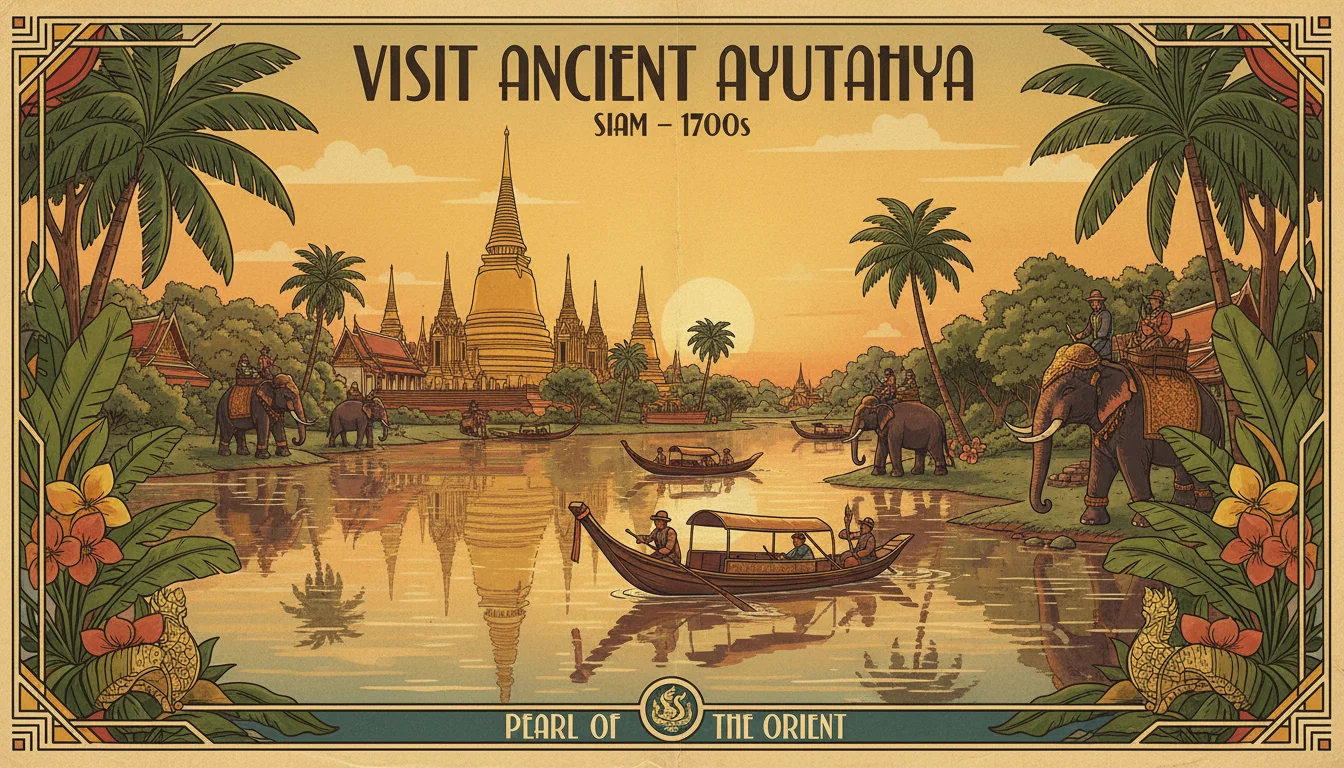
Your temporal coordinates lock onto 14.35°N, 100.57°E. The year is 1700. You're arriving in Ayutthaya, the capital of the Kingdom of Siam - and you've chosen well. This is arguably the most cosmopolitan city on Earth right now, an island metropolis where the Chao Phraya, Lopburi, and Pa Sak rivers converge to create something remarkable: a Venice of the East where Dutch merchants haggle alongside Chinese traders, Japanese samurai serve the king, and Persian diplomats navigate streets crowded with elephants.
With a population approaching one million, Ayutthaya is larger than London and rivals any European capital. It's also considerably more dangerous if you don't know the rules.
First Impressions: The Island of Spires
You'll smell Ayutthaya before you see it - the heady mix of burning incense, spices, rotting fish, and elephant dung. Then the city materializes: hundreds of golden spires piercing the tropical sky, temple roofs shimmering with glazed tiles, and a wall of sound that makes European cities seem pastoral.
The city occupies a man-made island, surrounded by water that serves as defense, transportation, and sewer. Your first challenge is getting past the customs officials at one of the river gates. They're notoriously corrupt, but also notoriously thorough. Whatever cover story you've prepared, make sure it involves trade.
What to Wear (This Really Matters)
Siamese dress codes aren't suggestions - they're law. The color yellow is reserved for the king. Purple is for high nobles. Certain patterns belong to specific ranks. Wear the wrong color, and you might lose your head. Literally.
For men: A pha nung - essentially a wide piece of cloth wrapped around the waist and tucked between the legs to create loose trousers. Leave your chest bare (this is tropical Southeast Asia, after all). Add a pha biang - a shawl worn diagonally across the chest - for formal occasions.
For women: A pha nung wrapped as a skirt, with a sabai (breast cloth) that covers one shoulder. More coverage than your modern sensibilities might expect for the tropics, but showing the shoulders is considered scandalous.
Footwear: Only the king wears shoes inside the palace. Outside, simple sandals work. Going barefoot in temples is mandatory.
Hair: Men should have their heads shaved or nearly shaved. Women wear their hair long but tied back. That man-bun you thought was creative? Save it for another century.
The Language Problem
Thai is tonal and complex, but here's what makes it truly treacherous: the social hierarchy is encoded directly into the language. There are multiple words for "I" and "you" depending on relative social status. Using the wrong one is a serious insult.
Your safest bet: Learn the prostration. When encountering anyone of status (which means basically everyone when you're a foreigner), you'll need to kraab - a bow where you touch your forehead to the ground. The number of times and the position of your hands communicate respect. Get this wrong, and no amount of linguistic fumbling will save you.
Key phrases:
- "Kha" (for women) or "khrap" (for men) - polite particle, add to everything
- Never point your feet at anyone or any Buddha image
- Never touch anyone's head - even a child's
Money and Commerce
The currency system is based on weight. Silver baht (also called tical) are the standard, with smaller denominations in cowrie shells. Yes, shells. You'll need about 6,400 cowries to equal one baht. That's not a typo.
Foreign coins are accepted but valued by their silver content, not face value. Spanish dollars are common. Dutch guilders circulate freely. The money changers along the river are shrewd but generally honest - they have reputations to maintain in this trade-dependent city.
What to buy: Siamese silk is extraordinary and cheap. Lacquerware, bronzeware, and ceramics are world-class. Precious stones flow through here from Burma. And if you're into exotic goods, you can buy anything from rhinoceros horn to live elephants.
Where to Stay
The city is divided into ethnic enclaves, each with its own character and rules:
The Dutch Quarter: Clean, orderly, and frankly a bit boring. The VOC (Dutch East India Company) maintains a solid compound where European travelers might find hospitality - or at least someone who speaks a familiar language.
The Chinese Quarter: Largest foreign community. Excellent food, bustling commerce, and Chinese-style inns that are reasonably comfortable. Your best bet if you want to blend in as a trader.
The Japanese Quarter: Smaller than it was in the previous century (the Tokugawa shogunate closed Japan, stranding a community here), but still distinct. The descendants of Japanese samurai who served as royal bodyguards maintain their own neighborhood.
The Portuguese Quarter: Catholics have been here for almost 200 years. If you need a church or a familiar face, find it here. They also know how to make wine.
Avoid: Sleeping rough. The tigers that prowl the surrounding forests sometimes venture into the city at night. Crocodiles in the rivers take several people per year.
Food and Drink
The good news: Siamese food is incredible. The bad news: Your 21st-century digestive system isn't ready for it.
Start gentle. Rice (khao) is the foundation of everything. Fish sauce (nam pla) seasons virtually every dish. Chilies arrived from the Americas a century ago and the Siamese have embraced them with abandon - what you consider "mild" Thai food in your era is significantly hotter here.
Safe bets:
- Khao tom - rice porridge, easy on the stomach
- Grilled fish from the floating market vendors
- Fresh tropical fruits - mangoes, durians (if you dare), rambutans
Drink only boiled water or tea. The locals manage the river water through long exposure; you won't be so lucky. Rice whisky is available but potent.
Street food is everywhere, served from floating kitchens on boats or from stalls along the main roads. The floating markets are something to behold - entire commerce districts that exist on the water, with vendors paddling between customers.
Getting Around
Everything happens on the water. The rivers and an intricate canal system (called klong) are the highways of Ayutthaya. You'll travel by boat - either poled by boatmen or, for longer distances, in larger vessels with oarsmen.
On land, elephants are the prestige transport. The king maintains thousands of them. Common people walk or, if wealthy, are carried in palanquins. Horses exist but aren't particularly popular in the heat and terrain.
The main roads are remarkably clean - the king employs teams to sweep them. Side streets are another matter. Watch your step, literally.
The Palace and Royal Protocol
King Phetracha has ruled for about twelve years, having seized power in a bloody coup. Don't mention this. The current situation is stable enough, but palace politics are Byzantine in their complexity.
You probably won't enter the palace, but you might see the royal procession. When you do: Get down. All the way down. Face to the ground. Do not look at the king. The penalty for making eye contact is death, and it's enforced.
Royal elephants are sacred. If a white elephant passes (reserved exclusively for the king), you prostrate. If any royal elephant seems agitated near you, make yourself as small and unthreatening as possible. Getting trampled by a royal elephant creates paperwork for everyone.
Religion: Temples Everywhere
Buddhism permeates everything. The temples (wat) are the most impressive structures in the city - hundreds of them, with golden spires, massive Buddha statues, and saffron-robed monks everywhere.
Etiquette:
- Remove shoes before entering any temple building
- Women cannot touch monks - not even accidentally
- Walk clockwise around stupas
- Never pose disrespectfully with Buddha images (I know you weren't going to, but still)
Alms-giving happens at dawn. Monks walk silently through the streets while laypeople offer food. This is merit-making, central to Siamese religious life. You can participate - it's actually a good way to be seen as respectable.
Dangers to Avoid
The King's Wrath: Siam has elaborate laws about royal respect. Speaking ill of any king (past or present), mishandling royal objects, or improper behavior in royal contexts can mean death.
Slavery: Yes, it exists here. About one-third of the population is in some form of bondage. More relevant to you: debt slavery is how people end up in that situation. Don't borrow money. Don't gamble. Don't sign anything you don't understand.
Disease: Malaria, cholera, smallpox, and various tropical diseases circulate constantly. Stay near the breezes. Keep clean. Avoid stagnant water.
Wild Animals: Tigers, leopards, and crocodiles are genuine threats. Cobras and kraits are common. Watch where you step and sleep under a net.
Foreign Intrigues: The French just failed spectacularly in their attempt to influence Siamese politics. Anti-European sentiment exists. Keep a low profile.
What to See
Wat Phra Si Sanphet: The royal temple, with three giant chedis containing the ashes of former kings. The main Buddha image is covered in 340 kilograms of gold. You can visit the grounds, though not the royal chapel.
The Floating Markets: Commerce on water. Hundreds of boats piled with goods, everything from rice to rubies. Best experienced at dawn.
The Portuguese Church: The oldest Christian church in mainland Southeast Asia. A strange sight among the temples.
The Elephant Kraal: Where wild elephants are captured and trained. Brutal to watch by modern standards, but impressive in scale.
The Foreign Quarters: Walk through and see how Persian, Chinese, Japanese, and European architecture blend with local styles.
Your Departure
Ayutthaya will stand for another 67 years before the Burmese burn it to the ground in 1767. The destruction will be so complete that the survivors abandon the site entirely, founding Bangkok downstream.
But in 1700, none of that is imaginable. The city is wealthy, confident, and cosmopolitan. It has stood for 350 years and feels eternal.
Before you leave, watch the sunset from the river. See the golden spires catch the last light. Hear the temple bells mix with the calls of vendors and the splash of boats. This is Southeast Asia at perhaps its most magnificent moment - before colonialism, before industrialization, before the wars.
Remember it. Nobody else will. For other great Asian capitals at their peak, our guides to Ayutthaya's neighbor in the east - Edo Tokyo in 1700 - and the Khmer capital at Angkor in 1150 show how different the experience of premodern Asian urban life could be depending on latitude and century.
Quick Reference Card:
- Era: King Phetracha's reign, Ayutthaya Kingdom
- Population: ~1 million
- Currency: Silver baht (tical), cowrie shells
- Language: Thai (but Portuguese and Malay serve as trade languages)
- Dangers: Royal protocols, disease, wild animals, debt slavery
- Don't Miss: Floating markets, Wat Phra Si Sanphet, the cosmopolitan quarters

Need Advice from Someone Who Lived There?
Get firsthand accounts from people who actually lived through these moments in history.
Create your free account →No card required. Some figures and features require a paid plan.
Join the HistorIQly Club
Get smarter about the past.
Weekly stories, deep dives, and exclusive content straight to your inbox.