Time Traveler's Guide to Babylon, 1750 BC
Survive and thrive in Babylon, the world's greatest city under King Hammurabi - where the law is carved in stone, ziggurats touch the sky, and the beer is always fresh.
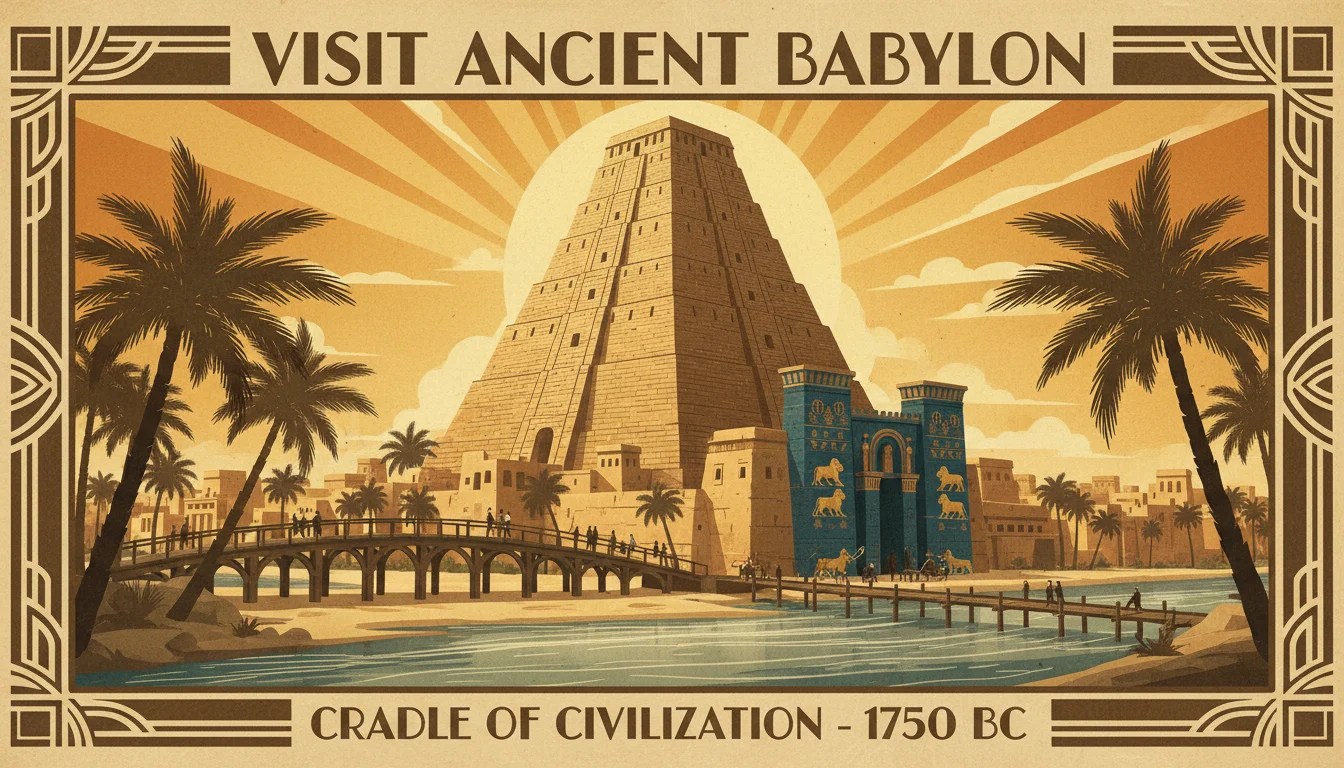
You've just materialized in the greatest city on Earth. No, really - in 1750 BC, Babylon under King Hammurabi is the undisputed center of civilization. With a population of over 200,000 people, sophisticated irrigation systems, and a legal code that would influence humanity for millennia, you're standing in the Silicon Valley of the ancient world. Here's how to survive without getting impaled on a stake.
First Impressions: The City That Invented Cities
The first thing you'll notice is the smell - a rich mixture of the Euphrates River, bread baking in clay ovens, and the musky incense wafting from every temple. The second thing? The sheer scale. Babylon's walls stretch for miles, punctuated by massive gates decorated with blue-glazed bricks depicting lions and dragons.
The Euphrates cuts through the city like a main artery, spanned by the world's first permanent bridge - a marvel of stone piers and wooden planking. On both banks, a grid of streets (yes, actual city planning!) connects temples, palaces, and the sprawling residential neighborhoods where most Babylonians live.
What to Wear: Dress Like You Belong
Men wear a simple kaunakes - a wool or linen wrap-around skirt that hits mid-thigh. For cooler evenings, add a fringed shawl draped over one shoulder. Women wear longer, ankle-length versions, often elaborately fringed and held with metal pins.
Pro tip: The fringe matters. More fringe = higher status. Show up in plain cloth and people will assume you're a servant. But overdo it and you'll get suspicious looks from the actual elites.
Footwear is basic leather sandals for most, though many Babylonians go barefoot in the city. Hair should be oiled and, for men, beards are absolutely essential. A clean-shaven man is either a slave or a priest. Both get treated differently than you want.
The Food Scene: Better Than You'd Expect
Babylonian cuisine is surprisingly sophisticated. Forget the image of ancient people gnawing on raw grain - these folks have been perfecting recipes for centuries.
Breakfast: Barley porridge with dates and honey, washed down with beer (yes, for breakfast - the beer is weak and nutritious, and the water can kill you).
Lunch: Flatbread dipped in a fish stew, or if you've got some silver, roasted mutton from one of the street vendors near the Ishtar Gate.
Dinner: This is where Babylon shines. Clay tablets from this era contain actual recipes - we're talking marinated gazelle, lamb with cumin and coriander, leek and garlic pies, and more than twenty different varieties of cheese.
What to drink: Beer. Always beer. Wine exists but it's imported and expensive. The Babylonians have perfected barley beer in dozens of varieties - thick breakfast beer, light session beer, dark celebratory beer. Taverns (run almost exclusively by women) are everywhere.
Warning: Don't ask for ice. Don't ask for wine unless you're spending serious silver. And whatever you do, don't drink the water.
Hammurabi's Code: The Law That Will Get You Killed
You've probably heard of Hammurabi's famous law code - those 282 laws carved on a giant stone stele. What you might not know is how brutally practical they are.
The basics:
- Eye for an eye - literally. If you blind a noble's eye, your eye gets gouged out.
- Class matters - injuring a commoner costs silver; injuring a slave costs much less. Injuring a noble costs your body parts.
- Merchants beware - fraudulent weights and measures can get you executed.
- Marriage is serious - adultery is punishable by drowning (both parties).
Survival tip: Don't get into fights. Don't make accusations you can't prove (false accusation = death). And definitely don't get caught stealing - punishments range from paying thirty times the value to having your hands cut off.
The good news? There's an actual legal system. Courts exist. You can hire a scribe to represent you. Just, you know, don't need to use it.
Money and Commerce: Silver Runs Everything
Babylon doesn't have coins - those won't be invented for another thousand years. Instead, everything runs on weight standards. The basic unit is the shekel - about 8 grams of silver.
Prices (approximately):
- A loaf of bread: a few grains of silver
- A jar of beer: 1/60th of a shekel
- A sheep: 1-2 shekels
- A slave: 20-40 shekels
- A house: 5-10 shekels (varies wildly)
How to pay: Silver gets weighed on scales at every transaction. Barley also works as currency - about 300 liters equals one shekel of silver. Most daily transactions happen via tabs and credit extended by tavern keepers and merchants who know each other.
If you need to establish yourself, find a trading house near the Shamash Gate. These proto-banks handle loans, currency exchange, and can vouch for your creditworthiness.
Must-See: The Marduk Temple Complex
The Esagila - Temple of Marduk - is Babylon's heart. Marduk isn't just A god; he's THE god, the patron deity who elevated Babylon above all other cities. The temple complex sprawls across multiple city blocks, with priests, scribes, and petitioners crowding its courtyards day and night.
Next to it rises the Etemenanki - the ziggurat whose name literally means "House of the Foundation of Heaven and Earth." This stepped pyramid soars nearly 300 feet into the sky, visible for miles in every direction. Yes, this is probably the original "Tower of Babel" from later biblical stories.
Visiting: Anyone can enter the outer courtyards. Inner sanctums are priest-only. Don't try to sneak in - the penalties involve fire.
Daily Life: What Ordinary Babylonians Do
Most Babylonians wake before dawn. Farmers head to the fields beyond the walls to work the irrigation canals that make Mesopotamia bloom. Craftsmen - weavers, metalworkers, potters, brewers - set up shop in their ground-floor workshops while their families live above.
Education exists but isn't universal. If you want your son (rarely daughters) to become a scribe, you'll enroll him in an edubba - a tablet house where students spend years memorizing cuneiform signs, copying texts, and doing math problems. It's expensive, demanding, and absolutely the path to success.
Entertainment options include:
- Taverns (socializing over beer)
- Religious festivals (frequent and raucous)
- Board games (the Babylonians love a good strategy game)
- Music and storytelling (hire musicians for dinner parties)
Dangers: What Can Kill You
Disease: Malaria is endemic. Intestinal parasites are universal. Don't drink untreated water under any circumstances.
Politics: Hammurabi has united Mesopotamia through war and diplomacy. His officials are everywhere. Don't criticize the king, don't discuss politics loudly, and don't get involved in whatever intrigue the palace nobility is cooking up.
Flooding: The Euphrates floods regularly. Low-lying areas can become death traps. Stay aware of which neighborhoods are at risk.
Debt slavery: If you can't pay your debts, you (or your family members) can be seized as collateral. The code limits debt slavery to three years, but still - don't borrow what you can't repay.
Making Friends: Babylonian Social Rules
Hospitality is sacred. If someone offers you bread and salt, they're bound to protect you. If you enter someone's home as a guest, they're responsible for your safety.
Gifts matter in business relationships. When meeting someone important, bring a small offering - a jar of quality beer, a piece of jewelry, quality textiles. Empty hands suggest you don't value the relationship.
Scribes are your friends. Need a contract? Need to send a message? Need someone to read that legal notice posted at the gate? Scribes handle everything involving writing - and in Babylon, writing handles everything.
Getting Out: Your Departure Strategy
When it's time to leave, head for one of the great caravan routes. The Shamash Gate connects to roads leading northwest to Assyria and eventually Anatolia. South takes you toward the Persian Gulf and the sea trade. East leads to Elam and eventually the Iranian plateau.
Whatever you do, travel in groups. Banditry is real. Desert crossings are deadly. And you definitely don't want to end up in a foreign city without documentation - being stateless in the ancient world is a death sentence.
Final Thoughts
Babylon in 1750 BC is humanity at a crossroads - sophisticated enough for literature, law, and complex economics, yet still brutal in its punishments and precarious in its public health. You're walking the same streets where the Epic of Gilgamesh is being copied, where mathematical astronomy is being invented, where the very concept of written law is being established.
Just remember: obey the code, tip your scribe, and never, ever drink the water.
If the ancient Near East has caught your interest, our guides to Hittite Hattusa in 1300 BC and Achaemenid Persepolis in 500 BC will take you to Babylon's neighboring civilizations.
Safe travels, time traveler.

Need Advice from Someone Who Lived There?
Get firsthand accounts from people who actually lived through these moments in history.
Ask Them YourselfJoin the HistorIQly Club
Get smarter about the past.
Weekly stories, deep dives, and exclusive content straight to your inbox.