A Time Traveler's Guide to Versailles Under Louis XIV
Everything you need to know before visiting Versailles, 1685 - the most theatrical court in European history, when the Sun King stood at the absolute height of his power.
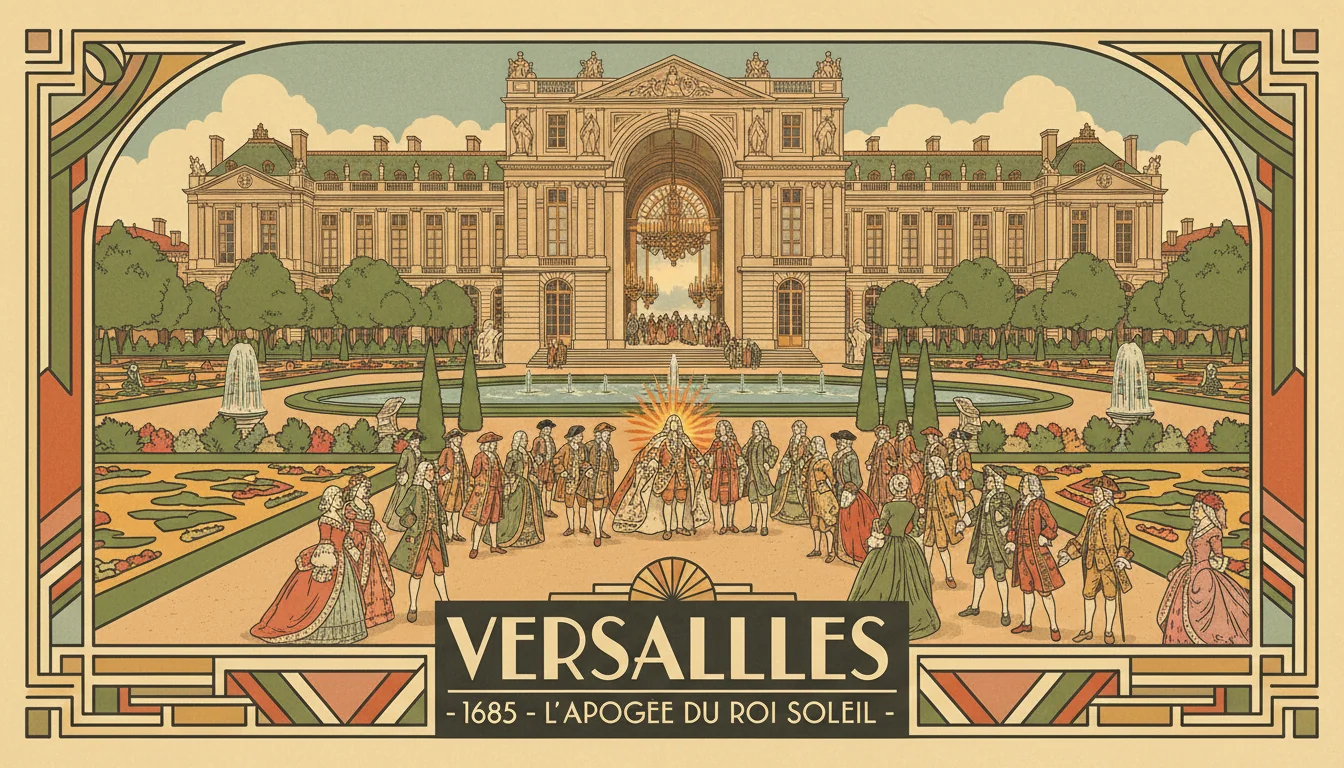
If you want to see absolute monarchy at the precise moment of its highest theater, set your time machine for Versailles in 1685. Louis XIV, the Sun King, has just moved the entire French court permanently into the expanded palace. The Hall of Mirrors was completed last year. The chapel is still a work in progress. The gardens by André Le Nôtre are the most elaborate landscape design in Europe.
Versailles in 1685 is also a freezing, smelly, ferociously stratified human anthill where every gesture, every meal, every bow is choreographed by an etiquette so detailed that even princes have to memorize it. So before you click your watch into 1685, here is your practical guide to surviving, blending in, and enjoying a visit to Bourbon Versailles.
First, know what kind of place you're entering
Versailles is not a city. It is a palace complex with a town attached. About 10,000 people live and work inside the palace and its dependencies. Another 30,000 live in the surrounding village, mostly serving the court. The court itself, the people who actually count, numbers perhaps 1,000 to 1,500 noble families.
The whole purpose of Versailles is to keep the high aristocracy of France physically present at court, where the king can watch them, regulate them, and prevent them from organizing rebellions in their provincial estates. The previous century had taught the Bourbon monarchy that nobles left to their own devices in the countryside became dangerous. Versailles is the response.
Your safest cover story is that you are a foreign visitor of moderate but not first-rank standing, perhaps from the Holy Roman Empire, the Italian peninsula, or one of the smaller German states. Foreigners have a recognized place at court, and a slightly clumsy German baron will be tolerated where a clumsy French marquis would not.
Dress like you belong
Court fashion in 1685 is the most expensive and elaborate in Europe. You will not survive sartorial scrutiny on a budget.
For men, the basic kit includes:
- a long brocaded coat (justaucorps) reaching to the knee, often heavily embroidered
- a fitted waistcoat under it
- knee breeches
- silk stockings, white or colored
- high-heeled leather shoes with bright buckles
- a long curled wig (the longer the better; full periwigs are at peak fashion)
- a sword on the left hip if you are noble
- a tricorn hat under the arm, never on the head indoors
For women:
- a heavy silk gown over a boned bodice
- a stomacher (a stiff triangular front panel) embroidered or jeweled
- a petticoat showing through a parted skirt
- elaborate lace at sleeves and neckline
- high-heeled shoes
- hair piled high (the fontange hairstyle is current peak fashion)
- a fan, used as a sophisticated communication tool
Avoid bright modern dyes. Court taste favors deep blues, dark reds, golds, and the occasional black. Never wear white outside formal mourning. Never wear what looks like work clothes.
If your finances allow only one investment, hire a quality wig. Wig quality is one of the strongest social signals at Versailles, and a thin or yellowed wig will mark you as poor.
Get used to the smell
This is going to be the most jarring part of your visit. Versailles in 1685 smells. Despite its theatrical magnificence, the palace has shockingly few proper toilets. Courtiers and servants alike relieve themselves in stairwells, behind tapestries, in chamber pots emptied into corridors, and out of windows into the courtyards.
The palace has been so badly perfumed for so long that the sweet floral overlay you will smell on entering does not actually replace the underlying odors. It joins them. The smell of close-packed unwashed bodies, candle smoke, and animal waste from the stables creates a permanent atmospheric layer that even the courtiers complain about.
Carry a perfumed handkerchief. Use it discreetly. Do not gag, do not visibly recoil, and do not comment on the smell. Everyone here notices it. Discussing it openly is humiliating.
How the day works
Versailles operates on the king's schedule. Louis XIV is one of the most regimented sovereigns in European history, and his daily routine, the lever, the mass, the cabinet meetings, the dinners, the games, the coucher, structures the entire palace.
Court positions are organized around participation in the king's intimate moments. There are roles for handing the king his shirt, holding his washcloth, presenting his gloves. Watching such a moment as a foreign visitor is permitted at certain times. Trying to participate without an assigned role is not.
If you can secure entry to the king's lever (his morning rising) or coucher (his evening retiring), do so. This is the most concentrated form of court spectacle, and observing it is one of the strongest reasons to visit Versailles in 1685.
Three places you absolutely must see
The Hall of Mirrors
Completed in 1684, the Galerie des Glaces is the most spectacular interior space in Europe. It runs 73 meters along the western façade of the palace, with seventeen arched mirrors facing seventeen windows that overlook the gardens. The ceiling is covered with paintings by Charles Le Brun celebrating Louis XIV's military and political achievements.
Visit at midday on a clear day, when sunlight hits both the gardens and the mirrors. The effect is, even by modern standards, overwhelming.
The Gardens of Le Nôtre
The gardens are not a casual stroll. They are a planned geometric statement designed to extend the king's authority over nature itself. The Grand Canal, the Apollo Fountain, the Latona Fountain, the parterres, and the bosquets are all part of a single composition.
You can walk freely in most of the public gardens during daylight. Avoid the bosquets reserved for royal use. The fountains run on a complex schedule because Versailles cannot afford to keep them all flowing at once, the water supply is famously limited.
The Royal Chapel
The current chapel is a temporary one. The grand new chapel will not be finished until 1710. Still, daily mass with the royal family in attendance is a major court event. Foreign visitors of acceptable rank can attend by introduction.
How to talk to people without causing trouble
French at Versailles in 1685 is a high-register language with rigid social codes. You should not attempt to speak it casually if you are not fluent. Latin or German is acceptable in some circles. Italian is fashionable. English is barely tolerated.
Always work through introductions. A foreigner without a vouching host is socially invisible.
A few universal rules help:
- never speak first to someone of higher rank
- never address the king or queen unless directly spoken to first
- bow deeply when the king or any prince of the blood passes
- walk backwards when leaving a royal presence
- never sit in a chair that is reserved by social rank, the wrong stool can be a social catastrophe
If you are introduced and do not know how to respond, smile faintly, bow correctly, and say as little as possible. Silence is rarely a mistake at Versailles.
What to eat, what to avoid
Court cuisine in 1685 is the most elaborate food culture in Europe. Royal dinners feature dozens of dishes served in successive courses. Sauces are heavy. Game is central. Sweet and savory mix freely.
Safe choices for a visitor:
- well-cooked roast meats from the public kitchens of the town
- bread and cheese from a respectable inn
- fresh fruit in season
- watered wine from a sealed bottle
- chocolate, recently fashionable, served thick and bitter
Things to avoid:
- complicated sauces from unfamiliar cooks
- shellfish in summer (the supply chain from the coast is unreliable)
- pâtés of unclear ingredients
- water from any well at the palace itself
- aged cheese offered casually by strangers (sometimes spoiled)
Politics you should know about, briefly
In 1685, Louis XIV is at the height of his power. The Edict of Fontainebleau, revoking the Edict of Nantes and beginning the persecution of the Huguenots, has just been signed in October. This is one of the most significant religious-political acts of the century, and it is reshaping French Protestantism, foreign policy, and the demographics of the kingdom.
If you must discuss it, repeat the official position: the king's Catholic faith requires it, and the country is now spiritually unified. Do not advance Protestant sympathies, even cautiously. France in late 1685 is a dangerous place for visible Protestant identity.
Other topics to avoid: criticism of the king's mistresses (especially Madame de Maintenon, whose unofficial elevation is recent and contested), French military actions against the Dutch, and the political ambitions of the king's brother, Monsieur.
What not to do under any circumstances
Let me save you from the classic mistakes.
Do not:
- speak first to the king
- sit in any chair before checking what rank it requires
- enter the queen's apartments uninvited
- praise Protestant theology
- mention the recent revocation of the Edict of Nantes critically
- admire English political institutions
- attempt to photograph or sketch the royal family
- visibly react to the smell
Most importantly, do not predict what will happen to France in the next century. Versailles in 1685 believes itself eternal. The Revolution is more than 100 years away.
The experience you should not miss
If you have one moment at Versailles, take it during the lighting of the chandeliers in the Hall of Mirrors before an evening reception. Hundreds of candles are lit by servants moving in choreographed sequence, and the room moves from cool grey marble to a warm, gold-saturated theater of reflections that has no equivalent anywhere else in 1685 Europe.
You are watching the most carefully designed political spectacle in the world. The king is performing power. The court is performing obedience. The architecture is performing eternity.
Bring a perfumed handkerchief, hire a good wig, and never sit in the wrong chair. Versailles in 1685 is not comfortable, but it is one of the most extraordinary destinations on any time-travel itinerary. For other European courts of the same era, see our guides to Renaissance Florence, 1490 and Ottoman Istanbul, 1555.

Need Advice from Someone Who Lived There?
Get firsthand accounts from people who actually lived through these moments in history.
Ask Them YourselfJoin the HistorIQly Club
Get smarter about the past.
Weekly stories, deep dives, and exclusive content straight to your inbox.