Time Traveler's Guide to Byzantine Constantinople, 540 AD
Survive and thrive in Byzantine Constantinople during Justinian the Great's reign - dodge chariot riots, marvel at the Hagia Sophia, and avoid the plague.
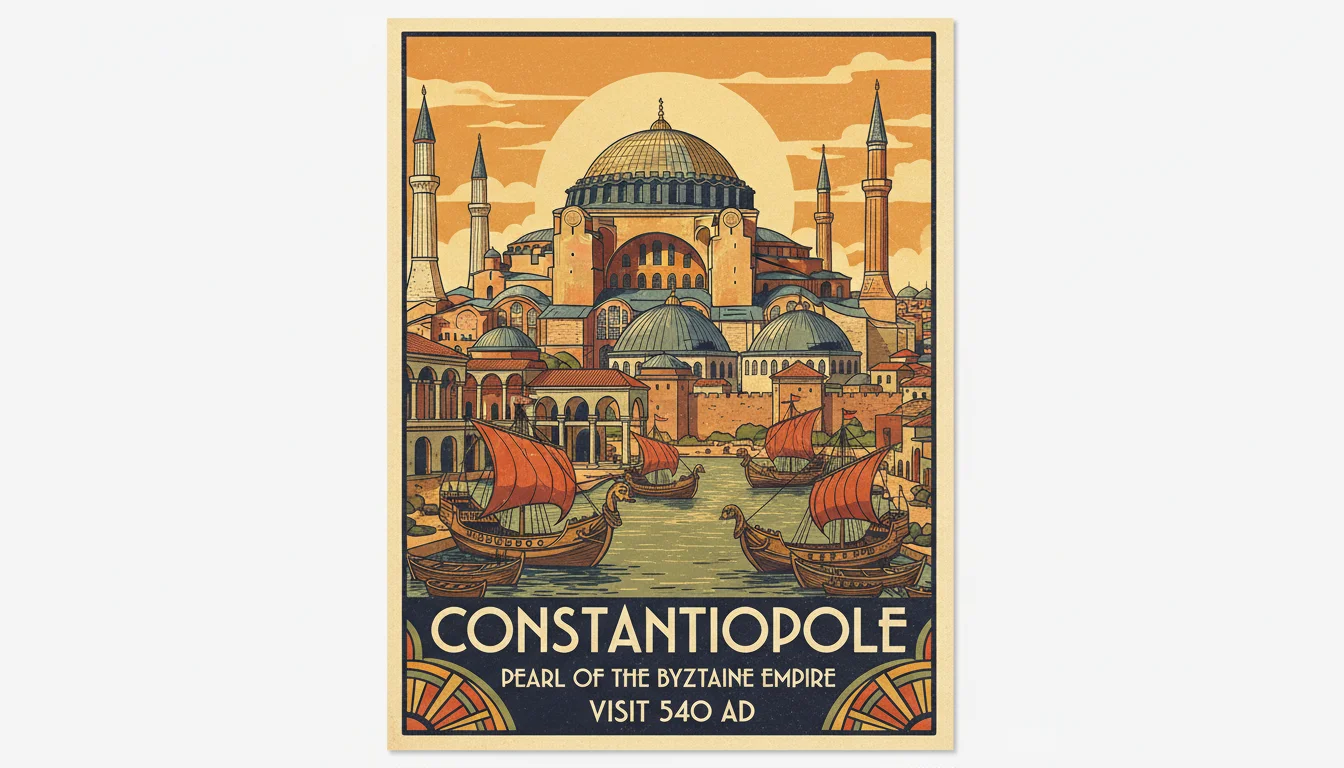
Welcome to Constantinople, 540 AD. You have just stepped into the largest, richest, and most cosmopolitan city in the known world. With roughly half a million inhabitants, it dwarfs anything in Western Europe by a factor of ten. The Roman Empire never fell here - it just kept going, speaking Greek, worshipping Christ, and building things that would make your jaw hit the marble floor.
But be warned. You are arriving at a dangerous moment. Justinian I sits on the throne, the Hagia Sophia has just been completed, and in two years, the deadliest plague in human history will arrive. Timing, as always, is everything.
Getting Your Bearings
Constantinople sits on a triangular peninsula flanked by the Golden Horn inlet to the north and the Sea of Marmara to the south. The Theodosian Walls - a triple line of fortifications stretching four miles across the land approach - have kept invaders out for over a century and will continue doing so for another 900 years.
Enter through the Golden Gate if you want to make an impression. This triumphal marble arch on the southern end of the walls is reserved for emperors and victorious generals, but nobody checks tickets. Walk the Mese, the main colonnaded avenue, straight through the heart of the city toward the Great Palace and the Hippodrome. You will pass forums, churches, baths, and markets - all built at a scale that says "we are Rome, and we never stopped."
What to Wear
Leave your jeans at home. Men wear a tunic (chiton) reaching the knees, belted at the waist, with a cloak (himation) over it when outdoors. Women wear ankle-length tunics with a maphorion - a large veil-like garment draped over the head and shoulders. Colors matter. Purple is reserved for the emperor. Bright reds and deep blues signal wealth. Undyed linen or wool marks you as common. Aim for something in between - a dyed tunic in green or ochre says "respectable merchant" without drawing imperial suspicion.
Footwear is leather boots or sandals depending on your station. The streets are paved but not always clean, so closed shoes are the practical choice.
What to Eat
Constantinople eats well. The city imports grain from Egypt, olive oil from Syria, wine from the Aegean islands, and spices from as far as India and China. Street vendors sell flatbreads, roasted meats, dried fish, cheese, and figs.
For a proper meal, find a tavern (kapeleia) near the harbors. Expect dishes heavy on olive oil, garlic, and herbs - stewed lentils, grilled lamb, fish fresh from the Bosphorus, and bread dipped in garum (fermented fish sauce, inherited from old Rome). The wine is usually mixed with water and sometimes flavored with resin or honey. It is an acquired taste, but you will acquire it quickly because the water alone is not always trustworthy.
Avoid eating pork from questionable vendors near the docks. Food safety regulations exist on paper but enforcement is spotty.
The Hagia Sophia - Do Not Miss This
Justinian's masterpiece was completed just three years ago, in 537 AD. When you step inside, you will understand why the emperor reportedly said, "Solomon, I have surpassed you." The central dome floats 180 feet above the floor, supported by an engineering trick involving pendentives that will not be replicated for a thousand years. Forty windows ring the base of the dome, flooding the interior with light that makes the gold mosaics shimmer as if the ceiling is hovering.
Attend a liturgy if you can. The incense, the chanting, the candlelight bouncing off gold and marble - even if you are not Orthodox, you will feel something. This building was designed to overwhelm the senses, and it succeeds completely.
The Hippodrome - But Be Careful
The Hippodrome seats 100,000 people for chariot racing, and the entire city is obsessed with it. The two main factions - the Blues and the Greens - are not just sports teams. They are political parties, street gangs, and social clubs rolled into one. Pick your colors carefully, or better yet, do not pick at all.
Just eight years ago, in 532 AD, the Nika Riots started right here when both factions united against Justinian. Half the city burned. Tens of thousands died. Justinian almost fled before Empress Theodora shamed him into staying and sending in the troops. The scars are still visible in rebuilt neighborhoods. Do not casually bring up the Nika Riots in taverns - people lost family.
Race days are spectacular, though. Arrive early, grab a seat on the upper tiers, and enjoy the spectacle without wearing faction colors.
The Great Palace and Imperial Protocol
The Great Palace complex sprawls across the southeastern tip of the peninsula - a labyrinth of halls, gardens, courtyards, and churches covering roughly 500,000 square meters. You will not get inside without an invitation, but you can admire the Bronze Gate entrance and watch the processions.
If by some miracle you do get an audience with Justinian, know the protocol: you will prostrate yourself fully on the ground (proskynesis). Everyone does this. The emperor is God's representative on earth, and the court choreography reflects it. Theodora will likely be present too - she is co-ruler in all but name, a former actress who became the most powerful woman in the Mediterranean. Do not underestimate her.
Dangers to Avoid
The Plague (542 AD): If you are visiting in 540, you have roughly two years before the Plague of Justinian arrives. This is bubonic plague - the same disease that will return as the Black Death 800 years later. It will kill an estimated 25-50 million people across the empire. If your time machine has any flexibility at all, leave before spring 542.
Street Crime: Constantinople has its rough neighborhoods, particularly around the harbor districts at night. The city has a prefect (eparch) who commands a police force, but after dark, you are largely on your own. Travel in groups.
Religious Arguments: This is a city where theology is discussed by bakers and taxi drivers (well, litter-bearers). Monophysite versus Chalcedonian debates can get heated - and sometimes violent. Smile, nod, and do not share your personal Christological opinions.
Legal System: Justinian has just codified all of Roman law into the Corpus Juris Civilis. This is great for civilization but means the legal system is thorough and the punishments are harsh. Theft can cost you a hand. Treason costs you everything.
Must-See Experiences
The Basilica Cistern: An underground water reservoir supported by 336 marble columns, many recycled from pagan temples. It is dark, atmospheric, and still functioning. Think of it as the city's hidden cathedral of water.
The Walls: Walk the Theodosian Walls from the Golden Gate to the Blachernae district. The triple fortification - moat, outer wall, inner wall - is the most sophisticated military architecture in the world.
The Markets: The Strategion market near the Golden Horn is where East meets West in the most literal sense. Silk from China, spices from India, amber from the Baltic, furs from the Slavic north. Constantinople sits at the crossroads of every trade route that matters.
The Baths: Public bathing is still a Roman tradition here. The Baths of Zeuxippus (recently rebuilt after the Nika Riots) are the finest - marble floors, heated pools, and a famous collection of classical statues.
Practical Tips
- Language: Greek is the daily language. Latin is used in law and administration. If you speak neither, hand gestures and coins are universal.
- Currency: The solidus (gold coin) is the dollar of the medieval world - accepted from Ireland to India. Carry smaller bronze coins (nummi) for daily purchases.
- Religion: Everyone is Christian, at least officially. Churches are everywhere. Cross yourself when passing one - it is expected.
- Sanitation: Better than most medieval cities but still rough by modern standards. Public latrines exist. Use them rather than the streets.
The Verdict
Byzantine Constantinople in 540 AD is a city at its absolute peak - the wealthiest, most cultured, most architecturally stunning place on the planet. You are witnessing the last great flowering of the Roman world before plague and war begin their slow erosion. The Hagia Sophia alone is worth the trip. Just watch the calendar, stay neutral in chariot politics, and get out before the rats arrive in 542.
Safe travels, time traveler. And remember - in Constantinople, even the beggars think they are Roman.
For related guides to the medieval Mediterranean world, see Time Traveler's Guide to Umayyad Cordoba, 950 AD and Time Traveler's Guide to Abbasid Baghdad, 800 AD.

Need Advice from Someone Who Lived There?
Get firsthand accounts from people who actually lived through these moments in history.
Ask Them YourselfJoin the HistorIQly Club
Get smarter about the past.
Weekly stories, deep dives, and exclusive content straight to your inbox.