Time Traveler's Guide to Carthage, 250 BC
Carthage in 250 BC was the richest city in the ancient Mediterranean - a Phoenician powerhouse controlling trade from Spain to Syria. Survival guide to the Punic capital.
Read Wikipedia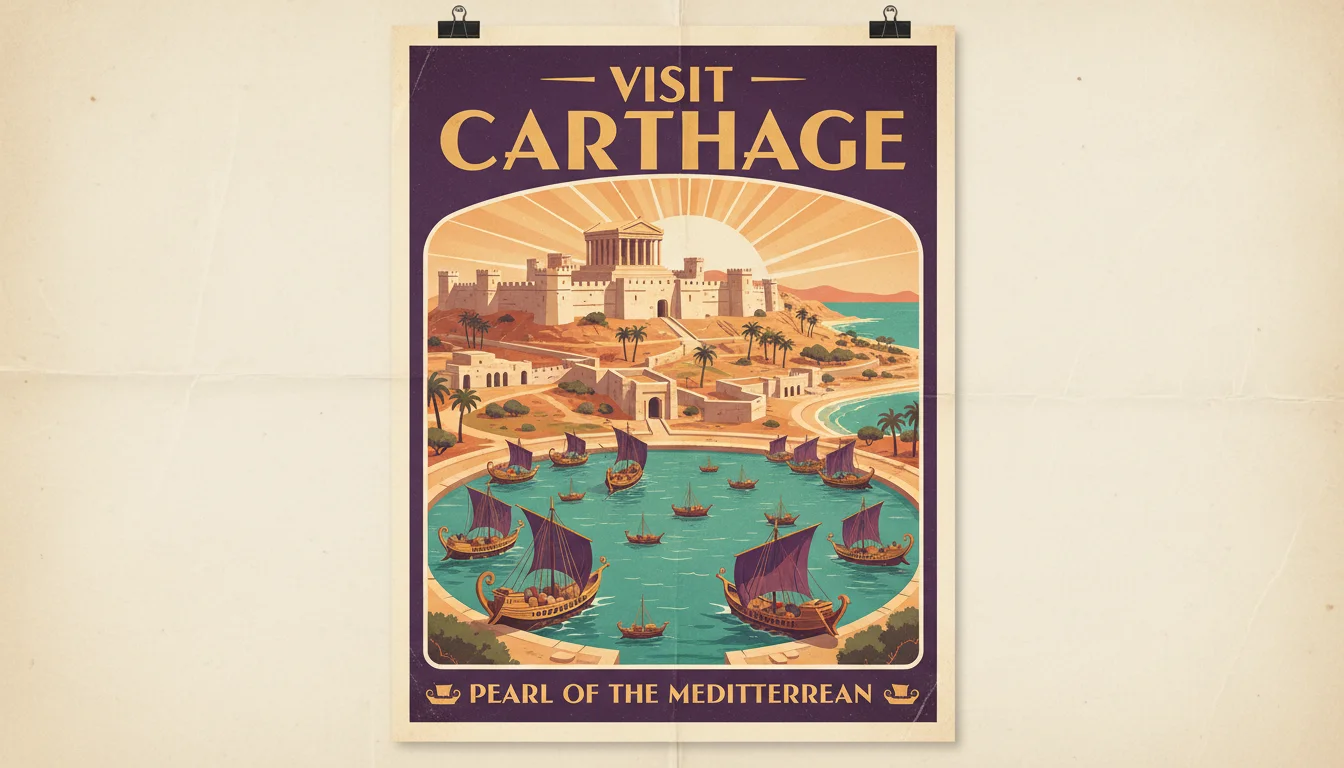
Welcome to Carthage, 250 BC - the wealthiest city on the Mediterranean and Rome's biggest headache. Perched on the coast of modern-day Tunisia, this Phoenician powerhouse controls trade routes from Spain to Syria. You're arriving at a perfect moment: the city is at the height of its commercial glory, flush with silver from Iberian mines and ivory from Africa. The First Punic War is wrapping up, and the locals are feeling... complicated about it. Let's get you oriented before someone tries to sell you counterfeit purple dye.
Getting Your Bearings
Carthage sits on a peninsula jutting into the Gulf of Tunis, and the first thing you'll notice is the Byrsa Hill - the fortified citadel at the city's heart. Legend says Queen Dido founded this spot by cutting an ox hide into thin strips to mark the boundaries. Carthaginians love telling this story. Nod appreciatively.
The city sprawls outward from Byrsa in a semicircle, protected by massive triple walls that stretch roughly 23 miles around the perimeter. These walls are so thick that they house stables for war elephants on the lower levels. Yes, inside the walls. You'll hear them trumpeting at night. You'll get used to it.
The population hovers around 300,000 to 400,000 people - making this one of the largest cities in the ancient world. It's cosmopolitan in the truest sense: Phoenician merchants, Numidian traders, Greek craftsmen, Iberian mercenaries, and Libyan farmers all jostle through the same markets.
What to Wear
Forget the toga - that's for Romans, and mentioning Rome here will earn you dirty looks. Carthaginian fashion runs toward long, flowing tunics in linen or wool, often with colorful embroidery. The wealthy drape themselves in robes with elaborate fringed borders.
The real status symbol? Tyrian purple. This famous dye, extracted painstakingly from murex sea snails, is Carthage's ancestral trade. A single pound of double-dyed purple wool costs more than most people earn in a year. If you're trying to blend in as a merchant of means, go for saffron yellow or crimson red instead - impressive without bankrupting your time-travel budget.
Women wear layered garments with veils for outdoor excursions, along with spectacular jewelry: gold earrings, carnelian necklaces, and glass paste amulets in vivid blues and greens. Men keep their hair short and beards neatly trimmed, unlike the shaggier Greeks.
Footwear is simple leather sandals. The streets near the harbor get muddy and smell powerfully of fish, so don't wear anything you're attached to.
What to Eat and Drink
Carthaginian cuisine is Mediterranean with a Phoenician twist. Your daily staples include:
- Flatbread dipped in olive oil (Carthage's olive groves are legendary)
- Garum - fermented fish sauce that goes on everything. Think of it as ancient ketchup, but fishier and more pungent
- Pomegranates - so associated with Carthage that Romans literally called them "Punic apples"
- Dates and figs - snack food of champions
- Grilled fish fresh from the harbor, seasoned with cumin and coriander
For drinks, wine mixed with water is standard. Drinking wine undiluted marks you as either a barbarian or dangerously drunk. Carthaginian wines are surprisingly good - their agricultural manual, written by a farmer named Mago, is so respected that the Romans will later translate it after burning everything else.
Street food vendors cluster around the harbors and markets. Look for stalls selling chickpea fritters and honey cakes. Avoid the mystery-meat skewers near the mercenary barracks unless your stomach is ironclad.
The Harbor - Don't Miss This
Carthage's Cothon (harbor complex) is the engineering wonder of the age, and honestly worth the entire trip. It consists of two connected harbors:
-
The rectangular commercial port - packed with trading vessels from across the Mediterranean. You'll see ships loaded with Spanish silver, Egyptian grain, Greek pottery, and African ivory.
-
The circular military harbor - a classified naval base with a central island command post. It houses 220 warships in covered dry docks arranged like spokes on a wheel. The whole thing is hidden from outside view. If you get caught snooping around the military harbor, you'll face some very uncomfortable questions.
Carthaginian quinqueremes (five-banked warships) are the aircraft carriers of the ancient world. The shipwrights can assemble one in about a week using prefabricated, numbered parts. This is essentially ancient mass production.
Customs and Social Rules
Religion is serious business. The chief deities are Ba'al Hammon and Tanit, whose crescent-and-disk symbol appears on everything from coins to tombstones. Temple rituals involve music, incense, and animal sacrifice. You'll hear drums and flutes from the temples at dawn and dusk.
About the Tophet - the sacred precinct near the harbor where offerings are made to the gods. Ancient sources claim child sacrifice occurred here. Modern archaeology confirms infant burials but debates the context fiercely. Regardless, this is a deeply sacred and emotionally charged place. Approach with extreme respect or avoid it entirely.
Business etiquette: Carthaginians are traders to their bones. Haggling isn't just accepted - it's an art form and a social activity. Opening with your real price is considered rude. Start high, drink some wine together, argue theatrically, and settle somewhere reasonable. Handshakes seal deals, and breaking a trade agreement is a serious offense.
Language: Punic (a dialect of Phoenician) is the official language, but Greek is widely understood in merchant circles. If you're stuck, try Greek first. Many Carthaginians are trilingual or more.
Politics: The city is governed by two elected suffetes (judges/magistrates) and a council of elders. There's also a popular assembly. Think of it as a merchant oligarchy with democratic elements. The wealthy trading families hold enormous influence. Don't criticize the Barcid family in public - they're war heroes and have loyal followers.
Dangers to Watch For
-
Mercenaries. Carthage relies heavily on hired soldiers from Numidia, Iberia, the Balearic Islands, and Gaul. They're professional, often bored between campaigns, and occasionally rowdy. The tavern districts near the barracks can get rough after dark.
-
Disease. The harbor areas breed mosquitoes, and malaria is a real risk. Stay on higher ground if possible and burn citronella.
-
Political tension. The recent war with Rome has strained the treasury and public mood. Anti-Roman sentiment runs hot. If anyone asks where you're from, "a small trading village in Iberia" is a safe answer.
-
The sea. If you're offered a spot on a trading voyage, know that piracy is rampant and storms are unpredictable. Carthaginian sailors are skilled, but the Mediterranean in winter is no joke.
Must-See Experiences
-
Sunrise from Byrsa Hill - Watch the light hit the harbor as the city comes alive. The view encompasses the entire Gulf of Tunis.
-
The Agora (marketplace) - Acres of covered market stalls selling everything from Iberian silver jewelry to African animal skins. The spice section alone is worth an hour.
-
Temple of Eshmun - Perched on Byrsa Hill, this healing temple features gardens, pools, and some of the finest stonework in the city. Pilgrims come from across the Mediterranean seeking cures.
-
The shipyards - Even from the public areas, watching the coordinated chaos of Mediterranean trade in action is mesmerizing. Hundreds of ships, thousands of dockworkers, goods from three continents.
-
A Carthaginian banquet - If you can wrangle an invitation from a merchant family, do it. Multi-course meals on cushioned couches, live music, and wine flowing freely. Just pace yourself - these events run for hours.
Final Tips
Carry small bronze and silver coins - Carthaginian currency is widely accepted and features the goddess Tanit and a horse's head. Keep larger denominations hidden.
Learn to say "Shalom" (peace/hello) and "Todah" (thanks) - the Punic equivalents will mark you as polite rather than clueless.
Don't mention Rome more than necessary. Don't predict the future of the Punic Wars. And whatever you do, don't tell anyone that in about a century, a Roman general will salt the earth where they're standing.
Just enjoy the purple-stained fingers of the dye workers, the smell of cedar ships and cumin-spiced fish, and the buzz of the greatest trading city the ancient world has ever seen. It won't last forever - but right now, in 250 BC, Carthage believes it will. And standing in the middle of it, you'll almost believe it too.
If the ancient Mediterranean world interests you, our guides to ancient Rome in 44 BC and ancient Sparta in 450 BC offer neighboring civilizations worth exploring.

Need Advice from Someone Who Lived There?
Get firsthand accounts from people who actually lived through these moments in history.
Create your free account →No card required. Some figures and features require a paid plan.
Join the HistorIQly Club
Get smarter about the past.
Weekly stories, deep dives, and exclusive content straight to your inbox.