Time Traveler's Guide to Chola Thanjavur, 1010 AD
Your guide to Chola Thanjavur, 1010 AD - where bronze gods dance, merchant fleets rule the Indian Ocean, and the world's largest temple rises from the plains.
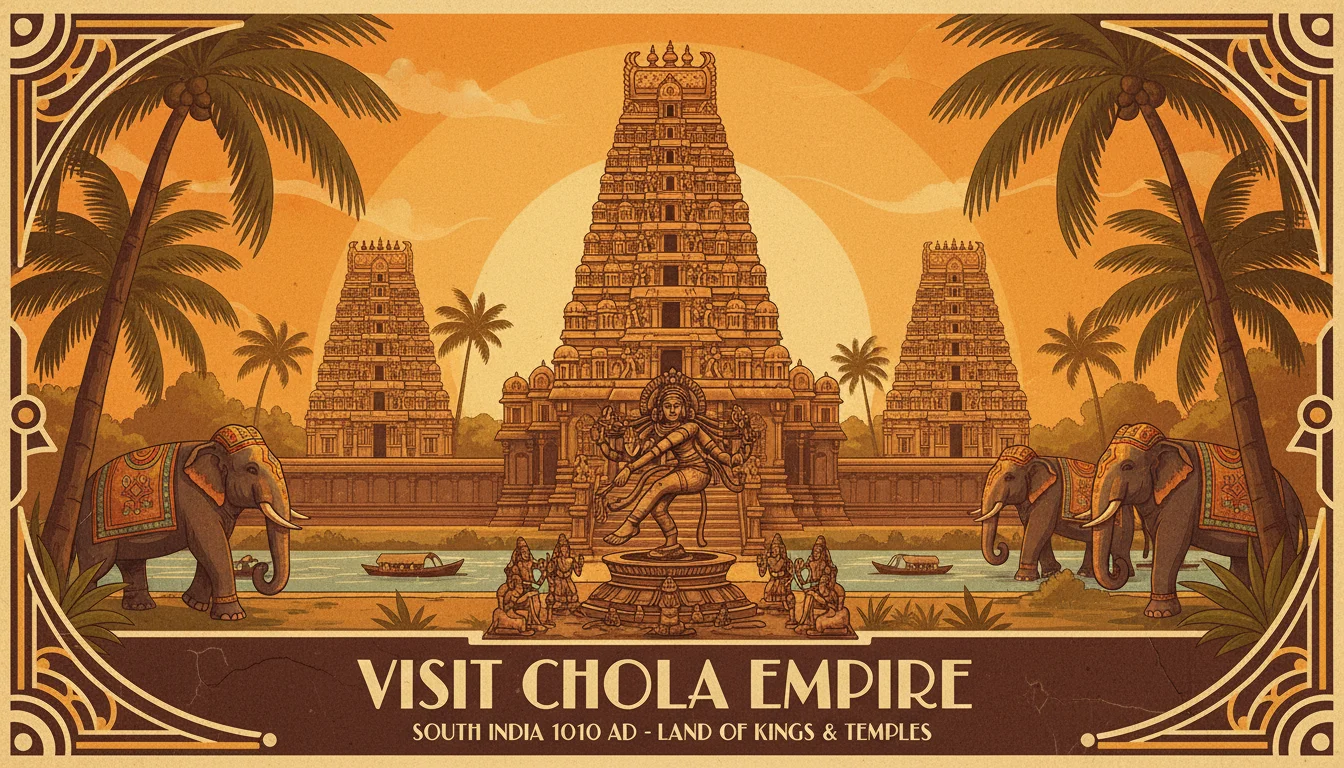
Welcome to Chola Thanjavur, the throbbing heart of the Chola Empire in 1010 AD. You're arriving at possibly the most powerful kingdom in Asia - a naval superpower whose merchant fleets control trade from China to Arabia, and whose armies have just conquered Sri Lanka. The emperor Rajendra Chola I is about to embark on a campaign that will reach the Ganges itself. This isn't the India of snake charmers and mystics that later European travelers would imagine - this is a maritime commercial empire with sophisticated banking, international trade networks, and engineering that will leave you speechless.
Oh, and they're currently building the largest temple the world has ever seen. No big deal.
First Impressions
The Kaveri River delta is absurdly fertile - you'll see why the Cholas call this region "the rice bowl." Irrigated fields stretch to the horizon, fed by an intricate canal system that would make Dutch engineers weep with envy. The roads are surprisingly good, maintained by the state and patrolled by guards. You'll share them with merchant caravans, pilgrims, and the occasional elephant bearing a noble.
Thanjavur itself sits behind substantial walls, but the real action spills into the suburbs where artisan quarters, merchant houses, and temple complexes create a sprawling metropolis. The population hovers around 100,000 - comparable to Constantinople, much larger than any city in Western Europe at this time.
And dominating everything is the Brihadeeswara Temple, still under construction during your visit. Even unfinished, it's staggering - the vimana (tower) will eventually rise 216 feet, topped by a single 80-ton granite capstone. How they'll get that up there is a mystery you might actually witness.
What to Wear
Get this wrong and you'll be instantly marked as a foreigner - which might be fine since the Cholas are remarkably cosmopolitan, but you'll pay tourist prices for everything.
Men: A simple white dhoti (unstitched cloth wrapped around the waist and legs) is universal. The quality of the cotton signals your status - coarser weaves for workers, fine muslin for elites. Upper body can be bare in the heat, or covered with an angavastram (shoulder cloth). Wealthy men wear gold thread borders on their dhotis.
Women: A sari wrapped in the ancient Tamil style - quite different from the modern drape. The fabric passes between the legs and tucks at the back, creating a bifurcated look. Married women wear heavy gold jewelry; the amount directly correlates to family wealth. Going without any gold marks you as either destitute or widowed.
Everyone: Sandalwood paste on the forehead is nearly universal. Religious marks (tilaka) in ash or vermilion indicate your sect and are practically expected. Going bare-foreheaded is like showing up to a business meeting without pants.
Footwear: Mostly barefoot indoors and in temples (mandatory). Simple leather sandals for outdoor walking. Shoes mark you as a foreigner - Muslims and possible Christians wear them.
What to Eat
Tamil cuisine in 1010 is sophisticated, regional, and delicious - though the spice profile differs from modern Indian food since chili peppers won't arrive from the Americas for another 500 years. Black pepper does the heavy lifting.
Breakfast: Idli (steamed rice cakes) with sambar and coconut chutney. Yes, this combo already exists and is already perfect. The fermented rice batter gives idlis their distinctive tang. Dosa (crispy fermented crepes) are the street food version.
Main meals: Rice is king - served on banana leaves with an array of curries, pickles, and condiments. Fish and seafood are abundant near the coast. Vegetarianism is common but not universal; the elite eat plenty of meat, especially game. Toddy (fermented palm sap) is the everyday alcohol.
Temple food: The Brihadeeswara complex feeds thousands daily through its annadana (free food) system. The prasadam (blessed offerings) include exceptional sweets - don't miss the payasam (rice pudding with jaggery and cardamom).
Warning: Water quality varies wildly. Stick to well water from known sources, coconut water, or boiled drinks. Buttermilk (mor) is safe and helps with the heat.
Social Customs
Chola society is hierarchical but not rigid in the way you might expect. Caste exists, but it's more occupational than the later ossified system. Merchants can become incredibly wealthy and influential regardless of birth. Women have more property rights than in most contemporary societies - they can own land, run businesses, and donate to temples in their own names.
Greetings: Folded hands (anjali) with a slight bow. The depth of the bow indicates relative status. Never touch someone's head - it's the most sacred part of the body. Feet are impure; don't point them at people or deities.
Temple protocol: This is serious business. Remove footwear well before entering. Walk clockwise around shrines. Never turn your back to the deity. Donations are expected - even small coins are acceptable. Women are not permitted during menstruation (they'll often not enter).
Commerce: Bargaining is standard except for staple foods with fixed prices. The Cholas minted excellent gold coins (kahavanu) and copper coins (kasu) that trade across the Indian Ocean world. Cowrie shells work for small transactions.
Language: Tamil is the common tongue. Sanskrit is the prestige language of religion and administration. You might also hear Malayalam, Kannada, and various foreign tongues in merchant quarters - the Cholas host Arab, Chinese, and Southeast Asian trading communities.
Dangers to Avoid
Disease: Malaria is endemic in the river delta. Dengue and various fevers thrive in the tropical climate. The monsoon season (October-December here - the northeast monsoon) brings heightened disease risk. Cholera outbreaks happen. Seriously, watch your water.
Animals: Cobras are common in the countryside. Wild elephants occasionally wander into agricultural areas. Crocodiles inhabit the rivers. Stay on established paths.
Politics: The Chola state is efficient but not gentle. Crimes against temples or Brahmins carry savage penalties. Tax collection is rigorous. Foreigners are generally left alone if they don't cause trouble, but don't get involved in local disputes.
Religion: The Cholas are Shaivite (Shiva worshippers) but tolerant of other Hindu traditions. Buddhists and Jains are present and protected. However, disrespecting any temple or sacred image is extremely dangerous - this is a society where religion and state power fuse completely.
Must-See Experiences
The Brihadeeswara Temple construction site: Watching them build this monster is worth the trip alone. The granite comes from quarries 50+ miles away, moved by elephants and human labor. The engineering solutions are ingenious - some scholars think they built a massive earth ramp to position the capstone.
The bronze workshops: Chola bronze casting is peaking right now. The nataraja (dancing Shiva) images being produced in Thanjavur workshops are some of the greatest sculptures humans have ever made. Lost-wax casting at a level that won't be surpassed for centuries. Try to watch a casting if you can arrange it.
The harbor at Nagapattinam: The Chola navy base and commercial port is a day's journey away but worth it. Ships from China, Arabia, and Southeast Asia crowd the harbor. You'll see goods from half the world changing hands. The scale of Chola maritime commerce is genuinely shocking.
Temple festivals: Time your visit for a major festival if possible. The processions feature enormous bronze deities carried on palanquins, accompanied by drummers, dancers, and thousands of devotees. The night processions with oil lamps are transcendent.
The palace complex: Access is limited, but the Chola court is spectacular. Military reviews, classical music and dance performances, and audiences with petitioners all happen in elaborately decorated halls.
Practical Tips
- Arrive in the dry season (January-May) if possible. The monsoon makes travel difficult and disease risk higher.
- Learn a few Tamil phrases. "Vanakkam" (greetings) and "romba nandri" (thank you very much) will help.
- Carry copper coins for daily expenses. Flash gold only for major purchases.
- The temple tanks are the safest places to bathe, and bathing is socially expected.
- Time moves slowly here. Business, audiences, everything takes longer than you expect. Accept it.
- Elephants have right of way. Always.
What You'll Take Home
Beyond the physical souvenirs - bronzes if you can afford them, textiles certainly, spices obviously - you'll leave with a fundamentally shifted perspective. The Chola Empire in 1010 is one of history's great achievements, a sophisticated civilization that most Westerners have never heard of. While Europe stumbles through its early medieval period, Thanjavur is building architectural wonders, casting transcendent art, and running a commercial empire that spans half the known world.
The Brihadeeswara Temple will still be standing a thousand years later, still in active worship, still astonishing visitors with its scale and beauty. That granite capstone will sit perfectly positioned atop the vimana, defying both gravity and explanation. The bronze Natarajas will end up in museums worldwide, icons of human artistic achievement.
You're witnessing a civilization at its peak. Enjoy it.
Safe travels, time traveler. And remember: always clockwise around the shrine.
For other immersive time travel guides to medieval empires, Fatimid Cairo, 970 AD takes you to the Islamic world's greatest city, and Mughal Delhi, 1650 brings you to the height of India's most splendid empire.

Need Advice from Someone Who Lived There?
Get firsthand accounts from people who actually lived through these moments in history.
Ask Them YourselfJoin the HistorIQly Club
Get smarter about the past.
Weekly stories, deep dives, and exclusive content straight to your inbox.