A Time Traveler's Guide to Etruscan Veii
Everything you need to survive Etruscan Veii in 600 BCE, when it was the most powerful city in Italy and the Etruscan League still ruled central Italy.
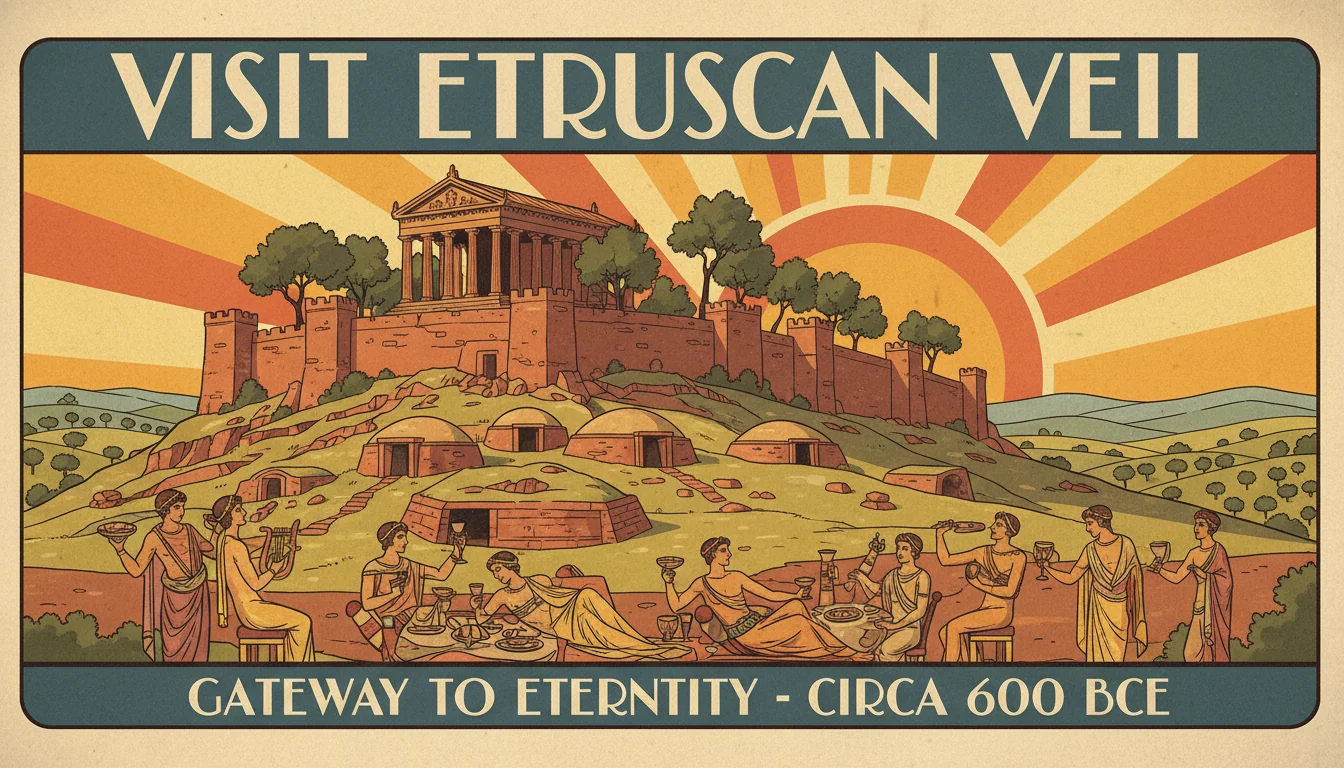
If you want to walk through the most powerful city in Italy before Rome, set your time machine for Veii in 600 BCE. The Etruscan League of Twelve Cities is at the height of its power. Veii itself, just 16 kilometers north of the muddy hill town that will eventually become Rome, sits on a defensible plateau above the Tiber valley and controls the salt trade of the lower Tiber. Etruscan kings still rule Rome. Greek pottery is being imported by the shipload. The first monumental temples in central Italy are being built.
It is also a place where political assassinations are common, religious divination shapes every state decision, and women hold a level of public visibility that will scandalize later Roman writers. So before you click your watch into 600 BCE, here is your practical guide to surviving, blending in, and enjoying a visit to Etruscan Veii.
First, know what kind of place you're entering
Veii in 600 BCE is one of the wealthiest cities in the western Mediterranean. Its territory covers about 580 square kilometers, encompassing rich agricultural land, mineral resources, and direct access to the Tiber River. The city sits on a rectangular plateau ringed by tufa cliffs, naturally defensible, with Iron Age origins extending back several centuries.
The population is probably around 25,000 in the city itself, with a comparable number in surrounding villages and farmsteads. The city has paved streets, a sewer system, monumental temples, aristocratic houses with painted frescoes, and a sophisticated hydraulic system that drains the plateau through deep tunnels called cuniculi.
Your safest cover story is that you are a Greek-speaking trader from southern Italy, attached to a merchant household importing fine pottery from Corinth or Athens. The Etruscans have been trading with Greek colonists for over a century. Greeks are recognizable, accepted, and sometimes deeply integrated into Etruscan society.
Dress like you belong
Etruscan dress in 600 BCE is colorful, expressive, and somewhat eclectic. The Etruscans borrow freely from Greek and Phoenician fashion while maintaining distinctive local traditions.
For men, wear:
- a knee-length linen or wool tunic, often with embroidered borders
- a heavy woolen cloak (tebenna) draped over one shoulder
- soft leather shoes or sandals, sometimes with curled-up toes (an Eastern influence)
- a conical felt cap or no head covering
For women, wear:
- a long woolen or linen dress reaching to the ankles
- a shoulder cloak or stole
- substantial gold or bronze jewelry, including elaborate fibulae (clasps), earrings, and necklaces
- soft leather shoes
- elaborate hairstyles, often braided and pinned
Etruscan women's jewelry is famous for its quality. The wealthy wear gold work that is among the finest in the ancient Mediterranean, including granulation techniques that modern goldsmiths still find difficult to replicate. You should wear modest decorations only, unless you have an established alibi as a wealthy merchant.
Avoid bright synthetic colors. Etruscan dyes lean toward deep reds, blues, and earth tones. Purple is restricted to the highest aristocracy.
Get used to social customs
The most important thing for a foreign visitor to understand: Etruscan women have far more public visibility than their Greek or later Roman counterparts. They dine with their husbands at banquets, wear their own names, attend religious festivals, and participate in public life in ways that Greek visitors find startling and that later Roman writers will describe as shocking.
If you are a woman, you can move more freely in Veii than in almost any other Mediterranean city of 600 BCE. If you are a man, do not be surprised when women address you directly, attend dinner parties, or appear at religious ceremonies.
The Etruscans also practice a strong cult of ancestors and divination. Auspices (omens read from bird flight) and haruspicy (omens read from animal entrails) shape every major political decision. The reading of livers from sacrificed sheep is a learned profession. Foreigners should never claim to know how to interpret omens, even casually.
Three places you absolutely must visit
The Portonaccio Sanctuary
The temple complex at Portonaccio, dedicated primarily to the goddess Menerva (the Etruscan equivalent of Athena), is one of the most spectacular religious sites in Italy. The famous terracotta statue of Apollo of Veii, sculpted by the master craftsman Vulca around the late 6th century, is being prepared here. Even in 600 BCE, the sanctuary is already a center of pilgrimage.
Visit during a festival day if you can. Watch the procession. Stay at the back of the crowd. Do not attempt to participate in any ritual.
The aristocratic tombs
Veii's necropolises, including the Grotta Campana, contain extraordinary chamber tombs decorated with frescoes depicting banquets, dancing, hunting, and athletic games. These tombs are the homes of the dead, designed to provide them with the company and pleasures of the living.
You can visit some tombs during family commemorations, when the descendants of the deceased open them for ritual offerings. Be respectful. Bring a small offering of wine or grain. Do not attempt to read inscriptions you do not understand, as Etruscan writing has only been partially deciphered even in the modern world.
The agora and trading district
Veii has a busy commercial district where Greek pottery, Phoenician glassware, North Italian metalwork, and Etruscan goods are traded. You will hear at least four languages on a busy day. The pottery alone is worth seeing. Some of the finest Greek vases in existence, painted by named masters in Athens or Corinth, are passing through Veii on their way to aristocratic tombs.
Browse, but do not buy anything you cannot account for. Customs officials at the city gates take an interest in luxury goods.
How to talk to people without causing trouble
The Etruscan language is unrelated to any other language in the ancient world that has been preserved. It is not Indo-European. Modern scholars can read the alphabet (which is derived from Greek) but understand only a limited vocabulary of religious and funerary terms.
You will not be able to fake fluent Etruscan. Your strategy is to use Greek, which most educated Etruscans understand, or to rely on an interpreter from your merchant patron's household.
A few universal rules help:
- bow lightly to magistrates and priests
- greet women directly when introduced (not through their husbands)
- accept offered wine, even if you only sip
- never refuse to participate in a religious procession
- avoid speculating about omens or signs
- do not handle ritual objects
If a magistrate asks your business, give a short and modest answer through your interpreter. Etruscan officials are not impressed by foreigners who speak too much.
What to eat, what to avoid
Etruscan food is varied, well-spiced, and generally excellent. Bread, olive oil, wine, fresh and cured meats, fish from the Tiber, cheeses, legumes, and seasonal vegetables form the core. The Etruscans are early adopters of viticulture in central Italy, and their wine is exported throughout the western Mediterranean.
Safe choices for a visitor:
- bread and olive oil from a respectable household
- roasted lamb or pork at a banquet or public festival
- fresh fish from the Tiber, well-cooked
- wine, watered with clean water in the Greek style
- olives, cheese, and nuts as informal snacks
Things to be careful of:
- river water from anywhere outside the central plateau
- shellfish in summer
- sausages or cured meats from market vendors you don't know
- exotic foreign foods at unfamiliar gatherings
- pure unwatered wine drunk on an empty stomach
Money, gifts, and the world of trade
Coinage has not yet arrived in central Italy in 600 BCE. The Etruscans use silver bars, weighed metal, and trade goods as units of value. The shift to coined money will not happen for another two centuries.
Acceptable barter goods:
- silver bars or fragments, weighed honestly
- amber from the Baltic (passing through Etruscan trade)
- small bronze objects
- imported Greek pottery in good condition
Do not flash quantities of metal. Etruscan customs and trade officials track substantial movements of value, and unusual transactions will attract attention from the local aristocracy.
Gifts of imported wine, honey, or spices are appropriate when meeting hosts.
Politics you should know about, briefly
In 600 BCE, the Etruscan League of Twelve Cities (the Dodecapoli) is the dominant political structure of central Italy. Veii is one of the league's most powerful members. Etruscan kings still rule Rome at this date, and Etruscan culture is the prestige culture of central Italy.
Tarquinius Priscus is the king of Rome. Servius Tullius will succeed him. Lucius Tarquinius Superbus will be the last Etruscan king of Rome, and his expulsion in 509 BCE will inaugurate the Roman Republic. None of this has happened yet from your point of view.
Avoid speculating about the future of Roman-Etruscan relations. Veii will fight a long series of wars with Rome over the next two centuries, ending in the city's destruction in 396 BCE under the Roman general Marcus Furius Camillus. Do not predict this.
Do not discuss Greek colonization in southern Italy critically, since many Etruscan elites have personal connections to Greek traders.
What not to do under any circumstances
Let me save you from the classic mistakes.
Do not:
- announce that you are from the future
- claim to read omens
- enter a private tomb without invitation
- speak ill of the league cities
- predict Roman expansion
- handle religious vessels
- attempt to interpret Etruscan inscriptions out loud
- mock the prominent role of women in public life
- refuse to participate in a ritual gesture at a banquet
Most importantly, do not warn anyone about the eventual destruction of Veii. Etruscan civilization will dominate central Italy for another two centuries before being absorbed by Rome. You are visiting near the height of its power. Let it be.
The experience you should not miss
If you have one moment in Veii, take it at sunset standing on the southern edge of the plateau, looking down at the Tiber valley. The river curves below you. Smoke rises from outlying farms and villages. The temples of Portonaccio glow with their painted terracottas in the late light. You can see, far to the south on a hill above the Tiber, the small early settlement of Rome, still ruled by an Etruscan king and not yet remarkable.
You are watching the most powerful Italian city of its century at the height of its wealth, looking down at the obscure neighbor that will, one day, be its destroyer.
Bring an interpreter, drink your wine watered, and never claim to read a liver. Etruscan Veii in 600 BCE is one of the most underrated destinations on any time-travel itinerary.
For cities that rose as Etruscan power declined, our guide to Ancient Rome in 44 BC shows what grew up to replace the Etruscan world. Ancient Sparta in 450 BC is a contemporary Greek city offering an equally strict and dangerous social order.

Need Advice from Someone Who Lived There?
Get firsthand accounts from people who actually lived through these moments in history.
Ask Them YourselfJoin the HistorIQly Club
Get smarter about the past.
Weekly stories, deep dives, and exclusive content straight to your inbox.