Time Traveler's Guide to Ghana's Koumbi Saleh, 1050 AD
Your guide to Ghana's Koumbi Saleh in 1050 - the legendary Land of Gold where trans-Saharan trade made the Ghana Empire one of medieval Africa's greatest kingdoms.
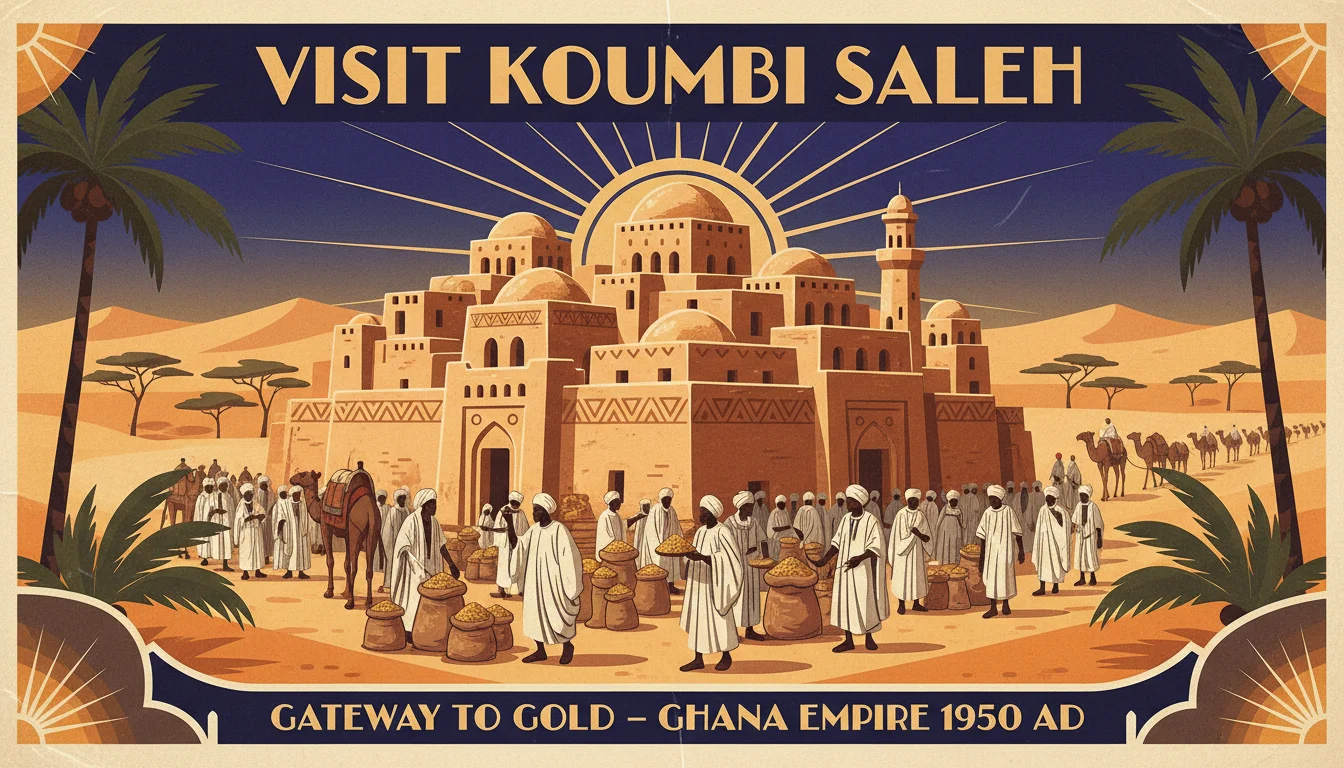
Welcome, temporal tourist, to Ghana's Koumbi Saleh - capital of the Ghana Empire and the beating heart of West African civilization. You've arrived at the legendary "Land of Gold" during its absolute zenith, when Arab travelers whispered in awe about a king so wealthy he tethered his horse to a gold nugget.
Fair warning: everything you thought you knew about medieval Africa is about to get spectacularly overturned.
First Things First: This Isn't Modern Ghana
Before you embarrass yourself - the Ghana Empire has nothing to do with the modern country of Ghana. That's about 400 miles south. You're in the southern Sahara, in what's now Mauritania. The name "Ghana" was the title for the king, meaning "warrior king," and Arab traders just started calling the whole empire that.
The current ruler is probably a member of the Soninke dynasty. Address him as "Ghana" if you somehow get an audience. Mispronouncing his title will get you exactly the reception you'd expect.
What to Wear
Leave your modern clothes in the time machine. Seriously.
For men: A loose cotton tunic works well for commoners. If you've got status to fake, you'll need fine white or indigo-dyed cloth imported from North Africa. Arab merchants wear flowing robes with turbans, so that's an easy costume if you want to blend with the trading class.
For women: Cotton wraps in bright colors, with your hair elaborately braided and decorated with gold ornaments if you can afford them (you probably can't). The local women wear their wealth literally on their bodies - gold earrings, bracelets, and anklets signal status instantly.
Critical note: The king and his court wear their wealth extravagantly. When the Ghana holds court, his pages carry gold-mounted swords and shields of gold. Don't try to out-dress royalty. That's a great way to lose your head - or at minimum, your gold.
The climate is hot and arid. Light, breathable fabrics aren't just fashion - they're survival.
The Twin Cities
Here's where it gets interesting. Koumbi Saleh is actually two towns about six miles apart.
El-Ghaba (The Grove): The sacred royal capital. The Ghana lives here with his court, surrounded by a grove of trees used for traditional religious ceremonies. This is where the ancestral spirits are honored, where justice is administered, and where you absolutely do not want to wander uninvited. The king's palace is impressive - domed buildings, surrounding residences for his entourage, and that famous gold hitching post.
The Muslim Quarter: A proper cosmopolitan trading town with twelve mosques, stone houses, and a permanent population of North African and Arab merchants. This is where you'll do your business and probably sleep. It's more welcoming to strangers, has proper inns, and the food is actually pretty good.
Both cities have wells providing fresh water - a feat of engineering that makes permanent habitation in this landscape possible.
What to Eat
Your diet here will be surprisingly varied, thanks to trans-Saharan trade bringing goods from everywhere.
Local staples: Millet porridge is the base of most meals. Sorghum too. Meat comes from cattle, goats, and sheep - the Soninke are pastoralists as well as traders. Fish from the Senegal and Niger Rivers shows up dried or smoked.
Trade goods: Dates from North Africa. Salt is so valuable it's sometimes worth its weight in gold - you'll taste it in everything. Honey for sweetening. Arab merchants have brought Mediterranean goods like olives and olive oil.
Don't miss: The kola nuts. Bitter, caffeinated, and the most important trade good you've never heard of. They're exported south to forest kingdoms who can't grow them, and they're used in every important social ritual. Offering someone a kola nut is serious business.
Pro tip: Meals are communal. Eat with your right hand only. Left hand usage at meals will mark you as either foreign or profoundly rude.
How to Behave
The Ghana Empire runs on hierarchy, protocol, and a sophisticated understanding of who owes what to whom.
At court: If you somehow get an audience with the Ghana, you'll need to approach on your knees, putting dust on your head as a sign of respect. The king sits in a domed pavilion surrounded by ten horses covered in gold cloth, with dogs wearing gold and silver collars guarding him. Yes, really. You'll kneel until addressed, speak only when permitted, and leave walking backwards.
In the market: More relaxed, but still hierarchical. Prices are negotiated - haggling is expected and respected. The currency is gold dust weighed against standardized measures, though salt bars and copper also circulate.
Religious sensitivity: The royal family and Soninke population follow traditional religion. The merchant quarter is Muslim. Both coexist remarkably well, but don't mock either tradition. The Ghana maintains his legitimacy partly through traditional religious roles, even while welcoming Muslim traders.
The Gold Trade (Why You're Really Here)
Let's be honest - you came for the gold.
The Ghana Empire controls the gold trade between the Wangara goldfields to the south and the trans-Saharan routes to the north. They don't actually mine the gold themselves - that happens in secretive forest regions to the south, through an extraordinary system of "silent trade" where goods are exchanged without buyers and sellers ever meeting.
Here's the important part: the Ghana has a monopoly on gold nuggets. All nuggets belong to the king. Ordinary gold dust circulates as currency, but nuggets are royal property. Getting caught smuggling a nugget out is punishable by death.
The main trade routes bring gold north to Morocco and Egypt in exchange for salt from the Saharan mines, copper, cloth, horses, and manufactured goods. A merchant can double his money on a successful trans-Saharan crossing. He can also die of thirst in the desert. It's a gamble.
Dangers to Avoid
The desert: Don't even think about crossing the Sahara without joining an established caravan. That's two months of scorching days, freezing nights, and death by dehydration if you miss a single oasis.
Royal displeasure: The Ghana's justice is absolute within his domain. Crimes against trade or hospitality are taken especially seriously - the empire's wealth depends on merchants feeling safe.
The Almoravids: Around 1050, you're in a relatively peaceful period, but storm clouds are gathering. The Almoravid movement is gaining strength in the Sahara, and within a few decades they'll conquer the empire. Don't mention this to anyone.
Snakes and scorpions: Sahel wildlife is not friendly. Check your shoes every morning.
What to See
The royal audience: If you can wrangle an invitation, watching the Ghana hold court is worth the trip alone. Musicians with gold and silver instruments, officials in fine clothes, the whole display of power that convinced Arab chroniclers they were witnessing something extraordinary.
The market: Koumbi Saleh's trading hub brings together goods from three continents. North African metalwork. Mediterranean textiles. Saharan salt. Sudanese gold. Forest kola. It's one of the great marketplaces of the medieval world.
The mosque: The Friday mosque in the merchant quarter is reportedly beautiful - stone construction with architectural influences from both North Africa and local traditions.
The sacred grove: You won't get in unless you're invited for a religious ceremony, but the grove at El-Ghaba is where the Soninke connect with their ancestors and traditional spirits. Respect the boundaries.
Your Takeaway
Koumbi Saleh in 1050 is proof that medieval Africa was as sophisticated, wealthy, and interconnected as anywhere on Earth. You're standing in a city that controls one of history's great trade networks, ruled by kings wealthy enough to literally display their power in gold.
The empire won't last forever - nothing does - but right now you're witnessing West African civilization at a peak it wouldn't reach again for centuries. The Arab chroniclers who visited here went home to write that the Ghana was one of the richest kings in the world.
They weren't exaggerating.
Safe travels, and remember: nuggets are for royalty. Stick to the gold dust.
If the Ghana Empire's trade networks have piqued your interest, our guides to Mali's Timbuktu, 1325 and Songhai's Gao, 1500 trace the successor empires that inherited these same Saharan routes.

Need Advice from Someone Who Lived There?
Get firsthand accounts from people who actually lived through these moments in history.
Ask Them YourselfJoin the HistorIQly Club
Get smarter about the past.
Weekly stories, deep dives, and exclusive content straight to your inbox.