A Time Traveler's Guide to Goryeo Kaesong, 1100
Your guide to Kaesong, capital of the Goryeo dynasty in 1100 - a Buddhist monarchy at its confident peak, trading with Song China and producing Korea's finest celadon.
Read Wikipedia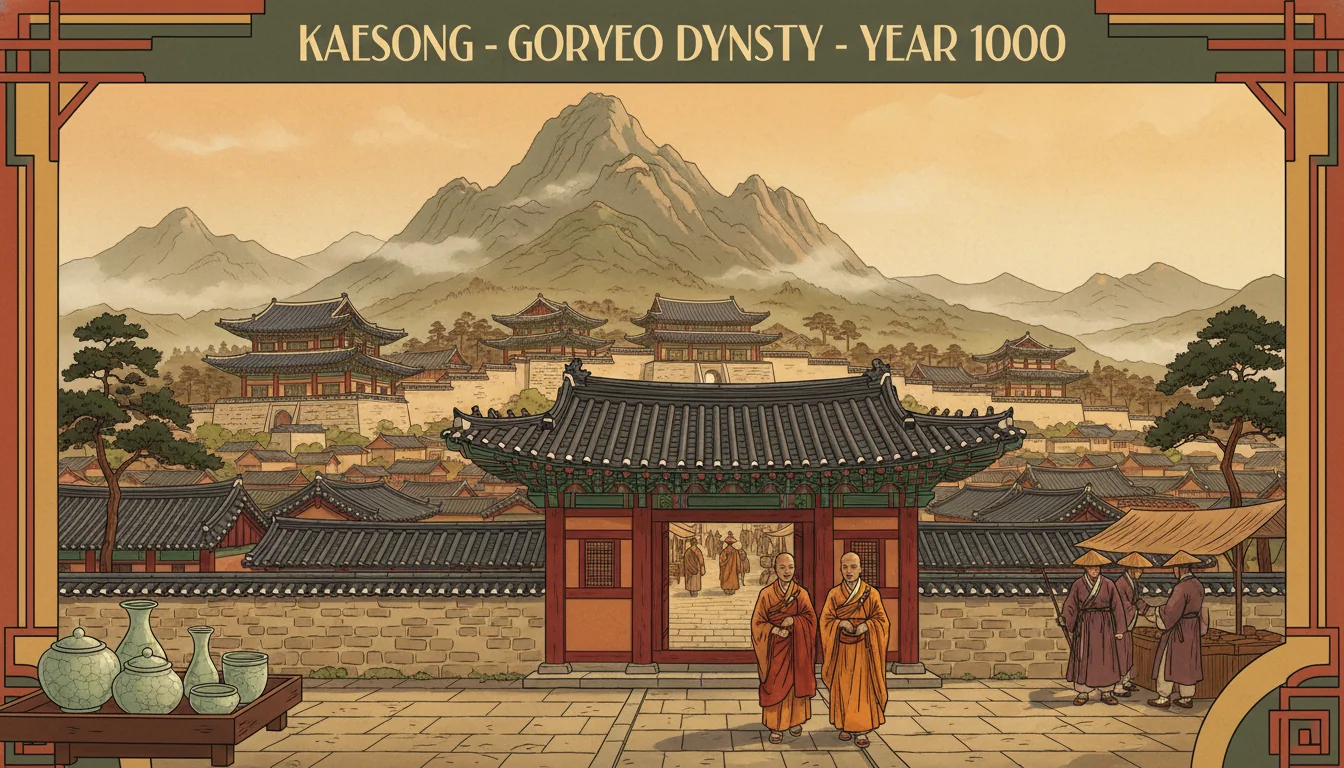
If you only ever take one trip to a medieval Asian capital, consider skipping the Tang Chang'an cliché and picking Kaesong in the year 1100 instead. Goryeo Korea is at a confident moment: the dynasty is nearly two centuries old, the celadon kilns are about to produce some of the most prized ceramics in East Asia, Buddhist monasteries control huge tracts of countryside, and Song merchants are arriving by sea with silk, books, and silver. The Mongols are not coming until 1231. The capital is rich, walled, polite, and only sometimes nervous about the Jurchen tribes massing to the north.
It is also a Confucian-bureaucratic society where strangers without paperwork get noticed immediately, a city where Buddhist monasteries can be politically dangerous places, and an Asian capital in winter where the climate will surprise you. Before you set your watch to 1100, here is your practical guide to surviving, blending in, and enjoying a visit to Goryeo Kaesong.
First, know what kind of place you're entering
Kaesong in 1100 is the political, religious, and commercial heart of the Korean peninsula. The city sits in a small valley ringed by hills, the most prominent of which is Songak Mountain, the spiritual guardian of the dynasty. The royal palace complex of Manwoldae stretches along the southern slope of Songak. Around it lies an inner walled city of officials, monks, and merchants. Beyond that, a broader outer enclosure that the Goryeo court has been extending since the early 11th century. The total population is probably between 100,000 and 200,000, modest by Song Chinese standards but substantial by anyone else's.
The reigning king is Sukjong, in his fifth year on the throne. The Khitan-led Liao dynasty north of the Yalu River is the official suzerain to whom Goryeo sends tribute. The Song court in Kaifeng is the cultural reference point. The Jurchen on the northeast frontier are quietly consolidating under chieftains whose grandsons will, in a generation, found the Jin dynasty and humiliate everyone in this paragraph.
Your safest cover story is that you are a foreign merchant from a trading community Goryeo deals with: a Song Chinese visitor from the port of Mingzhou, a Japanese envoy on Hakata-merchant business, or a Khitan traveler arriving by the overland tribute route. Arab and Persian merchants are documented in Goryeo records from this period, sometimes called Daesik in the sources, and the city is used to them. Pick the one your appearance and accent can support.
Dress like you belong
Modern clothing will give you away within seconds. Goryeo dress is sophisticated, regionally distinctive, and closely watched as a marker of status.
For men, your basic kit is:
- a long crossed-front robe (po) in undyed hemp or, for higher status, plain silk
- loose trousers (baji) tucked into soft leather shoes
- a horsehair hat (gat) if you are a yangban-class official, or a simple cloth cap (geon) if you are a commoner or a foreign merchant
- a sash belt, with a small pouch for cash and ink
For women, the silhouette is layered and longer:
- an inner blouse (jeogori) tied at the chest
- a long pleated skirt (chima) that falls to the ankle
- a wrap or short jacket if traveling
- hair gathered in a long braid for unmarried women, in a knot for married ones, often pinned with a wooden or metal ornament
Avoid bright synthetic dyes, modern fabrics, zippers, and anything with visible Roman lettering. Carry a small cloth wrapping cloth (bojagi) instead of a backpack. Leave the watch behind.
Foreign merchants are visibly foreign and not expected to look Korean. You can keep a Chinese or Khitan style if it suits your cover. What you cannot do is wear armor or weapons inside the inner city without official authorization.
Get used to the streets
Kaesong is laid out on a rough north-south axis, anchored by the Manwoldae palace at the north and the great south gate at the bottom. The inner walls run a perimeter of roughly 7 kilometers, the outer extension a longer one still under construction. The major commercial street, the Sijeon, hosts licensed merchants in fixed stalls dealing in silk, paper, ginseng, lacquer, hemp cloth, and Chinese books. Behind the Sijeon, alley markets sell food, charcoal, used clothing, and the cheap pottery that most ordinary Goryeo households use.
The Goryeo court has just introduced a new metal coinage, the haedong tongbo and samhan tongbo, as part of Sukjong's reforms. Acceptance is patchy. Cloth (mostly hemp) remains the common everyday currency, with rice for larger purchases. Carry small folded lengths of hemp for petty cash, a string of the new bronze coins for prestige use, and silver wire if you are doing serious commerce.
Streets are narrower than in Song Chinese cities and unpaved. Oxcarts haul goods. Horseback is reserved for officials and well-off travelers. The city is loud in the daytime with monastery bells, street vendors, and laborers hauling stone for the wall extensions.
Three places you absolutely must visit
The Manwoldae palace complex
You will not get inside the inner palace itself, but the lower precincts are open enough to give a sense of the scale. The complex is built along the southern slope of Songak Mountain in terraced platforms, with the central hall, the Hoegyeongjeon, sitting at the highest. The architecture is Korean adaptation of Tang and Song idioms: heavy timber framing on stone bases, tiled hipped-and-gabled roofs, painted brackets, and broad ceremonial courtyards. The roof tiles are slate gray. The bracketing is more restrained than Chinese examples of the same period. There is no Forbidden City scale here, but there is genuine refinement.
The best time to approach is on the morning of one of the court's regular ceremonies, when officials in graded robes process up the central axis in a long file. Stand at a respectful distance, do not point, and absolutely do not photograph (you do not have a camera; do not invent one).
A Buddhist temple complex
Goryeo Buddhism is at its most influential in 1100. The major temples around Kaesong include Heungwangsa and Yeongtongsa, both heavily patronized by the royal family. They have multiple halls, large bronze bells, libraries containing parts of the Tripitaka, the Buddhist canon that Goryeo will famously print in entirety later in the century, and resident communities of hundreds of monks.
Bring a small offering, a coin, a stick of incense, or a length of hemp. Bow before the central image. Avoid stepping on the threshold of a hall, which is considered both rude and unlucky.
A celadon kiln
The Goryeo celadon revolution is happening right now, mostly down at the kilns of Gangjin and Buan in the southwest, but smaller workshops within reach of Kaesong produce the soft jade-green wares Song connoisseurs already praise. Watch a single piece pulled from the kiln. The grayish-green crackled glaze, the inlaid white and black slip designs (the sanggam technique), and the careful firing temperatures are at the cutting edge of East Asian ceramic technology.
What to eat
Goryeo food is recognizably Korean in its outlines but milder and more Buddhist-influenced than what comes later. Rice and millet are the staple grains. Side dishes (banchan) are abundant: pickled or salted vegetables, mountain greens, fish where available, soybean paste (doenjang) and fermented sauces. Chili peppers have not arrived; the dishes are seasoned with garlic, ginger, scallions, sesame, vinegar, and salt. Modern red kimchi is centuries away.
Buddhist influence means monastic and aristocratic meals often skip beef. Pork and chicken are common. A traveler's safest order is a bowl of rice or millet porridge, several vegetable banchan, a bowl of soybean-paste soup, and either grilled fish or a few skewers of meat from a street vendor.
For drink, try the local fermented rice wine (makgeolli's ancestor), Chinese tea, or boiled water. Avoid unboiled water from anywhere except a known well.
Customs you must respect
Bow when greeting officials, monks, and elders. The depth of the bow matches the difference in status. As a foreign merchant, you bow lower than almost everyone you meet who is not a fellow merchant or a laborer.
Speak softly in public. Goryeo polite culture, like its Joseon successor, prizes restraint. Loud laughter, large gestures, and back-slapping mark you as foreign at best and rude at worst.
Do not enter a monastic precinct in a state of obvious agitation, drunkenness, or armed display. Do not eat in front of a monk who is fasting. Do not photograph anyone, by which we mean continue not to invent a camera.
If you are stopped by a magistrate's runner, produce your travel papers (you will have been given some by whoever sponsored your cover identity at the gate) and answer questions briefly and politely. Goryeo has a functioning bureaucracy with detailed records on foreign merchants, and a confident, calm, paperwork-citing answer will end most encounters quickly.
What to bring home (metaphorically)
If you only have a day in Kaesong, walk from the south gate to the lower terraces of the Manwoldae, pass through the Sijeon market, drop into a Buddhist temple at midday for the chanting, eat a long lunch of rice and banchan in a modest inn, and finish the afternoon at a celadon workshop. You will leave with a sharper sense of why Goryeo is one of the most underrated medieval polities on earth: a Buddhist monarchy with Confucian bureaucrats, a tribute partner of nomadic empires, a maritime trader with Song China, and the dynasty whose name, garbled into Arab and Persian and eventually European mouths, becomes the word "Korea" itself.
The Mongols will arrive in 1231 and shatter much of what you saw. The Manwoldae palace will burn. Most of the temples will be destroyed. By the time the Joseon dynasty replaces Goryeo in 1392 and moves the capital south to Hanseong, Kaesong itself will be a quieter provincial town. Go now, in 1100, while it is still the center of one of the more confident kingdoms in East Asia, and while the celadon glaze is still cooling in the kiln.
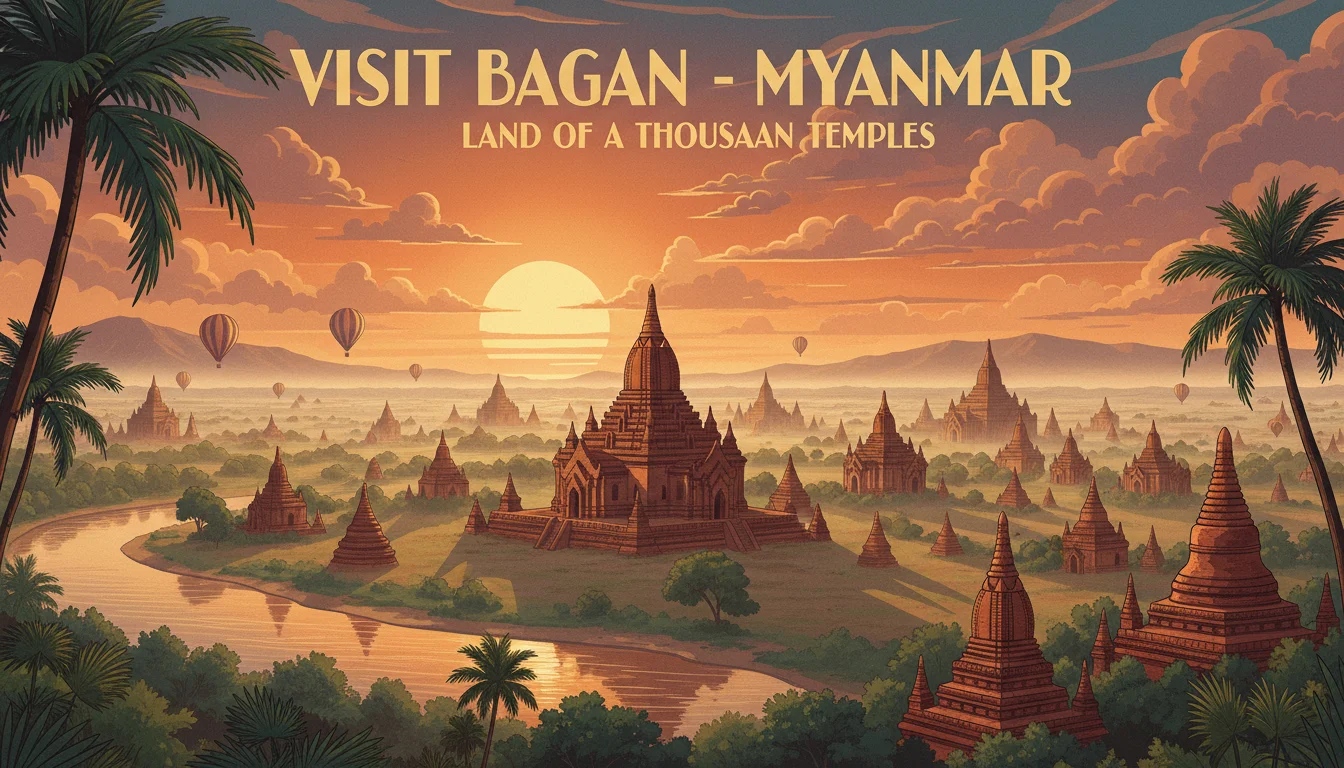
For neighboring civilizations worth visiting around the same period, see our guides to Heian Kyoto in 1000 and Bagan in 1100, two other Asian capitals at their cultural peaks.
Quick Answers
Common questions about this topic
Where is Kaesong and why was it the Goryeo capital?
Kaesong, also written Gaeseong, lies in what is today the southwestern corner of North Korea, about 70 kilometers northwest of Seoul. The Goryeo founder Wang Geon, a local strongman from the area, made it his capital when he proclaimed the dynasty in 918. It remained the capital for more than four centuries until the Joseon dynasty moved the seat of government to Hanseong, the modern Seoul, in 1394.
What religion did Goryeo Koreans practice?
Mahayana Buddhism was the state religion, supported by the throne and by an enormous monastic infrastructure. Sects such as the Hwaeom and the Cheontae schools dominated court ritual. Confucianism shaped the civil service, ancestor rites, and the law, while folk shamanism, called musok, persisted in the countryside. Most Goryeo Koreans participated in all three traditions without seeing a contradiction.
Who ruled in 1100?
King Sukjong, the 15th king of Goryeo, took the throne in 1095 after deposing his nephew King Heonjong. Sukjong was a reform-minded ruler who pushed for a new coinage system, supported the Cheontae Buddhist sect, and faced a growing Jurchen tribal threat on the northern frontier. He died in 1105 and was succeeded by his son Yejong.
Was Goryeo independent of China?
Yes, in practice. Goryeo paid tribute to whichever northern dynasty was strongest, in 1100 the Liao under the Khitan, and used Chinese Confucian institutions and the Chinese writing system. But Goryeo kings ran their own foreign policy, maintained an active maritime trade with Song China and Japan, fought their own wars against the Jurchen, and were never administered as Chinese territory. The English name Korea actually descends from Goryeo through the merchants who reached the city.

Need Advice from Someone Who Lived There?
Get firsthand accounts from people who actually lived through these moments in history.
Create your free account →No card required. Some figures and features require a paid plan.
Join the HistorIQly Club
Get smarter about the past.
Weekly stories, deep dives, and exclusive content straight to your inbox.