Time Traveler's Guide to Harappan Mohenjo-daro, 2000 BC
Visit Harappan Mohenjo-daro, the world's most advanced Bronze Age city - with indoor plumbing, grid streets, and a writing system we still can't read.
Read Wikipedia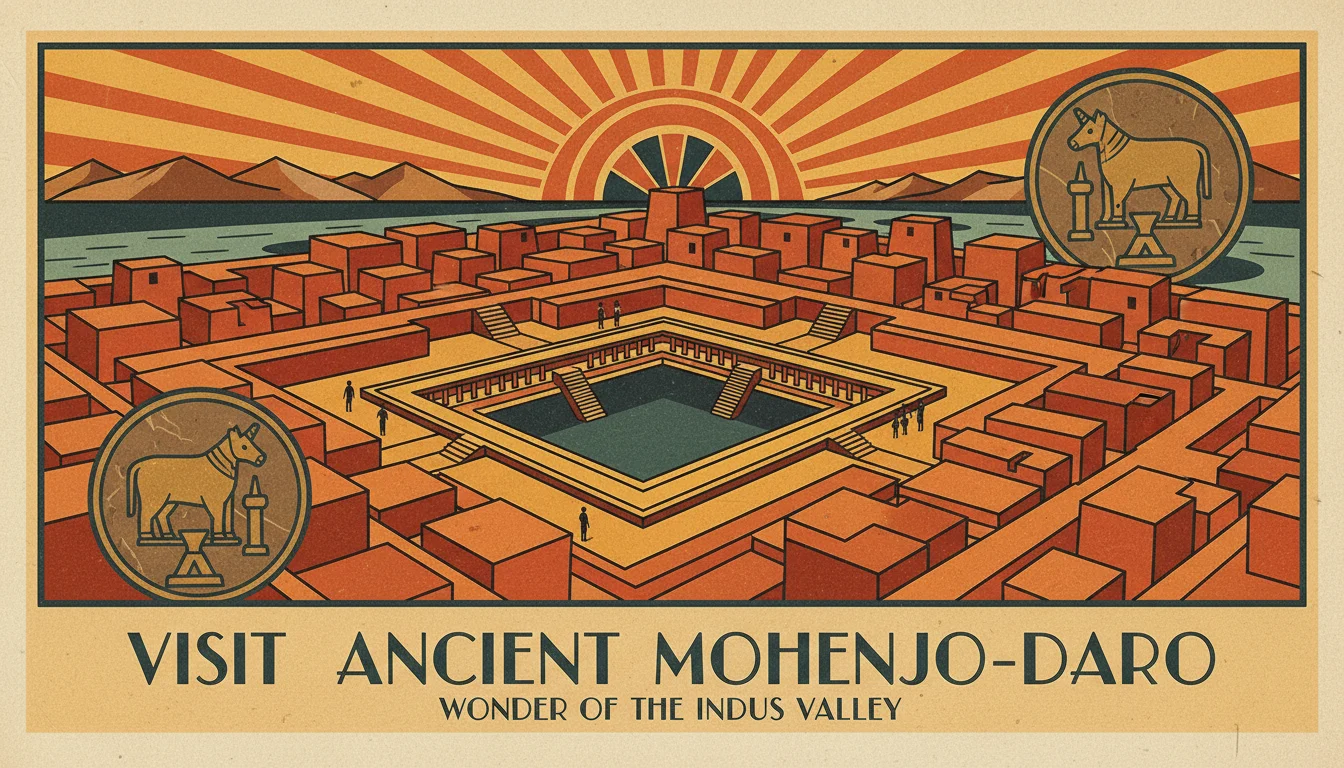
You've arrived in what might be the most orderly ancient city ever built. While Egyptians are stacking pyramids and Mesopotamians are fighting over irrigation rights, the people of Mohenjo-daro have figured out something revolutionary: urban planning. And indoor toilets.
Welcome to the Indus Valley Civilization at its peak - a culture so mysterious that we still can't read their writing, don't know what they called themselves, and aren't entirely sure why they disappeared. But we do know they built something extraordinary.
What You're Walking Into
Mohenjo-daro (which means "Mound of the Dead" in Sindhi, though its original name is lost) sits along the Indus River in what will become Pakistan. In 2000 BC, it's one of the largest cities in the world, home to perhaps 40,000 people - comparable to contemporary Ur or Memphis.
But unlike those cities, there are no massive temples dominating the skyline, no palaces for god-kings, no monuments celebrating military conquests. The Harappan civilization seems to have channeled its ambitions into something different: really excellent drainage.
This is not a joke. You will spend considerable time admiring their sewage system.
The Grid That Would Make Manhattan Jealous
The first thing you'll notice is that the streets make sense. Unlike the organic medieval tangles that will define most cities for the next 4,000 years, Mohenjo-daro is laid out on a careful grid. Main thoroughfares run north-south and east-west, intersecting at right angles. Side lanes connect in orderly fashion.
The main streets are about 30 feet wide - enough for carts to pass easily. The residential lanes are narrower, maybe 6 feet, designed for foot traffic. Street corners are rounded to help carts turn. There are no signs, but the system is intuitive enough that you won't get lost.
Along the main streets, you'll find covered drains running beneath the pavement. Every house connects to this system. Wastewater flows from homes into these channels, which empty into larger drains, which eventually discharge outside the city. It's essentially a municipal sewer system, 4,000 years before London will manage anything comparable.
What to Wear (Or Not Wear)
The climate here is hot and arid (the Indus Valley was more forested in this era, but still warm). Based on surviving figurines and impressions, locals wear minimal clothing - cotton cloth wrapped around the waist for men, longer draped garments for women. Cotton textiles are a Harappan specialty; they may have domesticated the plant.
Jewelry is where they go all out. Both men and women wear extensive ornaments: necklaces of carnelian, shell, and gold beads; bangles of shell, copper, and faience; elaborate hair ornaments. The bead-making is exquisite - they've mastered techniques for drilling through carnelian that won't be matched for millennia.
Your time-traveler tip: get a good cotton wrap (the heat is real) and some basic beadwork. Without jewelry, you'll look oddly naked.
The Great Bath and the Citadel Mound
The western part of the city features what archaeologists call the "Citadel" - a raised platform of mud brick holding several large public buildings. The most famous is the Great Bath: a brick-lined pool about 40 feet long and 8 feet deep, with steps descending on both sides.
This isn't a swimming pool. The elaborate waterproofing (bitumen between the brick layers) and the presence of side rooms suggest ritual bathing. Think more "sacred purification" than "community pool party." You can probably observe, but entering the water uninvited would be like wandering into a church's baptismal font.
Near the Great Bath is a large structure that might be a granary - a massive platform with ventilation channels that would be perfect for grain storage. Or it might be something else entirely. This civilization is frustratingly silent about its own institutions.
Food and Drink: The Harappan Menu
The Indus Valley people eat well. Their agriculture is sophisticated, drawing on both Mesopotamian and local traditions:
Grains: Wheat and barley are staples, ground into flour for flatbreads. They also cultivate rice in the wetter regions, millet, and various pulses (lentils, chickpeas, peas). The dal and roti combination that will define South Asian cuisine for millennia starts here.
Meat: Cattle are common (and possibly sacred - zebu bulls appear frequently in their art), but beef consumption is uncertain. Sheep, goats, pigs, and chicken are definitely eaten. Fish from the Indus River is plentiful. Wild game supplements the diet.
Produce: Dates, sesame (for oil), various vegetables. Possibly mangoes and bananas from wetter regions.
Drinks: No evidence of alcohol production, which is unusual for a complex society. They might be remarkably temperate, or we just haven't found the breweries yet. Expect water, possibly flavored with fruits or herbs.
To eat, find the food vendors near the main streets. Payment is tricky - they don't use coins. Trade goods, especially copper tools or textiles, work well. Their standardized weights suggest a careful commercial system, but we don't fully understand the currency.
The Houses You'll Wish You Had
Residential architecture here is remarkably uniform - not identical, but following consistent principles. Houses are built of fired brick (a Harappan specialty; most contemporary cultures use sun-dried mud brick) arranged around central courtyards.
Standard features include:
- Private wells in the courtyard (many houses have their own)
- Bathing platforms with drains leading to the street sewer
- Indoor toilets - brick seats over chutes leading to the drainage system
- Staircases suggesting second floors (which haven't survived)
- No windows facing the street - privacy was valued
The uniformity might indicate a highly regulated building code, or just cultural consensus about proper living. Either way, it's impressive. A middle-class Mohenjo-daran has better sanitation than a Victorian Londoner will have in 4,000 years.
What You Won't Find
Temples or palaces: If they exist, we can't identify them. No building clearly dominates the others. Religious practice may have been household-based, or we're just not recognizing the sacred architecture.
Military fortifications: The walls seem designed to protect against floods, not armies. No weapons caches, no martial imagery in their art. This civilization either had no enemies or defended itself in ways we don't understand.
Monumental inscriptions: The Harappan script appears only on small seals and tablets, usually just a few characters. We've found about 400 symbols, suggesting it's a true writing system, but no long texts survive. Or existed.
Clear rulers: No tombs of kings, no palatial compounds, no statues of leaders. Governance here remains a complete mystery.
The Seals and the Unicorn
The most common Harappan artifacts are small stone seals, usually about an inch square, carved in reverse so they can stamp impressions. They typically show an animal figure and a short inscription.
The most common animal? A creature that looks like a unicorn - a bull-like figure shown in profile with a single horn. It's almost certainly a stylized bull (shown from the side, two horns overlap), but the "Harappan unicorn" has captured modern imagination.
Other seals show elephants, rhinoceroses, tigers, and a mysterious figure sitting in what looks like a yoga pose surrounded by animals - possibly an early representation of a deity, possibly just a guy who likes sitting cross-legged.
The seals were probably used for commercial purposes - marking goods, identifying merchants, authenticating transactions. Buy one if you can; they're extraordinary works of miniature art.
Getting Around
Mohenjo-daro is walkable - maybe two miles across at its widest. The grid layout makes navigation simple. Bullock carts are used for heavy goods; you can probably catch a ride if you're tired.
For longer journeys, the Indus River is the main highway. Boats carry goods between the major cities - Harappa to the north, Lothal to the south on the coast. River travel is how this civilization maintains its remarkable cultural uniformity across hundreds of miles.
Dangers and Difficulties
The floods: The Indus is prone to catastrophic flooding. The city has been rebuilt at least seven times, each layer sitting atop flood debris. If the river rises unexpectedly, get to high ground fast.
The heat: Temperatures in summer can exceed 110°F. Midday is for staying indoors in the shade. Morning and evening are for business.
Disease: Standing water, even in well-drained cities, breeds mosquitoes. Malaria exists. The same sophisticated drainage that impresses you might be breeding illness in the slower-moving outflows.
The mystery: You can't read the signs, can't identify the authorities, can't find a temple to explain the worldview. This is a city you can walk through but never fully understand. That's frustrating and, honestly, a little unnerving.
The Quiet Collapse
You're visiting near the end. By 1900 BC, Mohenjo-daro and its sister cities will begin declining. By 1700 BC, they'll be mostly abandoned. What happened?
Theories include climate change (the monsoons shifted), river migration (the Indus moved away from major settlements), tectonic activity, disease, or some combination. There's no evidence of conquest - no burned buildings, no mass graves, no foreign weapons. The Harappans just... stopped.
Some migrated east toward the Ganges valley. Their descendants may have contributed to later Indian civilization. But the script was never passed on, the urban planning forgotten, the standardized weights abandoned. What survived was transformed beyond recognition.
What to Bring Back
- Carved seals: Small, portable, extraordinarily beautiful
- Carnelian beads: Their long, perfectly drilled beads are unmatched
- Cotton textiles: The best you'll find anywhere in the Bronze Age world
- Standardized weights: Cubical chert weights in precise ratios - curiosities for the technically minded
Final Thoughts
Harappan Mohenjo-daro challenges everything we think we know about ancient civilizations. Where are the kings? The armies? The temples? The propaganda? Instead, you find toilets, drains, standardized bricks, and careful urban planning. It's a civilization that seems to have valued order and cleanliness over glory and conquest.
Whether this reflects a remarkably egalitarian society, a priestly theocracy we can't recognize, or just gaps in the archaeological record, we may never know. The Harappans took their secrets with them when they left.
But stand on a Mohenjo-daro street corner in 2000 BC, watching merchants weigh goods on standardized scales while wastewater flows beneath your feet in covered drains, and you'll understand something important: progress isn't linear. Sometimes civilizations figure things out, then forget them for millennia.
The Harappans figured out a lot. We're still trying to figure out the Harappans.
For other Bronze Age time-travel stops, see our guides to Hittite Hattusa, 1300 BC and Achaemenid Persepolis, 500 BC.

Need Advice from Someone Who Lived There?
Get firsthand accounts from people who actually lived through these moments in history.
Create your free account →No card required. Some figures and features require a paid plan.
Join the HistorIQly Club
Get smarter about the past.
Weekly stories, deep dives, and exclusive content straight to your inbox.