Time Traveler's Guide to Heian Kyoto, 1000 AD
Your guide to Heian Kyoto in 1000 AD - where poetry could end your career, the wrong color was social death, and demons lurked outside the city gates.
Read Wikipedia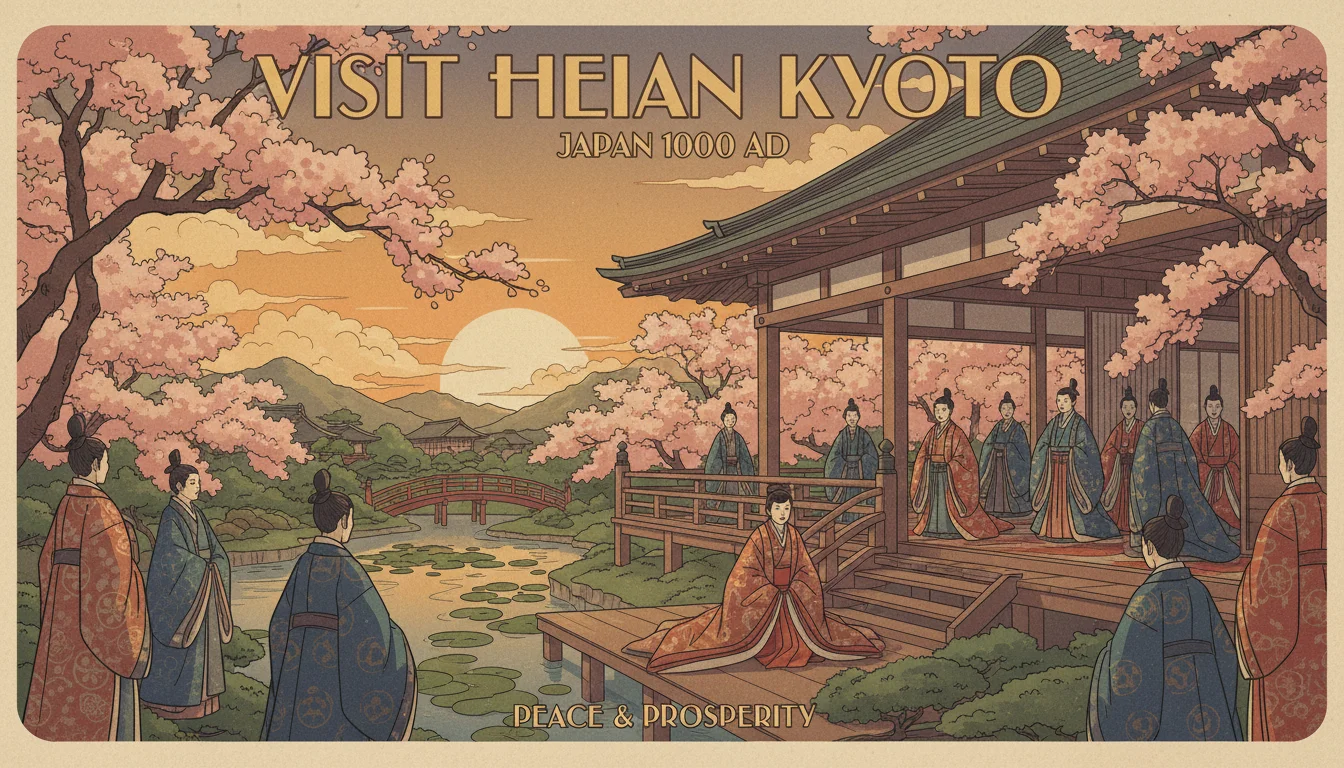
You've just materialized in the capital of Japan during its most refined era. Welcome to Heian-kyo - the "Capital of Peace and Tranquility" - a city so obsessed with beauty that a badly written poem could end your social life faster than a sword ever could.
The year is 1000 AD. Murasaki Shikibu is writing what many consider the world's first novel. Sei Shonagon is cataloging everything she finds delightful or dreadful. The Fujiwara clan runs everything behind a puppet emperor. And you're standing here in your modern clothes like some kind of barbarian.
Let's fix that before someone calls an exorcist.
What to Wear (This Is Not Optional)
Clothing in Heian Kyoto isn't fashion - it's communication. The aristocratic women wear junihitoe, twelve layers of silk robes in carefully coordinated color combinations that change with the seasons. In autumn, you'd want "fallen leaves" - layers shifting from green to gold to russet. Get the color scheme wrong and you might as well announce you have no taste, which here is roughly equivalent to announcing you have no soul.
Men of rank wear sokutai - elaborate court robes with impossibly long trailing trousers called nagabakama. You'll trip. Everyone trips at first.
If you can't manage full court dress, aim for a simple hunting outfit (kariginu) for men or a modest kosode for women. You'll mark yourself as minor nobility at best, but at least you won't cause a scandal.
One critical detail: your hair. Women wear it loose and flowing, ideally past the waist. The longer the better. Men wear theirs in a topknot under a lacquered cap called an eboshi. No exceptions. Bare-headed men are either monks or madmen.
Where You Are
Heian-kyo is laid out on a perfect Chinese-inspired grid, roughly four kilometers by five. The Imperial Palace compound sits at the northern center, with Suzaku Avenue - a grand boulevard eighty meters wide - running due south to the Rashomon gate.
The city looks magnificent on paper. In reality, the western half is mostly abandoned and overgrown. Everyone who matters lives in the eastern districts, particularly around the area that will eventually become modern Kyoto's city center.
The aristocrats live in shinden-zukuri mansions - graceful complexes of connected pavilions set around ornamental gardens with artificial ponds and winding streams. These gardens aren't decorative afterthoughts. They're essential to daily life. Parties happen on the water. Poetry gets composed by the streams. Love affairs begin with glimpsed silhouettes through garden screens.
Outside the aristocratic districts, ordinary people live in far simpler conditions. The markets along the eastern side of the city bustle with merchants selling everything from Chinese silk to dried fish.
What to Eat
Court food is elegant but honestly? Pretty bland by modern standards. Rice is the staple, served steamed and plain. Fish - mostly freshwater varieties like carp and trout - comes dried, salted, or simmered. The sea is far enough away that fresh saltwater fish is a luxury.
Vegetables are seasonal: radishes, eggplant, and burdock root feature heavily. Fruit means persimmons, chestnuts, and citrus. Everything is minimally seasoned. Soy sauce as you know it doesn't exist yet, though fermented bean paste is used.
The real star of Heian dining is the presentation. Food is served on elegant lacquerware and arranged with the precision of a flower arrangement. The aesthetic matters more than the flavor.
Sake is everywhere and practically mandatory at social gatherings. It's cloudier and sweeter than modern sake - closer to a rice smoothie with a kick. Refusing to drink marks you as deeply suspicious.
One thing you won't find: meat. Buddhism has made eating mammals deeply taboo among the upper classes. Technically some people still hunt, but they don't talk about it at court. Think of it as the Heian equivalent of a guilty pleasure.
The Social Rules (Break These at Your Peril)
Heian court culture has more unwritten rules than a middle school cafeteria, and the consequences for breaking them are worse.
Poetry is everything. You will be judged - constantly, ruthlessly - by your ability to compose waka poetry on the spot. A nobleman sees the first cherry blossoms and dashes off a perfect thirty-one-syllable poem referencing three classical allusions. If you can't do this, stay quiet and look mysterious. Mysterious beats incompetent.
Indirect communication is the only communication. Nobody says what they mean. A gift of autumn leaves means "I'm thinking of you as the season changes." A fan placed just so conveys a specific emotion. A poem sent on paper of a particular color and scent delivers a message the words alone don't carry. Direct speech is for peasants.
Romance follows strict choreography. Men visit women at night, arriving after dark and leaving before dawn. The woman stays hidden behind screens and curtains - the man might not see her face for months. Instead, he judges her by her voice, her scent, her handwriting, and those color-coordinated sleeve edges she lets peek under the curtain. The morning-after poem (kinuginu no uta, literally "the robe-of-parting poem") is absolutely mandatory. A late or poorly written one is grounds for never seeing her again.
Crying is encouraged. For everyone. Tears at a beautiful poem, a melancholy sunset, or a poignant memory are signs of refined sensitivity. Stoicism is for soldiers, not civilized people.
Dangers and Annoyances
The biggest physical danger is disease. Malaria is common in the marshy lowlands around the capital. Smallpox sweeps through periodically and devastates the population. The Heian response to illness is primarily spiritual - monks chanting sutras, yin-yang diviners (onmyoji) performing rituals, and exorcists driving out possessing spirits. If you get sick, you'll want modern medicine, not a divination session.
Fire is a constant threat. These beautiful wooden mansions burn spectacularly and regularly. The Imperial Palace itself has burned down and been rebuilt multiple times by this point.
Outside the city, bandits and brigands control the roads. Travel is genuinely dangerous, which is one reason the aristocrats almost never leave the capital. Many high-ranking nobles have never seen the countryside they technically govern.
Then there are the spiritual dangers, which to the Heian mind are just as real. Vengeful ghosts (onryo), malicious spirits, and demons (oni) are accepted facts of life. The onmyoji - masters of yin-yang divination led by the famous Abe no Seimei - are consulted before any major decision. Moving house, starting a journey, even which direction to face your bed: everything gets checked against the cosmic calendar. Certain directions are taboo on certain days (called katatagae), and people will literally detour for hours to avoid traveling in an unlucky direction.
Don't laugh at this. They're completely serious, and mocking someone's spiritual concerns will get you ostracized faster than a bad poem.
What You Must See
The Imperial Palace compound. Even if you can't get inside (and you probably can't without connections), the sheer scale is impressive - a walled complex of ceremonial halls, gardens, and residences covering several city blocks.
The Kamo River at twilight. The eastern edge of the city slopes down to this river, and at dusk the view of the eastern mountains turning purple is exactly the kind of beauty that makes court poets weep openly.
A kemari match. This is aristocratic kickball - a group of noblemen in flowing robes trying to keep a leather ball in the air without using their hands. It's surprisingly athletic and genuinely entertaining. No score is kept. The point is elegance, not competition.
An incense-guessing competition (takimono awase). Aristocrats blend their own signature incenses and compete to create the most evocative scent. Your clothes, your letters, even your hair should carry your personal fragrance. The competitions are taken with deadly seriousness.
A night of tale-telling. Gather around and listen to stories of ghosts, romance, and adventure. This is the golden age of Japanese literature happening in real time. Somewhere in the city, a lady-in-waiting is writing about Prince Genji's love affairs, and she doesn't know yet that people will still be reading it a thousand years later.
Survival Tips
Keep your shoes pointed toward the exit - you'll be removing them constantly when entering buildings, and the wrong shoes at the wrong time creates chaos.
Learn to write beautifully. Your handwriting is considered a direct window into your character. Ugly writing equals ugly soul, in the Heian worldview.
Carry a fan at all times. It's a communication tool, a face-covering device, a poetry surface, and a social shield all in one.
If an onmyoji tells you not to travel in a certain direction today, just don't. It's not worth the argument or the social consequences.
And above all: cultivate mono no aware - the bittersweet awareness of impermanence. The cherry blossoms are beautiful because they fall. The moonlight is poignant because dawn comes. This sensitivity to the fleeting nature of beauty isn't just philosophy here. It's the entire foundation of civilized life.
Enjoy Heian Kyoto. Just make sure your morning-after poem is ready before you need it.
For more East and South Asian time-travel guides, see our stops at Mughal Delhi, 1650 and Yuan Khanbaliq, 1280 AD.

Need Advice from Someone Who Lived There?
Get firsthand accounts from people who actually lived through these moments in history.
Create your free account →No card required. Some figures and features require a paid plan.
Join the HistorIQly Club
Get smarter about the past.
Weekly stories, deep dives, and exclusive content straight to your inbox.