A Time Traveler's Guide to Hittite Hattusa
Everything you need to know before visiting Hittite Hattusa in 1300 BC - the capital of the forgotten Bronze Age superpower that fought Egypt to a standstill at Kadesh.
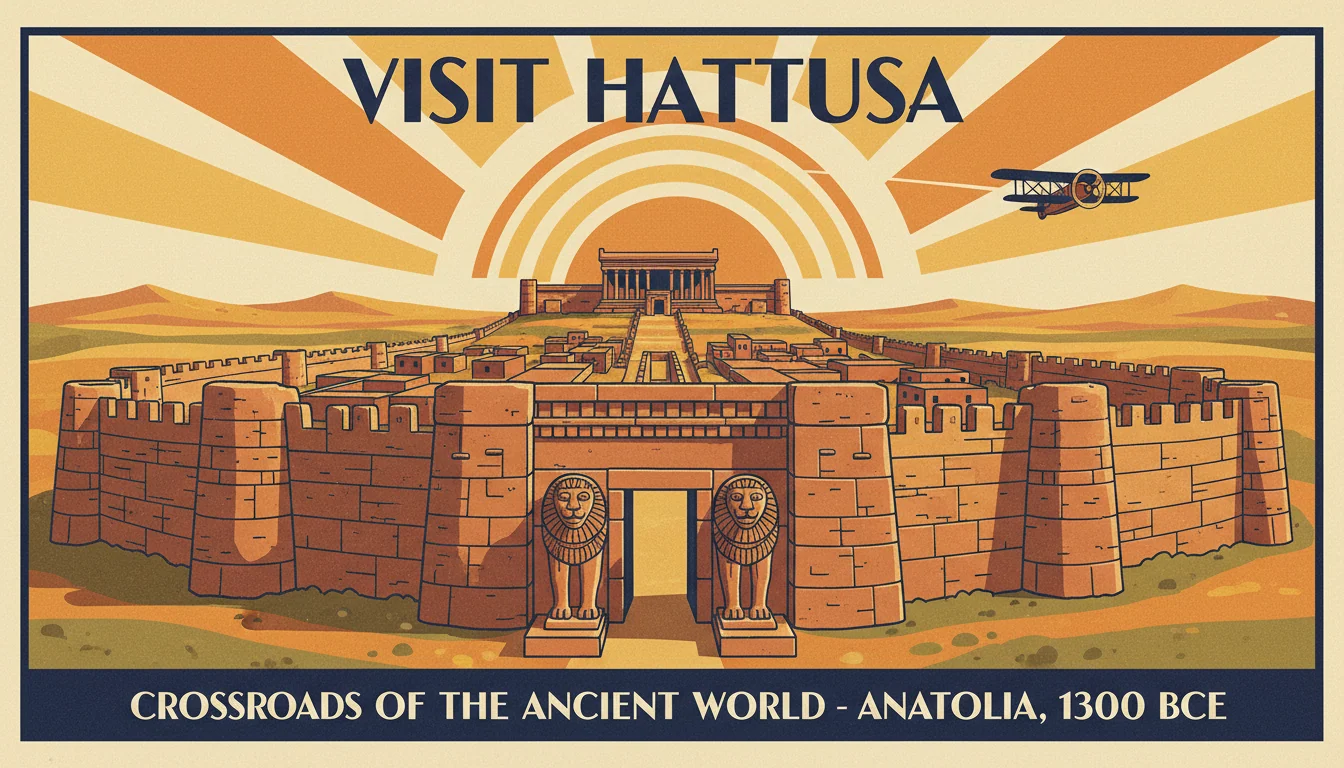
If your time machine drops you in central Anatolia in 1300 BCE, you have arrived at one of the most powerful and least famous capitals of the ancient world. Hattusa, the seat of the Hittite Empire, is a stone-walled city perched on a bluff above the Anatolian plateau. From here, the Great King controls a network of vassal states stretching from the Aegean coast to the upper Euphrates. The Hittites are about to fight Egypt at the Battle of Kadesh, and they will sign the world's first known peace treaty fifteen years later.
You are also about a century from the mysterious collapse that will erase the entire civilization from history for more than three thousand years. So pay attention.
Here is your practical guide to surviving, blending in, and enjoying a visit to Hittite Hattusa.
First, know what kind of place you're entering
Hattusa is not a sprawling open city. It is a fortified administrative and religious capital perched on irregular terrain, ringed by massive cyclopean walls, gated through monumental sculpted lions, sphinxes, and warriors. Population estimates vary, but somewhere between 40,000 and 50,000 people live here. The royal palace, the great temple complexes, the workshops, the granaries, and the diplomatic quarters all share an unforgiving stone landscape.
The state is multilingual. Official correspondence is conducted in Akkadian, the diplomatic lingua franca of the Late Bronze Age, but the population speaks Hittite, Luwian, Hattic, Hurrian, and other languages depending on origin and class. Almost no foreigner from outside the empire speaks Hittite well, and your accent in any language will mark you immediately as an outsider.
Your safest cover story is that you are a merchant or messenger attached to a vassal kingdom in northern Syria or southwestern Anatolia. The empire is full of envoys passing through. Keep details vague. Do not claim Egyptian, Mycenaean, or Assyrian origin unless you actually speak the language.
Dress like you belong
Late Bronze Age Anatolian dress is layered, practical, and weather-aware. The plateau is cold in winter and hot in summer, with sharp transitions in spring and autumn.
For men, wear:
- a long woolen tunic, knee-length, belted at the waist
- a cloak or shawl, draped over one shoulder
- soft leather shoes with curled-up toes (genuinely a Hittite signature)
- a conical or rounded woolen cap
For women, wear:
- a long woolen or linen dress to the ankles, often with embroidered borders
- a shawl or veil for outdoor wear
- soft leather shoes
- bronze or silver pins to fasten the shoulder of the dress
Avoid bright synthetic colors. Hittite dyes lean toward earth tones, with reds, ochres, and indigos as accents. A merchant or middling craftsman would dress modestly. Royal and priestly figures wear richer fabrics with silver or gold thread that you will recognize immediately.
Leave anything modern behind: zippers, elastic, plastic, sunglasses, watches, and modern footwear. Carry a leather or woven bag for your supplies.
Get used to the geography
Hattusa is a vertical city. The terrain rises steeply from the lower parts to the royal acropolis. Streets are narrow, paved with stone where slopes demand it, and crowded with workers, water-carriers, and pack animals. The walls are dramatic, with the famous Lion Gate, Sphinx Gate, and King's Gate punctuating the southern perimeter.
The Great Temple of the Storm God, also known as Temple 1, dominates the lower city. It is a massive complex of courtyards, shrines, and storerooms. Wandering near it is fine. Entering uninvited is not.
The royal palace and citadel of Büyükkale rises on a rocky outcrop in the upper city. Do not climb up there casually. The royal residence is heavily guarded.
Yazılıkaya, the open-air rock sanctuary about two kilometers northeast of the city, is one of the most impressive religious sites in the ancient world. You can visit it as a pilgrim. Behave with reverence. Do not touch the carvings.
How to talk to people without causing trouble
You will not be able to fake fluent Hittite. Don't try. Your strategy is to be politely uninformed and to lean on someone who is already in the system.
If you can hire a guide for a day, do so. Look for a junior scribe, a low-level temple servant, or a market broker. They will appreciate small bronze offerings and will translate, vouch for you, and steer you away from accidental disasters.
A few universal rules help:
- bow lightly when meeting officials
- never speak directly to a priest or scribe in their working space
- stand aside for processions, especially religious ones
- avoid physical contact with strangers
- keep your hands visible at all times near gates and guarded buildings
If a guard asks your business, give a short answer in your weakest Hittite, then defer to your guide or merchant patron. Hittite officials are paperwork-loving bureaucrats. Boring them is a survival skill.
What to eat, what to avoid
Hittite food is grain-heavy, with bread, porridge, beer, and stews as the base. Meat appears at festivals and on wealthy tables but is rare in daily life. Sheep, goats, and cattle are all consumed. Cheeses, yogurts, lentils, chickpeas, onions, garlic, leeks, apples, and pomegranates are common.
Safe meals for a visitor:
- thick wheat or barley bread, broken from a fresh loaf
- a stew of lentils and onions
- roasted goat at a religious festival, where it has been freshly slaughtered
- a cup of barley beer, lightly fermented
- pomegranate juice or fresh figs in season
Things to be careful of:
- standing water from city wells in summer
- raw or undercooked meat
- old porridge that has sat out
- anything offered in a context you do not understand socially (some foods are religiously restricted)
When you are uncertain, copy the most ordinary-looking person near you.
Money, gifts, and the value of metal
The Hittite economy uses weighed silver and other metals as units of value, alongside grain, livestock, and labor obligations. Coinage will not exist for another six centuries. If you want to buy anything, you need to bring something tradeable.
Acceptable barter goods:
- small pieces of weighed silver, in standard fractions
- worked bronze, especially in functional shapes
- well-made woolen cloth, neatly folded
- a simple bone or bronze pin or seal
Do not flash quantities of silver. The Hittite state is highly organized, and unusual movements of metal will attract attention from the palace administration. The capital has its own internal accounting bureaucracy that tracks goods entering and leaving the city through the gates.
Gifts of fruit, bread, or mild wine are appropriate when meeting someone who has helped you. Avoid lavish gifts unless you know what you're doing.
Three survival behaviors to learn immediately
1. Defer to anything religious
Hittite Hattusa is a sacred city. The state is bound up with the gods to a degree that modern visitors will struggle to grasp. The Great King is also the high priest. Almost every major action of the state is wrapped in ritual. If you see a procession, step aside. If you hear chanting, do not interrupt. If a priest passes you, do not look at him directly.
The Hittites kept extensive ritual texts on clay tablets, recording offerings, oaths, festivals, and the proper way to handle pollution. Many of those tablets still survive in modern museums. The city you are visiting is the source of the world's most detailed Late Bronze Age ritual archive.
2. Watch the weather
Anatolia in 1300 BCE has sharper seasonal swings than coastal Mediterranean climates. Summer days can be brutally hot. Winter on the plateau is genuinely cold, with snow possible. Plan your visit for late spring or early autumn if you have the choice.
Layer clothing. Carry a wool cloak even in summer. The night winds off the plateau can drop temperatures rapidly.
3. Avoid official paperwork
The Hittite state runs on tablets. Trade goods, royal decrees, vassal correspondence, oaths, treaties, ritual instructions, and even personal letters are inscribed in cuneiform on baked clay. The royal archives at Hattusa contain tens of thousands of tablets.
Stay out of the archives. Do not pretend to be a scribe. Do not handle a tablet unless someone authorized hands it to you. Cuneiform is not something you can fake your way through, and a scribe will know within seconds that you are out of place.
Politics you should know about, briefly
In 1300 BCE, the Hittite Empire is locked in a long-running rivalry with Egypt over Syria and the Levant. The Pharaoh in Egypt is currently Seti I or Ramesses II, depending on exactly when in the year you arrive. Hittite vassals in Syria are restless. Mitanni, the great Hurrian kingdom to the east, has just collapsed. Assyria is rising in the southeast. The Mycenaean kingdoms to the west are wealthy but distant.
If you must discuss politics, mumble about Syrian trade. Do not advance opinions about Egypt, the Pharaoh, or the recent diplomatic correspondence between the two empires. The Battle of Kadesh, the most famous military encounter of the era, will occur in either 1274 or 1275 BCE depending on chronology, so it is in the future from your point of view. Do not predict it.
What not to do under any circumstances
Let me save you from the classic mistakes.
Do not:
- announce that you are from the future
- mention iron working, which the Hittites are still pioneering as a state secret
- enter the royal palace area
- speak Egyptian loudly
- climb on the Lion Gate or Sphinx Gate
- attempt to remove a tablet, fragment, or seal as a souvenir
- argue with a priest about a god
- offer to interpret omens
Most importantly, do not say a single word about the Bronze Age Collapse that will hit Hattusa around 1180 BCE. The empire you are visiting believes itself to be permanent.
The experience you should not miss
If you have one moment in Hattusa, take it at Yazılıkaya at dawn. The procession of carved gods marches across the limestone walls of the open-air sanctuary. The morning light catches the deeply carved figures and the air smells of cold stone and juniper. You are watching one of the most sophisticated religious systems of the Late Bronze Age in its working capital, in the period of its greatest power.
Hittite Hattusa is not easy to visit. The city is steep, the language is impossible, the bureaucracy is invasive, the food is plain, and the politics are dangerous. But you are looking at one of the four great powers of the Late Bronze Age, in a capital that the world will entirely forget for over three thousand years.
Pack practical wool, weigh your silver carefully, and never argue with a scribe. Hittite Hattusa is the rarest of time-travel destinations: a complete civilization in its prime, with no surviving descendants and no living memory.
For other Bronze Age time-travel guides, see our stops at Achaemenid Persepolis, 500 BC and Harappan Mohenjo-daro, 2000 BC.

Need Advice from Someone Who Lived There?
Get firsthand accounts from people who actually lived through these moments in history.
Ask Them YourselfJoin the HistorIQly Club
Get smarter about the past.
Weekly stories, deep dives, and exclusive content straight to your inbox.