A Time Traveler's Guide to the Inca Empire, 1450 AD
Survive Inca Cusco in 1450 - the navel of the world's highest empire. What to wear, eat, and avoid in a city where the sun is god and the roads never end.
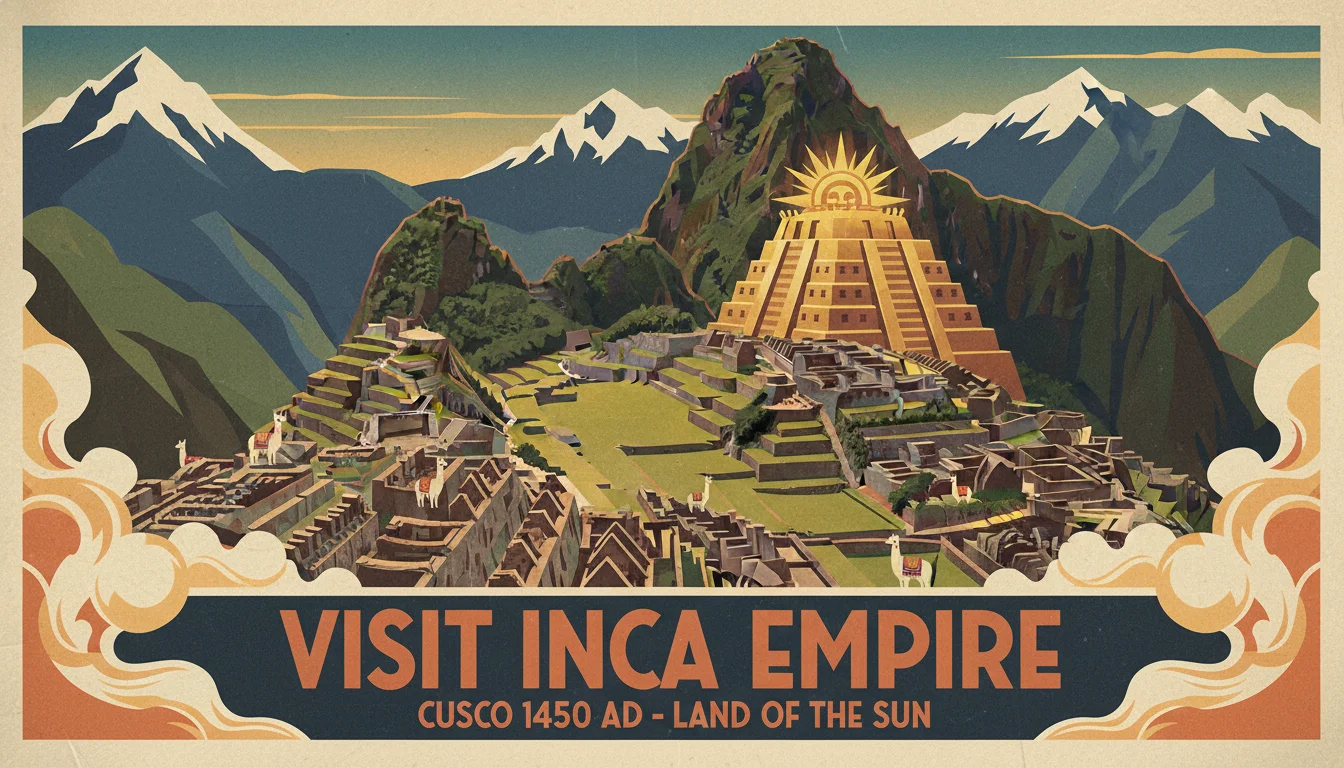
You've just materialized at 3,400 meters above sea level, the air is painfully thin, and the city sprawled before you is shaped like a puma. Welcome to Cusco, the navel of the world, capital of the largest empire in pre-Columbian America. It's 1450 AD, the reign of Pachacuti Inca Yupanqui, and the Inca Empire is expanding at a pace that would make Alexander the Great nervous.
Here's how to survive it.
Getting Your Bearings
Cusco sits in a mountain valley in the Andes, surrounded by peaks that scrape past 5,000 meters. The city is divided into two halves - Hanan (upper) and Hurin (lower) - reflecting the Inca obsession with duality. Everything comes in pairs: upper and lower, left and right, male and female.
The population is around 100,000, making it one of the largest cities in the world right now. The streets are narrow, paved with stone, and fed by channels of clean water running along their centers. There is no written language, no wheeled vehicles, no iron tools, and no horses. Yet this civilization has built 40,000 kilometers of roads across the most brutal terrain on Earth. They're doing things the Old World can't imagine.
What to Wear
Your modern clothes will get you killed. Not because they're offensive - because you'll freeze. Cusco nights drop near freezing, and the UV at this altitude will cook your skin by noon.
You need an uncu - a knee-length sleeveless tunic made from alpaca wool. The quality of your fabric signals your status. Coarse weave means commoner. Fine cumbi cloth with geometric patterns means nobility. Wear the wrong one and you're in serious trouble, so aim for something middle-of-the-road: clean, well-made, but not too fancy.
On your feet, wear ushutas - sandals with leather soles and wool straps. Your ankles will be cold. Accept this. Everyone else's ankles are also cold.
Bring a lliclla (shawl) for the evenings. Not optional. The temperature swing between midday sun and nightfall can be 25 degrees.
What to Eat
Good news: you won't starve. The Inca state feeds its people through an enormous system of storehouses called qollqas, dotted across the empire. The bad news: variety is limited.
Your staple is potato. Not the single boring kind you know - the Inca cultivate over 3,000 varieties. Purple, yellow, tiny, enormous, bitter, sweet. They also make chuno, freeze-dried potato that lasts for years. It tastes like cardboard but has saved millions from famine.
You'll eat quinoa daily, often as a porridge. Corn is present but considered sacred and mostly reserved for chicha - fermented corn beer. Chicha is everywhere. Refusing it is rude. It's mildly alcoholic, slightly sour, and made by women called acllas who chew the corn to start fermentation. Don't think about that part.
Protein comes from cuy (guinea pig), roasted whole, and charqui - dried llama meat. The word "jerky" comes from charqui. You're eating the original.
There is no sugar, no wheat, no rice, no cattle. But there are tomatoes, avocados, peanuts, and chili peppers. The food is honest, hearty, and designed for altitude survival.
Customs That Will Save Your Life
Never look directly at the Sapa Inca. If Pachacuti passes in his golden litter, get on your knees, face down, and don't move. He is considered the son of Inti, the sun god. Making eye contact is the fastest way to die in Cusco.
Carry something. Everyone in the Inca Empire works. There is no money, no markets in the way you understand them. Instead, the state operates on mit'a - a labor tax. Every citizen owes work to the empire. If you're seen idle, you'll be assigned to a work crew building roads, farming terraces, or hauling stone. Look busy.
Respect the huacas. Sacred sites are everywhere - unusual rock formations, springs, mountain peaks, even specific bends in the road. The Inca see the landscape as alive with spiritual power. Walk around them, not over them.
Learn to use a quipu. The Inca have no writing, but they have quipus - knotted strings that encode numbers, records, and possibly narratives. Every community has a quipucamayoc (knot keeper) who manages local data. Think of them as the IT department.
The Biggest Dangers
Altitude sickness will hit you within hours. Headache, nausea, dizziness. The locals chew coca leaves to manage it - so should you. Coca is legal, common, sacred, and effective. It's offered at every social gathering.
The justice system is merciless. There are three cardinal rules: ama sua (don't steal), ama llulla (don't lie), ama quella (don't be lazy). Theft is punished by death. Laziness can get you thrown off a cliff. There are no prisons because sentences are either labor or execution. Be honest, work hard, and keep your hands to yourself.
Earthquakes. Cusco sits in seismic territory. The Inca know this, which is why their walls use interlocking stone blocks with no mortar - they flex during earthquakes instead of collapsing. If the ground shakes, stay near Inca walls, not European-style structures (there aren't any yet, but the principle holds).
Sacrifice. The Inca practice capacocha - ritual sacrifice of children during major events like the emperor's illness, military victories, or natural disasters. It's rare, carefully selected, and considered the highest honor. As a foreigner, you're unlikely to be chosen, but witnessing the ceremony is a possibility you should prepare for emotionally.
What You Must See
Sacsayhuaman. The fortress above Cusco is under active construction right now, and the scale is staggering. Stones weighing over 100 tons, cut to fit so precisely that a knife blade can't slide between them. No wheels, no iron, no cranes. Watching the work crews is worth the trip alone.
The Coricancha. The Temple of the Sun, the holiest site in the empire. Its interior walls are literally plated in gold. A golden sun disc reflects light across the main chamber at dawn. The garden contains life-sized gold and silver replicas of corn, llamas, and flowers. It is the most extravagant building in the Americas.
The road system. Walk even a short section of the Qhapaq Nan, the royal highway. It stretches from modern-day Colombia to Chile. Rope suspension bridges span impossible gorges. Relay runners called chasquis carry messages at speeds that rival a horse postal system - covering 240 kilometers per day across mountains.
The terraces of Moray. Circular agricultural terraces that function as an experimental farm - each level has a slightly different microclimate. The Inca are literally doing agricultural science, testing crop varieties at different temperatures. It's 500 years before anyone in Europe thinks systematically about agronomy. For a Mesoamerican counterpart, see Mayan Tikal at its 8th-century height.
One Last Thing
The Inca Empire has about 80 years left. In 1532, Francisco Pizarro will arrive with 168 men and dismantle an empire of 12 million people. Smallpox will arrive before him, and a civil war between Atahualpa and Huascar will do the rest - a fate the Aztec capital of Tenochtitlan would meet a decade earlier.
But right now, in 1450, none of that exists. The empire is ascending. The roads are expanding. The storehouses are full. Pachacuti is transforming Cusco from a regional settlement into an imperial capital that rivals anything on Earth.
Enjoy it while it lasts. Bring coca leaves. And for the love of Inti, don't look the emperor in the eye.

Need Advice from Someone Who Lived There?
Get firsthand accounts from people who actually lived through these moments in history.
Ask Them YourselfJoin the HistorIQly Club
Get smarter about the past.
Weekly stories, deep dives, and exclusive content straight to your inbox.