Time Traveler's Guide to the Khmer Empire, 1150 AD
Survive the Khmer Angkor civilization at its peak in 1150: the world's largest city, hidden in the jungle. What to wear, eat, and avoid.
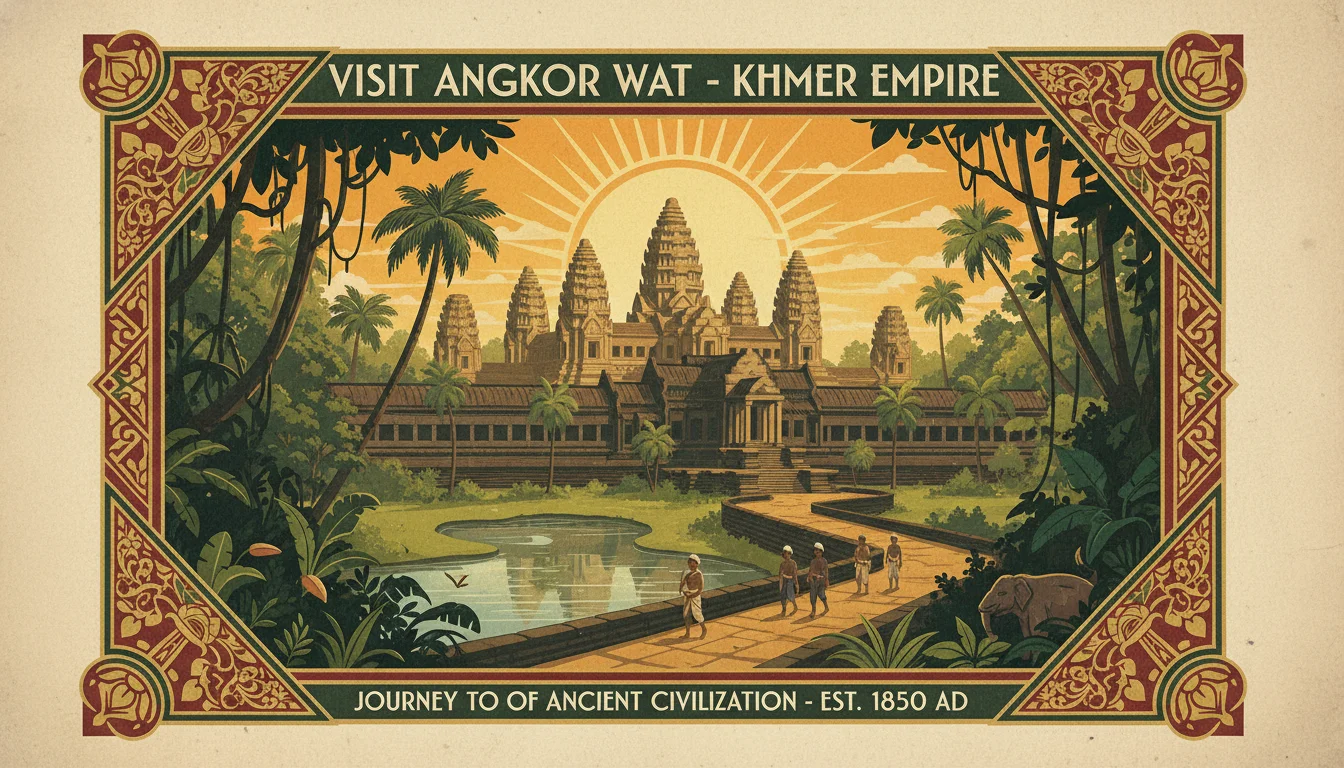
You step out of your time machine and the heat hits you like a wall. Not desert heat - this is wet, heavy, tropical air that wraps around you like a damp blanket. Welcome to the Khmer Empire at its absolute peak. The city of Angkor is home to nearly a million people, making it the largest urban center on Earth. London won't match this population for another 700 years.
Getting Your Bearings
You're standing somewhere in the sprawl of Greater Angkor, a metropolitan area covering over 1,000 square kilometers of what is now northwestern Cambodia. The landscape is a patchwork of rice paddies, reservoirs, canals, and temple complexes linked by raised causeways. The massive Western Baray - an artificial reservoir stretching 8 kilometers long and 2 kilometers wide - glints in the distance. This isn't just decoration. It's the engineering backbone of a hydraulic civilization that feeds a million mouths.
King Suryavarman II sits on the throne. He's the one who commissioned Angkor Wat, and construction is well underway. You'll see thousands of workers hauling sandstone blocks from quarries 50 kilometers away, floating them down canals on bamboo rafts. The temple is being built as a funerary monument dedicated to Vishnu, and it will take roughly 30 years to complete.
What to Wear
Forget everything you know about medieval European fashion. Here, less is more. Men of all classes wear a sampot, a rectangular cloth wrapped around the waist and pulled between the legs to form loose trousers. Women wear a similar garment, sometimes with a cloth draped over one shoulder. The fabric quality tells everyone your status. Commoners wear plain cotton. Nobles wear fine silk, sometimes imported from China, with gold thread woven through it.
Go barefoot or wear simple leather sandals. Shoes are rare and mostly ceremonial. Your skin should be visible - the Khmer consider pale, covered-up foreigners slightly suspicious. If you're trying to blend in, rub some turmeric paste on your skin. It's used as both sunscreen and a beauty treatment.
One critical detail: jewelry matters more than clothing here. Gold earrings, arm bands, and ankle bracelets signal your rank. If you wear too much gold without the social standing to back it up, you'll attract the wrong kind of attention from temple guards.
What to Eat
The food is extraordinary, and you won't go hungry. Rice is the foundation of every meal, grown in paddies fed by the vast irrigation network. The Khmer eat it with freshwater fish from the Tonle Sap lake - the largest freshwater lake in Southeast Asia - which is so abundant with fish that Chinese visitors described the water as "more fish than water."
Street vendors sell prahok, a fermented fish paste that is the backbone of Khmer cuisine. It smells terrible to the uninitiated, but it adds a savory depth to everything. You'll find grilled fish wrapped in banana leaves, rice porridge with herbs, and curries made with galangal, lemongrass, and turmeric. Coconut milk enriches most dishes.
Fruit is everywhere: mangoes, jackfruit, bananas, and something the locals call "durian" that smells like a crime scene but tastes like custard. The Khmer also drink palm wine, tapped from sugar palms that dot the landscape. It's mildly alcoholic and refreshing. Drink it fresh in the morning before it ferments too much in the afternoon heat.
Avoid drinking untreated water from the canals. Stick to boiled water, coconut water, or the palm wine. Dysentery is the fastest way to ruin your time travel experience.
The Temples (Your Must-See List)
Angkor Wat is the obvious headliner. Even half-finished, it's staggering. Five lotus-bud towers rise from a rectangular enclosure surrounded by a moat 200 meters wide. The walls are covered in bas-reliefs depicting scenes from Hindu mythology - the Churning of the Ocean of Milk stretches 49 meters along the eastern gallery. You'll see artisans still carving them, working with iron chisels and extraordinary patience.
But don't skip the older temples. Angkor Thom (the great city) is being expanded and will eventually feature the famous Bayon temple with its 200 smiling stone faces, though in 1150, that project is still a few decades away under Jayavarman VII. Visit Phnom Bakheng for the sunset view over the entire complex. Ta Prohm and Preah Khan don't exist yet, so enjoy the jungle where they'll eventually stand.
The temples aren't just tourist attractions. They're active religious centers where priests perform daily rituals, dancers perform sacred apsara dances, and the king demonstrates his divine connection to Vishnu. Behave accordingly. Remove your sandals before entering. Never point your feet at a sacred image. Bow when priests pass.
The Dangers
Malaria is your biggest enemy. The mosquitoes here carry it, and there's no quinine for another 400 years. If you didn't bring modern repellent, burn neem leaves or rub lemongrass oil on your skin. Sleep under nets if you can find them.
The jungle surrounding Angkor is home to tigers, elephants (many domesticated for construction work), and cobras. Stay on the raised causeways and don't wander into the forest at night.
Political danger is real but manageable. The Khmer Empire is powerful but surrounded by rivals. The Cham kingdom to the east raids periodically, and in about 30 years they'll sack Angkor itself before being driven back. In 1150, things are stable, but the military presence is visible. Soldiers patrol with spears and shields, and foreign visitors are watched closely.
The caste system is rigid. Slaves (many captured in warfare) form a large underclass. Don't interfere with this system or express modern opinions about it unless you want to test the Khmer justice system, which includes trial by ordeal - holding your hand in molten tin to prove innocence.
Practical Tips
Currency: There's no coinage. Trade happens through barter. Rice, cloth, and silver by weight are the common mediums of exchange. Small pieces of silver and gold work well for purchases.
Language: Old Khmer, written in a script derived from Indian Pallava. Sanskrit is the language of religion and court inscriptions. If you can read Sanskrit, you'll navigate temple inscriptions easily. For daily conversation, learn basic Khmer phrases and rely heavily on gestures.
Religion: The empire is officially Hindu (Vishnu and Shiva), but Buddhism is growing fast and will eventually become dominant under Jayavarman VII. Religious tolerance is surprisingly high. You'll see Hindu and Buddhist imagery side by side.
Climate: Two seasons - wet (May to October) and dry (November to April). February is dry season, hot but bearable. The rains transform the landscape entirely, flooding the Tonle Sap to five times its dry-season size.
Why 1150 AD?
You're witnessing a civilization at its absolute zenith. Khmer Angkor is the largest pre-industrial city ever built, supported by the most sophisticated water management system in the ancient world. The art, architecture, and urban planning rival anything in contemporary Europe, China, or the Islamic world. Within 300 years, the empire will collapse - possibly from the very hydraulic infrastructure failing under climate change and overextension.
But right now? Right now it's magnificent. Sandstone temples glow gold in the tropical sunrise. A million people live, trade, worship, and build in a city the jungle will eventually swallow whole. You're standing in the greatest city most people have never heard of.
For other civilizations at their peak, our guide to Heian Kyoto in 1000 AD covers Japan's golden age of courtly culture, and our guide to Fatimid Cairo in 970 AD shows the Islamic world's most dynamic city in the same era.
Don't forget the mosquito repellent.

Need Advice from Someone Who Lived There?
Get firsthand accounts from people who actually lived through these moments in history.
Ask Them YourselfJoin the HistorIQly Club
Get smarter about the past.
Weekly stories, deep dives, and exclusive content straight to your inbox.