Time Traveler's Guide to Joseon Hanyang, 1450
Joseon Hanyang in 1450 was Korea's golden age - when King Sejong invented Hangul and the kingdom reached its cultural and intellectual peak.
Read Wikipedia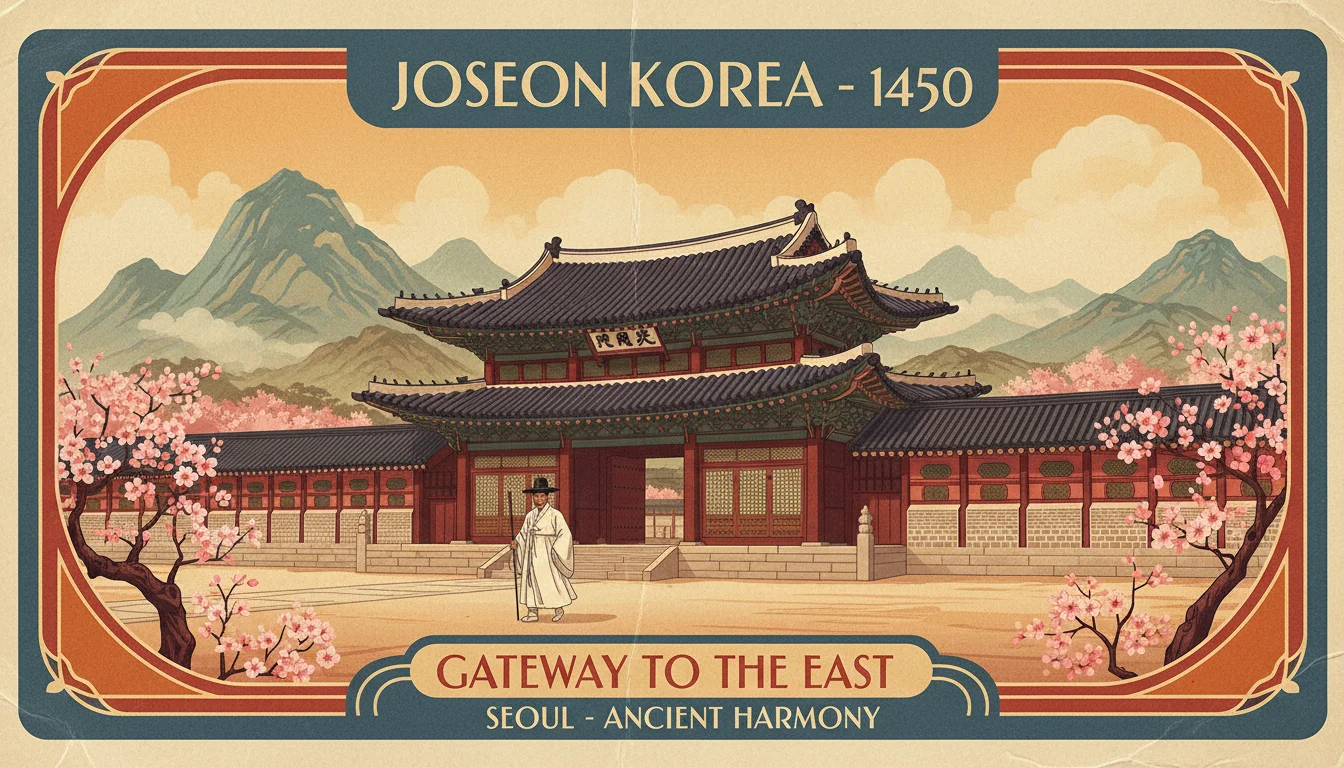
Welcome to Hanyang, capital of the Joseon Dynasty and the heart of one of history's most remarkable cultural flowerings. The year is 1450, and you've arrived during the reign of King Sejong the Great - a ruler so beloved that Koreans will still celebrate him six centuries later. Just four years ago, he unveiled Hangul, the scientific alphabet that would revolutionize literacy. You're walking into a kingdom at its intellectual peak, where astronomers map the heavens, farmers consult rain gauges, and scholars debate the proper way to mourn one's parents. Don't let the Confucian formality fool you - there's warmth beneath the bows.
Getting Your Bearings
Hanyang sits in a natural fortress of mountains, with the Han River flowing to the south. The city walls snake across four peaks - Bugaksan, Naksan, Namsan, and Inwangsan - creating a defensive perimeter that would make any medieval European city envious. About 100,000 people live within these walls, though the metropolitan area extends into surrounding villages.
The city is geometrically organized on Chinese principles, but with distinctly Korean adaptations. Gyeongbokgung Palace dominates the northern center, backed against Bugaksan for spiritual protection. From there, Yukjo Street (Six Ministries Street) runs south past government buildings - this is the Broadway of bureaucracy, where the kingdom's fate is decided.
The key landmarks: Gwanghwamun (main palace gate), the Bell Pavilion (Bosingak) that marks the hours, and the bustling markets of Jongno. Orient yourself by the mountains - Bugaksan (north), Namsan (south) - and you'll never get lost.
What to Wear
Joseon Korea has strict clothing regulations based on social class, so getting this wrong marks you as either a criminal or an idiot. The basic outfit for commoners is simple: white or pale-colored hanbok. Yes, white. Joseon is called the "nation of white clothing" for good reason. Bright colors are reserved for royalty, officials, and special occasions.
Men wear a jeogori (jacket) over baji (pants), with a po (overcoat) in colder weather. The crucial accessory: a gat, the distinctive black horsehair hat that marks a learned gentleman. Without proper headwear, you're essentially walking around naked from a Confucian perspective.
Women wear a longer jeogori that's evolved into a distinctive short style by this era, paired with a chima (long wraparound skirt). Married women tie their hair up; unmarried women wear it in a long braid. A jangot (full-body outer covering) provides modesty when going out.
Footwear matters: leather shoes for the wealthy, straw sandals for everyone else. Remove them at every doorway - Korean homes have ondol heated floors, and outdoor shoes would be an insult.
What to Eat
Korean cuisine in 1450 is sophisticated but not yet the spicy feast you might expect - chili peppers won't arrive from the Americas for another century. Instead, prepare for fermented complexity. Kimchi exists, but it's made with native chili-like ingredients, garlic, ginger, and various vegetables. The fermentation tradition is ancient.
Rice is the prestige grain, but most commoners eat barley, millet, or mixed grain porridge. A typical meal follows the bapsang structure: rice, soup, and an array of banchan (side dishes) - pickled vegetables, dried fish, seasoned greens. Everything arrives at once, arranged according to strict aesthetic principles.
Must-try dishes: galbi-jjim (braised short ribs - a celebration dish), jeon (savory pancakes), tteok (rice cakes for festivals), and the ever-present doenjang-jjigae (fermented soybean paste stew). Tea culture is refined, though common people drink sungnyung (scorched rice water).
Street food exists near markets - rice cakes, roasted chestnuts, and simple noodle soups warm you on cold days. Taverns serve makgeolli (milky rice wine) to the common folk and soju (distilled liquor) to those with means.
The Social Hierarchy
Joseon society divides into four rigid classes, and your treatment depends entirely on which one you fit. At the top: yangban, the scholar-official aristocracy who've passed the civil service examinations. Below them: jungin, technical specialists like translators and astronomers. Then sangmin, the common farmers, artisans, and merchants. At the bottom: cheonmin, including butchers, tanners, and slaves.
Yes, slavery exists in Joseon Korea. About 30% of the population are nobi (slaves), though their conditions vary enormously from household servants living comfortably to agricultural workers in brutal conditions. This isn't something you can change - just understand what you're walking into.
Gender relations follow Confucian principles rigidly. Women of yangban families rarely appear in public after marriage. Men and women travel on different sides of the street after dark. A woman speaking directly to an unrelated man causes scandal.
The practical takeaway: bow lower to those above you, accept bows from those below, and never, ever sit in someone's seat. Seniority determines everything from who speaks first to who gets the better cut of meat.
Daily Survival
Life in Hanyang follows natural rhythms. The great bell at Bosingak strikes at 4 AM (gates open) and 10 PM (curfew begins). Being caught on the streets after curfew without a valid excuse means arrest. The night patrol takes this seriously.
Ondol heating makes Korean winters survivable. The ingenious system channels smoke from the kitchen fire under stone floors, radiating warmth throughout the room. You'll sleep on the floor on a heated section - it's remarkably comfortable. Just don't burn yourself by sleeping directly over the hottest stones.
Bathhouses exist but aren't as common as in Japan. Personal hygiene involves heated water at home, with public facilities near streams. The outhouse situation is... basic. Night soil is collected for fertilizer, so at least nothing goes to waste.
Medicine blends Chinese theory with Korean herbal traditions. Heo Jun won't write his famous medical encyclopedia for another 150 years, but competent doctors exist who treat with acupuncture, herbal remedies, and surprisingly effective surgical techniques for the era.
Must-See Experiences
Gyeongbokgung Palace: You can't enter the inner palace without official business, but you can observe the morning assembly from outside Gwanghwamun when officials gather at dawn. The architecture alone is worth the early wake-up.
Jiphyeonjeon (Hall of Worthies): This royal research institute is where King Sejong's scholars developed Hangul. You can't waltz in, but the building itself represents the intellectual ambitions of the era.
Jongno Markets: The commercial heart of the city. Silk shops, paper merchants, pottery dealers, and food stalls create a sensory overload. This is where all classes mix, at least during daylight.
Buddhist Temples: Though Neo-Confucianism dominates official ideology, Buddhism persists in mountain temples. Visit Jogyesa or venture outside the walls to experience the older spiritual tradition that Joseon is actively suppressing.
Agricultural Innovations: If you can arrange a trip outside the city, see the cheugugi (rain gauges) and sundials that King Sejong has distributed throughout the kingdom. This is cutting-edge scientific instrumentation for 1450.
Dangers and Annoyances
Political Factionalism: Joseon politics is vicious. Scholars debate not just policy but cosmic principles, and losing an argument can mean exile or death. Don't offer political opinions. Ever.
Tigers: They're not just in the mountains. Tigers occasionally enter the city walls, and attacks aren't unheard of in the outer districts. The government offers bounties.
Disease: Smallpox and typhoid are endemic. The medical theory is advanced for its time, but antibiotics don't exist. Avoid sick people and contaminated water.
Corruption: Despite Confucian ideals, bribery oils the bureaucratic wheels. Officials expect "gifts" for services. Budget accordingly.
Cold: Korean winters are brutal. January temperatures drop well below freezing, and even ondol heating only does so much. The lined hanbok helps, but you'll understand why Koreans historically spent winters indoors.
Bringing Something Home
Joseon produces extraordinary crafts. Celadon pottery has declined from Goryeo-era heights, but buncheong stoneware offers rustic beauty. Hanji (mulberry paper) is the finest in East Asia - it will last centuries. Embroidered pojagi (wrapping cloths) combine practicality with art.
Books are precious - Korea pioneered movable metal type a century before Gutenberg, and printed texts circulate among the literate. A Hangul primer would be the ultimate souvenir, a piece of one of humanity's greatest linguistic inventions.
Final Thoughts
Joseon Hanyang in 1450 offers a glimpse of Confucian civilization at its most refined. The rigid social hierarchy can feel suffocating, and the gender restrictions will frustrate modern sensibilities. But beneath the bowing and the rules, you'll find a society that genuinely values learning, that's measuring rainfall and charting stars, that just invented a writing system designed to be learnable by commoners.
King Sejong will die later this year, and the kingdom will never quite reach these heights again. But for now, in this moment, you're witnessing what happens when a nation decides that literacy, science, and culture matter more than conquest. Take notes. In Hangul, if you can. For neighboring civilizations at similar peaks, see our guides to Heian Kyoto in 1000 and Ming Beijing in 1420.
The morning bell is ringing. Adjust your gat, practice your bow, and step through Sungnyemun Gate. The nation of white clothing awaits.

Need Advice from Someone Who Lived There?
Get firsthand accounts from people who actually lived through these moments in history.
Create your free account →No card required. Some figures and features require a paid plan.
Join the HistorIQly Club
Get smarter about the past.
Weekly stories, deep dives, and exclusive content straight to your inbox.