Time Traveler's Guide to Lisbon, 1495
Pack your bags for Lisbon, 1495: where explorers dream of reaching India by sea. Survive sardine feasts, avoid the Inquisition, witness the birth of a global empire.
Read Wikipedia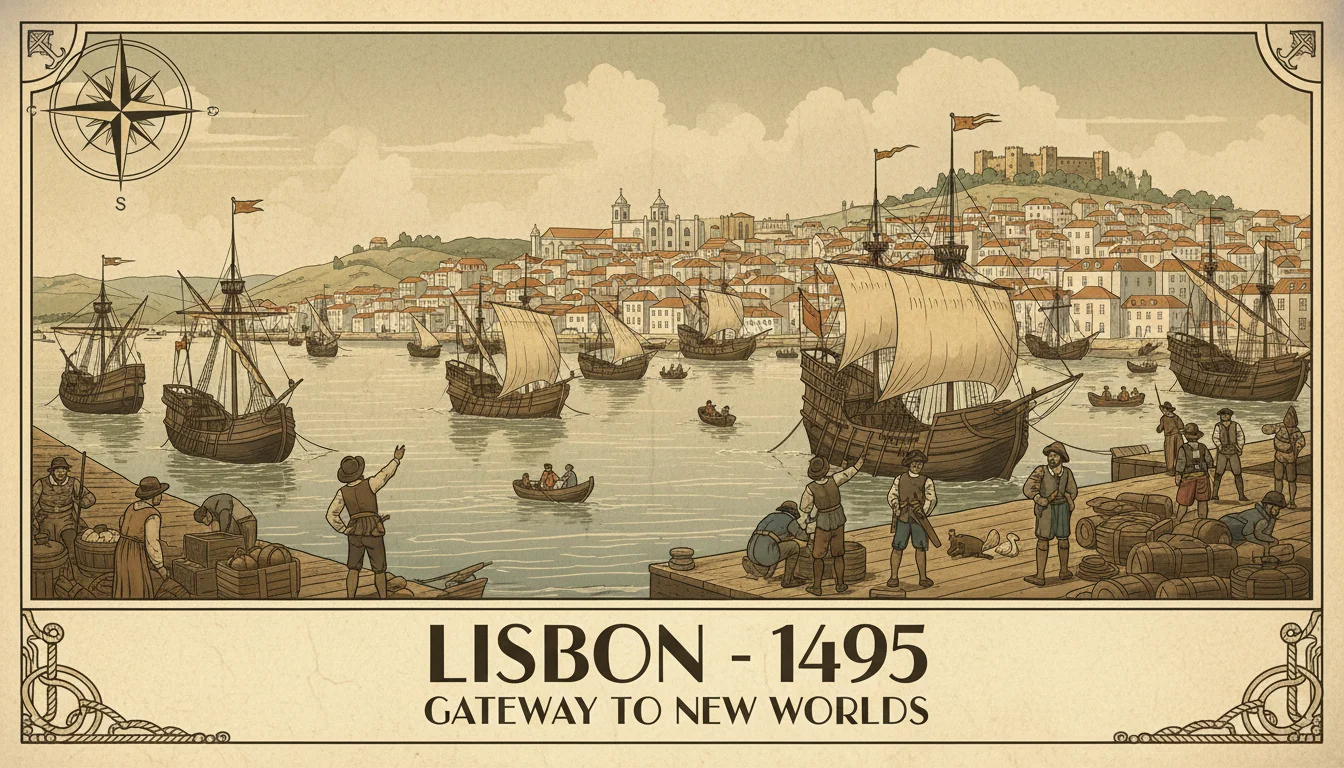
You've chosen Lisbon in 1495 - the year King Manuel I takes the throne and Portugal stands on the edge of history. In two years, Vasco da Gama will sail from this very harbor and reach India, changing the world forever. But right now, everyone's just talking about it, wondering if it's possible, and fighting over who gets the royal funding.
This is a city intoxicated by possibility. The scent of salt and ambition hangs in the air. Let's make sure you survive long enough to watch history unfold.
First Impressions: The City on Seven Hills
Lisbon rises from the Tagus River on seven hills (yes, like Rome - the Portuguese will remind you). The Alfama district cascades down from São Jorge Castle in a maze of whitewashed buildings, terracotta roofs, and streets so narrow two donkeys can barely pass.
The harbor dominates everything. Carracks and caravels bob in the water, their crews loading supplies for voyages down the African coast and beyond. Dockworkers haul spices, gold, and ivory from ships returning from Guinea. The whole city smells like salt, sardines, and wealth in the making.
Pro tip: The Portuguese have just completed the Tower of Belém... wait, no they haven't. That doesn't get built until 1519. In 1495, the harbor fortifications are much more modest. Don't ask about the famous tower or you'll get confused looks.
What to Wear
Portuguese fashion in the 1490s is surprisingly restrained compared to the flashy Italian courts. Men wear doublets (fitted jackets) with hose, in practical colors like brown, dark green, or black. Wealthy merchants might add velvet trim or silver buttons, but outrageous displays invite suspicion.
Women wear long gowns with high waistlines and simple headdresses. Married women cover their hair; unmarried women can show theirs. If you're a woman traveling alone, prepare for endless questions about your husband's whereabouts.
Critical warning: Do not wear anything that could be interpreted as Jewish or Moorish. The forced conversions of 1497 are coming - we'll get to that - and religious anxiety is already building. Stick to clearly Christian styles with visible crosses.
The Language Situation
Portuguese in 1495 sounds like a mix of modern Portuguese and medieval Spanish, with some Arabic loanwords thrown in. If you speak modern Portuguese, you'll manage, but expect confusion over vocabulary changes.
Latin is the language of the educated - clergy, lawyers, and royal administrators. Castilian Spanish is widely understood because Portugal's royal family intermarries with Spain constantly.
Survival phrases:
- "Deus vos salve" (God save you) - standard greeting
- "Onde está a igreja?" (Where is the church?) - always useful
- "Não sou judeu!" (I am not a Jew!) - might save your life
What to Eat
Good news: Portuguese cuisine in 1495 is excellent if you like seafood. Bad news: it's excellent if you like seafood.
Breakfast: Bread and cheese, maybe some olives. Wine diluted with water. Coffee won't arrive for another century (the Portuguese will eventually introduce it from their colonies, but not yet).
Dinner (midday, the main meal):
- Sardines. Grilled, salted, stewed. Portugal's national obsession already exists.
- Bacalhau (salt cod) - brought back from Newfoundland fishing expeditions
- Caldo verde - kale soup with sausage
- Game meat for the wealthy - wild boar, rabbit, partridge
Supper: Lighter fare - more bread, cheese, fruit, whatever's left from dinner.
Avoid: Anything claiming to be "spices from India." India route hasn't been discovered yet. If someone's selling Indian pepper, it came through Venice and costs roughly what a horse costs.
Where to Stay
Forget inns - they're flea-infested and dangerous. Your options:
-
Monasteries and convents - Clean, safe, and they won't rob you. Donation expected. Best choice for respectable travelers.
-
Private lodging - If you can arrange an introduction to a merchant family, they might rent you a room. Network at church.
-
Harbor taverns - Only if you have a death wish. Sailors, criminals, and people who'd sell you to slavers mix freely here.
Best neighborhood: The Baixa (downtown) near the royal palace offers the best combination of safety and proximity to interesting events. Avoid the Mouraria district - it's where the remaining Moors live, and the authorities watch it closely.
The Religious Situation (Critical)
This is where your trip could turn deadly.
In 1492, Spain expelled its Jews. Many fled to Portugal, where King João II let them stay - for a massive fee and only temporarily. Now Manuel I has just taken the throne, and he's about to marry a Spanish princess who demands Portugal expel its Jews too.
In 1497, Manuel will force all Jews to convert or leave. Unlike Spain, he won't actually let them leave - instead, he'll forcibly baptize them and create a population of "New Christians" who'll be persecuted for centuries.
In 1495, the storm is building. Tensions are high. The Inquisition hasn't arrived yet (that comes in 1536), but informers are everywhere. If you're suspected of Jewish ancestry or practices, you're in danger.
Rules for survival:
- Attend Mass every Sunday. Be seen.
- Eat pork publicly. It's a loyalty test.
- Don't light candles on Friday nights
- Don't wash meat before cooking (seen as Jewish)
- Know your saints' days
The Exploration Scene
This is why you're really here, right?
The Portuguese have been systematically exploring the African coast for decades. Bartolomeu Dias rounded the Cape of Good Hope in 1488, proving you could sail from the Atlantic to the Indian Ocean. Now everyone's obsessed with reaching India by sea and cutting out the Venetian middlemen who control the spice trade.
Key figures you might encounter:
- King Manuel I - Just took the throne, ambitious, nicknamed "The Fortunate." He'll fund Vasco da Gama's expedition.
- Vasco da Gama - A minor noble from a seafaring family. In 1495, he's just a name on a list of potential expedition leaders.
- Jewish astronomers and mathematicians - Despite the persecution, they're essential to navigation. Abraham Zacuto's astronomical tables will guide da Gama to India.
Want to witness history? Hang around the Casa da Guiné e Mina, the royal trading house that handles all African commerce. Every explorer, merchant, and schemer in Portugal passes through here.
Money Matters
Portugal uses the real (plural: réis). You'll need:
- 1 real for a loaf of bread
- 10 réis for a simple meal
- 100 réis for a night's lodging
- 1,000 réis for a month's rent on a modest room
Gold coins exist (cruzados) but flashing them marks you as wealthy and worth robbing. Use copper and silver for daily transactions.
Entertainment
- Bullfighting - Yes, already a thing. Portuguese style is done on horseback.
- Fado music - Not quite, actually. Fado develops later. But you'll find guitar-accompanied ballads about the sea and lost love.
- Religious festivals - Constant. Every saint has a day, and Lisbon celebrates them all.
- The harbor - Watch ships come and go. See what exotic goods they're unloading. Dream about what's beyond the horizon.
Dangers to Avoid
- The Plague - It cycles through periodically. If people start dying in a neighborhood, leave immediately.
- Crime - The harbor area after dark is genuinely dangerous. Gangs, sailors, people with nothing to lose.
- Religious accusation - We covered this. Cannot emphasize enough.
- Shipboard recruitment - If someone offers you a voyage to "Guinea," know that many sailors don't return. Disease, shipwreck, and violence kill most of them.
What to Bring Home
If you can smuggle souvenirs back to your century:
- African ivory - Carved pieces are exceptional
- Malagueta pepper - From West Africa, the best Portugal can offer before India
- Azulejos - Decorative tiles, though the famous blue-and-white style hasn't developed yet
- Manuscript maps - Portuguese cartography is the best in the world
The Vibe
For the world that Lisbon's explorers were about to transform, our guide to the Spanish Conquest of Mexico in 1521 picks up the story thirty years later at Tenochtitlan. And for a look at medieval Iberia before the Reconquista completed, our guide to Nasrid Granada in 1360 covers the world the Portuguese were leaving behind.
Lisbon 1495 feels like a startup hub right before the big exit. Everyone's convinced they're about to change the world. Most of them are wrong, but a few are absolutely right.
There's an energy here - restless, ambitious, slightly desperate. The Portuguese are a small nation punching above their weight, and they know it. Within a few decades, they'll control trade routes from Brazil to Japan. Right now, they're just dreamers standing on the docks, watching ships disappear over the horizon, and wondering what's out there.
Visit Lisbon in 1495 and you'll see the world before globalization - the last moment when India was a rumor, Brazil was undiscovered, and the future was still unwritten.
Just try not to end up on one of those ships. The survival rate is not great.
The Time Traveler's Guide series helps you navigate history's most fascinating moments. No guarantee of safe return.

Need Advice from Someone Who Lived There?
Get firsthand accounts from people who actually lived through these moments in history.
Create your free account →No card required. Some figures and features require a paid plan.
Join the HistorIQly Club
Get smarter about the past.
Weekly stories, deep dives, and exclusive content straight to your inbox.