Time Traveler's Guide to Kushite Meroe, 200 AD
Time travel to Meroe in 200 AD: the Kushite capital offers steep pyramids, sub-Saharan Africa's largest iron foundry, and queens whose power was anything but ceremonial.
Read Wikipedia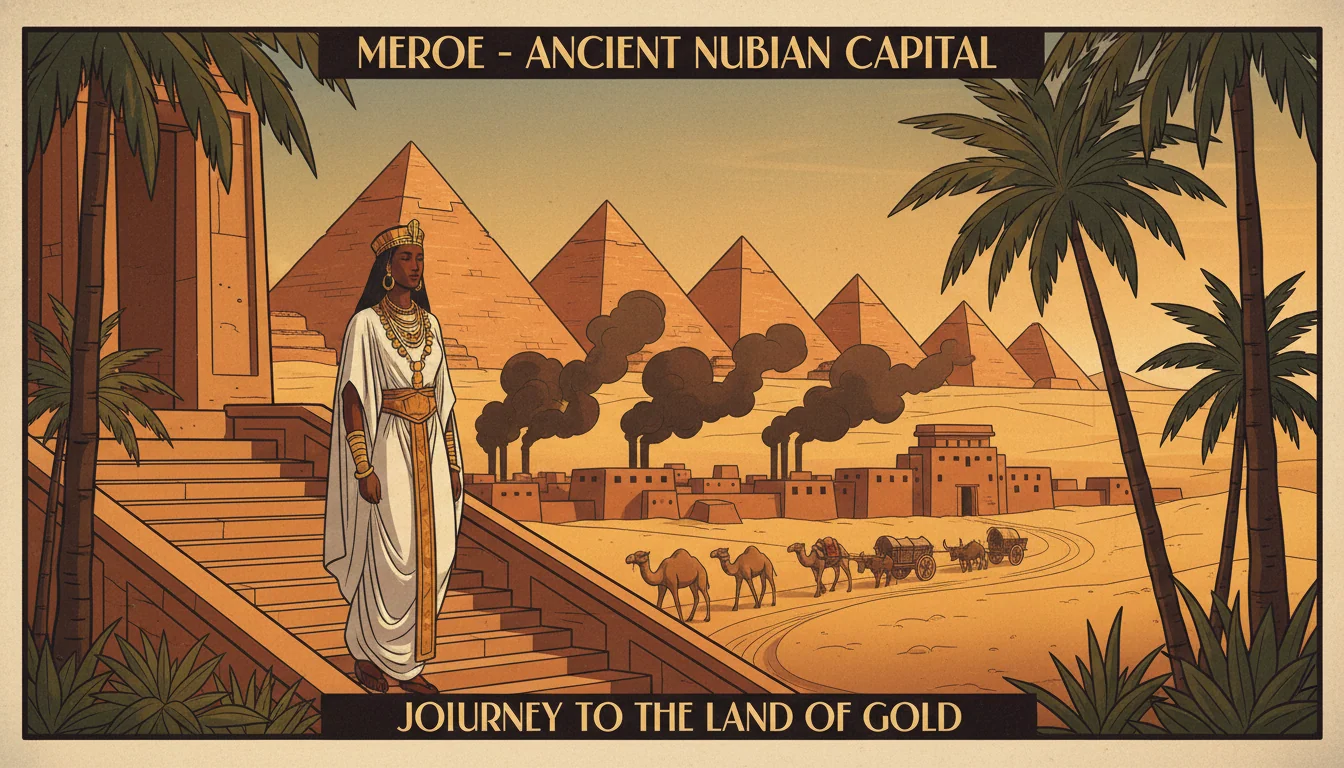
Your arrival point is the eastern bank of the Nile, somewhere in what will eventually become central Sudan, in the early years of the third century AD. The nearest identifiable landmark on the horizon is a line of steep-sided pyramids in warm sandstone - narrow, angular structures that look nothing like the monuments you may have seen pictures of in Egypt. That is not a navigation error. You are precisely where you intended to be.
Welcome to Meroe. The capital of an African kingdom that has governed the upper Nile for roughly five centuries and that the Western world largely ignores.
What you are looking at
The first thing to understand is that Meroe is not a provincial satellite of the Roman or Egyptian worlds. It is the independent capital of the Kingdom of Kush, which has governed the Nile valley south of the first cataract since roughly 300 BC, when the court relocated here from Napata following pressure from Ptolemaic Egypt.
At 200 AD, Meroe is a city of considerable wealth and organizational complexity. It occupies a strategically excellent location: the Nile bends here in a way that traps rainfall from the Butana plateau, creating a band of cultivable land that makes Kush less dependent on annual Nile flooding than Egypt. Grain cultivation, cattle herding, and, crucially, iron smelting on a scale that has no peer in the region - these are the economic pillars you are walking into.
The Royal City, the administrative and ceremonial core, stands behind a massive outer wall of dressed sandstone. Inside: a palace complex, temples dedicated to the god Amun and to Apedamak, the lion-headed war god who belongs to no Egyptian tradition, bath-houses with Hellenistic-influenced tile work, and administrative buildings staffed by scribes working in Meroitic script. There are also warehouses, full ones. This city trades north, south, east, and west.
What to wear
Linen, and enough of it. The heat of the Butana plateau regularly exceeds 40 degrees Celsius in summer and remains oppressive in the shoulder seasons. Avoid black. Avoid closed shoes. A good head covering is not optional.
Social hierarchy is legible in dress. Court elites wear fine white linen with elaborate gold jewelry - the Meroitic goldsmiths are among the best craftspeople in the ancient world, and layered necklaces, armlets, and earrings of extraordinary quality appear throughout the upper city. Common laborers and artisans wear plainer woven cloth, sometimes dyed red or indigo blue. Foreign merchants, and there are several nationalities of them in any given week, tend to overdress in ways that signal immediately that they are not local.
If you want to pass as an ordinary traveler, dress like someone from the Red Sea trade routes. That is a category Meroites encounter regularly and are accustomed to dealing with without excessive scrutiny.
Language
This is where you will have serious difficulty. Meroitic is not accessible through Greek or Egyptian. The script borrows its visual alphabet from Egyptian demotic, adapted around 300 BC, but the underlying language belongs to a completely different family. Even future linguists will be able to read the phonetic values aloud while understanding only fragments of the vocabulary. You will recognize names, numbers, and titles, and very little else.
Your best working language is Greek, which is understood by educated Meroites, by administrators with connections to Alexandria, and by the merchants moving between Meroe, the Red Sea ports, and the Nile trading posts. Latin is recognized by anyone who has had dealings with the Roman province of Egypt to the north. There is a permanent Meroitic diplomatic presence at Maharraqah on the northern border where treaty arrangements with Rome are maintained.
Come with Greek, some patience, and a working knowledge that silence combined with a small gift is universally understood.
What to eat
The Butana plateau produces sorghum and millet. Flatbreads made from both appear at every meal level, from common households to court kitchens. Cattle, sheep, and goats are raised in quantity; fresh meat is available at market stalls and is also smoked or sun-dried for longer storage. Nile fish - perch, catfish, and tilapia - are grilled over charcoal or dried in the open air and are the most reliable safe option for an unfamiliar stomach.
Imported goods arriving through the Red Sea port of Adulis, or down the Nile from Alexandria, include olive oil, wine, and Roman pottery. These are elite goods that signal wealth and external connections. Common households use sesame oil for cooking and drink fermented sorghum beer, produced locally in large ceramic jars. Quality varies from surprisingly good to inadvisable. The safe choice is to watch what your host pours for themselves before drinking.
Stay away from the food stalls immediately adjacent to the iron foundry quarter. Heat, dust, uncertain provenance, and the fact that foundry workers eat quickly and without much attention to storage conditions combine to make this a gamble you do not need to take.
What to see
The pyramids
The royal burial ground northwest of the city contains more than two hundred pyramids built over several centuries, with new ones under active construction. You can hear the stonecutters at work from inside the city on still days. The pyramids are steep-sided, fronted with small chapel structures, and significantly smaller than the Egyptian monuments you may have in mind: the largest standing ones reach about thirty meters. Some of the older tombs have been robbed, some of them centuries ago. Approach them as active religious sites rather than archaeological monuments, because that is what they currently are. Mortuary priests conduct rituals in the chapel annexes and do not welcome interruption.
The iron foundries
Meroe's iron-smelting complex is the most industrially significant operation on the African continent at this date. The slag heaps adjacent to the working quarter are large enough to serve as landmarks, and the foundries run through most of the daylight hours. Kushite iron technology has roots going back centuries before 200 AD, and by now the process is sophisticated: charcoal-fired shaft furnaces producing wrought iron in quantities that supply both local tool-making and long-distance trade. Watch from a respectful distance. The smelting pits operate at temperatures that are uncomfortable to stand near, and the labor there is serious rather than theatrical.
The Temple of Amun
The main Amun temple complex inside the Royal City admits foreign visitors to the outer courts. The inner sanctuary is restricted to priests and members of the royal family. The painted reliefs in the accessible areas are worth extended study: royal hunt scenes, battle victories with bound captives presented to the god, and the depictions of the kandake in warrior posture at a scale that dwarfs the male figures around her. That scale is not decorative convention borrowed uncritically from Egypt. It is a statement about who actually holds power in this court.
The kandake
Do not make the mistake of treating the female ruler as a ceremonial figure. The Meroitic tradition of powerful queen mothers and, in some periods, ruling queens in their own right is old and substantive. The kandake Amanirenas led Kushite forces against the Roman province of Egypt around 25-22 BC, achieved victories including the capture of the Roman fort at Qasr Ibrim, negotiated a peace treaty directly with the representatives of Augustus, and secured terms that returned Meroitic prisoners and eliminated a tribute obligation. That was nearly two centuries before your arrival, and the women of the royal court in 200 AD carry that institutional memory without any sign of having forgotten it.
The kandake's image on temple walls appears at a scale that dominates the surrounding male figures. This is not an artistic accident. Address titled women with appropriate formality, do not initiate conversation without an introduction, and accept that you will not be seated at royal meals unless invited.
Commerce and trade goods
The market that operates near the Nile landing stages is your best introduction to what Meroe produces and what it receives. Local goods on offer include high-quality iron tools and weapons, gold from the upper Nile alluvial deposits, ivory from the elephant-hunting grounds to the south, leopard skins, ostrich feathers, and slaves. Incoming goods from the north include bronze objects, glass vessels, Roman-period ceramics, wine amphorae, and olive oil.
The trade flow tells you something about the kingdom's economic position: Meroe exports raw materials and luxury wildlife products and imports manufactured goods and agricultural products that grow poorly in the Butana. This is not the profile of a poor kingdom. It is the profile of a specialized one, operating at the intersection of the Mediterranean, Red Sea, and sub-Saharan trade systems simultaneously.
Getting out
Return is from the arrival point on the eastern riverbank. If you find yourself at the northern bath-house complex, which shows clear Hellenistic architectural influence and is not hard to confuse with a market entrance, you have gone too far in the wrong direction. Walk south along the outer palace wall until the desert opens on your right. The departure point is there.
If you miss the window, the next practical exit involves either waiting for a northbound merchant caravan toward Naqaa and from there down to the Nile road, or accepting that you are staying at least one more season. The iron foundries are always hiring. The work is hot, loud, and well-paid by local standards, which makes it a viable last resort.
For another African civilization at its cultural peak, see our guide to Visiting Great Zimbabwe, 1300. For the kingdom that eventually ended Kush, see Visiting Aksum, 350 AD.
Quick Answers
Common questions about this topic
Where was the ancient city of Meroe?
Meroe was located in what is now central Sudan, on the eastern bank of the Nile between the fifth and sixth cataracts. At 200 AD it was the capital and commercial center of the Kingdom of Kush, which had governed the upper Nile valley since roughly 300 BC and would persist until around 350 AD when it was sacked by the Aksumite King Ezana.
Who were the kandake of Meroe?
The kandake was a title given to the queen mother or ruling queen of the Meroitic kingdom. These women held real political authority, appeared on temple reliefs as warriors, and in some periods ruled independently. The kandake Amanirenas famously repelled a Roman invasion around 25-22 BC, negotiating directly with Augustus. The title and the authority it represented remained central to Meroitic court life through 200 AD.
What was the Meroitic script?
Meroe had its own writing system, developed around 300 BC, distinct from Egyptian hieroglyphs. The Meroitic script consists of an alphabet of twenty-three signs. Linguists decoded the phonetic values in the 19th century, but the underlying language remains only partially understood - you can read Meroitic texts aloud but translate very few of them with confidence.
Why were the Meroitic pyramids steeper than Egyptian ones?
The Nubian pyramid tradition diverged from the Egyptian model over centuries. Meroitic pyramids have slopes between roughly 65 and 70 degrees, compared to about 52 degrees for the Great Pyramid at Giza. They are also smaller, standing between 20 and 30 meters, and are fronted with small chapel structures. The design reflects a distinct aesthetic tradition and the influence of Egyptian New Kingdom temple-tombs rather than the Old Kingdom pyramid form.

Need Advice from Someone Who Lived There?
Get firsthand accounts from people who actually lived through these moments in history.
Create your free account →No card required. Some figures and features require a paid plan.
Join the HistorIQly Club
Get smarter about the past.
Weekly stories, deep dives, and exclusive content straight to your inbox.