Time Traveler's Guide to Asuka Period Japan, 650 CE
Asuka period Japan in 650 CE is remaking itself: new laws, new Buddhism, new bureaucracy. A practical guide to navigating Japan's most transformative century.
Read Wikipedia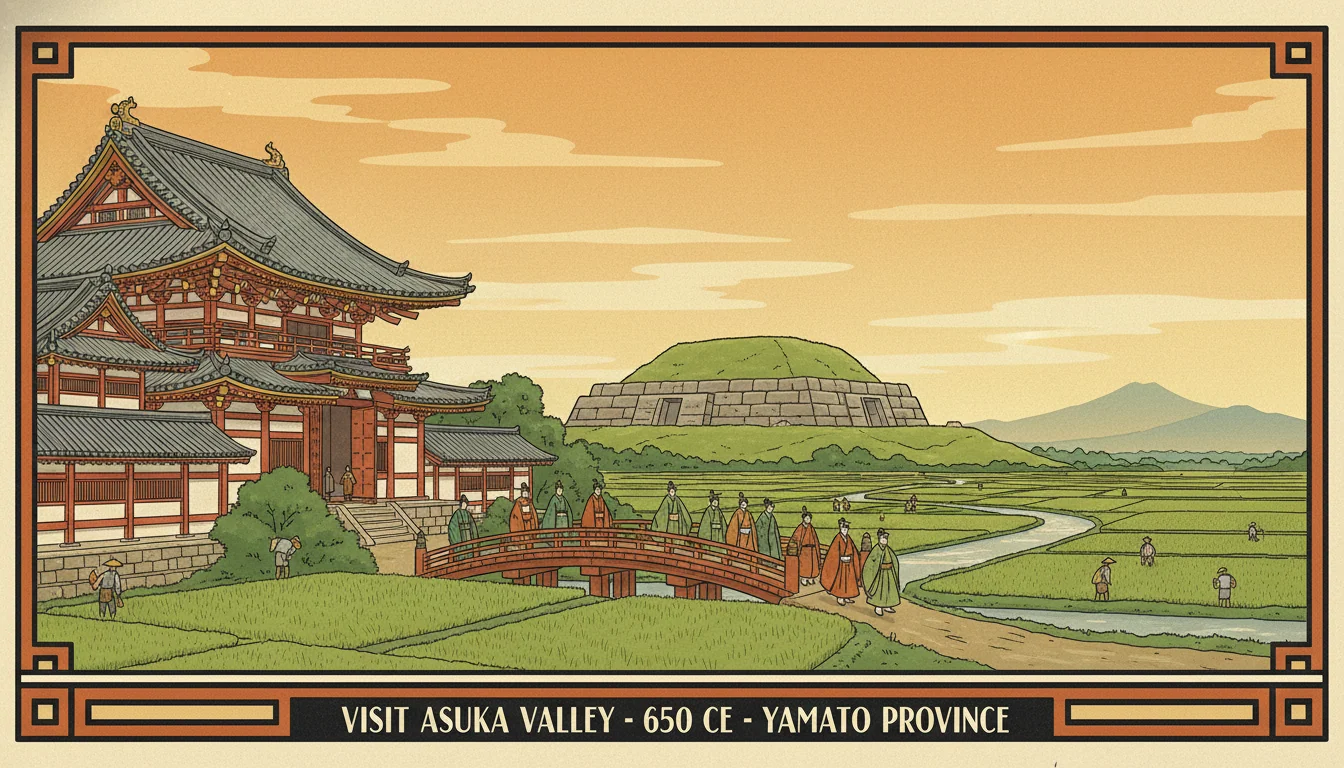
Japan in 650 CE is a country that has just rewritten itself. Five years earlier, in what historians call the Taika Reform, a palace coup killed the most powerful man in the country, overhauled the entire system of land ownership, restructured the bureaucracy on Chinese Tang dynasty models, and moved the imperial court from the old Asuka region to a new palace at Naniwa, on the coast of what is now Osaka Bay.
The Asuka region itself - a compact valley in Yamato Province, modern Nara Prefecture, a day's hard walk south of Naniwa - remains the spiritual heartland of the emerging Japanese state. Its great Buddhist temples are busy. Its old clan tombs still dominate the hillsides. Its royal rice paddies feed the court. The new government has stripped the Soga clan of their estates, reorganized everyone else's, and is in the middle of writing down laws that have never existed in written form before.
Everything is in motion. This is exactly what makes it interesting, and exactly what makes it dangerous.
Getting oriented
The Asuka valley is small enough to walk in an afternoon and rich enough to occupy you for a week. The Yamato River and its tributaries define the geography. The low hills around the valley hold kofun, the great burial mounds of powerful families, some of them stripped of their earthen covering since the Soga clan's political destruction - the Ishibutai Kofun, believed to cover the tomb of Soga no Umako, now exposes its enormous stone burial chamber to the open air like a monument to institutional overreach.
If the imperial court is currently at Naniwa Palace (it moves frequently; check current political conditions carefully before announcing any court-related business), the Asuka valley is quieter than it was a decade ago, but not empty. Temple complexes, clan compounds, and the farms that supply them all remain. Construction continues. The sound of woodworking is constant.
You are in Yamato Province. The broader island is called Yamato or, increasingly, Nihon. The people are Japanese in the sense that the language, culture, and political structure of what will later be called Japan is actively being assembled around you. Chinese writing is the language of official documents and religious texts; classical Old Japanese is what people actually speak.
What to wear
This determines everything. Dress wrong and you will spend your visit being treated as a suspicious commoner, a lunatic, or both.
The imperial court has just adopted a formal color-coded rank system inspired by Chinese precedent. High-ranking courtiers wear layered silk robes in prescribed colors - deep purples and greens for the senior nobility, lighter blues and yellows for the middle grades. If you have no rank and no introduction, do not attempt this. You will be recognized immediately as wearing something you have no right to wear, which is considerably more dangerous in 650 CE Japan than it sounds.
Practical travelers wear undyed or lightly dyed hemp or ramie cloth, the material of farmers, craftspeople, and minor functionaries. A loose robe gathered with a sash covers you without marking you as either noble or destitute. Shoes are important: straw sandals (waraji) are universal outside formal settings and mark you as someone who belongs in the physical world.
Remove your footwear before entering any building where you are a guest. Do this without being asked. Doing it wrong is the fastest way to be identified as a foreign nuisance.
Women at court wear layered garments that will later evolve into the formal junihitoe of the Heian period - multiple robes of slightly different lengths, with the layered hems visible at the collar and cuffs. You do not need to replicate this. You need to be appropriately covered, appropriately deferential in posture, and appropriately invisible unless someone important has decided you matter.
What to eat
Rice is the staple, the currency, and the measure of wealth. The quality of your rice indicates your social position. Polished white rice is for the upper classes. Brown rice and millet are for everyone else. If you are offered polished rice, you are being signaled that someone thinks you are worth the expense.
Fish is abundant and prepared in several forms: dried, salted, fermented. The sea is close enough to Yamato that marine fish reach the valley regularly, preserved by salt. Freshwater fish from the rivers are more common in daily diet. Shellfish and seaweed are also present.
Vegetables include taro, radishes, turnips, and various greens depending on the season. Soy products in early fermented forms are present, though the soy sauce and miso of later centuries are still developing. Salt is precious.
Meat is complicated. Emperor Kotoku issued an edict in 646 CE restricting the consumption of beef, horse, dog, monkey, and chicken, largely following Buddhist precepts against taking animal life. The edict's enforcement was uneven, particularly outside the immediate orbit of the court, and hunting of deer and boar continued in practice. But if you are eating with anyone who monitors religious compliance, animal meat is risky.
Sake (rice wine) is available and socially important. Offering it and accepting it are both significant social acts. Drink slowly and carefully, particularly if someone of higher rank is watching.
Who to avoid
The hierarchy is strict in a way that carries physical consequences. A person of lower rank who fails to prostrate or bow deeply enough in the presence of a senior noble is not merely committing a social faux pas. They are committing an offense that the aggrieved party has the authority to address with violence and that the state will not intervene to prevent.
The Buddhist clergy are powerful and mostly safe to interact with cautiously and respectfully. The great temples function as centers of learning, bureaucratic record-keeping, and political connection, not just devotion. Monks who have the ear of the court are not simple religious figures; they are advisors, diplomats, and occasionally operators. Be respectful of rank even within the clergy.
Clan politics are the hidden map of everything. The Soga clan's destruction in 645 was total and swift: Soga no Iruka was killed at the imperial court itself, in front of the empress, during what should have been a formal ceremony. His father, Soga no Emishi, burned his compound and his family's historical records the next day rather than surrender them. If you encounter anyone who was associated with the Soga before 645, they are either completely reformed, hiding, or waiting for an opportunity. Possibly all three.
Nakatomi no Kamatari, one of the architects of the Soga coup, is alive in 650 and powerful. His family will eventually become the Fujiwara, the clan that dominates Japanese court politics for the next several centuries. Getting on his bad side is an error with extremely long consequences.
What to see
Start at Asuka-dera. Founded in 596 CE under Soga patronage, it is the first full-scale Buddhist temple in Japan and is absolutely functioning in 650. Its three-building layout follows Korean and Chinese models and feels nothing like the later Heian temple aesthetic. The centerpiece is the Asuka Daibutsu, a bronze seated Buddha cast in 609 CE by the sculptor Tori Busshi, still the oldest surviving Buddha statue in Japan. It has been repaired many times over the centuries; in 650 it is relatively new and very much an active object of veneration.
The Ishibutai Kofun is just south of the village of Asuka, up a gentle slope. Its enormous granite cap stones, some weighing an estimated 75 tons each, are exposed where the earthen mound was removed after the Soga clan's fall. Nobody is buried inside anymore; the chamber was looted or cleared long before your visit. But the stones themselves are extraordinary: precise, massive, fitted without mortar in the middle of a mountain valley, a monument to what early state power in Japan could actually move.
If you can arrange access, the road west toward Sakurai passes through productive farmland that is, in 650, being reorganized under the new government land-allocation system. You can watch the Taika Reform in action: surveyors, administrators, and very unhappy former landowners negotiating the transition from clan-controlled estates to theoretically state-controlled allotments.
Getting out alive
The single most important rule is to know your rank and perform it correctly at all times. If you have no rank, perform the posture and deference of a minor functionary: useful, present, not important enough to investigate closely.
Do not discuss the succession. The question of which imperial line, which prince, and which clan has authority is deeply contested and changes several times during this period. Opinions on this subject get people killed. Have none.
If you are anywhere near the court at Naniwa when political tensions peak - and they peak regularly in this decade - leave the immediate area. The political violence of the Asuka period tends to happen suddenly, completely, and with permanent consequences for anyone adjacent to the losing side. The Soga did not survive their fall. The people who depended on them were reorganized, reassigned, or quietly disappeared.
The temples are the safest ground. Religious establishments have a degree of political neutrality that secular spaces do not, and a traveler who is clearly a devotee of the Buddha, or at least a respectful visitor at a temple, has a plausible reason to be present that does not require careful clan connections to explain.
Japan in 650 CE is genuinely fascinating. A country assembling itself in real time, borrowing everything from China and Korea while insisting on its own imperial dignity, building temples of extraordinary beauty, and reorganizing an entire system of land and power without a complete legal code yet in place. It is also exactly the kind of moment when political violence arrives without warning. Stay near the temples, know your rank, keep your opinions about the succession entirely to yourself.
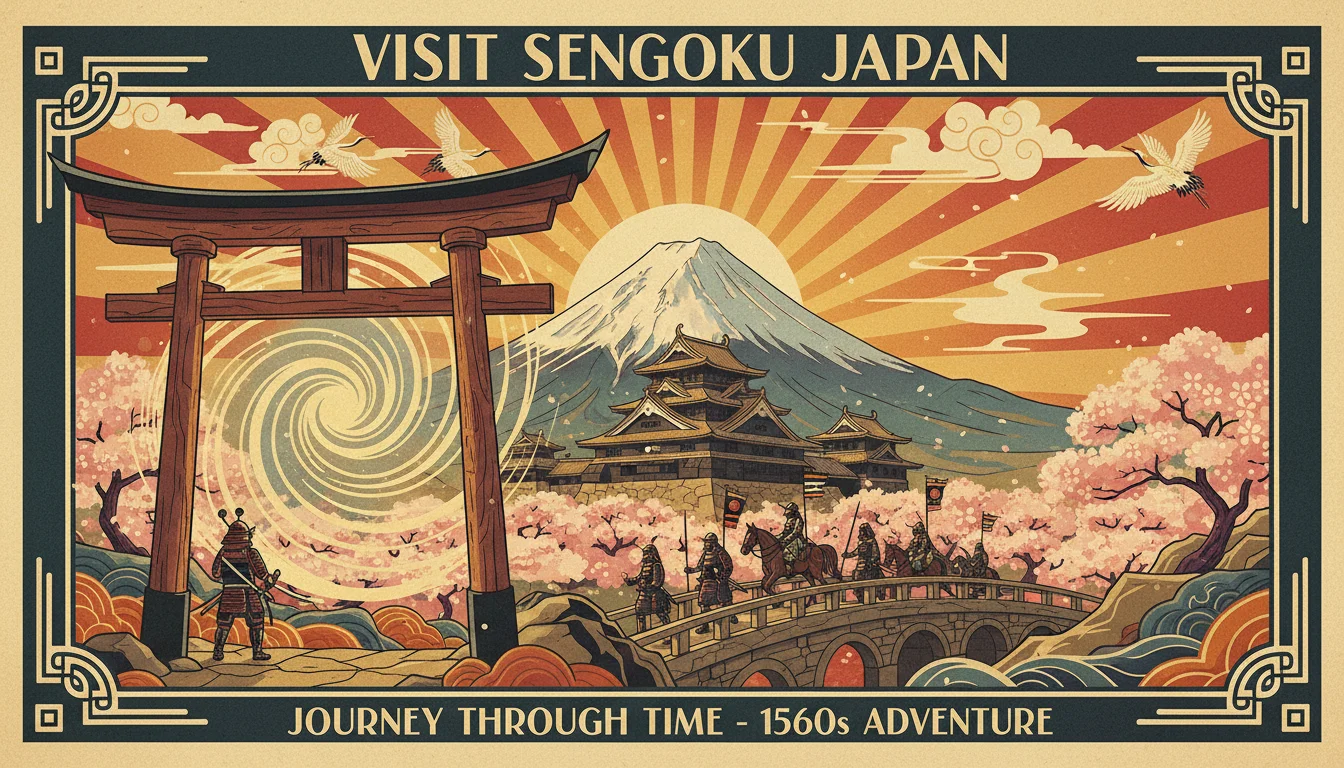
For later periods of Japanese history, our guide to Heian Kyoto in 1000 CE shows the court culture that grew from the Asuka period foundations. Sengoku Japan in 1560 is a later era when the fragile unity built after the Taika Reform had collapsed entirely into civil war.
Quick Answers
Common questions about this topic
What was the Asuka period in Japan?
The Asuka period (roughly 538 to 710 CE) takes its name from the Asuka region of Yamato Province, in present-day Nara Prefecture. It was a transformative era defined by the introduction of Buddhism from the Korean kingdoms, the adoption of Chinese-style centralized government, and the emergence of a distinct Japanese court culture. Prince Shotoku (574-622) is its most famous figure.
What was the Taika Reform?
The Taika Reform of 645 CE reorganized the Japanese state along Tang Chinese administrative lines. It abolished private land ownership by clans, established a census and land allotment system, and created a centralized bureaucracy. It was triggered by the Isshi Incident, in which Prince Naka no Ooe and Nakatomi no Kamatari killed the powerful Soga clan leader Soga no Iruka at the imperial court.
What religion did people practice in 650 CE Japan?
Both Buddhism and the indigenous practices now called Shinto coexisted, and in 650 CE there was no sharp distinction between them. Buddhism had arrived via Korea in the 6th century and was actively promoted by the court. The major Asuka temples were functioning religious centers. Local kami worship continued alongside Buddhist practice, and the two traditions would remain intertwined for centuries.
What is the oldest temple in Japan?
Asuka-dera (also called Hoko-ji), founded in 596 CE and located in the Asuka region of modern Nara Prefecture, is generally considered the first full-scale Buddhist temple in Japan. It houses Japan's oldest surviving Buddha statue, the Asuka Daibutsu, cast in 609 CE by the sculptor Tori Busshi.

Need Advice from Someone Who Lived There?
Get firsthand accounts from people who actually lived through these moments in history.
Create your free account →No card required. Some figures and features require a paid plan.
Join the HistorIQly Club
Get smarter about the past.
Weekly stories, deep dives, and exclusive content straight to your inbox.