A Time Traveler's Guide to Zapotec Monte Alban, 300 CE
Monte Alban time travel, 300 CE: the Zapotec capital ruled the Valley of Oaxaca with temples, markets, and one of the Americas' first writing systems.
Read Wikipedia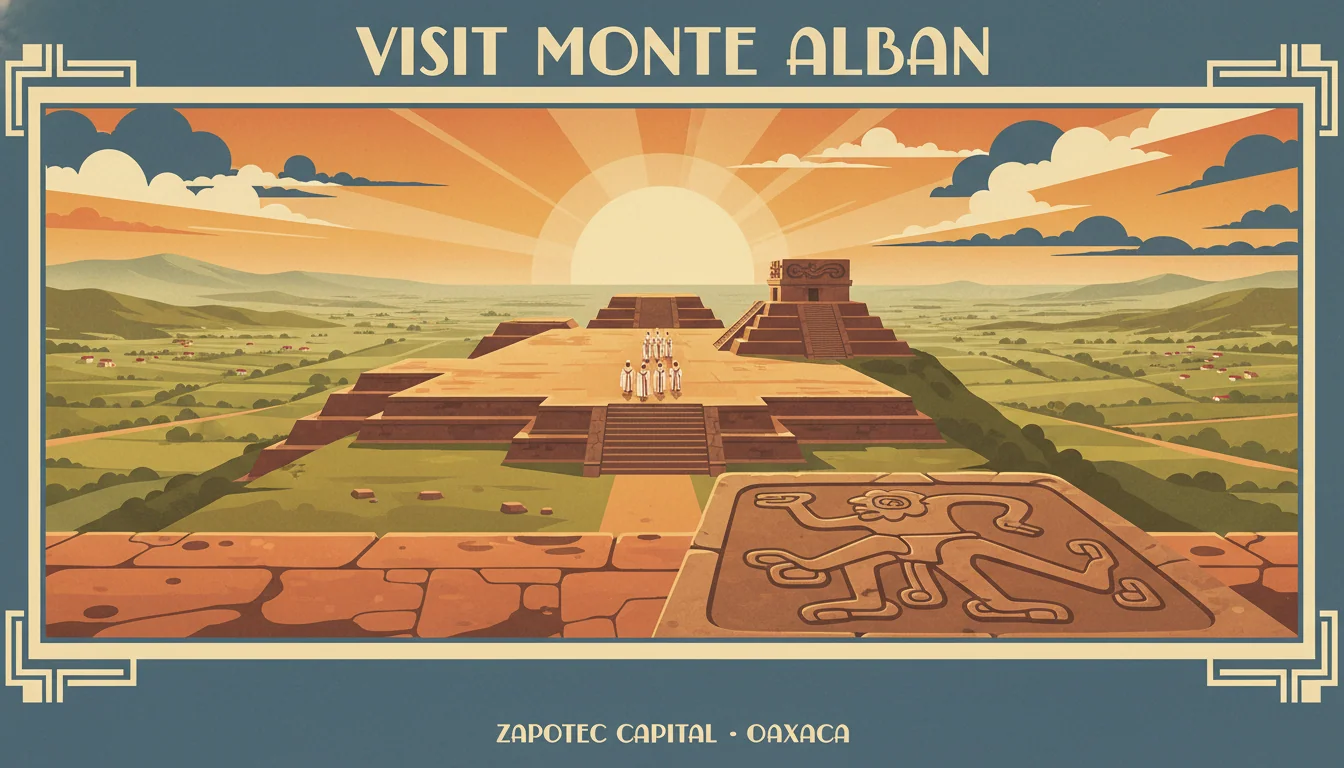
There is no gradual approach to Monte Alban. The city announces itself from the valley floor, a dark mass of temple platforms riding a leveled hilltop above the converging valleys of Oaxaca like the prow of a ship above a green sea. You cannot arrive as a neutral observer. The Zapotec built their capital at 1,800 meters above sea level specifically because it could not be approached without notice.
By the year 300 CE, this city has been the dominant political force in the region for six centuries. Its population stands somewhere between 20,000 and 25,000, making it larger than any settlement in North America and contemporary with the early phases of Teotihuacan to the north, with which the Zapotec maintain a careful and profitable trading relationship. The city on the hill controls the entire Valley of Oaxaca, collects tribute from dozens of subordinate communities, and runs one of the earliest writing systems in the Western Hemisphere.
You are not in a chiefdom or a village complex. You are in a state.
Getting there and what you will find
The climb from the valley floor is not optional. Monte Alban is not at the valley floor. It is above it, connected to the surrounding agricultural communities by worn dirt paths that the Zapotec maintain for exactly this purpose: the movement of tribute, workers, and goods upward, and the prestige of the city's altitude pressing symbolically downward.
Plan for an hour of steep walking. The path is packed earth, sometimes cut into steps on the steeper sections. The air at the top is drier and marginally cooler than the valley. When you arrive, you will step through a gap in the outer terrace walls and suddenly have nothing in front of you but the Gran Plaza, 300 meters long and 150 meters wide, a leveled ceremonial space ringed by pyramidal platforms so deliberately aligned with the horizon that they read as a statement about the relationship between the city and the cosmos.
That statement is intentional. Do not mistake it for decoration.
Dress and cover story
You will be immediately conspicuous unless you make decisions now. The Zapotec of 300 CE wear cotton clothing, woven locally or obtained through trade. Men wear a breechcloth called a maxtlatl in later terminology, sometimes with a cotton cape over the shoulders. Women wear long wrapped skirts with a cotton huipil blouse. Both sexes go barefoot or wear simple sandals of leather or woven fiber.
What you cannot wear: anything synthetic, anything with pockets, anything with buttons or metal fastenings. Nothing from your own century works here. The weaving is plain: undyed cotton in natural white and brown tones for ordinary people, richer colors and more elaborate patterns for the nobility and priests.
Your best cover, if you do not speak Classical Zapotec, is to pass yourself off as a trader from Teotihuacan or from one of the coastal communities. The Zapotec have regular contact with outsiders and are experienced at dealing with people who arrive not speaking the local language. Stay at the market, make your trades if you have anything to trade, and do not attempt to enter the central ceremonial areas of the Gran Plaza without an escort.
Entering a temple unannounced is not a mistake you make twice.
The Gran Plaza and what not to touch
The Gran Plaza is organized around a central axis, with major platform-pyramids marking the north and south ends and additional structures defining the east and west. The large pyramids have stairways on their front faces. Priests and ritual specialists ascend and descend these stairways as part of ceremonies you will witness at regular intervals tied to the Zapotec calendar.
Building J, a five-sided structure in the center of the plaza oriented at a 45-degree angle to everything else, is used for astronomical observation. Its tunnels and openings align with the heliacal risings of specific stars and the movements of the sun across particular points on the horizon. Astronomers, or more accurately the priest-astronomers whose role combines both functions, spend time here. You can examine the exterior. You should not enter unbidden.
The Danzantes panels, older carvings set into walls and platforms throughout the site, show human figures in unusual postures: limbs akimbo, eyes closed, sometimes with blood-scroll symbols at the groin or chest. These have been interpreted as sacrificial victims, as slain captive leaders, as swimmers, as rulers. The Zapotec do not call them dancers; that name came much later. Whatever they are, treat them as the sacred objects they are. Do not touch.
Food and water
The valley below Monte Alban grows corn, squash, beans, and chili peppers. Corn in 300 CE Oaxaca is already a sophisticated cultivated crop, far removed from its wild ancestor, ground into masa on stone metates and cooked as tortillas or tamales. A tamale from a market stall is safe to eat. The tortillas are cooked on a clay comal over a wood fire and will be hot.
Do not drink water from the streams near the city without boiling it first. The valley streams are used for multiple purposes and the correlation between contaminated water and illness is not yet understood here, though the Zapotec healers have effective knowledge of local plant remedies for intestinal complaints.
Chocolate is available, though it is a luxury consumed primarily by elites and in ceremonial contexts. If someone offers you a drink made from ground cacao mixed with water and chili, accept it. Refusing hospitality is a significant social error.
Agave is everywhere. Maguey sap, fermented into what will eventually be called pulque, is widely consumed. At 300 CE it is a ritual and social drink rather than a casual one, and consumption is regulated by context. Pay attention to who is drinking what, and when.
The ball court
At the base of the hill, accessed by a path from the Gran Plaza, the ball court is one of the oldest in Mesoamerica. The game played here uses a solid rubber ball, weighing several kilograms. Players use their hips, knees, and elbows, not their hands. The game has ritual associations that vary by region and period, but at 300 CE Monte Alban it is connected to the ceremonial calendar and to the display of political relationships between ruling lineages.
Watching is permitted and common. Participating without invitation is not.
The ball game was a defining tradition across Mesoamerica. For a sense of how these cities organized ritual and commerce together, our guide to Aztec Tlatelolco in 1521 covers the same region a millennium later, and the Inca capital at Cusco shows a parallel Andean tradition.
The calendar and timing your visit
The Zapotec operate two interlocking calendars simultaneously: a 365-day solar calendar called the yza, and a 260-day ritual calendar called the piye. The intersection of these two cycles produces a 52-year Calendar Round, which the Zapotec share conceptually (though not identically) with their Mesoamerican neighbors. Certain days in the ritual calendar are auspicious; others are inauspicious for travel, commerce, or any number of activities.
You cannot easily determine which kind of day you have arrived on without consulting someone who knows the calendar, and such people are specialists. If you notice that normal activity in the market has stopped, that people are staying indoors, or that the priests are doing something unusual at the temple platforms, you have arrived on a significant ritual day. Stay still, observe, and let the professionals operate.
When to leave
You will know when your welcome has expired. The Zapotec are not an unwelcoming people, but they are a stratified and hierarchical one, and strangers who overstay their understood role attract the kind of attention that ends badly. If someone in a position of authority, identifiable by elaborate headdress, jade ornaments, or the simple fact that other people are deferring to them, begins asking you pointed questions, begin thinking about the path back down the hill.
The descent takes half the time of the ascent. The valley is full of smaller villages where travelers can rest without attracting the scrutiny that the capital demands. The milpa fields are green in the growing season, and the Valley of Oaxaca at dusk, seen from halfway down the hill with Monte Alban still glowing above you and the firelight of the communities below coming on, is worth the climb, the heat, and the considerable risk of having been up there in the first place. For a Monte Alban time travel visit, January or February is the practical window, when the dry season keeps the paths open and the Gran Plaza ceremonies follow a predictable calendar.
Quick Answers
Common questions about this topic
What was Monte Alban in 300 CE?
Monte Alban was the capital of the Zapotec civilization in what is now Oaxaca, Mexico. By 300 CE it was one of the largest cities in Mesoamerica, with an estimated population of 20,000 to 25,000 people spread across a leveled hilltop and its surrounding slopes. The city served as the political, religious, and economic center of a state controlling much of the Valley of Oaxaca.
How do you get to Monte Alban?
Monte Alban sits atop a spur of the Sierra Madre del Sur about 400 meters above the floor of the Valley of Oaxaca. There are no roads in the 4th-century sense, only paths worn into the hillside by generations of use. The climb from the valley floor takes the better part of an hour on foot and is steep enough to be punishing in the heat.
What language did the Zapotec speak at Monte Alban?
The inhabitants of Monte Alban in 300 CE spoke an ancestor of modern Zapotec languages, sometimes called Classical Zapotec or Proto-Zapotec. The language is unrelated to Nahuatl, Mayan, or any other Mesoamerican language family. The Zapotec also had a writing system, one of the earliest in the Americas, used primarily for recording calendrical and political information on stone monuments.
Was Monte Alban dangerous for visitors?
The city itself was not casual territory for strangers. Monte Alban was a densely populated, stratified state capital with a priestly hierarchy, warrior class, and elaborate protocols around access to the Gran Plaza's ceremonial spaces. An unannounced outsider would attract immediate suspicion. The city's position above the valley also made it naturally defensible, and Zapotec military power was real: the carved Danzantes panels display what appear to be conquered enemy leaders.

Need Advice from Someone Who Lived There?
Get firsthand accounts from people who actually lived through these moments in history.
Create your free account →No card required. Some figures and features require a paid plan.
Join the HistorIQly Club
Get smarter about the past.
Weekly stories, deep dives, and exclusive content straight to your inbox.