A Time Traveler's Guide to Mansa Musa's Timbuktu (1325 AD)
Your guide to Mansa Musa's Timbuktu in 1325 - gold-dusted streets, Saharan heat, and the legendary court of the wealthiest empire on Earth.
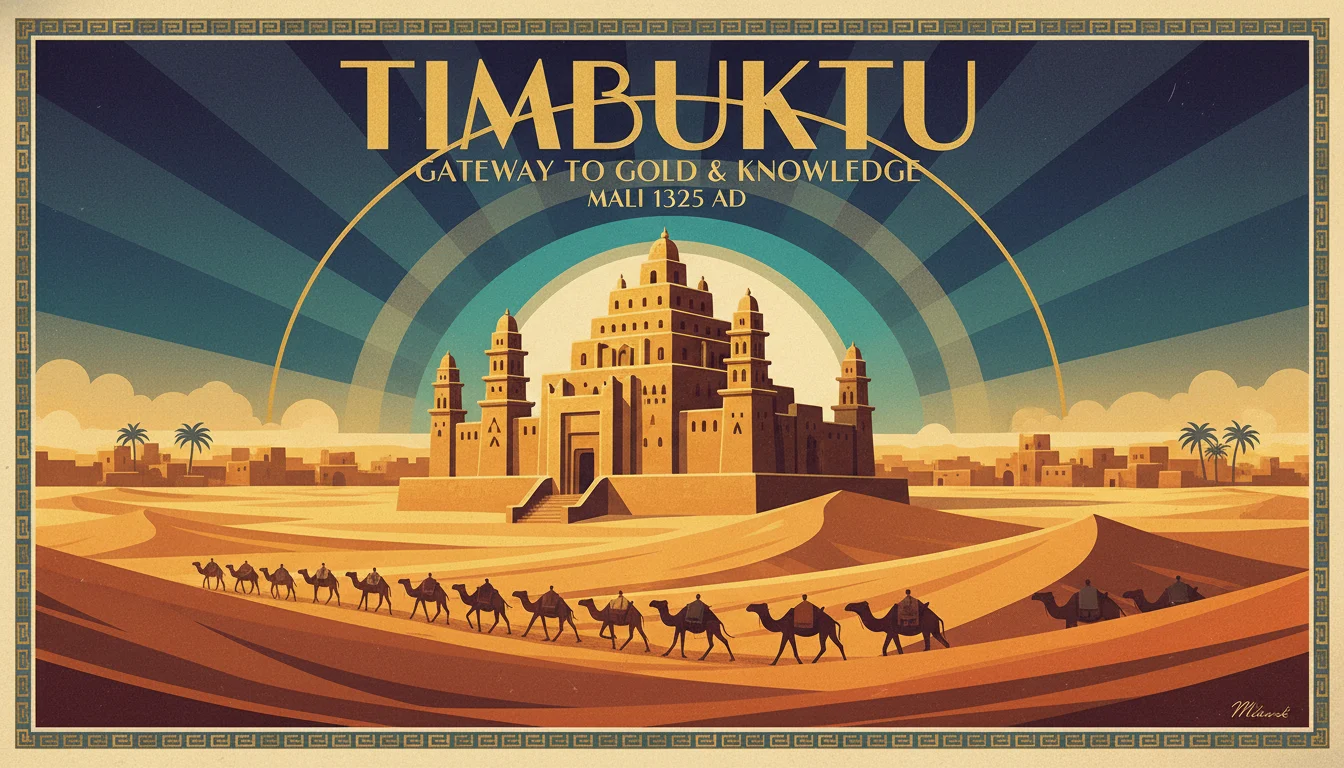
You just materialized in the middle of the Sahel, somewhere between the Niger River and an ocean of sand. The air is dry enough to crack your lips in minutes. A caravan of camels stretches to the horizon, loaded with salt slabs the size of doors. Welcome to the Mali Empire at its absolute peak - the wealthiest civilization on the planet, ruled by a man whose net worth makes modern billionaires look like hobbyists.
The year is 1325. Mansa Musa has just returned from his legendary hajj to Mecca, during which he spent so much gold in Cairo that he crashed the Egyptian economy for a decade. You're standing in his kingdom. Try not to embarrass yourself.
What to Wear
Forget your jeans. You'll want a flowing boubou - a wide, ankle-length robe made from locally woven cotton. The fabric is dyed in deep indigo using techniques the Mandinka people have perfected for centuries. The darker the blue, the higher your perceived status. White cotton works for daily wear, but showing up to the royal court in anything less than richly dyed cloth is a social death sentence.
Cover your head. A tagelmust (cloth wrap) protects you from sun and sandstorms while signaling that you understand Saharan life. Women wear elaborate head wraps and gold jewelry - and yes, the gold is everywhere. Earrings, bracelets, anklets. This is an empire built on gold mines. Even modest traders carry gold dust in small leather pouches.
Sandals are standard. Leather ones, crafted by Tuareg artisans who treat leatherwork as high art. Go barefoot and you'll burn your feet on the sand before noon.
What to Eat
The staple is millet - boiled into porridge or pounded into couscous. It shows up at every meal, usually topped with a sauce made from baobab leaves, okra, or ground peanuts. Rice grows along the Niger River floodplains, and if you're dining well, you'll get jollof-style preparations that taste surprisingly familiar to modern West African cuisine.
Meat options include goat, mutton, and dried fish from the Niger. Chicken is common but considered everyday food. Beef is a luxury - cattle are wealth on the hoof, and slaughtering one means a celebration is happening.
Drink hibiscus tea (bissap) or ginger water. Both are everywhere and both are delicious. Fresh milk from cattle or goats is available if you're near herders. Avoid drinking directly from the Niger unless you enjoy intestinal adventures.
The real treat is shea butter. Used in cooking, skin care, and as a trade commodity, it makes everything taste richer. Dates arrive by caravan from the north, and honey is prized enough to feature in diplomatic gifts.
The City Itself
Timbuktu in 1325 is a city of maybe 50,000 people - not the largest in the Mali Empire (that honor goes to Niani, the capital), but easily the most cosmopolitan. It sits at the crossroads of two trade networks: gold and kola nuts flowing north from the forest regions, and salt, copper, and books flowing south from the Sahara and Mediterranean.
The Djinguereber Mosque dominates the skyline. Mansa Musa commissioned the Andalusian architect Abu Es Haq es Saheli to design it after returning from his hajj. It's built from banco (mud-brick reinforced with wooden beams), and it's stunning. The University of Sankore is already emerging as a center of Islamic scholarship that will eventually house hundreds of thousands of manuscripts.
The streets are sandy but organized. Markets cluster by trade: textiles here, salt there, gold dealers in their own quarter with scales so precise they'd impress a modern jeweler. You'll hear Mandinka, Arabic, Tamasheq, Fulfulde, and Songhay spoken within a single block.
Biggest Dangers
The desert will kill you faster than anything else. Dehydration in the Sahel is no joke - you need several liters of water daily, and the dry harmattan wind pulls moisture from your body without you noticing until you collapse. Stay hydrated or die. It's that simple.
Malaria is endemic along the Niger River. The locals have some resistance. You don't. Sleep under whatever covering you can find and avoid standing water at dusk.
Politically, you're safe as long as you don't insult the Mansa. His authority is absolute and divinely sanctioned. Court protocol is elaborate: you approach the throne by prostrating yourself and pouring dust over your head. Skip this ritual and the royal guards will educate you on proper manners in ways you won't enjoy.
Banditry exists on the trade routes between cities, but within Timbuktu itself, crime is remarkably low. Ibn Battuta, who visited about 27 years after your arrival date, specifically noted that the roads were safe and theft was almost nonexistent. The Mali Empire takes justice seriously.
Must-See Experiences
Watch the salt trade in action. Enormous slabs of rock salt arrive by camel from the Taghaza mines, 500 miles north in the deep Sahara. Each slab is worth its weight in gold - literally. The exchange rate fluctuates, but the silent barter system between gold miners and salt traders is one of the most elegant economic mechanisms in the medieval world.
Visit the Sankore quarter at prayer time. The call to prayer echoing off mud-brick walls while scholars debate theology and astronomy in courtyards is something you can't experience anywhere else on earth in 1325.
If your timing is right, catch a royal audience. Mansa Musa holds court with hundreds of attendants, musicians playing balafon (wooden xylophones) and kora (harp-lutes), and slaves carrying gold staffs. The sheer display of wealth is designed to overwhelm visiting diplomats. It works.
Take a pirogue (wooden canoe) on the Niger River at sunset. The light turns the water copper and gold - fitting for an empire that has more of both than it knows what to do with. Hippos are a hazard, so keep your distance, but the river is the lifeblood of the region and the best way to understand why civilization flourished here.
For more medieval African and Islamic world time-travel guides, see our stops at Fatimid Cairo, 970 AD and Abbasid Baghdad, 800 AD.
Survival Summary
Dress in indigo. Eat the millet. Drink the bissap. Prostrate before the Mansa. Stay hydrated. Avoid hippos. And whatever you do, don't try to match anyone's gold jewelry collection - in the Mali Empire of 1325, you simply cannot compete.
You're visiting the richest empire on Earth at the exact moment of its greatest power. Enjoy it. In two centuries, the trade routes will shift, the empire will fragment, and European colonizers will rewrite the narrative. But right now, Timbuktu is the center of the world, and it knows it.

Need Advice from Someone Who Lived There?
Get firsthand accounts from people who actually lived through these moments in history.
Ask Them YourselfJoin the HistorIQly Club
Get smarter about the past.
Weekly stories, deep dives, and exclusive content straight to your inbox.