Time Traveler's Guide to Mughal Delhi, 1650
Your guide to Mughal Delhi in 1650 - Shah Jahan's glittering capital where the Taj Mahal is freshly built, spices flow like water, and one wrong bow could cost you your head.
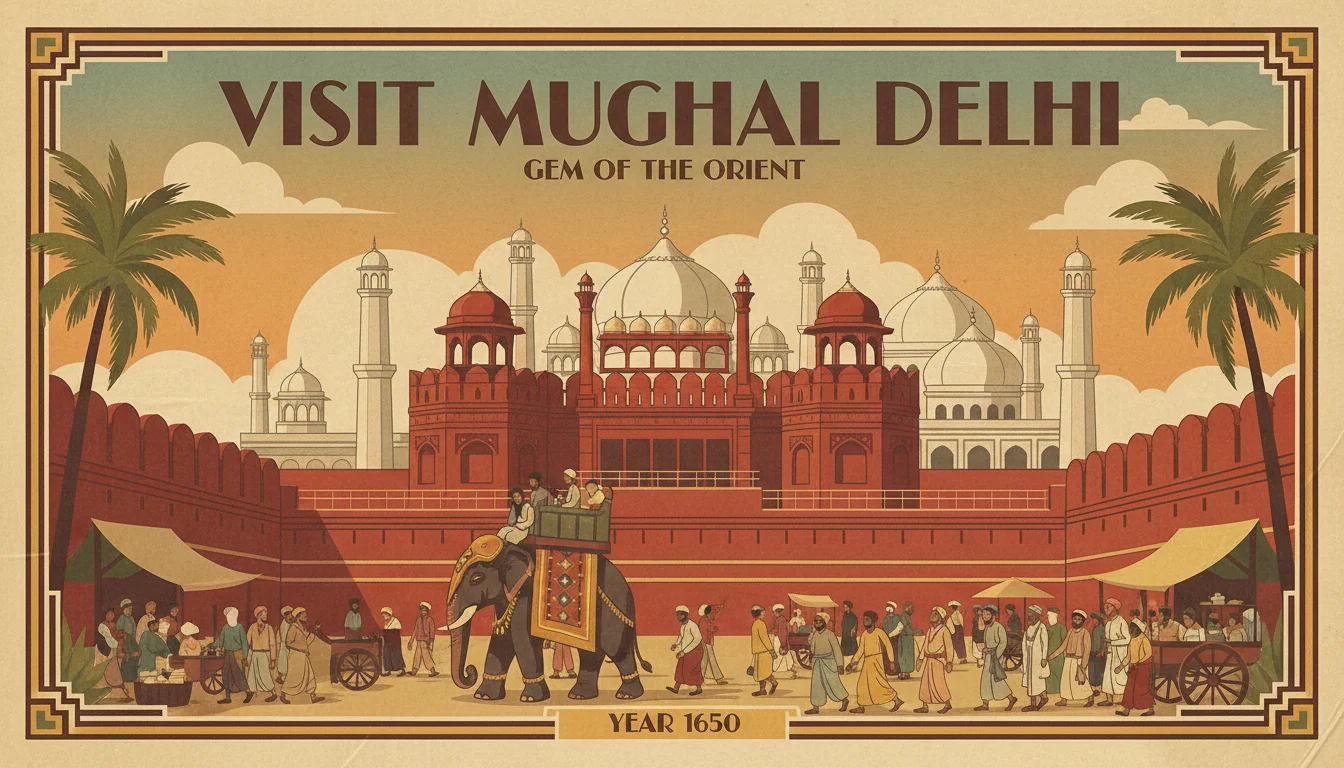
You've just materialized in Shahjahanabad - the walled city that Shah Jahan built from scratch starting in 1639. It's 1650, and you're standing in what might be the richest, most spectacular city on Earth. The Mughal Empire controls most of the Indian subcontinent, commands an economy that dwarfs England's, and its emperor has just finished building a little marble tomb you might have heard of.
Welcome to Mughal Delhi. Try not to stare.
What You're Walking Into
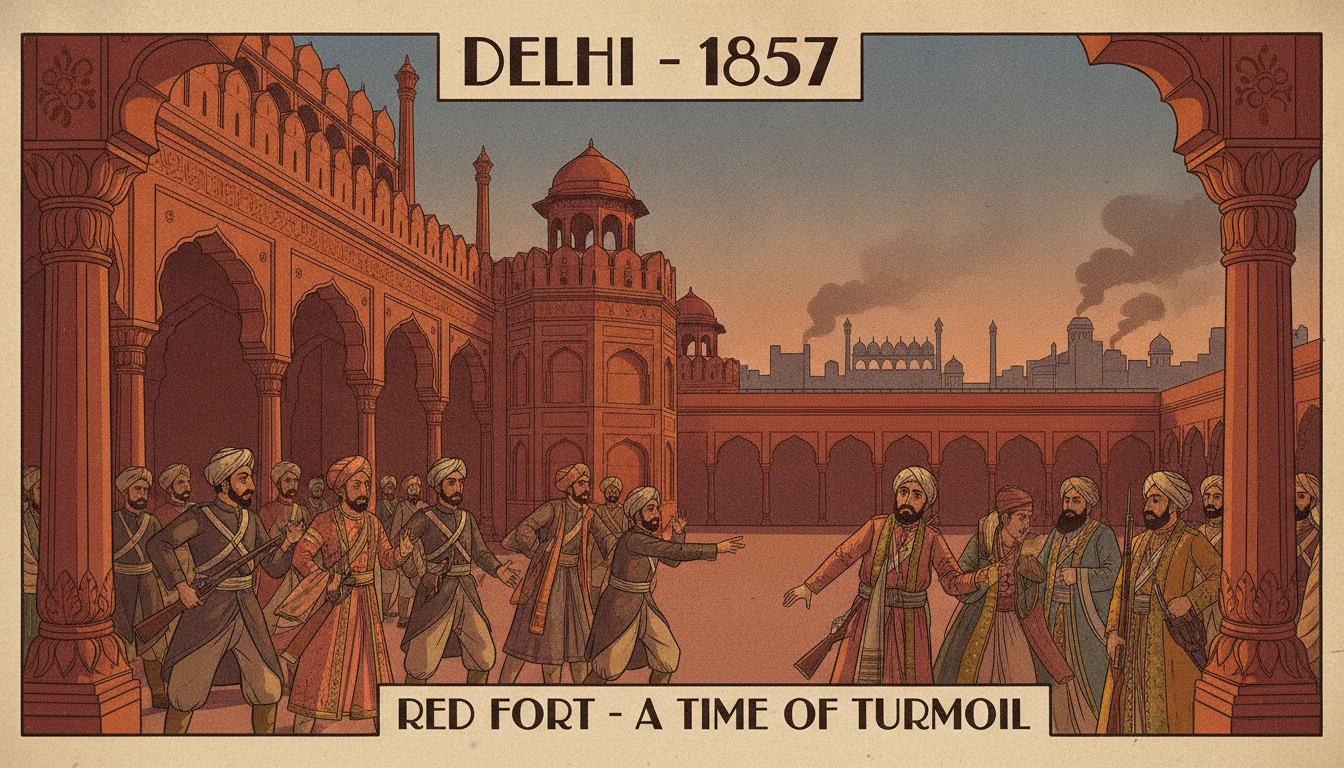
Shah Jahan sits on the Peacock Throne - literally encrusted with rubies, emeralds, and diamonds worth more than any European palace. His empire of roughly 150 million people generates about a quarter of the world's GDP. The Red Fort (Lal Qila) was completed just two years ago, and its walls stretch over a mile along the Yamuna River.
Shahjahanabad is a planned city built on a grid, with Chandni Chowk as its main artery - a wide boulevard with a canal running down the center, flanked by markets that sell everything from Persian silk to Kashmiri saffron. European travelers who visit consistently call it the finest street in the world.
The emperor is 58 years old and still grieving his wife Mumtaz Mahal, who died in 1631. He's poured his grief into architecture, and the results are staggering. The Taj Mahal in Agra was completed just a couple of years ago. The Jama Masjid in Delhi is still under construction - you can watch the workers hauling red sandstone if you time your visit right.
What to Wear
Get this wrong and you'll attract the wrong kind of attention immediately. Men should wear a jama - a long, fitted coat that wraps across the chest and ties at the side, worn over loose trousers called paijama (yes, that's where "pajamas" comes from). Add a patka or turban on your head. Going bareheaded marks you as either very poor or very strange.
Women wear a choli (fitted blouse) with a flowing skirt and a dupatta (long scarf) draped over the head and shoulders. Covering your hair in public isn't optional - it's basic social expectation regardless of your religion.
Fabric matters enormously. Cotton is for common people, silk signals wealth, and muslin from Bengal is the luxury fabric of the era - so fine it's called "woven air." If you can afford it, wear muslin. People will treat you better.
Colors signal status. Deep reds and purples suggest nobility. White is for mourning or religious devotion. Avoid wearing yellow - it's associated with the emperor's household, and impersonating royalty is exactly as dangerous as it sounds.
What to Eat
You've landed in one of history's great food cities. Mughal cuisine is a fusion of Central Asian, Persian, and Indian traditions, and it's extraordinary.
Start your morning at a chai stall in Chandni Chowk. Tea hasn't fully arrived yet (it won't become common for another century), so you're more likely to find sherbet - fruit drinks cooled with ice brought down from the Himalayas by runners. Yes, they have ice. The logistics are incredible.
For a proper meal, expect biryani - the Mughal version is layered rice with meat, saffron, and dried fruits, slow-cooked in a sealed pot. Kebabs of every variety line the streets: seekh kebab, shami kebab, chapli kebab. Naan bread comes from tandoor ovens, and the smell alone will guide you to the right stalls.
If you're invited to a noble's home, prepare for a feast. Dishes arrive in dozens - korma (meat braised in yogurt and cream), nihari (slow-cooked stew eaten at dawn), haleem (wheat and meat porridge), followed by sweets drenched in rosewater and cardamom. Eat with your right hand only. The left hand is considered unclean, and using it at the table is a genuine insult.
Drink the sherbet. Avoid the water unless it's been boiled or comes from a known well. Dysentery kills more people here than any army.
Customs That Could Save Your Life
The Mughal court runs on elaborate etiquette called adab. When meeting anyone of rank, place your right hand on your forehead and bow slightly. This is the taslim, and forgetting it suggests you're either rude or a barbarian. For the emperor himself, you perform the kornish - a deeper bow with your hand touching the ground.
Religion is complicated here, and that's actually good news. Shah Jahan is a Muslim ruling a Hindu-majority population, and the Mughal approach has generally been pragmatic tolerance (though Shah Jahan is stricter than his predecessors). Temples and mosques stand side by side. You'll hear the azan (call to prayer) five times daily and temple bells at dawn and dusk.
The bazaar operates on haggling. The first price quoted is always two to three times the real value. Counter at a third and work upward. Paying the asking price marks you as a fool, and word travels fast.
Caste and social hierarchy are rigid. Avoid sitting at the same level as someone of higher rank. If a nobleman rides past on an elephant, step aside and bow. If the emperor's procession comes through, get off the street entirely and kneel.
Don't touch anyone's head, and remove your shoes before entering any home, mosque, or temple. Both rules are absolute.
Dangers to Watch For
Disease is your biggest enemy. Malaria, cholera, typhoid, and plague all circulate through Delhi. Sleep under netting if you can find it, and avoid standing water. The monsoon season (July through September) is beautiful but deadly - flooding brings waterborne illness, and mosquitoes multiply exponentially.
Crime in the bazaars is real but manageable. Pickpockets work Chandni Chowk, and confidence men target obvious foreigners. Keep your money in a cloth belt under your jama, not in a visible purse.
Political violence is always simmering. Shah Jahan's four sons are already jockeying for succession. In about eight years, this will explode into a full civil war when Aurangzeb imprisons his father and seizes the throne. If you're here long-term, keep your political opinions to yourself.
The justice system is swift and public. Thieves lose hands. Serious crimes earn execution by elephant - the condemned is placed before a trained war elephant that crushes them. Public punishments happen in the maidan (open ground) near the Red Fort. You'll want to avoid these spectacles.
What You Absolutely Must See
The Red Fort. Even unfinished in some details, it's breathtaking. The Diwan-i-Khas (Hall of Private Audiences) has walls inlaid with precious stones and a ceiling of silver. The inscription on its walls reads: "If there is paradise on earth, it is this, it is this, it is this."
Chandni Chowk by moonlight. The name means "Moonlight Square," and the canal reflects the light beautifully. Night markets sell everything from Persian carpets to fighting birds.
The Jama Masjid (even under construction). When finished, it will be the largest mosque in India, with a courtyard that holds 25,000 worshippers.
Take the road to Agra (about 200 miles south) to see the Taj Mahal while the marble still gleams white and new. The gardens are immaculate, the reflecting pools perfectly maintained. You're seeing it in its absolute prime.
A Sufi shrine. The dargah of Nizamuddin Auliya is already centuries old and draws devotees from every religion. The qawwali singing at dusk is haunting and beautiful.
How to Blend In
Learn a few phrases in Persian - it's the language of the court and educated classes. "Salaam aleikum" (peace be upon you) works in any situation. Common people speak Hindustani (early Hindi-Urdu), and knowing "kitna?" (how much?) will serve you well in the bazaar.
Carry a small pouch of cardamom pods to chew after meals - it freshens breath and signals good manners. Accept any food or drink offered to you by a host. Refusal is an insult.
Walk slowly. Nobody rushes in Mughal Delhi. The midday heat makes it physically impossible for half the year anyway, and hurrying signals low status. Take your time. Drink your sherbet. Watch the elephants lumber past the Red Fort.
You're standing in a civilization at its absolute peak - wealthy, cultured, architecturally magnificent, and about to begin its long, slow decline. Enjoy it while it lasts.
For more Asian time-travel guides, see our stops at Heian Kyoto, 1000 AD and Yuan Khanbaliq, 1280 AD.

Need Advice from Someone Who Lived There?
Get firsthand accounts from people who actually lived through these moments in history.
Ask Them YourselfJoin the HistorIQly Club
Get smarter about the past.
Weekly stories, deep dives, and exclusive content straight to your inbox.