A Time Traveler's Guide to Mughal Lahore, 1600
Mughal Lahore in 1600 was among the largest cities on earth. Here is how to survive a visit without attracting official attention in Akbar's still-formidable empire.
Read Wikipedia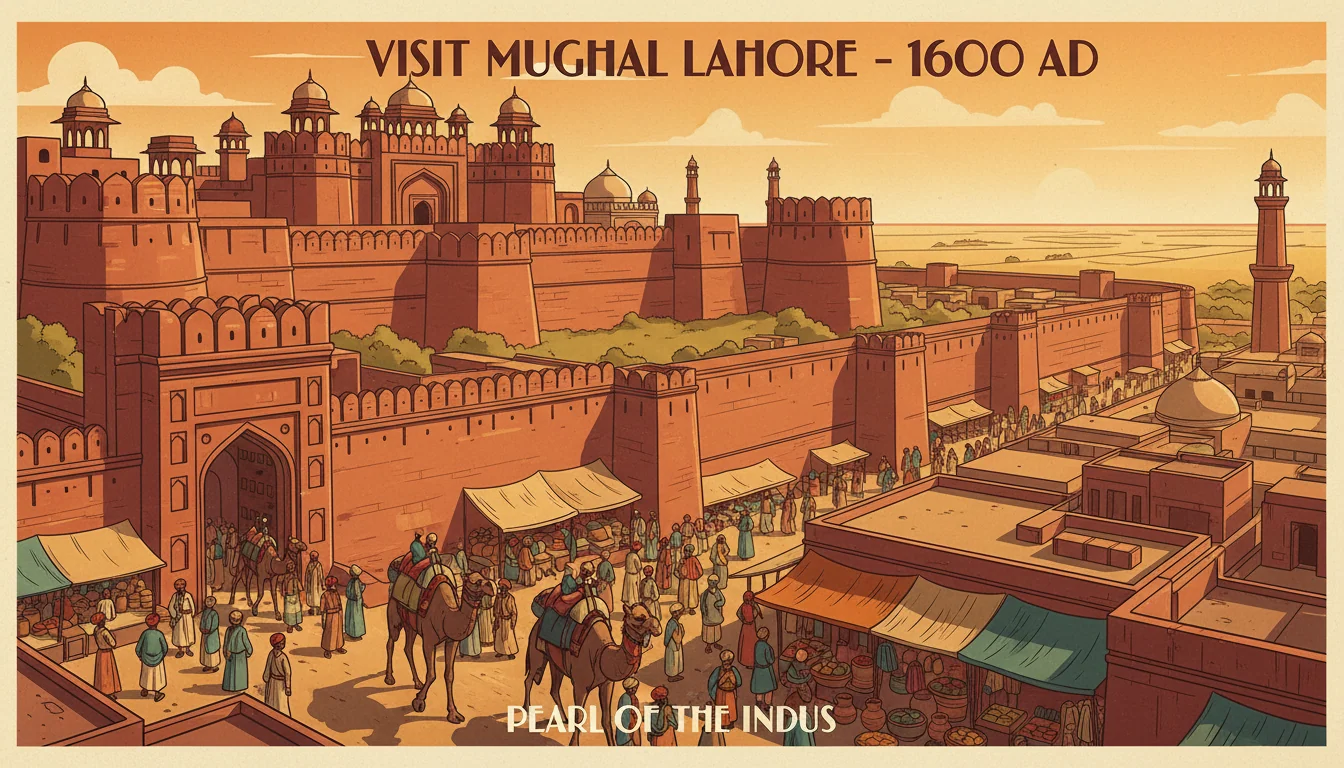
Few cities in 1600 could match Lahore for sheer concentrated activity. Constantinople had more history. Beijing had more wealth. But Lahore had something neither of them quite possessed: it was a city at the fulcrum of everything, the last great Mughal city before the mountain passes to Central Asia, the first major city a caravan from Kabul or Samarkand would reach after descending into the Punjab plains.
The Mughal Empire under Akbar was, by several credible measures, the most administratively sophisticated state in the world. Its revenue collection was organized, its religious policy unusually tolerant for its era, and its capital cities enormous. Lahore had served as Akbar's principal court from around 1585 to 1598, and even with the court now back in Agra, the city in 1600 retains the scale and energy of a great imperial capital that has not quite finished believing in its own demotion.
If you are going to visit one Mughal city, visit Lahore now, while it is still functioning at full power, before the architectural refinements of Shah Jahan's era transform its character in the mid-17th century. In 1600, the city is rich, loud, and dangerous in exactly the ways a great city should be.
What kind of place you're entering
Lahore in 1600 holds somewhere between two hundred thousand and four hundred thousand people - estimates vary, but it ranked among the larger urban concentrations on earth. The walled old city is dense, loud, and permanently in motion. Caravans from Kabul and Kandahar arrive through the northern gates. Textile merchants from Gujarat and Rajputana operate out of the eastern bazaars. Persian scholars and Sufi mystics occupy the neighborhoods around the major shrines. Sikh craftsmen and Hindu bankers manage much of the commercial infrastructure.
The city runs on Persian. That is the language of the Mughal government, of educated culture, and of formal commerce. If you present yourself as a merchant from Isfahan or Samarkand, your Persian will be tested within the first serious conversation. Do not fake fluency you do not have.
Your safest cover identity is a trader in fine cloth or horses, traveling from Kabul with letters of introduction to a merchant house in the city. Both trades are common enough that a degree of unfamiliarity with local customs reads as ordinary foreignness. Horse traders have plausible reasons to move between the city's periphery and its inner markets. Cloth merchants have reasons to linger in the bazaar quarter for days without attracting suspicion.
Dress and presentation
Arrive dressed as a prosperous traveler from Khorasan or Transoxiana. The basic outfit for a man of means:
- a long-sleeved qaba or jama, a fitted coat worn over a long shirt and loose trousers, in silk or fine cotton for a merchant of standing
- wide draped trousers tucked into pointed leather boots
- a turban, white or light-colored for a merchant, wrapped cleanly
- a sash at the waist, useful for carrying a small knife and the papers you will need
- a short sword or dagger; an unarmed foreign traveler in the Punjab raises questions
Do not wear European clothing. The Portuguese maintain trading posts on the coast, but a European deep in the Punjab interior in 1600 will be treated as a curiosity requiring official examination. Official examination in Mughal administration means fees, questionnaires, and escorts to someone with the authority to decide what to do with you. Avoid it.
Women traveling alone face a far more constrained environment. The range of socially legible identities for a foreign woman moving independently through Mughal Lahore in 1600 is narrow, and none of them are comfortable for long.
The Lahore Fort and the walled city
The Shahi Qila - the Lahore Fort - dominates the northwestern corner of the city. Akbar spent heavily rebuilding it in the 1580s, and in 1600 it is a working administrative complex, not a monument. Guards control the gates. A Mughal governor holds court here on formal days. You can observe the exterior, watch the formal processions and parades on major days, and follow the movement of officials in and out, but you will not walk inside without a legitimate reason and someone recognized by the guards to vouch for you.
The walled city itself, entered through gates that open at dawn and close at dusk, is freely explorable. Inside, the city is organized by trade, as all great Mughal cities are. Silversmiths cluster in one lane, cloth merchants in another, spice dealers near the central market. The Anarkali bazaar is already an established commercial corridor - this is where you will see the full cosmopolitan range of the empire: Persian scribes, Rajput soldiers in distinctive dress, Kashmiri shawl merchants with bolts of fine wool, Gujarat traders with glass beads from India's western ports.
The Friday Mosque near the Fort is the city's principal place of communal prayer. If you are presenting as a Muslim - the most logical identity for a merchant from Central Asia or Persia - you will be expected to attend on Fridays. Know the motions. Know enough of the Arabic to navigate the prayers without standing out. If your knowledge is inadequate, arrive late and stand at the edge of the gathering.
Caravanserais, food, and water
Caravanserais line the main roads into the city and occupy several interior lots. They are the accepted solution to traveler accommodation: walled courtyards with cells for travelers, stabling for horses and camels, a well, and usually a tea seller near the gate. They are not clean by any modern standard. They are anonymous in a useful way. Pay your fee at the gate, stable what you brought, and do not advertise your origin to strangers in the courtyard.
For food, the market stalls near the central bazaar sell flatbreads from clay tandoor ovens, roasted meats on skewers, lentil preparations, spiced rice with dried fruit, and seasonal vegetables. Drink boiled tea or spiced milk, not raw water from the open channels. The Ravi River, which runs along the northern edge of the walled city in this period, is also the city's primary drain.
If you have sufficient funds and a plausible introduction, a wealthy merchant household will host you under the rules of hospitality that govern Mughal commerce. This is the comfortable option. It also requires a convincing backstory, because your host will ask about the roads you traveled, the prices in Kabul, and the people you know in common. Have answers.
Politics and what not to say
Akbar is approaching 60 in 1600 and has ruled for over four decades. His policy of sulh-i-kull, or universal peace across religious communities, has made the empire function in ways no previous Indian power managed. He holds formal debates at court that bring together Muslim theologians, Hindu scholars, Zoroastrian priests, Jain philosophers, and Jesuit missionaries. This policy is real and it matters. It also exists within a political system that is becoming unstable.
Akbar's eldest son Salim - who will become the emperor Jahangir - is already in open rebellion. The succession question dominates court politics and infects every senior provincial appointment. Do not comment on succession. Do not discuss the loyalty of any named official. Do not offer opinions on the imperial family. If pressed, offer a brief blessing on the emperor's health and redirect the conversation toward trade prices or road conditions.
On religion: Lahore has a majority Muslim population, a large Hindu merchant and banking community, and a growing Sikh presence. Guru Arjan Dev is working on the Harmandir Sahib at Amritsar, roughly 50 kilometers to the east. Religious coexistence is the practical norm in commerce. Do not perform conspicuous religious observances that conflict with the identity you have claimed.
Health and the Punjab summer
Bring everything you need medically. Lahore's water supply is not safe for a traveler without prior immunity. Boil water or drink only tea. Wash hands before eating, obsessively. The Punjab summer, roughly May through September, is severe - temperatures well above 40 degrees Celsius combined with the density of the walled city are genuinely dangerous. Plan your visit for October through March. Spring is adequate. Avoid July entirely.
Plague is not an active concern in Lahore in 1600, but cholera, dysentery, and typhoid are endemic. The city has Unani physicians - practitioners of the Greek-Arab medical tradition who arrived via Persia - who treat certain conditions effectively. Avoid surgery from any practitioner. If you develop severe fever or bloody flux, your options are rest, hydration, and optimism.
What is worth your time
Watch the formal evening closing of the Fort gates with drums and torches. Walk the Anarkali Bazaar at midmorning, when the silk merchants spread their cloth in the sunlight and you can see what the Silk Road and the Indian Ocean trade routes actually deliver in material form. Stand at the edge of the Friday prayers and listen to the call spreading across the rooftops.
Lahore in 1600 is not the architectural marvel it will become under Shah Jahan. The marble screens and the inlaid stone will arrive later. What you have now is the empire at its full operational power - vast, dense, and slightly chaotic, before the elegance arrives. That is worth the trip.
For a visit to the Mughal Empire at a slightly later date, see our guide to Visiting Mughal Agra, 1630. For the empire's later years in its third great capital, see Visiting Mughal Delhi, 1650.
Quick Answers
Common questions about this topic
Was Lahore the Mughal capital in 1600?
Lahore served as Akbar's primary capital from approximately 1585 to 1598, after which the administrative center returned to Agra. By 1600, Lahore was no longer the formal capital, but it remained one of the largest and most strategically important cities in the empire - the hub of Mughal power in the Punjab and the gateway to the northwest.
What was daily life like in Mughal Lahore?
Mughal Lahore was a densely populated walled city with active bazaars trading silk, cotton, horses, spices, and luxury goods from across Eurasia. The population was cosmopolitan - Persians, Central Asians, Rajput warriors, Hindu merchants, and Sikh craftsmen all operated within the city. Persian was the language of administration and high commerce.
What is still standing from Mughal-era Lahore today?
The Lahore Fort, known as the Shahi Qila, preserves substantial Mughal construction including work from Akbar's reign in the 1580s. The Walled City retains its historic street layout and some surviving gate structures. The Badshahi Mosque and the Shalimar Gardens were built after 1600 but represent the continuation of the same Mughal tradition.
What language did people speak in Lahore in 1600?
Persian was the language of the Mughal court, formal administration, and educated commerce. Most literate merchants and officials would have known Persian. On the streets, Punjabi dialects and Hindustani dominated. A traveler presenting as a Persian or Central Asian merchant - the most plausible foreign identity - would need competent Persian and patience with local variation.

Need Advice from Someone Who Lived There?
Get firsthand accounts from people who actually lived through these moments in history.
Create your free account →No card required. Some figures and features require a paid plan.
Join the HistorIQly Club
Get smarter about the past.
Weekly stories, deep dives, and exclusive content straight to your inbox.