A Time Traveler's Guide to Mycenae, 1300 BC
A time traveler's guide to Mycenae in 1300 BC, when the citadel of Agamemnon commanded the Aegean and the Bronze Age palace civilization was at its peak.
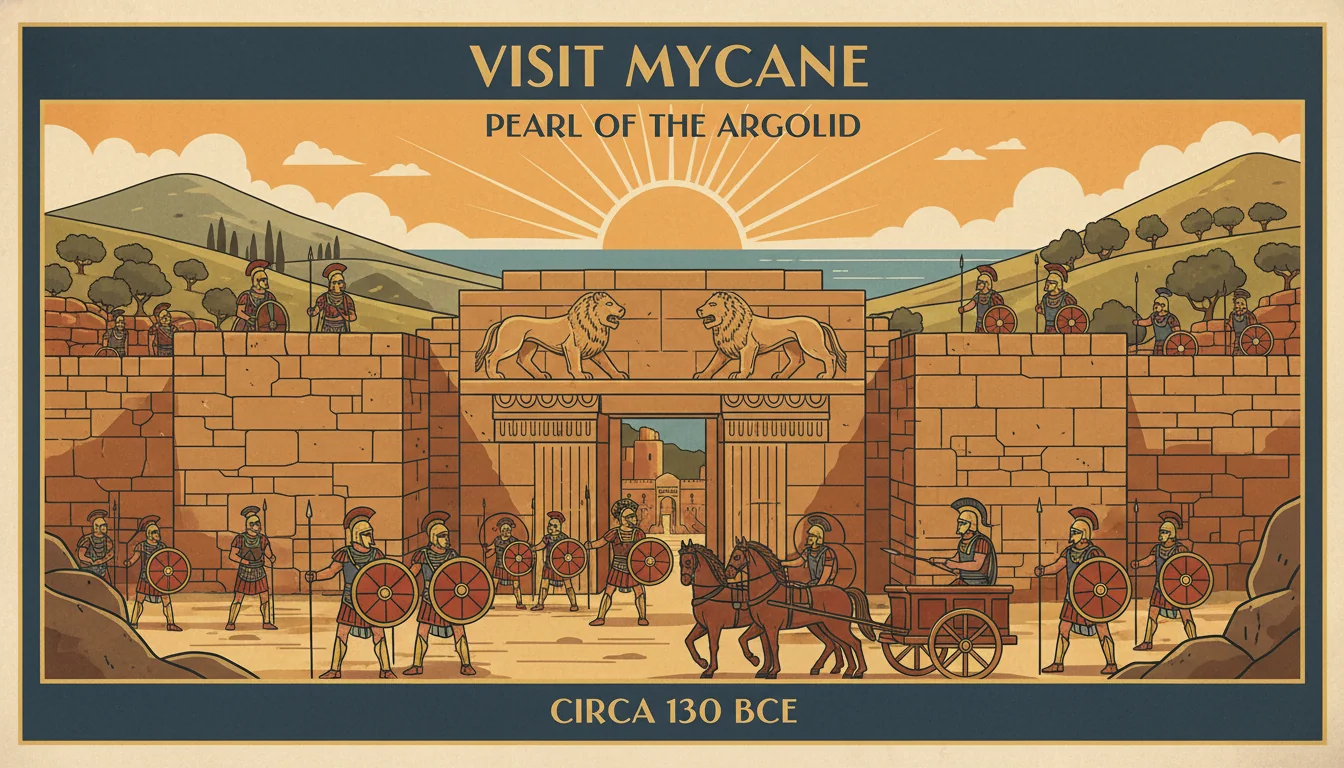
If you want to walk the citadel that gave Homer the heroes of the Trojan War, set your time machine for Mycenae in 1300 BCE. The great Lion Gate is being built. The shaft graves of the founding dynasty are already three centuries old. The Mycenaean palace economy controls trade across the Aegean, the eastern Mediterranean, and the Black Sea. Linear B scribes are recording wool inventories on baked clay tablets. The kings of Mycenae call themselves Wanax and live at the head of a complex hierarchical society.
It is also a hot, dry, ferociously stratified Bronze Age citadel where outsiders are welcomed only through proper introduction, and where 90 percent of the population are unfree laborers tied to the palace economy. So before you click your watch into 1300 BCE, here is your practical guide to surviving, blending in, and enjoying a visit to Mycenaean Greece.
First, know what kind of place you're entering
Mycenae sits on a fortified hill in the Argolid plain of the northeastern Peloponnese. The citadel itself covers about 30,000 square meters, surrounded by the famous cyclopean walls (so massive that later Greeks believed they had been built by Cyclopes). The palace at the heart of the citadel is a multi-room complex centered on a great hall (megaron) with a circular hearth, four columns, and frescoes depicting hunting scenes, chariot processions, and goddesses.
Below the citadel, in the surrounding plain, sit clusters of houses, workshops, granaries, and the great tholos tombs of the aristocracy, including the so-called Treasury of Atreus. The total population of greater Mycenae and its territory is probably around 30,000 to 50,000 people. Most are agricultural laborers, herders, craftsmen, or palace dependents.
Your safest cover story is that you are a foreign trader from Cyprus, the Levant, or the western Anatolian coast, attached to a delegation bringing copper, tin, or ivory to the palace. Mycenae's economy depends heavily on imported metals, and traders from these regions are common visitors.
Dress like you belong
Mycenaean dress in 1300 BCE is sophisticated and class-stratified. The aristocracy wear elaborate fabrics and prominent jewelry. Ordinary people wear simple woolen or linen garments.
For men, wear:
- a knee-length woolen or linen tunic, belted at the waist
- a heavy woolen cloak for cold mornings
- leather sandals or soft boots
- a simple bronze or bone pin at the shoulder
For women, wear:
- a long flounced skirt (a famous Aegean style going back to the Minoans)
- a fitted bodice with short sleeves
- a shoulder cloak or stole
- soft leather shoes
- elaborate hair, braided or piled with bronze pins
Avoid bright synthetic colors. Mycenaean dyes favor reds, blues, yellows, and earth tones. Saffron is reserved for elite women's fabrics.
Crucially: do not wear weapons inside the citadel unless you are escorted. The palace controls access to bronze tightly. Walking into the citadel armed without authorization will mark you as either a foreign noble warrior or a threat. Both invite scrutiny.
Get used to the geography
Mycenae is a citadel city, not a sprawling lowland capital. The terrain is steep, rocky, and exposed to the Mediterranean sun. Summers are hot and dry. Winters are cool with occasional rain. Spring is the most pleasant season for a visit.
The roads connecting the citadel to outlying tombs, sanctuaries, and farms are stone paved at key points, including major junctions and bridges. Travel by foot is the norm. Horses are reserved for chariots and elite messengers.
Carry water. Wells inside and around the citadel are reasonably reliable, but spring runoff streams in summer can be contaminated.
Three places you absolutely must visit
The Lion Gate
The famous gate, with its triangular relief of two lions flanking a central column, is being completed in this period. It is the principal entrance to the citadel and one of the most striking pieces of monumental sculpture in Bronze Age Europe.
You can pass through the gate as part of an official delegation. Do not loiter or stare. Guards on the bastion above watch all comers. Pass through with purpose.
The Treasury of Atreus
This massive tholos tomb, also called the Tomb of Agamemnon, was built around 1250 BCE, so it may be very recent or just completed depending on exactly when in 1300 BCE you arrive. The corbelled stone dome is the largest enclosed space in the world until the construction of the Pantheon in Rome over 1,400 years later.
Visit the entrance during a funerary commemoration. Do not enter the chamber unless invited. The tholoi are sacred royal spaces.
The palace megaron
The great hall at the heart of the palace is the political and ceremonial center of the kingdom. The Wanax (king) holds court here, banquets are conducted here, and major announcements are made here. The hall has a circular central hearth, four wooden columns, brightly painted frescoes, and a throne dais against one wall.
You will probably not be admitted unless you are a high-ranking foreign envoy. If you are, behave with extreme deference. Do not approach the throne. Do not speak first.
How to talk to people without causing trouble
The Mycenaean language is an early form of Greek, written in the Linear B syllabary. Modern scholars can read Linear B (it was deciphered in 1952 by Michael Ventris), but Mycenaean Greek differs significantly from later Classical Greek in vocabulary, grammar, and pronunciation.
You will not be able to fake fluent Mycenaean. Your strategy is to engage:
- a multilingual scribe or merchant from a coastal city
- in fragmented Akkadian, the diplomatic lingua franca for international trade
- through gestures and goods if all else fails
A few universal rules help:
- bow lightly to officials and palace dependents above your status
- never speak first to a noble
- accept offered food and wine, even if you only sip
- give way to processions
- avoid the workshop districts at midday, when the heat and the smoke from forges make the air dangerous
- never enter the megaron uninvited
If a guard asks your business, give a short and modest answer. Defer to your patron.
What to eat, what to avoid
Mycenaean food is grain-heavy with some meat, fish, and a substantial amount of olive oil and wine. Bread, barley porridge, lentils, chickpeas, olives, figs, grapes, and cheese form the core. Sheep, goats, pigs, and cattle are eaten in different proportions depending on status. Fish from the nearby coast and the Argive Gulf is common.
Safe choices for a visitor:
- bread and olive oil from a respectable household
- barley porridge with chickpeas
- roasted goat at a religious festival
- fresh cheese from a herding household
- watered wine from a sealed amphora
Things to be careful of:
- standing water from any reservoir
- raw fish in summer
- exotic foods from caravans whose origin you don't know
- pure unwatered wine on an empty stomach
- meat that has been hanging too long in the sun
When in doubt, copy the most ordinary-looking person nearby.
Money, gifts, and the palace economy
The Mycenaean economy is centralized. The palace controls major industries, including textile production, metalworking, perfume manufacture, and chariot construction. Coinage does not exist. Value moves through goods, especially bronze, gold, silver, ivory, textiles, and grain.
Linear B tablets record the palace's inventory in extraordinary detail. They list wool by color and quality, sheep by location and shepherd, slaves by name, chariots by part, and oil by destination. A foreign visitor's gifts and trade goods will be recorded by the palace bureaucracy.
Acceptable barter goods:
- copper or tin ingots, especially from Cyprus
- ivory in small worked pieces
- amber from the Baltic
- finely woven linen or wool
Do not flash quantities of bronze. The palace will want to know where it came from.
Gifts of wine, honey, or saffron are appropriate when meeting officials.
Politics you should know about, briefly
In 1300 BCE, the Mycenaean palace network is at the height of its power. Multiple regional centers, including Mycenae itself, Tiryns, Pylos, Thebes, and Knossos on Crete, function as semi-independent kingdoms with overlapping trade and political relationships. The Mycenaean elite share a common Greek language, a common religion centered on Zeus, Poseidon, and a great mother goddess, and a common warrior aristocracy.
Relations with the Hittite Empire to the east are complicated. The Hittites refer to a kingdom called Ahhiyawa in their correspondence, almost certainly meaning the Mycenaean Greeks. There are recurring tensions over western Anatolian cities, including a place called Wilusa, which many scholars identify as Troy.
If you must discuss politics, defer to your hosts and avoid taking positions. Do not speculate about the Trojan War, which (depending on traditional dating) lies anywhere from 50 to 200 years in your future. Do not predict the Bronze Age Collapse that will overwhelm Mycenae and its sister palaces around 1200 BCE.
What not to do under any circumstances
Let me save you from the classic mistakes.
Do not:
- announce that you are from the future
- attempt to read a Linear B tablet aloud
- enter the megaron without invitation
- climb on the Lion Gate
- enter a tholos tomb without authorization
- handle bronze weapons casually
- predict the Trojan War or any Mycenaean military campaign
- mock the Wanax or his court
- attempt to bring iron objects into the citadel (iron metallurgy is just emerging here and will draw immediate attention)
Most importantly, do not warn anyone about the Bronze Age Collapse. The kingdom you are visiting believes itself eternal. It is one century from being burned and abandoned.
The experience you should not miss
If you have one moment in Mycenae, take it at dawn standing on the ramparts above the Lion Gate, looking south across the Argolid plain toward the sea. The plain is golden in the early light. The road from the gulf winds upward through olive groves and vineyards. Smoke rises from the household kitchens of the lower town. Linear B scribes are already at work in the palace storerooms.
You are watching one of the four great Mediterranean palace civilizations of the Late Bronze Age, in a citadel that will give Homer his heroes 500 years from now. The cyclopean walls around you will outlast everyone who walks past them today.
For the Greek world that evolved from these Bronze Age palaces, our guide to Ancient Sparta in 450 BC shows how the same Peloponnese looked eight centuries later. And for the great empire contemporary with the palace period, our guide to Achaemenid Persepolis in 500 BC covers the world on the other side of the Aegean.
Pack your sandals, drink your wine watered, and never approach the throne. Mycenae in 1300 BCE is one of the most evocative destinations on any time-travel itinerary.

Need Advice from Someone Who Lived There?
Get firsthand accounts from people who actually lived through these moments in history.
Ask Them YourselfJoin the HistorIQly Club
Get smarter about the past.
Weekly stories, deep dives, and exclusive content straight to your inbox.